QUIZ-BANK MUSIC 2MT3 Latest Update QUIZ #1 1) What is the aim of music therapy? a) To reach health care goals b) To make great music c) To assist with relaxation d) To provide music education 2) Which organization regula
...
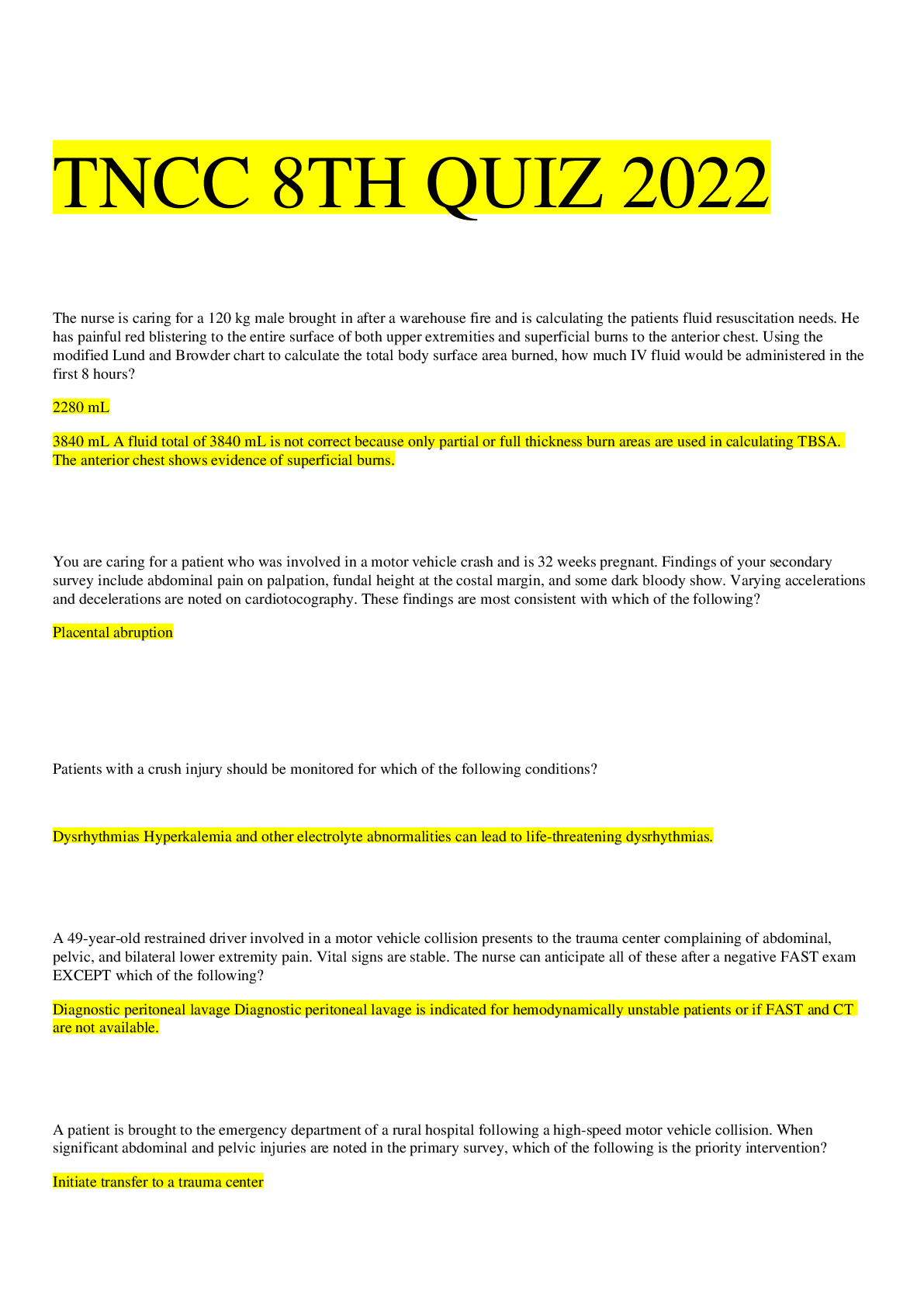
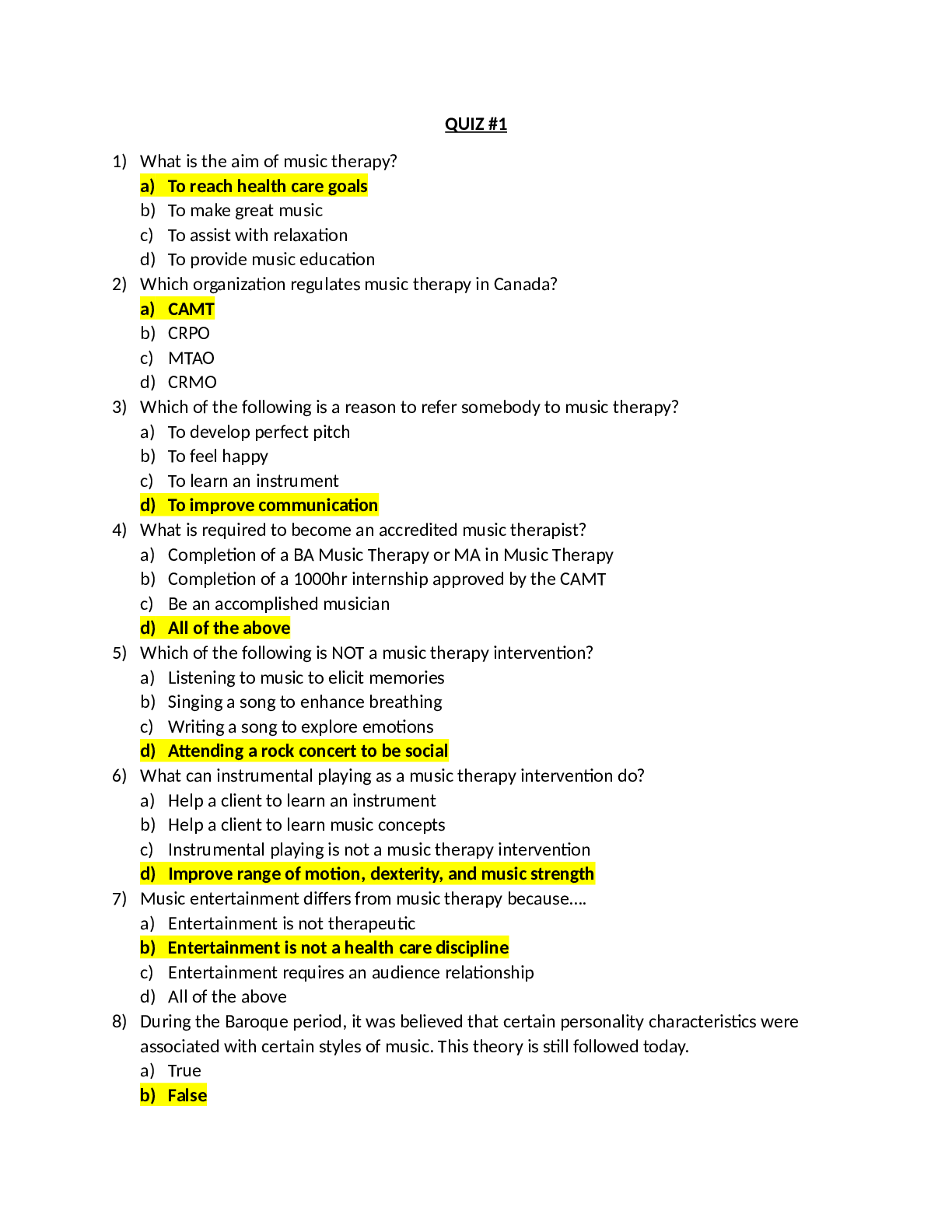
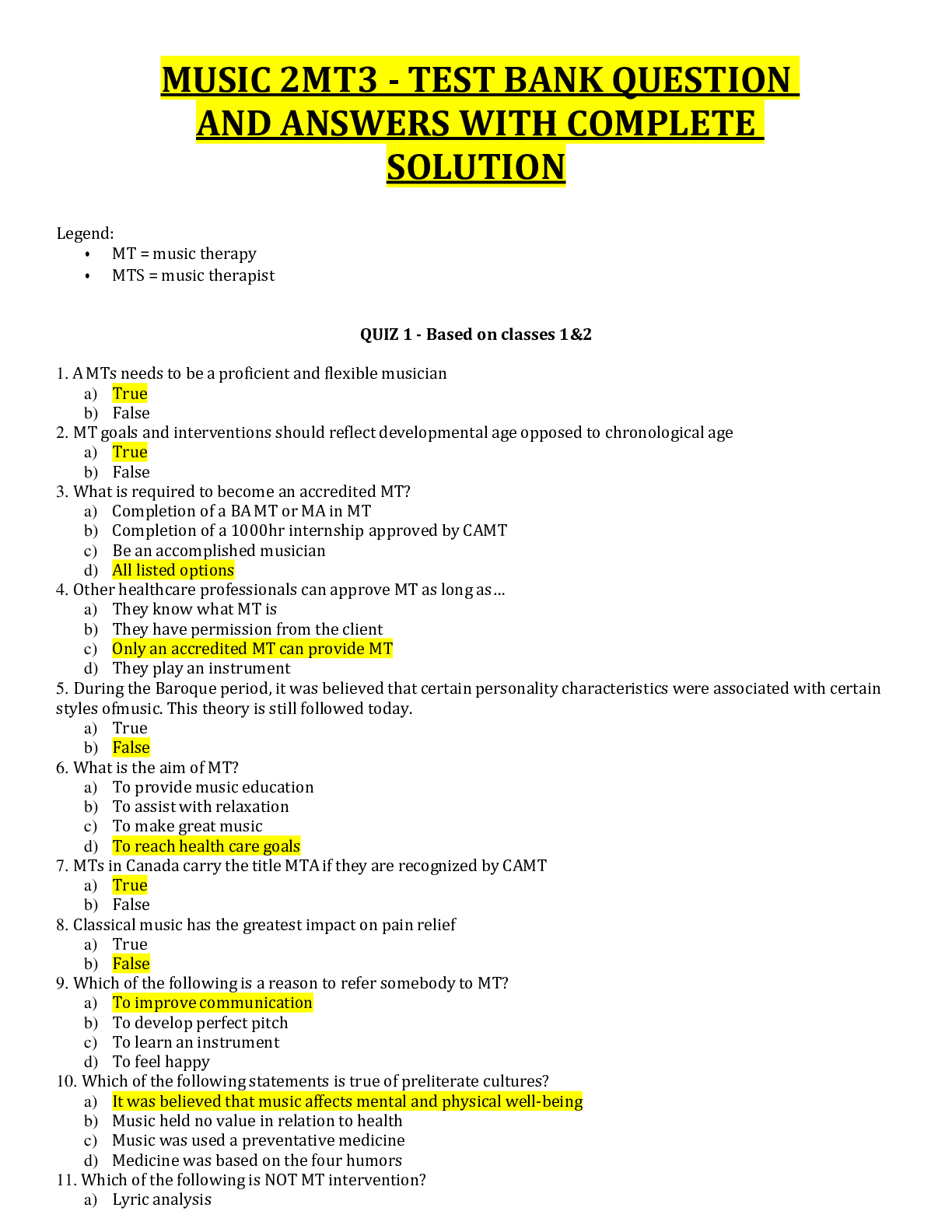
QUIZ-BANK MUSIC 2MT3 Latest Update QUIZ #1 1) What is the aim of music therapy? a) To reach health care goals b) To make great music c) To assist with relaxation d) To provide music education 2) Which organization regulates music therapy in Canada? a) CAMT b) CRPO c) MTAO d) CRMO 3) Which of the following is a reason to refer somebody to music therapy? a) To develop perfect pitch b) To feel happy c) To learn an instrument d) To improve communication 4) What is required to become an accredited music therapist? a) Completion of a BA Music Therapy or MA in Music Therapy b) Completion of a 1000hr internship approved by the CAMT c) Be an accomplished musician d) All of the above 5) Which of the following is NOT a music therapy intervention? a) Listening to music to elicit memories b) Singing a song to enhance breathing c) Writing a song to explore emotions d) Attending a rock concert to be social 6) What can instrumental playing as a music therapy intervention do? a) Help a client to learn an instrument b) Help a client to learn music concepts c) Instrumental playing is not a music therapy intervention d) Improve range of motion, dexterity, and music strength 7) Music entertainment differs from music therapy because…. a) Entertainment is not therapeutic b) Entertainment is not a health care discipline c) Entertainment requires an audience relationship d) All of the above 8) During the Baroque period, it was believed that certain personality characteristics were associated with certain styles of music. This theory is still followed today. a) True b) False9) A music therapist needs to be a proficient and flexible musician. a) True b) False 10) Classical music has the greatest impact on pain relief. a) True b) False 11) In order for a client to engage in a music therapy he or she must…. a) Identify a heath care goal b) Have experience with music and like music c) Have music training d) Identify music goal 12) Music therapists in Canada carry the title MTA (Music Therapist Accredited) if they are recognized by the CAMT: a) True b) False 13) Music is a universal language. For this reason, an individual’s cultural background is irrelevant when engaging in a Music Therapy session. a) True b) False 14) A music therapist is likely to start a music therapy session with a “hello” song or a “greeting song” for the following reason: a) Music therapists are usually working toward social skills such as saying “hello” b) A “hello” or “greeting song” provides a socially acceptable introduction to the session c) A “hello” or “greeting song” provides an indicator of the session starting and can prime for the health care goals d) Music therapists mostly work with children, and children like “hello songs” 15) Music has not been historically documented as a part of health and wellness. Music is currently accessed as a means of entertainment, which is in line with the historical use of music. a) True b) False 16) MT goals and interventions should reflect developmental age opposed to chronological age a) True b) False 17) Other healthcare professionals can approve MT as long as… a) They know what MT is b) They have permission from the client c) Only an accredited MT can provide MT d) They play an instrument 18) Which of the following statements is true of preliterate cultures? a) It was believed that music affects mental and physical well-beingb) Music held no value in relation to health c) Music was used a preventative medicine d) Medicine was based on the four humors 19) Which of the following is NOT MT intervention? a) Lyric analysis b) Composing c) Listening alone to your iPod d) Singing 20) MT was used in educational institutions in the USA as early as the 1830s a) True b) False 21) All MTs in Ontario, must be recognized by the CRPO a) True b) False 22) According to Piaget, on the of the following is not a primary stage of child development a) Concrete operational b) Communication operations c) Formal operations d) Sensorimotor 23) Music and speech use the same areas of the brain. This is why music can activate speech and communication. a) True b) False 24) In the early 20th century, MT research could be found in scientific publications a) True b) False 25) During the renaissance, music was often used in combination with medicine to treat medical conditions as well as a preventative measure against mental and physical disorders? TRUE 26) Why is improvisation an effective intervention in MT? a) Offers a creative nonverbal means of expressing thoughts and feelings b) There are no mistakes c) Provides control d) All listed options QUIZ #21) When creating a treatment plan, what must music therapists consider? a) Chronological age b) Developmental age c) Background / culture d) All of the above 2) Music therapy session, a music therapist can support a client to self-express through improvising on a piano, even if a client does not have previous experience playing on the piano a) True b) False 3) GIM training is part of most music therapy training programs a) True b) False 4) Using a metronome to deliver a music therapy intervention is common with which approach? a) Neurologic music therapy b) Psychodynamic music therapy c) Community music therapy d) Aesthetic music therapy 5) A music therapist begins his session with a “Hello Song”. Throughout the session, he is encouraging self expression through using improvisation and using precomposed music to facilitate coordination of movement. Sometimes, the client changes the words to the song. The therapist supports this as part of the self expression goals. Which approach describes the music therapist’s way of working most? a) Improvisation Informed Approach b) Psychodynamically Informed Approach c) Behaviour Approach d) Eclectic Approach 6) NMT provides measurable outcomes a) True b) False 7) Which of the following is NOT an improvising technique. a) Mirroring b) Free flow c) Playing rules d) Matching 8) Based on common themes found in self-written songs in a music therapy session, by the client with a TBI, which of the following would be a likely line in a song. a) When I grow up, I want to be famous b) Will they ever see me the same way again c) Roses smell the sweetest in springd) I want to go home 9) Which statement best describes the philosophy of Analytically Oriented Music Therapy a) Music is a tool to explore client’s inner life, providing a way forward for growth & greater self knowledge b) All people possess a “Music Child” c) Analysis is key to self-understanding d) Free association through music provides the opportunity for analysis 10) The Nordoff Robbins Music Therapy Approach is best defined as a) Facilitating song writing, and indexing the song writing process b) Facilitating education goals (as Clive Robbins was a special education teacher) c) Tapping into the client’s innate musical ability d) Using “active” music to facilitate verbal processing 11) It is effective for music therapists to use a biopsychological approach to pain management because… a) Music can evoke relaxation, memories and movement b) Music can address they physical, emotional and social aspects of pain c) Music can address physical, emotional and mental aspects of pain d) Music therapy is not an effective intervention for pain 12) Some music therapy approaches are psychoanalytically informed. a) True b) False 13) A music therapist is working with a client who has been referred to build coping mechanisms related to anxiety. Which approach is the music therapy most likely to draw upon? a) Cognitive Behavioural Music Therapy b) NMT c) Nordoff-Robbins d) Freud MT 14) Which of the following is NOT a song writing technique. a) Fill in the blanks b) Song Parody c) Self-Direction d) Song Collage 15) Which model / approach aims to change unhealthy patterns of behaviour? a) Behavioural approach b) Cognitive Behavioural Approach c) Psychodynamic approach d) Pavlov approach 16) Music therapists trains to use NMT are most likely to work with clients who have the following diagnosis.a) Anxiety disorder b) Traumatic brain injury c) Autism spectrum disorder d) Depression 17) One of the following is a factor that heavily influences music therapy approaches. a) Change to music industry b) Changes to education programs c) Societal changes d) Cultural differences 18) Music therapy in a medical setting promotes “normalization”. a) True b) False 19) It can be beneficial for music therapists to collaborate with other professionals such as speech therapists or physiotherapists. a) True b) False 20) “Music therapy in Parkinson’s disease” An Integrative Method for Motor and Emotional Rehabilitation” had measurable results supporting music therapy. a) True b) False 21) Music can influence physical behavior including autonomic activity. a) True b) False 22) Parkinson’s disease is a motor system disorder. a) True b) False 23) What was / were the outcome(s) of the study “Music therapy in Parkinson’s disease: an integrative method for motor and emotional rehabilitation”? a) MT demonstrated significant improvement in UPDRS scores b) MT demonstrated no improvement in HM c) MT demonstrated no improvement to the UPDRS scores d) MT demonstrated significant improvement in speech scores 24) What was the purpose of the study “Music therapy in Parkinson’s disease: an integrative method for motor and emotional rehabilitation”? a) To explore the efficacy of improvising on motor functions in patients with PD b) To explore the efficacy of passive MT on motor and emotional functions in patients with PD c) To explore the efficacy of active MT on motor and emotional functions in patients with PD d) To explore the efficacy of listening to music on motor functions in patients with PD25) MTs should not receive supervision or personal therapy as it may bring up issues that will negatively impact their MT sessions with clients. a) True b) False 26) Pain is best described as: a) A physical experience b) An emotional experience c) A fight or flight experience d) A subjective experience 27) NMT would be an appropriate approach for a MTs working with a client toward the following goal… a) Managing depression b) Processing bereavement c) Supporting social skills d) Improving gait 28) NMT is a research-based system of standardized clinical techniques for training in the following areas a) Sensorimotor, speech & language, and concrete operations b) Sensorimotor, cognition, and concrete operations c) Sensorimotor, speech & language, and cognition d) Sensorimotor, speech & language, and memory 29) Which MT approach aims to replace irrational thinking? a) Eclectic b) Behavioural c) Cognitive behavioural d) Psychodynamic 30) NMT is an example of biopsychosocial model. a) True b) False 31) Dementia is most closely defined as a) A result of aging b) Defined by the experience of confusion c) Declining language and memory d) All of the above 32) The iPod project is best described as a) A music therapy intervention b) An example of pre-composed music therapy intervention c) A way for apple to give back to the community d) An example of how meaning music can have a positive cognitive impact 33) Pre-composed music can facilitate dialogue because a) Music motivates people to speak with one anotherb) Life events are often associated with pre-composed place of music c) People like talking about music d) All of the above 34) Pre-composed music as a music therapy intervention with clients in a long-term care facility is useful a) To provide a sense of familiarity and ability b) When used in a collaboration with the iPod project c) As a form of entertainment d) At all times 35) Pre-composed music can facilitate cognitive rehabilitation a) Because music is healing b) Because music can regenerate neurons c) Music cannot facilitate cognitive rehabilitation d) Because the ABA structure allows for repetition 36) Using meaningful pre-composed music to create a playlist for the iPod project a) Is always beneficial b) Can evoke negative emotions and memories c) Is a music therapy intervention d) Always brings back positive memories 37) Memory is impaired as a result of Alzheimer’s disease, however; a) Ability to learn to play an instrument remains intact b) Ability to recall lyrics of a song often remains intact c) Ability recall the names of loved ones often remains in tact d) All of the above 38) Memory loss is a normal part of ageing a) True b) False 39) In a music therapy session, it is typically better to use live music opposed to pre-recorded music for the following reason a) People prefer live music b) Live music can be flexible c) Pre-recorded music can become overwhelming d) Live music is more engaging 40) Developmental theory perspective suggests the following a) All children learn music equally b) There is a connection between early music ability and pre-verbal development c) Children with a disability are more likely to respond to music in preverbal development than “normally” developing children d) Sound dialogues between parents and infants do not contribute to the development of communication 41) Interactional theory perspective suggests the following: a) Music education is essential to relationships b) Music is the basis for development c) Music interactions are the basis for all developmentd) Relational interactions are the basis for all development 42) The following is NOT a response-evoking technique in music therapy a) Imitation b) Improvising c) Expectation d) Pausing 43) Music in Medicine is defined by Bruscia as: a) The use of music to induce physical, mental, emotional states before or after medical treatment b) The use of music to influence physical, mental, emotional states at any time c) The use of music in a medical setting d) The use of music by a doctor to influence physical, mental, emotional states 44) Classical music has the greatest impact on pain relief a) True b) False 45) Responses can be evoked in music therapy through creating small recognizable themes a) True b) False 46) Research in Music and Medicine can only be conducted by a music therapist a) True b) False QUIZ #3 1) According to Jampel, when clients are working toward recognizing and resolving issues within each of the dimensions, only their music performance will be effected. a) True b) False 2) What was the purpose of the “bubble space” exercise implemented in the special needs class? a) To create a fun and interactive environment b) Children were motivated by using bubbles as part of a game c) Children were able to practice recognizing personal space d) The bubbles were used as musical instruments 3) Autism presents itself the same in all people diagnosed with Autism. a) True b) False 4) Which is the best description for Health? a) Complete physical and mental well-being b) The ability to contribute to the community c) The absence of illness d) Complete mental, physical and social well-being 5) Autism is best described as: a) A complex developmental disabilityb) A result of poor parenting c) An acquired brain injury d) Developmental delay specific to children 6) Which of the following is NOT one of the 5 dimensions as described by Jampel? a) Connecting the performer with the audience b) Connecting with the inner voice c) Connecting the music to the performer d) Connecting the music to the audience 7) How did understanding the 5 dimensions assist Trish in the case study? a) Assisted Trish in her guitar skills b) Assisted Trish to recognize her self worth c) The process was not helpful to Trish d) Assisted her performance 8) What was the intention of the study… “In Five Dimensions, by Jampel, P.F” a) To develop a language not only between therapists but with clients b) To change the stigma associated with mental illness c) To assist individuals with mental health issues with performance d) To understand the dimension of performance 9) The result of the article Collaborative Work: Negotiations between Music Therapists and Community Musicians in the Development of a South African Community Music Therapy Project Oosthuizan, H, determined that it would be better to use of resources if music therapists and musicians ran separate groups. a) True b) False 10) Male role models are important in the Music for Life project because: a) Children prefer to be with males b) Many children did not have a positive male role model in their lives c) Male role models are not important d) Culturally, only men engaged in music 11) Which tool was used in Collaborative Work: Negotiations between Music Therapists and Community Musicians in the Development of a South African Community Music Therapy Project Oosthuizan, H, to determine the result(s) of the paper? a) Likert scale b) Video recordings c) Interviews d) Visual analogue scale 12) In the article Collaborative Work: Negotiations between Music Therapists and Community Musicians in the Development of a South African Community Music Therapy Project Oosthuizan, H, how did the children benefit from the Music For Life Program? a) The program provided the children with positive male role models b) The program provided the children with cultural knowledgec) The program provided the children with healthy alternative to gangsterism d) All of the options provided 13) The musicians in Collaborative Work: Negotiations between Music Therapists and Community Musicians in the Development of a South African Community Music Therapy Project Oosthuizan, H, et al were providing music therapy. a) True b) False 14) One of the following is NOT a typical goal of music therapy for a child with ASD: a) To improve social skills b) To lessen self-harming behaviours c) To improve communication through music d) To explore trauma of refrigerator mother experience 15) Structure in Music Therapy session is particularly important when working with an individual with Autism. a) True b) False 16) A music therapist may use a behavioural approach with a client diagnosed with Autism who has been referred to enhance social skills. a) True b) False 17) An individual with autism could be referred to music therapy to facilitate speech and communication. a) True b) False 18) The developmental deficits of child with Autism are highlighted when engaging in music. a) True b) False 19) Autism is one of the most common developmental disabilities in Canada? a) True b) False 20) As per Performance in Music Therapy… Jampel P.F. projecting dynamics into the music therapy performance group is an example of? a) A family therapy b) Song parody c) Transference d) A dysfunction in one of the dimensions QUIZ #4 1) Palliative care addresses the same principles as the biopsychosocial model. a) True b) False2) Which of the following scenarios is (are) considered music therapy? a) A doctor playing piano to a patient to provide comfort before going into surgery b) MTA accompanying a teenager with guitar to help facilitate communication c) A nurse at a retirement home providing iPods to patients with Alzheimer’s to evoke memories d) All of the above are considered music therapy 3) A child with ASD is referred to music therapy to support self-expression through music. Which approach/model would a music therapy most likely draw upon? a) Analytical Music Therapy b) Cognitive Behavioural Approach c) GIM d) Nordoff-Robbins 4) Collecting data about physiological responses to music therapy intervention would most likely be a) Quantitative data b) Experiential data c) Qualitative data d) Unreliable data 5) Music is a universal phenomenon, not a universal language a) True b) False 6) A music therapist is working with a client who has been referred to build coping mechanisms related to anxiety. Which approach is the music therapist most likely to draw upon? a) Cognitive Behavioural Music Therapy b) Freud MT c) Nordoff-Robbins d) NMT 7) There is a specific area of the brain that has been identified as responsible for processing music, if this area is damaged, an individual will not be able to engage in music. a) True b) False 8) Which of the following is NOT an improvising technique? a) Playing Rules b) Matching c) Harmonics d) Mirroring 9) Music therapists can work with every culture a) As long as they study the culture b) As long as they learn the language c) Only if they share the same cultured) Music therapists need to recognize if culture is a barrier to reaching health care goals 10) Which music therapy approach/model/intervention is NOT likely to be implemented in palliative care? a) NMT b) Song Writing c) Improvising d) GIM 11) Music therapy can be offered as group therapy and/or individual therapy. a) True b) False 12) Pain is subjective a) True b) False 13) Music therapy research can only be found in music therapy journals. a) True b) False 14) Palliative care does not include… a) End of life care b) Preventing pain and discomfort c) Physician lead care d) Patient guided care 15) In the article by Jampel, the music therapy space for the Music Therapy Performance Group looked like… a) A typical music therapy space b) A clinical space c) A classroom d) A performance space 16) Music therapy in NICU is most likely to draw upon which technique to reach health care goals? a) Entrainment b) Listening to pre-recorded music c) Lyric analysis d) Improvisation 17) If a music therapist is referred to work with an individual in palliative care, it would be unethical for the client to ask family members to be involved in any way in the client’s music therapy process. a) True b) False 18) Palliative care is a reason to refer an individual to music therapy a) True b) False19) An individual cannot be in palliative care for more than 6 months a) True b) False 20) Community music therapy was one of the models used in the South African research discussed a) True b) False 21) In a music therapy session, a music therapist can support a client to self express though improvising on the piano, even if a client does not have previous experience playing on the piano a) True b) False 22) An example of community music therapy in the “Collaborative Work…” paper is a) The children performing self-written songs in nearby communities b) Musicians and music therapists working together c) Musicians and music therapists working together d) The children working with musicians and music therapists to impact the community 23) A journal dedicated to music therapy research was established in the states in: a) 1990s b) 1940s c) 1960s d) 1980s MIDTERM 1) Music therapy aims to achieve: a) Health care goals b) Great music c) Music education d) Relaxation 2) Music Therapy interventions include: a) Lyric analysis b) Composing c) Singing d) all the above (lyric analysis, composing, singing) 3) An individual may be referred to group music therapy a) To practice performance b) To learn how to write a song c) to facilitate social skills d) because she/he likes being with people 4) For an individual to engage in creating music in a music therapy session, he/she should: a) Take music lessons b) not be concerned about their musical abilityc) be musical d) want to learn an instrument 5) Song writing in music therapy: a) is aimed to address psychosocial, emotional and cognitive needs b) Requires the client to have music training c) Is aimed to support the client in being recognized in the music world d) Is only beneficial for clients who are verbal 6) Musical entertainment differs from music therapy because: a) Entertainment is not meant to meet health care goals b) Entertainment is not a healthcare discipline c) Entertainment does not build a relationship with individual audience members d) all of the above 7) For the following reasons, it is important for a music therapist to be knowledgeable about child development: a) Music therapists only work with children b) Music therapists need to address the developmental age of the client c) Music therapists need to address the chronological age of the client d) Music therapy interventions need to be age appropriate 8) Music therapists only work as part of a health care team. Not in private practice: a) True b) False 9) A reason to refer someone to music therapy is a) to facilitate self expression b) Parkinsons Disease c) Aquired Brain Injury d) To develop perfect pitch 10) A music therapy assessment allows therapist to determine: a) a treatment plan b) if music therapy would be beneficial c) goals and objectives d) All the above 11) To become a music therapist in Canada one must: a)
[Show More]




.png)


.png)