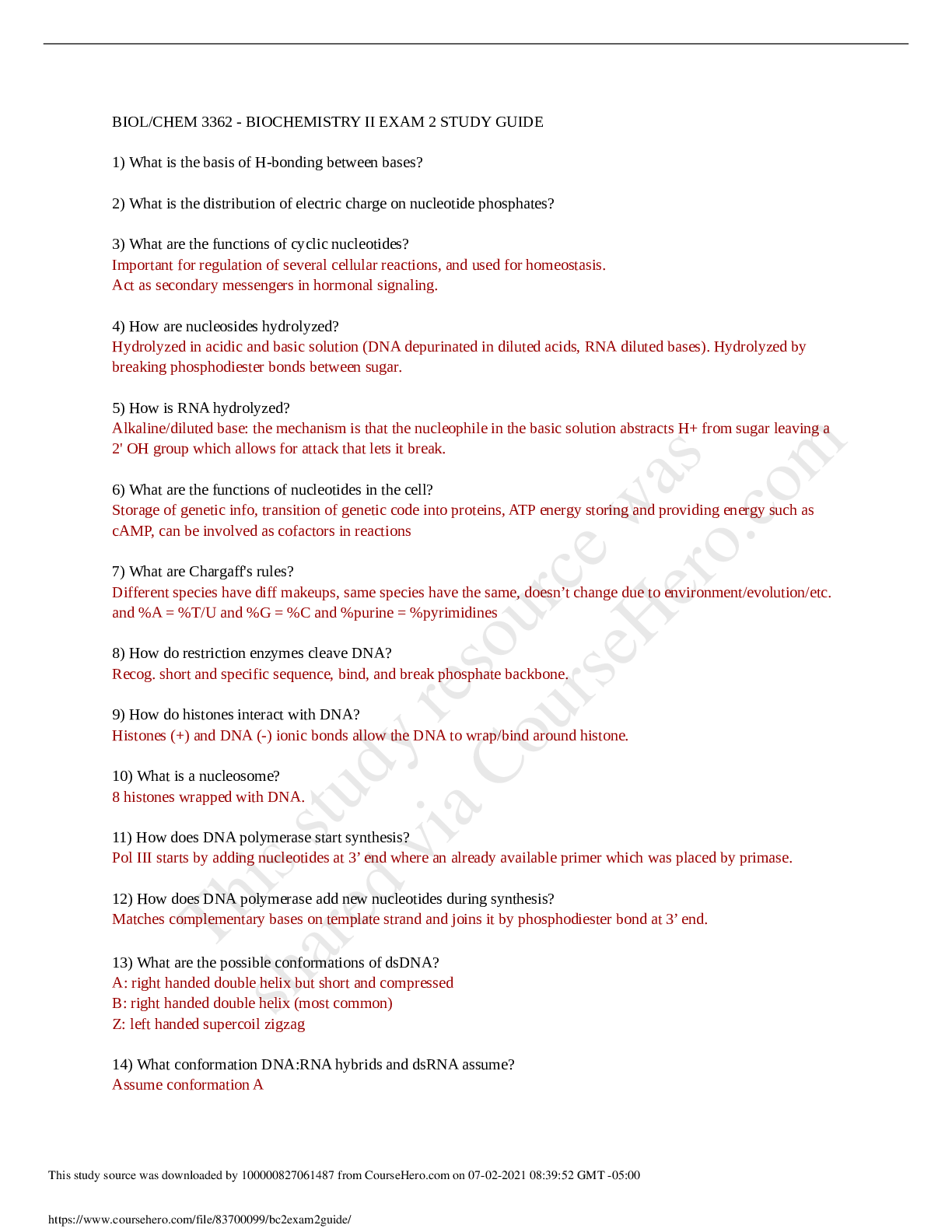
BIOL/CHEM 3362 - BIOCHEMISTRY II EXAM 2 STUDY GUIDE
1) What is the basis of H-bonding between bases?
2) What is the distribution of electric charge on nucleotide phosphates?
3) What are the functions of cyclic nucleot
...
BIOL/CHEM 3362 - BIOCHEMISTRY II EXAM 2 STUDY GUIDE
1) What is the basis of H-bonding between bases?
2) What is the distribution of electric charge on nucleotide phosphates?
3) What are the functions of cyclic nucleotides?
Important for regulation of several cellular reactions, and used for homeostasis.
Act as secondary messengers in hormonal signaling.
4) How are nucleosides hydrolyzed?
Hydrolyzed in acidic and basic solution (DNA depurinated in diluted acids, RNA diluted bases). Hydrolyzed by
breaking phosphodiester bonds between sugar.
5) How is RNA hydrolyzed?
Alkaline/diluted base: the mechanism is that the nucleophile in the basic solution abstracts H+ from sugar leaving a
2' OH group which allows for attack that lets it break.
6) What are the functions of nucleotides in the cell?
Storage of genetic info, transition of genetic code into proteins, ATP energy storing and providing energy such as
cAMP, can be involved as cofactors in reactions
7) What are Chargaff's rules?
Different species have diff makeups, same species have the same, doesn’t change due to environment/evolution/etc.
and %A = %T/U and %G = %C and %purine = %pyrimidines
8) How do restriction enzymes cleave DNA?
Recog. short and specific sequence, bind, and break phosphate backbone.
9) How do histones interact with DNA?
Histones (+) and DNA (-) ionic bonds allow the DNA to wrap/bind around histone.
10) What is a nucleosome?
8 histones wrapped with DNA.
11) How does DNA polymerase start synthesis?
Pol III starts by adding nucleotides at 3’ end where an already available primer which was placed by primase.
12) How does DNA polymerase add new nucleotides during synthesis?
Matches complementary bases on template strand and joins it by phosphodiester bond at 3’ end.
13) What are the possible conformations of dsDNA?
A: right handed double helix but short and compressed
B: right handed double helix (most common)
Z: left handed supercoil zigzag
14) What conformation DNA:RNA hybrids and dsRNA assume?
[Show More]




 Charles Herrick - 100 Q&A About Alcoholism & Drug Addiction-Jones and Bartlett Publishers, Inc.png)