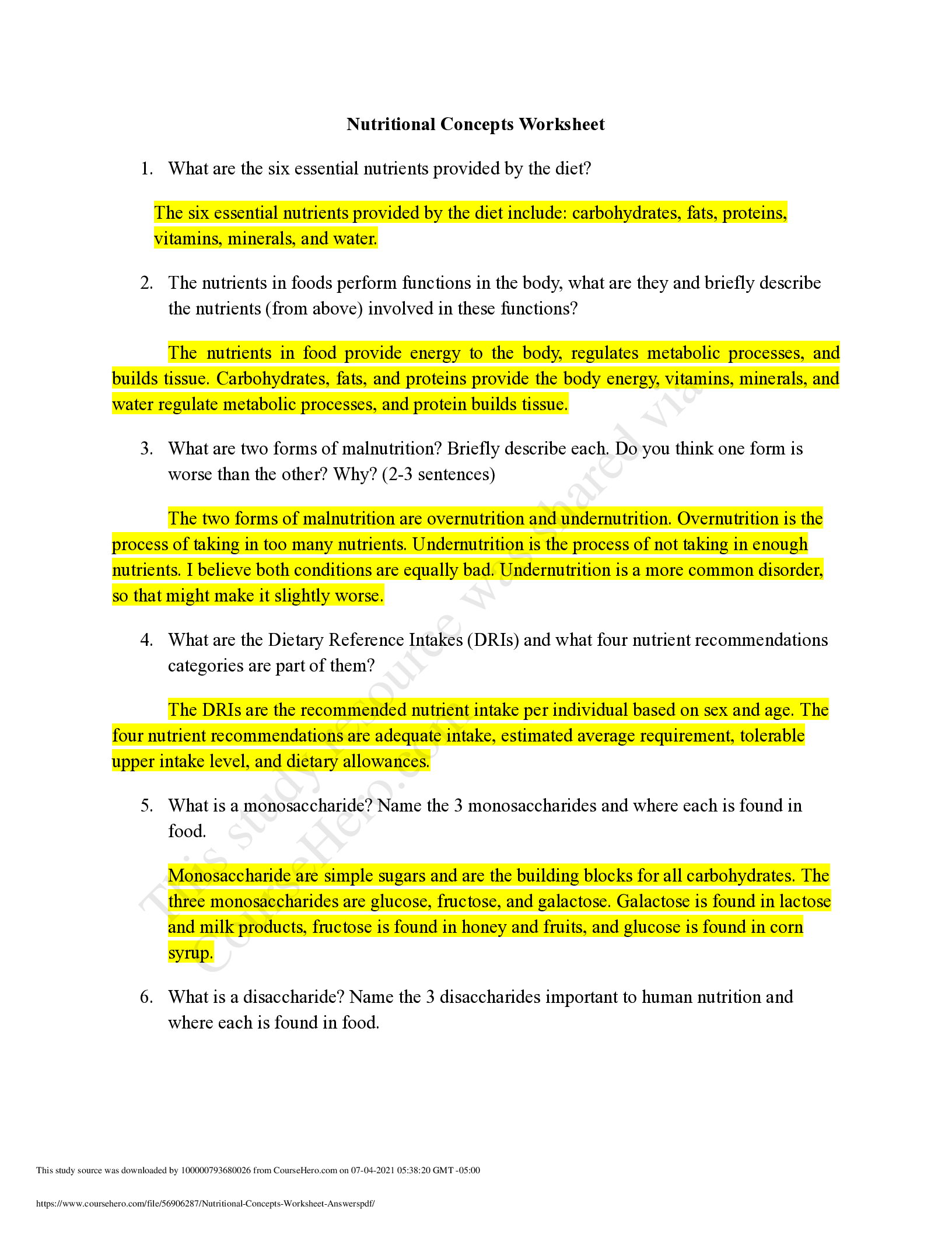
Nutritional Concepts Worksheet
1. What are the six essential nutrients provided by the diet?
The six essential nutrients provided by the diet include: carbohydrates, fats, proteins,
vitamins, minerals, and water.
2.
...
Nutritional Concepts Worksheet
1. What are the six essential nutrients provided by the diet?
The six essential nutrients provided by the diet include: carbohydrates, fats, proteins,
vitamins, minerals, and water.
2. The nutrients in foods perform functions in the body, what are they and briefly describe
the nutrients (from above) involved in these functions?
The nutrients in food provide energy to the body, regulates metabolic processes, and
builds tissue. Carbohydrates, fats, and proteins provide the body energy, vitamins, minerals, and
water regulate metabolic processes, and protein builds tissue.
3. What are two forms of malnutrition? Briefly describe each. Do you think one form is
worse than the other? Why? (2-3 sentences)
The two forms of malnutrition are overnutrition and undernutrition. Overnutrition is the
process of taking in too many nutrients. Undernutrition is the process of not taking in enough
nutrients. I believe both conditions are equally bad. Undernutrition is a more common disorder,
so that might make it slightly worse.
4. What are the Dietary Reference Intakes (DRIs) and what four nutrient recommendations
categories are part of them?
The DRIs are the recommended nutrient intake per individual based on sex and age. The
four nutrient recommendations are adequate intake, estimated average requirement, tolerable
upper intake level, and dietary allowances.
5. What is a monosaccharide? Name the 3 monosaccharides and where each is found in
food.
Monosaccharide are simple sugars and are the building blocks for all carbohydrates. The
three monosaccharides are glucose, fructose, and galactose. Galactose is found in lactose
and milk products, fructose is found in honey and fruits, and glucose is found in corn
syrup.
6. What is a disaccharide? Name the 3 disaccharides important to human nutrition and
where each is found in food.
Disaccharides are carbohydrates with two units of sugar. The three disaccharides that are
important to human nutrition are lactose, maltose, and sucrose. Sucrose is found in table sugar,
maltose is found in molasses, and lactose is found in milk products.
7. What is a polysaccharide? Name the 3 polysaccharides important to human nutrition and
one unique thing about each.
Polysaccharides are carbohydrates with many sugar units; they are also called complex
carbohydrates.The three polysaccharides that are important to human nutrition are
glycogen, starch, and dietary fiber. Glycogen maintains blood sugar levels, starch breaks
down slowly, and dietary fiber cannot be broken down by the body and therefore have no
energy value.
8. What is the adequate intake for fiber for both men and women (ages 19 to 50)? A diet
rich in whole grains, vegetables, and fruits (therefore fiber) has what 5 health benefits?
The adequate intake for men and women aged 19 to 50 is 25 to 38 grams. The five health
benefits are: increases satiety, prevents constipation due to promoting normal bowel function,
protects disorders in the large and small intestines, lowers blood cholesterol levels, and slows
glucose absorption.
9. With the aid of enzymes, carbohydrate digestion begins in the mouth and ends in the
small intestine. What is an enzyme? What are the five major enzymes used and where do
they come from?
Enzymes are proteins that the body produces that digest nutrients in chemical reactions.
The first enzyme is salivary amylase and comes from the parotid glands. The second enzyme is
pancreatic amylase and comes from the pancreas. The third, fourth, and fifth enzymes are
lactase, maltase, and sucrase and they come from the intestinal tract, specifically, the brush
border.
10. What is the Dietary Reference Intake for carbohydrates? If a person consumed an 1800
calorie diet, how many calories should come from carbohydrates per day? Now convert
these calories to grams per day. Show your work. (Hint these are ranges)
An individual on an 1800 calorie diet should consume 840-1160 calories, or 210-290
grams, or carbohydrates.
11. Describe lactose intolerance. What are the symptoms? What enzyme is missing? What
foods need to be avoided? Who is at greatest risk?
[Show More]













.png)

.png)


