Disclaimer/Special Note: These are just the sample of the Answers/Solutions to some of the Questions given in the Assignments. These Sample Answers/Solutions are prepared by Private Teacher/Tutors/Authors for the help an
...
Disclaimer/Special Note: These are just the sample of the Answers/Solutions to some of the Questions given in the Assignments. These Sample Answers/Solutions are prepared by Private Teacher/Tutors/Authors for the help and guidance of the student to get an idea of how he/she can answer the Questions given the Assignments. We do not claim 100% accuracy of these sample answers as these are based on the knowledge and capability of Private Teacher/Tutor. Sample answers may be seen as the Guide/Help for the reference to prepare the answers of the Questions given in the assignment. As these solutions and answers are prepared by the private teacher/tutor so the chances of error or mistake cannot be denied. Any Omission or Error is highly regretted though every care has been taken while preparing these Sample Answers/Solutions. Please consult your own Teacher/Tutor before you prepare a Particular Answer and for up-to-date and exact information, data and solution. Student should must read and refer the official study material provided by the university.
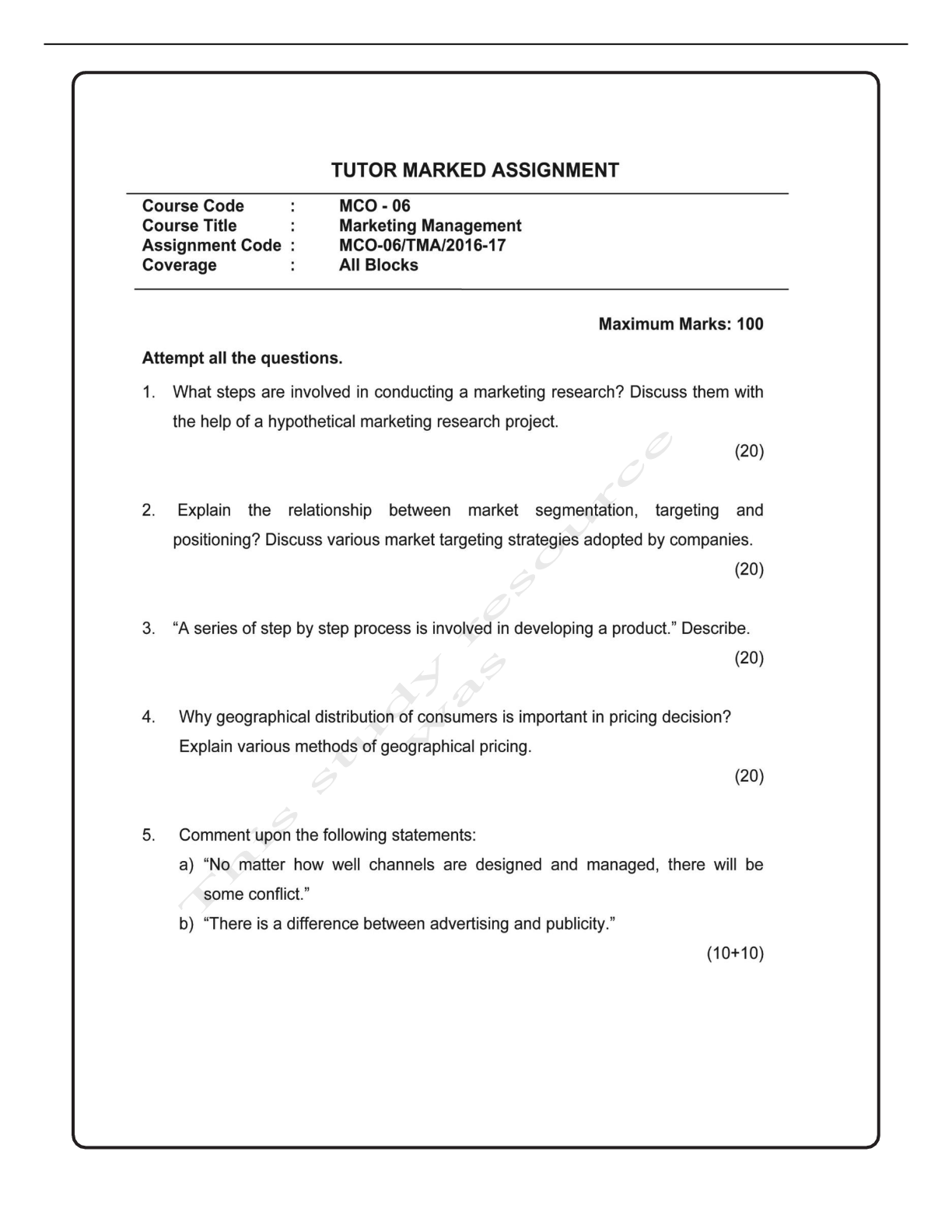
Attempt all the questions
Q. 1. What steps are involved in conducting a marketing research? Discuss them with the help of a hypothetical marketing research project.
Ans. Marketing research is carried out to collect and record the data for understanding the market situations or problems. Success of the market research largely depends on how well it is planned and carried out. It is a series of steps which require systematic and planned investigation of a marketing problem.
It consists of the following steps:
● Defining your problem
● Determining the research design
● Field work and data collection
● Data analysis
● Report preparation and presentation
Defining your problem
Determining the research design
Field work and data collection
Data analysis
Report preparation and presentation
After identifying the market segments, Marketing managers evaluate the opportunities and select either one or more significant segments for launching marketing campaigns. Marketers have to decide which segment and how many segments to target. Target market refers to the segments which an organization selects to serve. After identifying the target market, marketers evaluate each segment on five factors: segment size and worthwhileness, segment measurability, segment attractiveness, segment accessibility, company objective and resources. Marketing managers find out the strategic options available for launching their products and services in the selected market segments. Kind of product market coverage that firm takes for the future, influence the targeting strategy decisions. And, the product market coverage is influenced by the resources and capabilities of the organization. These product market coverage strategies are classified as follow: concentrated marketing, differentiated marketing, undifferenti- ated marketing. Concentrated marketing is used by the companies whose resources are limited and competition is immense. Companies in this case stretch their market budget and cover a large niche. In differentiated marketing strategy, marketing managers decide to target various market segments with different marketing offers according to the needs of each segment.
Q. 2. Explain the relationship between market segmentation, targeting and positioning? Discuss various market targeting strategies adopted by companies.
Ans. After the marketing managers have divided the entire market into smaller segments, they evaluate the opportunities to select one or more segments to be targeted. They take decisions regarding which segment to select and how many segments to select. The method of selecting the segment or segments to launch the marketing programme and serve them refers to market targeting. After selecting the desired segments, marketing managers decide the marketing campaign to capture the market segment. They decide the market targeting strategies which depends on the kind of product coverage taken by the firm for the future. The product market coverage strategies are broadly classified into three categories. They are, concentrated marketing, differentiated marketing and undifferentiated marketing.
Concentrated Marketing: An organization follow concentrated marketing strategy when the resources are less and competition is high. In this strategy, marketing managers do not fight for a small share in large market rather they cover large niche. This is the most preferable strategy for the small scale manufacturers. Firm specializes in production, distribution and promotion and so it enjoys operating economies. But, large competitors may be attracted towards this market looking at the profit potential. An organization can earn strong market position in the market with this strategy.
Differentiated Marketing: In this strategy, marketing managers decide to target various market segments with different marketing offers for each segment. This strategy is used with an objective to get higher sales and earn a dominant position in each segment. For example, Hyundai offers Santro for the upcoming middle class, Accent GVS for upper middle class, VIVA for the upper class and Sonata Gold for the elite class of customers. Limitation of this strategy is that it is very expensive as it requires high promotional budget to reach different market segments with varied marketing offers. It also involves extra cost for marketing research, product development, different forecasting models, varied sales analysis, channel management and promotional planning.
Undifferentiated Marketing: Unlike the two strategies discussed above, marketers decide to cover the entire market in this strategy. Marketing managers do not segment the market and ignore the characteristic differences. They develop one single marketing offer for the whole market. Marketing cost in this strategy is low and it is easier to manage. Marketing managers can track the market forces uniformly. He focuses on the common points rather than finding the differences in the market. An organization reaches the buyers with mass distribution ad mass promotion. Marketers face problem in finding a common marketing plan that can cater to the whole market which includes customers with different characteristics and interests.
.................................................................CONTINUED.............................................................................
[Show More]