ASSESSMENT 3 – QUESTIONING
WRITTEN ASSESSMENT
SECTION 1: PLAN FOOD PRODUCTION REQUIREMENTS
Q1: Briefly describe four food production requirements that affect the planning processes in a commercial
kitchen.
1. Estima
...
ASSESSMENT 3 – QUESTIONING
WRITTEN ASSESSMENT
SECTION 1: PLAN FOOD PRODUCTION REQUIREMENTS
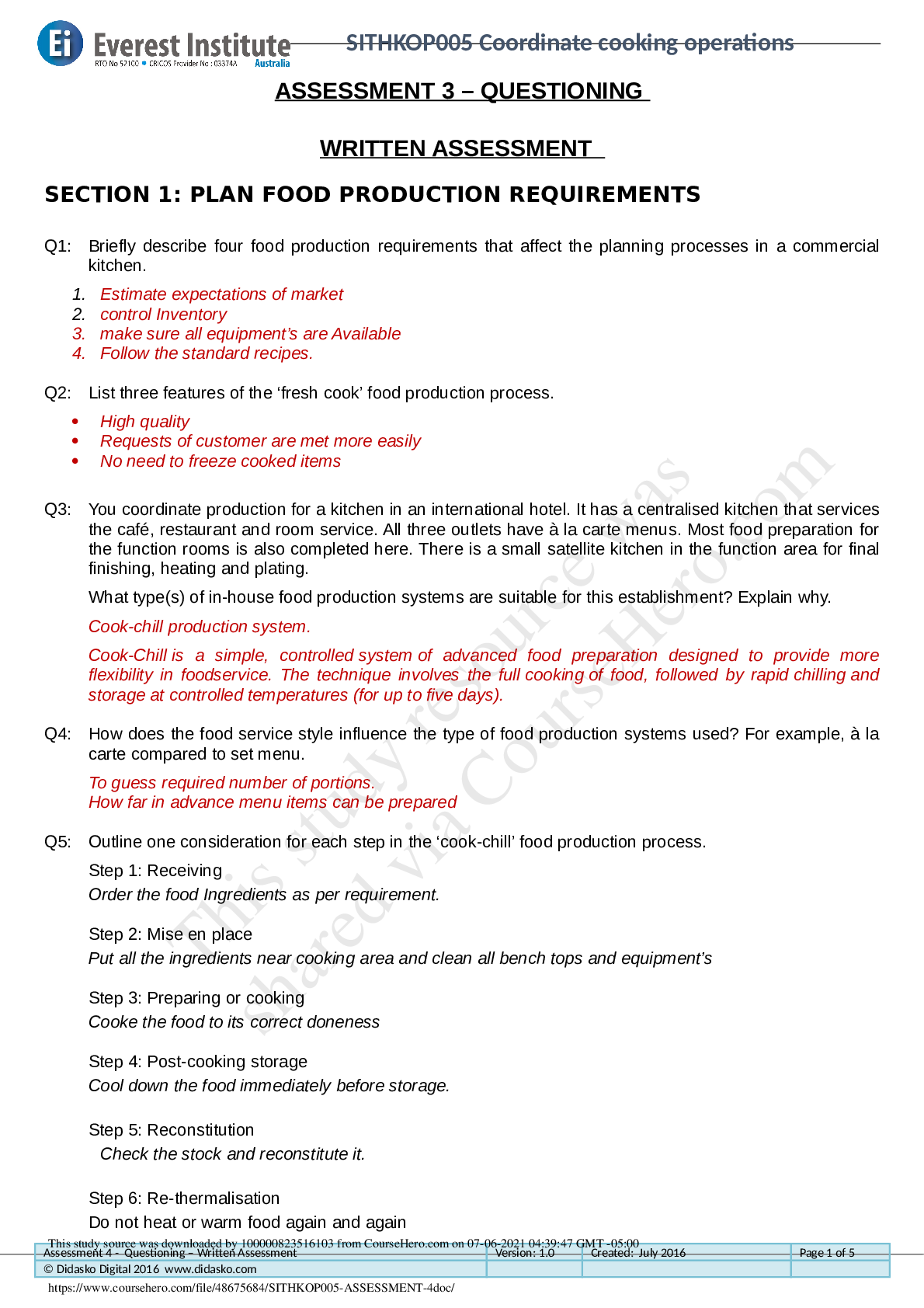
Q1: Briefly describe four food production requirements that affect the planning processes in a commercial
kitchen.
1. Estimate expectations of market
2. control Inventory
3. make sure all equipment’s are Available
4. Follow the standard recipes.
Q2: List three features of the ‘fresh cook’ food production process.
High quality
Requests of customer are met more easily
No need to freeze cooked items
Q3: You coordinate production for a kitchen in an international hotel. It has a centralised kitchen that services
the café, restaurant and room service. All three outlets have à la carte menus. Most food preparation for
the function rooms is also completed here. There is a small satellite kitchen in the function area for final
finishing, heating and plating.
What type(s) of in-house food production systems are suitable for this establishment? Explain why.
Cook-chill production system.
Cook-Chill is a simple, controlled system of advanced food preparation designed to provide more
flexibility in foodservice. The technique involves the full cooking of food, followed by rapid chilling and
storage at controlled temperatures (for up to five days).
Q4: How does the food service style influence the type of food production systems used? For example, à la
carte compared to set menu.
To guess required number of portions.
How far in advance menu items can be prepared
Q5: Outline one consideration for each step in the ‘cook-chill’ food production process.
Step 1: Receiving
Order the food Ingredients as per requirement.
Step 2: Mise en place
Put all the ingredients near cooking area and clean all bench tops and equipment’s
Step 3: Preparing or cooking
Cooke the food to its correct doneness
Step 4: Post-cooking storage
Cool down the food immediately before storage.
Step 5: Reconstitution
Check the stock and reconstitute it.
Step 6: Re-thermalisation
Do not heat or warm food again and again
[Show More]










.png)

.png)


