NURSING 101 Exit Exam Remediation
Legal Responsibilities: Actions to Take Regarding Advance Directives
Managing Client Care: Delegating Assignments to a Licensed Practical Nurse
Coordinating Client Care: Client Inform
...
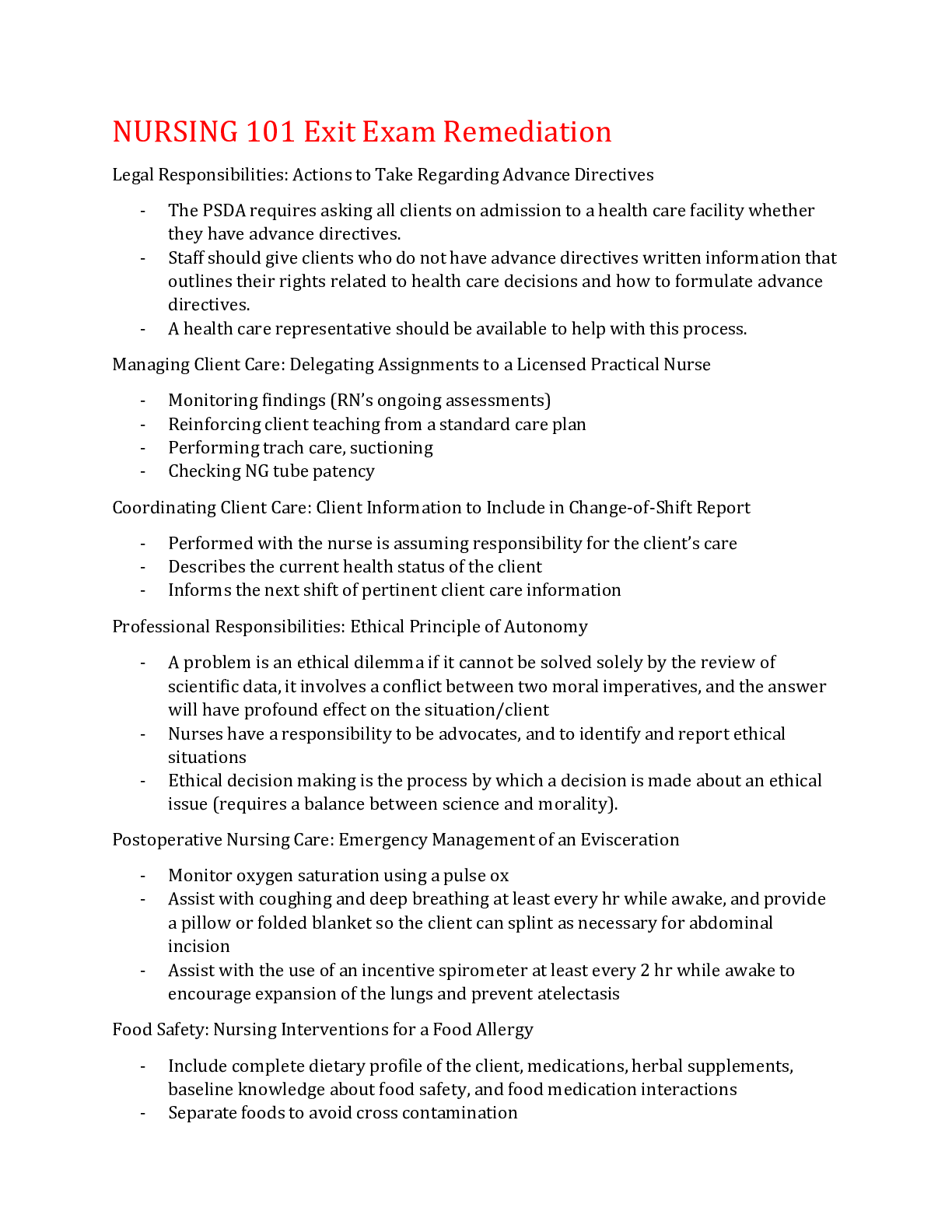
NURSING 101 Exit Exam Remediation
Legal Responsibilities: Actions to Take Regarding Advance Directives
Managing Client Care: Delegating Assignments to a Licensed Practical Nurse
Coordinating Client Care: Client Information to Include in Change-of-Shift Report
- Professional Responsibilities: Ethical Principle of Autonomy
Postoperative Nursing Care: Emergency Management of an Evisceration
Food Safety: Nursing Interventions for a Food Allergy
Home Safety: Assisting With Education about a Community Chemical Disaster
Safe Medication Administration and Error Reduction: Verifying Identities of Clients Who Have the Same Name
Communicable Diseases: Identifying the Need for Droplet Precautions
HIV/AIDS: Identifying Risks for Infections in a Client Who Is Immunosuppressed
- Medical and Surgical Asepsis: Using Hand Sanitizer
- Medical and Surgical Asepsis: Using Risk Management to Improve Hand Hygiene
Tuberculosis: Reinforcing Teaching about Infection Control
Health, Wellness, and Illness: Modifiable Risk Factors for Cardiovascular Disease
- Provide resources to strengthen coping abilities
- Identify and encourage use of support systems during times of illness and stress
- Identify obstacles to health and wellness, and create strategies to reduce these obstaclesContraception: Contraindications for Oral Contraceptives
Nursing Care of Newborns: In-Service Regarding Newborn Safety
Psychosocial Issues of Infants, Children, and Adolescents: Recognizing Indications of Possible Child Maltreatment
- Parent/caregiver rejects, isolates, terrorizes, ignores, verbally assaults, or overpressures the child
- Delayed development
- Self-stimulating behaviors
Anxiety Disorders: Priority Intervention for a Client Who is having a Panic Attack
- Assist in providing a structured interview to keep the client focused on the present
- Provide safety and comfort to the client during the crisis period
Substance Use Disorders: Manifestations of Alcohol Withdrawal
- Increase heart rate, blood pressure, respiratory rate, and temperature
- Diaphoresis
- Tonic clonic seizures
Depressive Disorders: Planning Client Care
- Depressive disorders are twice as common in women ages 15 to 40 than in males
- Depression is very common among clients over age 65, but it is more difficult to recognize and can go untreated
- Neurotransmitter deficiencies, such as serotonin deficiency (affects mood, sexual behavior, sleep cycles, hunger, and pain perception)
Effective Communication: Addressing a Client’s Concerns about Nursing Care
- Establish a trusting nurse-client relationship.
- Provide empathetic responses and explanations to the client by using observations and providing hope, humor, and information
- Minimize distractions, and face the client when speaking Sensory Perception: Caring for a Client who has a Hearing Aid
- Speak slowly and clearly
- Try lowering vocal pitch before increasing volume
- Write down what clients do not understand Sensory Perception: Providing Ear Irrigation
- Advise clients not to place any objects in the ear, including cotton-tipped swabs
- Tell clients to have an otologist remove any object lodged in the car. Use a commercial ceruminolytic for impactions, and follow with warm-water irrigation
- Tell clients to blow the nose gently and with both nostrils unobstructed Urinary Elimination: Skin Care for Incontinence
- Assist with measures to conceal urinary leaking (perineal pads, external catheters, adult incontinence garments).
- Assess for signs of breakdown
- Keep the skin clean and dry
Urinary Elimination: Planning Preventive Care
- Avoid caffeine and alcohol consumption because these produce diuresis and the urge to urinate
- Monitor and increase fluid intake during the daytime, and decrease fluid intake prior to bedtime
Pain Management: Priority Indicator for Validating Client Pain
- Instruct clients to report developing or recurrent pain and not wait until pain is severe
- Help clients reduce fear and anxiety
- Create a treatment plan that includes both nonpharmacological and pharmacological pain-relief measures
Enteral Nutrition: Caring for a Client Who Develops Diarrhea
- Provide adequate amounts of free water
- Consider changing formula to one that is isotonic
- Monitor electrolytes, serum glucose, and weights
Ingestion, Digestion, Absorption, and Metabolism: Nutritional Requirements for Wound Healing
- Add cheese, peanut butter, chopped hard-boiled eggs, or yogurt to foods
- Dip meats in eggs or milk and coat with bread crumbs before cooking
- Nuts and dried beans are significant sources of protein. These are good alternatives for a daily allergy or lactose intolerance
Nasogastric Intubation and Enteral Feedings: Checking for Residual Feeding
- Review the prescription and purpose, plan for drainage or suction, and understand the need for placement for diagnostic purposes
- Identify the client and explain the procedure
- Review the client’s history (nasal problems, anticoagulants, previous trauma, past history of aspiration).
Sources of Nutrition: Teaching a Client about Foods High in Potassium
- Oranges + dried fruits
- Tomatoes + avocados
- Meats + whole grains Hygiene: Providing Denture Care
- Remove the dentures with a gloved hand, pulling down and out at the front of the upper denture, and lifting up and out at the front of the lower denture
- Places the dentures in a denture cup, emesis basin, or on a washcloth in the sink
- Brush in a horizontal back and forth motion with a soft brush and denture cleaner Angina and Antilipemic Agents: Adverse Effects of Atorvastatin
- Observe for indications of liver damage (anorexia, vomiting, nausea) and report them
- Increases the risk of liver dysfunction and myopathy Medications Affecting Coagulation: Contraindications for Warfarin
- Dabigatran and argatroban are Pregnancy Risk Category C. bivalirudin is Pregnancy Risk Category B.
- Active bleeding and an allergy to the medication are contraindications
- Clients who have liver or kidney impairment or who are at risk for bleeding require caution when receiving this med
Medications for Psychotic Disorders: Screening Tool to Identify Tardive Dyskinesia
- Chlorpromazine, low potency
- Thioridazine, low potency
- Loxapine, medium potency
Medications for Substance Use Disorders: Contraindication during Alcohol Withdrawal
- Manifestations usually start within 4 to 12 hr of the last intake of alcohol and can continue 5 to 7 days
- Common manifestations include nausea, vomiting, tremors, restlessness, and inability to sleep
- Alcohol withdrawal delirium can occur 2 to 3 days after cessation of alcohol Airflow Disorders: Reinforcing Teaching about Montelukast
- Instruct patient not to discontinue or reduce other asthma medications without consulting health care professional.
- Advise patient that montelukast is not used to treat acute asthma attacks, but may be continued during an acute exacerbation.
- Encourage patient and family to be alert for emergence of anxiety, agitation, panic attacks, insomnia, irritability, hostility, impulsivity, akathisia, and hypomania, mania, worsening of depression and suicidal ideation, especially during early antidepressant therapy.
Angina and Antilipemic Agents: Reinforcing Teaching about Simvastin
- Observe for indications of liver dysfunction
- Avoid drinking alcohol
- If liver function test results are above the expected reference range, the provider might discontinue statin therapy
Psychotic Disorders: Family Education about Risperidone
- Minimizes weight gain, advise the client to follow a healthy, low-calorie diet; engage in regular exercise and monitor weight
- Adverse effects of agitation, dizziness, sedation, and sleep disruption can occur
Airflow Disorders: Reinforcing Teaching about Beclomethasone Inhaler
- Rinse mouth or gargle with water after use
- Monitor for redness, sores, or white patches, report to provider if they occur
- Treat candidiasis with nystatin oral suspension
Blood and Blood Product Transfusions: Indications of a Transfusion Reaction
- Manifestations include crackles, dyspnea, cough, anxiety, jugular vein distention, and tachycardia, and progress to pulmonary edema
- Slow or stop the transfusion depending on the severity of adverse manifestations
- Position the client upright with feet lower than the level of the heart
Pharmacokinetics and Routes of Administration: Reinforcing Teaching about Use of a Metered-Dose
- Remove the cap and shake the inhaler vigorously five or six times
- Hold the inhaler with your thumb near the mouthpiece and your index and middle fingers at the top
- Hold the inhaler about 2 to 4 cm away from the front of your mouth or close your mouth around the mouthpiece of the inhaler with the opening pointing toward the back of your throat
Infection Control: Identifying Laboratory Values That Indicate Infection
- Leukocytosis (WBCs greater than 10,000/uL)
- Increases in the specific types of WBCs on differential
- Elevated erythrocyte sedimentation rate over 20 mm/hr; an increase indicates an active inflammatory process or infection
Diabetes Mellitus Management and Complications: Reinforcing Teaching
- Plan meals to achieve appropriate timing of food intake, activity, onset, and peak of insulin. Calories and food composition should be similar each day
- Count grams of carbohydrates consumed for glycemic control
- Restrict calories and increase physical activity as appropriate to facilitate weight loss (for clients who are obese) or to prevent obesity
Hemodialysis and Peritoneal Dialysis: Care for an AV Shunt
- Monitor for hemorrhage at the insertion site
- Ensure aseptic technique for device cannulation
- Avoid compression of the access site
Mobility and Immobility: Applying Antiembolic Stockings
- Identify clients at risk for pressure ulcer development
and wedge pillows
- Turn every 1 to 2 hr, and use devices for support or per protocol
Acute and Infectious Respiratory Illnesses: Action to Take for Suspected Epiglottitis
- Protect the airway. Have the resuscitation equipment and suction equipment at bedside
- Avoid throat culture or using a tongue blade
- Assist with preparations for intubation or tracheostomy for severe respiratory distress
Benign Prostatic Hyperplasia: Reportable Findings after Transurethral Resection of the Prostate
- Avoid heavy lifting, strenuous exercise, straining, sexual intercourse for the prescribed length of time (usually 2 to 6 weeks)
- Drink 12 or more 8oz glasses of water each day unless contraindicated
- Avoid nonsteroidal anti-inflammatory medications due to increased risk for bleeding
Brain Stimulation Therapies: Caring for a Client Who is Receiving Electroconvulsive Therapy
- Provide continuous monitoring during the procedure and in the immediate recovery phase
- Monitor vital signs and cardiac rhythm regularly per protocol
- Observe client following procedure for cardiovascular changes, such as chest pain, and cerebrovascular changes (slurred speech, unilateral weakness).
Ergonomic Principles: Prevention of Pressure in the Prone Position
- The client lies flat on his abdomen and chest with his head to one side and his back in correct alignment
- This position promotes drainage from the mouth after throat or oral surgery but inhibits chest expansion. It is for short-term use only
- This position helps prevents hip flexion contractures following a lower extremity amputation
Peripheral Vascular Diseases: Reinforcing Discharge Teaching Following Vein Stripping
- Mild analgesics, such as acetaminophen, can be taken for discomfort
- Wear elastic stockings after bandage removal
- Elevate the legs when sitting and avoid dangling them over the side of the bed Intravenous Therapy: Findings of Peripheral IV Infiltration
- Burning, cramping, and pain in the legs during exercise (intermittent claudication)
- Pain that is relieved by placing legs at rest in a dependent position Nursing Care of Newborns: Evaluating Client Understanding of Circumcision Care
- A tub bath should not be given until the circumcision is healed. Until then, warm water should be trickled gently over the penis
- Keep the area clean. Change the newborn’s diaper at least every 4hr, and clean the penis with warm water with each diaper change
- A film of yellowish mucus can form over the glans by day two and it is important not to wash it off
Complications of the Postpartum Period: Priority Action for a Client Who Has a Displaced Uterus
- Follow instructions for measures to prevent DVT
- Avoid prolonged periods of standing, sitting, or immobility
- Elevate legs when sitting
Diabetes Mellitus Management and Complications: Identifying Manifestations of Hypoglycemia
- Irritability or moodiness
- Anxiety or nervousness
- Shakiness and/or dizziness
Gastrointestinal Therapeutic Procedures: Contributing to the Plan of Care for a Client Who Has a New Ileostomy
- Check the peristomal skin integrity and appearance of the stoma. It should appear pink and moist
- Apply skin barriers and creams (adhesive paste) to peristomal skin and allow to dry before applying a new appliance
- Evaluate stoma output. Output should be more liquid and more acidic the closer the ostomy is to the proximal small intestine
Noninflammatory Bowel Disease: Reinforcing Client Teaching About Crohn’s Disease
- Manifestations should resolve within 1 to 4 weeks. Discontinue medication after 4 weeks is manifestations persist
- Avoid concurrent use of psychoactive drugs and antihistamines
- Report constipation, fever, increasing abdominal pain, fatigue, dark urine, bloody urine, or rectal bleeding immediately bc alosetron can ischemic colitis
Respiratory Diagnostic and Therapeutic Procedures: Reporting Complications for a Client Who Has a Chest Tube
cough or talk unless instructed
- Gargling with saltwater or using throat lozenges can provide comfort for soreness of the throat
- Immediately report persistent cough, increased swallowing, blood tinged or purulent sputum, difficulty breathing, or chest pain
[Show More]