NURS 341ATI nursing care of children /RATED A/; FULL SOLUTION
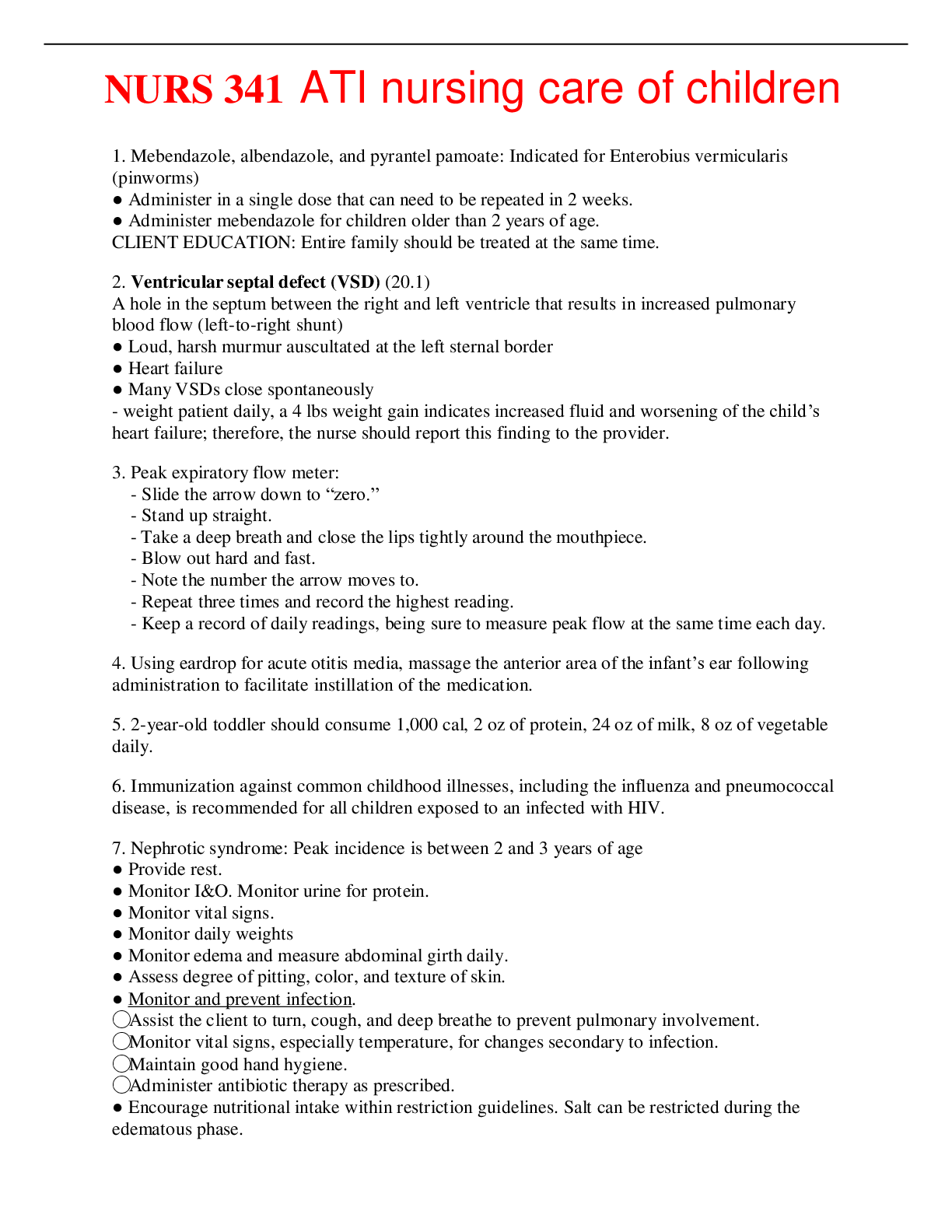
1. Mebendazole, albendazole, and pyrantel pamoate: Indicated for Enterobius vermicularis (pinworms)
2. Ventricular septal defect (VSD) (20.1)
A hole in t
...
NURS 341ATI nursing care of children /RATED A/; FULL SOLUTION
1. Mebendazole, albendazole, and pyrantel pamoate: Indicated for Enterobius vermicularis (pinworms)
2. Ventricular septal defect (VSD) (20.1)
A hole in the septum between the right and left ventricle that results in increased pulmonary blood flow (left-to-right shunt)
3. Peak expiratory flow meter:
4. Using eardrop for acute otitis media, massage the anterior area of the infant’s ear following administration to facilitate instillation of the medication.
5. Immunization against common childhood illnesses, including the influenza and pneumococcal disease, is recommended for all children exposed to an infected with HIV.
6. Nephrotic syndrome: Peak incidence is between 2 and 3 years of age
7. Celiac disease also known as celiac sprue, is an immunologic disorder in which gluten, a product most commonly found in grains, causes damage to the small intestine. The child must adhere to a strict gluten-free diet for his or her entire life. This is often very challenging, because gluten is found in most wheat products, rye, barley, plain flour pastry, and possibly oats. Encourage the parents and child to maintain this gluten-free diet.
8. Gastroesophageal reflux (GER) occurs when gastric contents reflux back up into the esophagus, making esophageal mucosa vulnerable to injury from gastric acid and resulting in gastroesophageal reflux disease (GERD).
9. Chemotherapy:
10. Cystic fibrosis page 118
11. Cardia catheterization: a Bp of 86/40 mmHg is indicative of hypotension and bleeding in a 6- month-old infant and should be immediately reported to the provider. (normal range of BP for infants: 65-78/41-52 mmHg)
12. Tonsillectomy: 104
PREOPERATIVE NURSING ACTIONS: Maintain NPO status. POSTOPERATIVE NURSING ACTIONS:
● Positioning
◯ Place in position to facilitate drainage.
◯ Elevate head of bed when child is fully awake.
● Assessment
◯ Assess for evidence of bleeding, which includes frequent swallowing, clearing the throat, restlessness, bright red emesis, tachycardia, and/or pallor.
◯ Assess the airway and vital signs.
◯ Monitor for difficulty breathing related to oral secretions, edema, and/or bleeding.
13. Tracheoesophageal fistula repair: Infants who have tracheomalacia have a weakened trachea, which leads to collapse. Clinical manifestations of tracheomalacia include barking cough, stridor, wheezing cyanosis, and apnea.
14. For a fiberglass arm cast, the nurse should instruct the adolescent to keep the cast dry by placing a plastic bag over it while showering. Avoid insert any instruments inside the cast can injure the skin and cause an infection. The fingers should be moved and exercised every 4 hr for the first 24 hr.
15. Hemophilia: the nurse should instruct the parents to inspect the toddler’s toys for sharp edges or parts because this decreases the risk of injury and bleeding to the toddler; should instruct the parents to elevate and rest the affected joint during a bleeding episode.
16. Postoperative for myelomeningocele repair:
● Assess head circumference. The pathway for the cerebral spinal fluid is altered; therefore, the infant is at risk for hydrocephalus and the nurse should monitor the infant for this condition.
● Assess skin integrity.
● Assess for allergies, such as latex allergy.
● Assess cognitive development.
● Assess bladder and bowl functioning.
● Assess motor development.
● Monitor for infections.
● Address body image concerns.
● Offer support to the family.
● Assist the client with independence through the lifespan.
● Assist the family with obtaining medical equipment/services needed at home.
17. Antistreptolysin O (ASO) titer: positive indicator for the presence of streptococcal antibodies. Elevated antistreptolysin titer if streptococcal infection present.
18. Following surgical repair of a cleft lip and palate, the nurse should gently suction the infant’s mouth with a bulb syringe to maintain a patent airway; clean the operative incision with sterile saline or sterile water after each feeding and as needed.
19. Boston brace: The nurse should instruct the child to wear the brace for 23 hr each day and to only remove it for showering or participating in physical therapy.
20. Wilms’ tumor (nephroblastoma) is a malignancy that occurs in the kidneys or abdomen. If Wilms’ tumor is suspected, do not palpate the abdomen.
Expecting finding:
● Painless, firm, nontender abdominal swelling or mass
● Fatigue, malaise, weight loss
● Fever
● Hematuria
● Hypertension
● Manifestations of metastasis include dyspnea, cough, shortness of breath, and chest pain.
21. Intussusception: Proximal segment of the bowel telescopes into a more distal segment, resulting in lymphatic and venous
obstruction causing edema in the area. With progression, ischemia and increased mucus into the intestine will occur. Common in infants and children ages 3 months to 6 years. The presence of an intussusception is confirmed by an abdominal X-ray, ultrasound, or CT scan. A barium enema is given, which also may correct the condition by nonsurgical means. The telescoping of the bowel, which characterizes intussusception, may be reduced by hydrostatic pressure of the barium enema.
22. An adolescent who has sickle cell anemia and is experiencing a vaso-occlusive crisis, the nurse should maintain bed rest for the child who is experiencing a vaso-occlusive crisis to minimize energy expenditure and avoid additional oxygen needs which promotes rest to decrease oxygen consumption.
23. Pyloromyotomy: feedings begin 4-6 hr after the surgical procedure. The nurse should anticipate feeding the infant small, frequent increments of an electrolyte solution or sterile water.
24. Dehydration:
- MANIFESTATIONS:
■ Capillary refill greater than 4 seconds
■ Tachycardia present, and orthostatic blood pressure can progress to shock
■ Extreme thirst
■ Very dry mucous membranes and tented skin
■ Hyperpnea
■ No tearing with sunken eyeballs
■ Sunken anterior fontanel
■ Oliguria or anuria
25. Measles (rubeola):
3 TO 4 DAYS PRIOR TO RASH:
● Mild to moderate fever; Conjunctivitis; Fatigue; Cough, runny nose, red eyes, sore throat RASH:
● Koplik spots (tiny, irregular white oral spots/lesions) appear in mouth 2 days before rash
● Red or reddish-brown rash beginning on the face spreading downward
● Spike in fever with rash
26. The infant should be fed clear liquids using a cup for 7-10 days following a cleft palate repair to prevent trauma and injury to the suture line.
27. Hypospadias
● Urethral opening located just below the glans penis, behind the glans penis, or on the ventral surface of the penile shaft
● Meatus opening below the glans penis
● Meatus opening along the ventral surface of the penis, scrotum, or perineum
● Possible chordee present
28. For a 3-year-old are very concerned about their body integrity. They believe that their insides can leak out from even a small wound, which explains their preoccupation with bandages. Surgery to such a private and delicate part will certainly cause children anxiety about the damage to their bodies.
29. An adolescent with diabetes mellitus with diabetic ketoacidosis, the Hemoglobin A1C test should the nurse rebognize as the best information to evaluate the client’s compliance. The Hemoglobin A1C also referred to as the glycosylated hemoglobin assay, is the most sensitive indication of client compliance with the treatment regimen. The life span of a red blood cell is about 120 days, and glucose molecules adhere to about 4-6% of hemoglobin. Because of the longevity of the RBCs, recent changes in diet, activity, or medication will not affect the results of this test.
30. Acute glomerulonephritis is common features are oliguria, edema, hypertension and circulatory congestion, hematuria, and proteinuria. Acute glomerulonephritis in children usually follows a strep. Infection, however, it is an immune system response to the strep. toxins, which causes the glomerulonephritis, not an actual infection of the urinary tract. 169
31. To treat hydrocephalus, a ventriculoperitoneal (VP) shunt catheter is placed in an enlarged ventricle. The shunt diverts the flow of cerebrospinal fluid (CSF) within the central nervous system to the peritoneum, where CSF is now absorbed across the peritoneal membrane into the body’s circulation.
- Common signs and symptoms reported during the health history of the undiagnosed child might include:
Irritability; Lethargy; Poor feeding; Vomiting; Complaints of headache in older children; Altered, diminished, or changes in LOC (textbook 527) Signs and symptoms of a shunt infection include elevated vital signs, poor feeding, vomiting, decreased responsiveness, seizure activity, and signs of local inflammation along the shunt tract. Signs and symptoms of shunt malfunction include vomiting, drowsiness, and headache.
32. For a preschooler diagnosed HIV for immunizations, he/she must be immunized to the common preventable childhood disease. However, the oral polio vaccine (OPV) contains a form of virus that in a very small number of clients can lead to an actual case of polio. This risk is greatly increased in client who are immune compromised, such as those who are HIV positive. Consequently, infants who are immune compromised, or who have caregivers that are immune compromised, must receive the injectable form of the polio immunization.
33. The effective method to teach to d finger sticks for blood glucose checks for a 6-year-old child, like most adult learners, are concrete, hands-on learners who need to practice a skill in order to perfect it. By practicing the skill the child will learn more effectively (allow the child to practice the sill on themselves or others.
34. Thalassemia is a genetic disorder that most often affects those of African descent, but it also affects individuals of Caribbean, Middle Eastern, South Asian, and Mediterranean descent
- Thalassemia minor (also called β-thalassemia trait): leads to mild microcytic anemia; often no treatment is required.
- Thalassemia intermedia: child requires blood transfusions to maintain adequate quality of life.
- Thalassemia major: to survive the child requires ongoing medical attention, blood transfusions, and iron removal (chelation therapy). Textbook 940
35. Stuttering: The 3- to 6-year-old is starting to develop fluency (the ability to smoothly link sounds, syllables, and words when speaking). Initially, the child may exhibit dysfluency or stuttering. Speech may sound choppy, or the child may say repeated consonants or “um.” Stuttering usually has its onset in the preschool years and will resolve in 80% of children by age 8 years . Parents should slow down their speech and should give the child time to speak without rushing or interrupting. Textbook 132 Stuttering is a disorder of fluency characterized by repetition of sounds. Vocal hesitancy is common in young children and often corrects itself. The repetition of songs and nursery rhymes may help the child speak more smoothly. Offering the child full attention, without rushing the child or drawing attention to the stuttering, will assist the child in speaking clearly.
36. A child with bronchiolitis, assessment findings indicate wheezing, SpO2 100%, RR 40/min, and HR 92bpm, the child is receiving oxygen at 2 LPM. The child is clearly in no distress and is well-oxygenated (a RR of 40 is only slightly elevated for a toddler and an expected finding in bronchiolitis). Therefore, the child meets the parameters of the order to wean to room air. The nurse should begin in the weaning process by lowering the oxygen to 1 L/min and then rechecking the child’s respiratory assessment.
37. Chronic use of oral steroids in children can result in decreased linear growth. Inhaled steroid are also preferred because they deliver the anti-inflammatory agent directly to the local target area without the risks of side effects associated with oral administration of steroids, such as immunosuppression and adrenal suppression.
38. Esophageal atresia and tracheoesophageal fistula are gastrointestinal anomalies in which the esophagus and trachea do not separate normally during embryonic development.
Tracheoesophageal fistula is an abnormal communication between the trachea and esophagus. Review the maternal history for polyhydramnios. Often this is the first sign of esophageal atresia because the fetus cannot swallow and absorb amniotic fluid in utero, leading to accumulation.
The presence of a fistula increases the risk of respiratory complications such as pneumonitis and atelectasis due to aspiration of food and secretions. The newborn may have rattling respirations, excessive salivation and drooling, and “the three C’s” (coughing, choking, and cyanosis) if feeding is attempted. (Copious oral secretion)
39. In nephrotic syndrome, prednisone acts on the body to decrease the excretion of protein, and thus, help fluid shift back to their normal spaces. The extra fluid is excreted in the urine. A decrease in edema can be measured by weight loss.
40. Spinal fusion with rod placement: Used for curvatures greater than 45°. Turn the adolescent frequently by log rolling to prevent damage to the spinal fusion. Assess skin for pressure areas, especially if a brace has been prescribed.
41. Treatment of sickle cell crisis focuses on pain control. Oxygen administration is necessary during episodes of crisis to prevent additional cell sickling. Adequate hydration with intravenous fluids is critical. Close monitoring of Hgb, Hct, and reticulocytes determines the point at which transfusion of PRBCs becomes necessary. Due to the viscosity of the RBCs as they change shape during a crisis, the child needs to increase fluid intake to help prevent dehydration.
42. Inhaled steroid help the client manage asthma by decreasing reactivity of the airways by preventing or lessening the inflammatory process when the client is exposed to a trigger, such as an allergen. Therefore, it is critical for the client to use the medication daily, even when manifestation free.
43. Otitis media: Instruct the family to avoid getting water into the child’s ears while the tubes are in place. The
effectiveness of earplugs is not conclusive. Advise the parents to follow the health care provider’ s instructions. Inform the client and parents about comfort measures. Encourage the parents to feed the child in an upright position when bottle- or breastfeeding. If drainage is present, clean the external ear with sterile cotton swabs. Apply antibiotic ointment. Teach parents to avoid exposure of child to risk factors if possible (secondhand smoke, exposure to individuals with viral/bacterial respiratory infections).
[Show More]