VATI REVIEW Children /;RATED A';FULL SOLUTION
1. A nurse is caring for a child admitted with an acute exacerbation of asthma. Discuss the nursing care needs of this child. Suggested Nursing Care of Children Learning Act
...
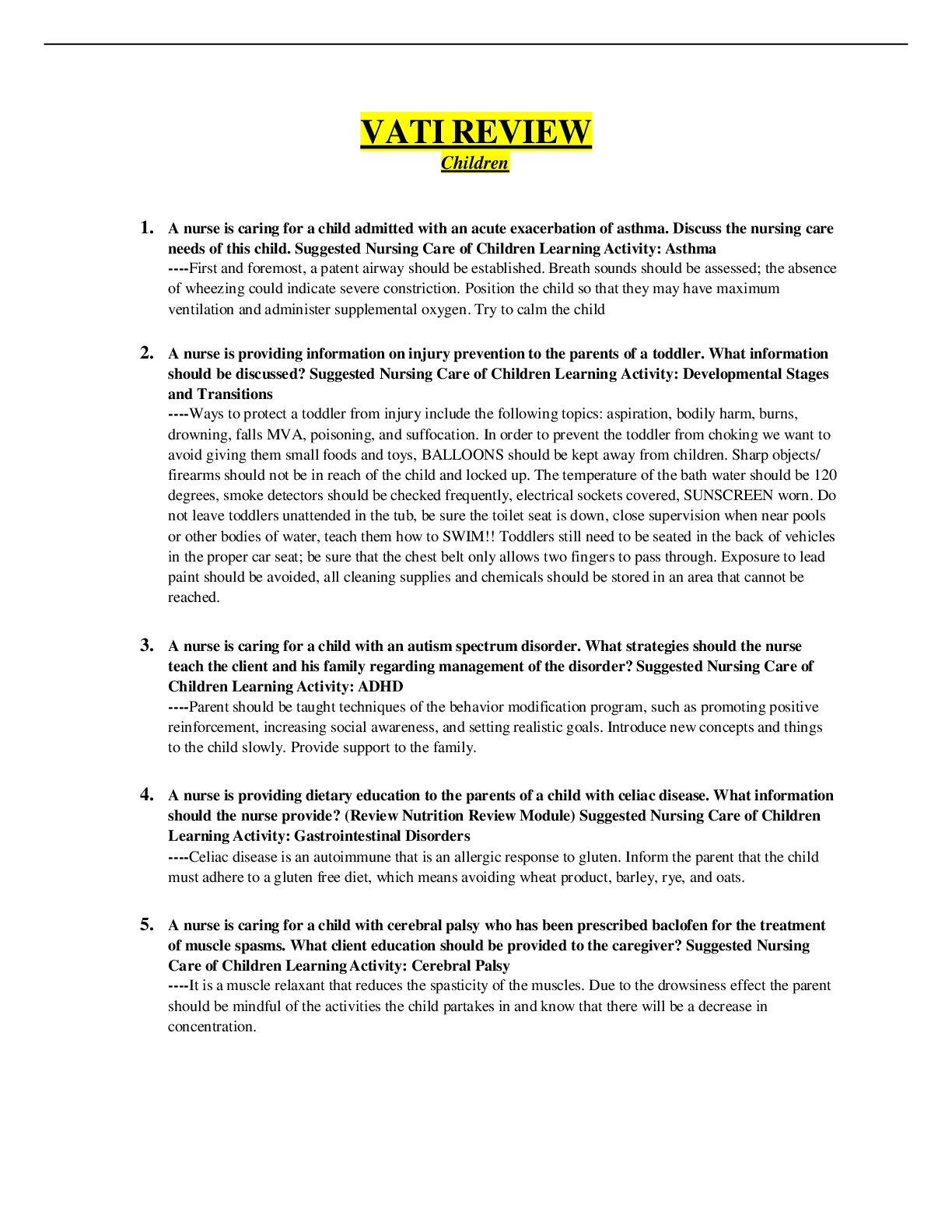
VATI REVIEW Children /;RATED A';FULL SOLUTION
1. A nurse is caring for a child admitted with an acute exacerbation of asthma. Discuss the nursing care needs of this child. Suggested Nursing Care of Children Learning Activity: Asthma
2. A nurse is providing information on injury prevention to the parents of a toddler. What information should be discussed? Suggested Nursing Care of Children Learning Activity: Developmental Stages and Transitions
3. A nurse is caring for a child with an autism spectrum disorder. What strategies should the nurse teach the client and his family regarding management of the disorder? Suggested Nursing Care of Children Learning Activity: ADHD
4. A nurse is providing dietary education to the parents of a child with celiac disease. What information should the nurse provide? (Review Nutrition Review Module) Suggested Nursing Care of Children Learning Activity: Gastrointestinal Disorders
5. A nurse is caring for a child with cerebral palsy who has been prescribed baclofen for the treatment of muscle spasms. What client education should be provided to the caregiver? Suggested Nursing Care of Children Learning Activity: Cerebral Palsy
6. A nurse is caring for a client following pylorotomy for the treatment of pyloric stenosis. What post- operative care will be required? Suggested Nursing Care of Children Learning Activity: Pyloric Stenosis
7. A nurse is assessing pain in a toddler. What are findings in this age group that indicate pain? Suggested Nursing Care of Children Learning Activity: Vital Signs in the Pediatric Population
8. A nurse is caring for a 12-year-old anorexia nervosa. What are common laboratory and diagnostic testing results commonly associated with anorexia nervosa?( Review the Mental Health Review Module)
9. A nurse is caring for a child with moderate dehydration secondary to an acute gastrointestinal infection. What manifestations should the nurse anticipate? Suggested Nursing Care of Children Learning Activity: Gastrointestinal Disorders
----Clinical manifestations of dehydration include dark urine, thirst, poor skin turgor, lethargy, and fatigue.
10. A nurse is providing information to the parents of a child with cystic fibrosis. What information should the nurse include in this education
VATI REVIEW
Summaries (Maternal VATI)
2. Pain Management: Assessing Pain in a 2 year old- The FLACC scale is used to assess pain in infants and children up to 7 years of age. F-faces, L-legs, A-activity, C-cry, C-consolabilty. Expected findings in a toddler would include loud cry/scream, verbal expressions of pain, noncooperation, clinging to a significant person, attempts to push away or avoid stimulus.
3. Eating Disorders: Priority Laboratory Testing for a Client Who Has Anorexia Nervosa- Eating disorders affect mostly females ranging from age 15-25. Some labs that are monitored in the client with anorexia, would include the following:
• Potassium (hypokalemia)
• Liver function (impaired; increase in enzymes)
• Cholesterol (elevated)
• Thyroid
• Carotene (elevated levels causing yellow discoloration of skin)
• Bone density decreased
• Glucose
• ECG changes
4. Bone and Soft Tissue Cancers: Planning Care for a Below-the-Knee-Amputation- Prepare the child for prosthesis fitting which the child can wear immediately after surgery. Will benefit from group therapy. Initiate referral for mental health counseling
5. Health Promotion of Toddlers (1-3 years old): Nutritional Needs for a Toddler- Lifetime eating habits can be established during this time. Toddlers become to develop and sense of taste and are quite picky, and may request their favorite food. Can consume 24-328 oz of milk and should switch from whole to low-fat at the age of 2. Food serving size should be 1 tbsp. for each year of age
VATI REVIEW
Summaries (Maternal Practice A)
1. Pediatric Emergencies: Planning Interventions for Lead Exposure- Lead poisoning can be fatal to infants and toddlers. S/S may vary depending on the amount of exposure to the toxin. Some S/S include distractability, hearing impairments, congnitive delays, blindness, seizures, or death. Treatment intervention involves chelation using calcium EDTA.
2. Fluid Imbalances: Evaluating the Effectiveness of Sodium Polystyrene Sulfonate- This medication is a potassium-removing agent. Indications of effectiveness would be a lowering potassium level. It’s method of action is ridding the potassium by binding to it in the intestines. Treatment for hyperkalemia.
3. Acute Neurological Disorders: Preparing an Adolescent Client for a Lumbar Puncture- Lumbar punctures are done as the definitive diagnoses for meningitis. The physician does the procedure by inserting a needle in the space between L3-L4/L4-L5 and measures the spinal fluid for analysis. The child should empty the bladder and a topical anesthetic will be applied 45min-1 hour prior to the procedure. Will be in a knee-chest (fetal position during) and will remain on bed rest flat following.
4. Gastrointestinal Structural and Inflammatory Disorders: Discharge Teaching Following Cheiloplasty- Cheiloplasty is the surgical repair of a cleft lip. Discharge instructions would be to educate the parents on the importance of restricting the infant from bothering the surgical site. We would also want to educate them on hand hygiene and cleaning the surgical site. The area should be cleaned by starting closer to the nose first in a circular motion, cleaning away from the incision. After cleaning the site, a thin coat of antibiotic ointment should be applied. This is to cut down the risk of developing an infection
[Show More]