N212 GERO EXAM 1 REVIEW HIGHLIGHTED MOMEMNTS
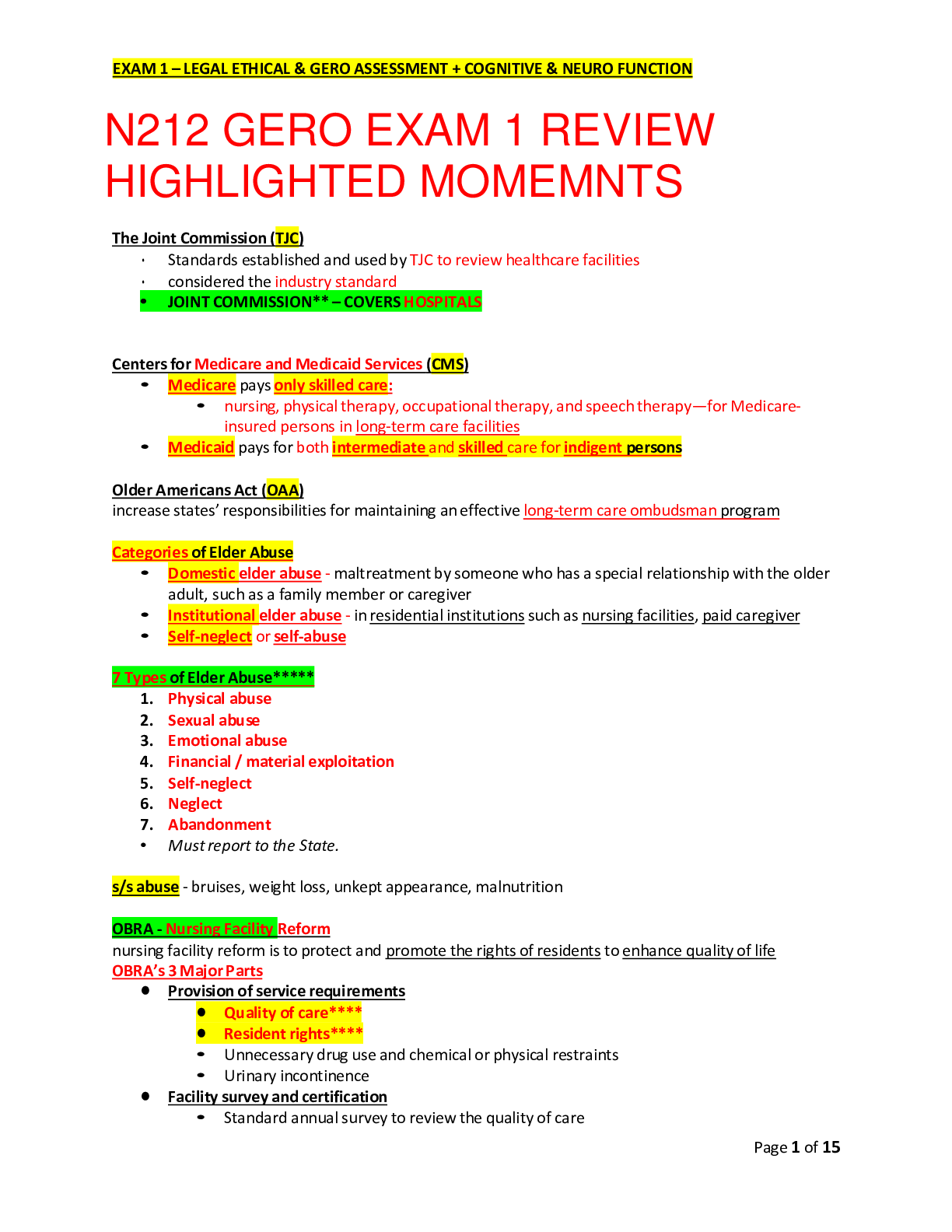
The Joint Commission (TJC)
• Standards established and used by TJC to review healthcare facilities
• considered the industry standard
• JOINT COMMISSION** – COVERS HOSPITA
...
N212 GERO EXAM 1 REVIEW HIGHLIGHTED MOMEMNTS
The Joint Commission (TJC)
• Standards established and used by TJC to review healthcare facilities
• considered the industry standard
• JOINT COMMISSION** – COVERS HOSPITALS
Centers for Medicare and Medicaid Services (CMS)
• Medicare pays only skilled care:
• nursing, physical therapy, occupational therapy, and speech therapy—for Medicare- insured persons in long-term care facilities
• Medicaid pays for both intermediate and skilled care for indigent persons
Older Americans Act (OAA)
increase states’ responsibilities for maintaining an effective long-term care ombudsman program
Categories of Elder Abuse
• Domestic elder abuse - maltreatment by someone who has a special relationship with the older adult, such as a family member or caregiver
• Institutional elder abuse - in residential institutions such as nursing facilities, paid caregiver
• Self-neglect or self-abuse
7 Types of Elder Abuse*****
1. Physical abuse
2. Sexual abuse
3. Emotional abuse
4. Financial / material exploitation
5. Self-neglect
6. Neglect
7. Abandonment
• Must report to the State.
s/s abuse - bruises, weight loss, unkept appearance, malnutrition
OBRA - Nursing Facility Reform
nursing facility reform is to protect and promote the rights of residents to enhance quality of life
OBRA’s 3 Major Parts
• Provision of service requirements
• Quality of care****
• Resident rights****
• Unnecessary drug use and chemical or physical restraints
• Urinary incontinence
• Facility survey and certification
• Standard annual survey to review the quality of care
• If care is substandard, facility may be given extended survey
• Enforcement **** mechanisms and sanctions
• The Department of Health and Human Services (DHHS)**** and the states may apply sanctions or penalties for failure to meet requirements and standards
IDPH?? – Illinois department of public health – nursing homes
Autonomy and Self-Determination
The right to self-determination**** is based on the doctrine of informed consent***.
The Patient Self-Determination Act – PSDA = INFORMED CONSENT
NEXT OF KIN IN ORDER
• Spouse
• Oldest Child
o Other child in order
• Parent
• Siblings
• Grandparents /Aunt/uncle /Cousins
DNR: specific order from physician which instructs health care providers not to use or order specific methods of therapy such as CPR
Advance Medical Directives
• AMDs: documents that permit people to put in writing - wishes and preferences regarding healthcare
• indicate their decisions if the time should come when they are unable to speak for themselves
• permit people to designate someone to convey their wishes in the event they are unable
Living will***
written expression of wishes regarding medical treatments
Pain and comfort measures**
Can be revoked verbally
Designation of health care agents (Surrogate)
Appointment of a trusted person to express wishes regarding the withholding or withdrawal of life support
Durable Power of Attorney
• Legal instrument to designate someone else to make health care decisions at a time in the future when he or she may be rendered incompetent**
Must be legally changed
General Power of Attorney
• Does not cover medical decision making
Conflicts between Directives and Family Desires
Should conflict occur, most AMD statutes specifically provide immunity for physicians who follow, in good faith, the wishes of a patient
Nurses’ Ethical Code and End-of-Life Care
• Role of HCP is to
o maintain pt autonomy
o maintain/improve health
o do no harm
Key Principles
• Autonomy or self-determination = INFORMED CONSENT
• Beneficence (doing good)
• Bene = good
• Nonmaleficence (avoiding evil)
• Mal = bad/evil
• Justice (allocation of resources)
• Fair
• Veracity (truthfulness)
• Vera = truth
KNOW THE BELOW – SEE BEGINNING OF 2ND RECORDING PATIENT CONFIDENTIALITY – HYPER-SENSITIVE INFORMATION
• HIV
• MENTAL HEALTH
CAN A DURABLE POA (POWER OF ATTORNEY) BE REVOKED? / ADVANCED DIRECTIVE
• THE ONLY IF DOCUMENT LEGALLY CHANGED. MUST FOLLOW. UNLESS PERSON IS PROVEN INCOMPETENT
CHAPTER 4 PPT – GERONTOLOGIC ASSESSMENT
Setting dictates the way data collection & analysis are managed
• Aging does not necessarily result in disease and disability***
• Chronic disease increases functional decline
• Self-reported vague S/S such as lethargy, incontinence, decreased appetite, and weight loss can indicate functional impairment
Homeostatic Mechanisms
• Reduction in the body’s ability to respond to stress through all of its homeostatic mechanisms
• Most important, the immune system
• Decline in physiologic function
• Increase in diseases
Altered Presentation of and Response to Specific Diseases
• In times of physical and emotional stress, older people will not always exhibit the expected or classic signs and symptoms
• Compare the presenting signs and symptoms with the older adult’s normal baseline
Cognitive Impairment
• ***Delirium is one of the most common, atypical presentations of illness in older adults
• ACUTE SUDDEN, ONSET – REVERSIBLE/CURABLE
• Confusion
• Mental status changes
• Cognitive changes
• Delirium
• Acute confusional state (ACS??)
Acute Confusional State (ACS)
• A sudden change in cognitive function is often the result of ILLNESS, NOT aging***
• Knowing older adults’ baseline mental status is essential to avoid overlooking a serious illness manifesting itself as an ACS
• Eg – UTI
Dementia – Sustained Deterioration*** of Cognitive Functioning**
• Includes MEMORY IMPAIRMENT AND one or more of the following cognitive disturbances:
• +Aphasia – (Speech)
• +Apraxia – (Movement)
• +Agnosia – (Sensory Impairment)
• +Disturbance in executive functioning
• SLOW ONSET**
Dementia Assessment
• Family/friends - valuable sources of data: onset, duration, associated symptoms
Nursing Assessment of the Older Person
• The overall atmosphere - conveys trust, caring, and confidentiality Environmental Modifications
• Should take into account sensory changes
• Minimize noise and distraction
• Set a comfortable temperature and ensure there are no drafts
• Use diffuse lighting with increased illumination
• Avoid glossy or highly polished surfaces
• ASK PT IF FAMILY CAN BE PRESENT
• Should take into account musculoskeletal changes
• Place the patient in a comfortable sitting position
• Maintain proximity to a bathroom
• Keep fluids available
• Provide adequate space for mobility aids
• Maintain absolute privacy
Health History - subjective
• Topics for health teaching can be identified
• Can serve as a life review
• Should include assessment of functional, cognitive, affective, and social well-being
• COGNITIVE
• DO NOT TOUCH PT UNLESS CARE/SENSITIVITY
• ***INTERVIEW PT AT A TIME THEY ARE INTERACTIVE WITH YOU
INTERVIEWER
Consider personal space requirements
• Interviewing the patient at mealtime, or even while participating in a game, hobby, or other social activity, often provides more meaningful data about a variety of areas****
The Patient
• Major factors requiring special consideration while gathering the health history
• Sensory-perceptual deficits
• Anxiety
• Reduced energy level
• Pain
• Multiple and interrelated health problems
• Tendency to reminisce
The nurse knows that the best way to obtain an accurate assessment is to implement which of the following? (Select all that apply.)
a. Turn off the television or mute the sound.
b. Provide privacy by closing the curtains.
c. Ask only yes or no questions to keep older adult on task.
d. Request the patient's family wait in the waiting room.
e. Turn on the over-bed light to increase illumination. Correct answers a, b, e
Health History Format
• Occupational profile** – DON’T ASSUME PT IS RETIRED**
• Recreation/leisure profile**
Assessment Tools
• FANCAPES***: - Assess physical functioning as well as evaluation of their ability to meet their
needs
• Fluids,
• Aeration,
• Nutrition,
• Communication,
• Activity,
• Pain,
• Elimination
• Social skills
• SPICES***:
• sleep disorders,
• problems with eating/feeding,
• incontinence,
• confusion,
• evidence of falls,
• skin breakdown
Functional Status Assessments
• The ability to perform activities of daily living (ADLs) and instrumental activities of daily living (IADLs) – SEVERAL ASSESSMENT TOOLS TO ASSESS ADLs***
• The Katz Index of ADLs
• The Barthel Index
• The Philadelphia Geriatric Center
Instrumental Activities of Daily Living Scale
SEVERAL ASSESSMENT TOOLS TO ASSESS ADLs**
Cognitive/Affective Assessment – SEVERAL TOOLS TO ASSESS***
• The Short Portable Mental Status Questionnaire
• The Mini-Mental State Examination
• The Mini-Cog
• The Beck Depression Inventory
• The Geriatric Depression Scale**
Chapter 27 Cognitive and Neurologic Function
Structural Age-Related Changes of the Neurologic System
● Cellular and Structural Changes
O Neuron (LOST)
O Neurotransmitters (DECREASE)
O Cerebrospinal fluid and ventricular system
O Balance and motor function
O Reticular formation and sleep patterns
O Sensorimotor function
O Complete neurocognitive examinations to establish baseline function and to detect potentially reversible conditions causing mental and behavioral disturbances
Cognitive Function and Memory in Typical Aging
O Decline in cognitive function is effect of disease, NOT effect of normal aging** process
O Depression
O As one ages, the rate of depression increases
O Associated with higher suicide rates than in younger depressed population, 19% of all suicide deaths
O Clinical manifestations
O Fatigue; constipation; psychomotor retardation; depressed mood; loss of interest, energy, libido, or pleasure; changes in appetite, weight, and sleep patterns; and agitation; anxiety; or crying
O First seen as cognitive impairment, particularly in areas of attention and concentration
O Common response to serious illness of any kind
O Normal losses that occur with aging and even retirement may trigger depression
O Pseudodementia = depression masquerading as dementia
O Pseudodelirium = acute confusion found to be due to depression
Delirium
• rapid (hours to days) and typically fluctuates
• underlying illness may cause the delirium
• Emergent condition
DELIRIUM Risk factors - infection, polypharmacy, trauma Symptoms – fluctuate
Difficulty maintaining concentration
● Difficulty maintaining concentration
● language disturbance, including slurred, forced, or rambling speech
● Disorganized thinking
DELIRIUM Management
● Rapid diagnosis and treatment of underlying cause
● Provide a therapeutic environment
● Management of disruptive behaviors, and supportive care
● Medication is a last resort****
Dementia
● Syndrome of gradual and progressive cognitive decline
● S/S - May involve
● language deficits
● apraxia (difficulty with the manipulation of objects; movement, tasks),
● agnosia (inability to recognize familiar objects),
● agraphia (difficulty drawing objects), and
● impaired executive function
Reversible Dementia
● when other pathologic conditions masquerade as dementia
● Identify and treat underlying causes of dementia symptoms; even if disorders are identified and treated, not all individuals with dementia symptoms will improve
Alzheimer Disease
● Most common form of dementia***
● Progressive, neurodegenerative disease
● Characterized by the presence of neurofibrillary tangles composed of misplaced proteins within brain, cortical amyloid plaques, and granulovascular degeneration of neurons in pyramidal cell
layer of hippocampus
● Genetic
● Nutritional
● Viral
● Environmental
● Age (most important risk factor)
● AD Genetic factors
● Early-onset Alzheimer—ages 30 - 60, named Familial Alzheimer Disease (FAD)***, caused by one of any number of different single-gene mutations on chromosomes 1,14, and 21
● AD Diagnostic studies
● Autopsy*** remains gold standard for diagnosis
● AD Tx
● No cure for AD
● Namenda (Memantine) is used to treat moderate to severe Alzheimer disease and the main effect is to delay the progression of some of the symptoms
Vascular Dementia
● Some recovery of function may occur over time, but never full recovery
● Clinical manifestations
● Gradual onset: result of small lacunar infarcts affecting very small area of brain, causing
● memory, motor, or sensory perceptual function deficits
● Abrupt onset: immediate neurologic symptoms, such as one-sided weakness, gait abnormalities, or focal neurologic signs
● Destruction of brain tissue resulting from small emboli or brain attacks may be localized or diffuse
● Lewy Body Dementia
● LBD can be found in persons with Alzheimer and those with Parkinson***
● CLINICAL MANIFESTATIONS
● Often marked by prominent fluctuations
● attention
● ability to communicate
● severity of psychiatric symptoms, particularly visual hallucinations
● Extrapyramidal features:
● rigidity, bradykinesia, flexed posture, and shuffling gait
● Frontotemporal Dementia
● Syndrome of exclusion associated with non-AD pathologic conditions and relatively rare in clinical setting
● Risk factors—poorly understood
● Clinical manifestations
● Behavioral variant frontotemporal dementia (Pick disease): progressive behavior/personality decline where there is a change in
● personality, emotions, behavior, judgment
● Primary progressive aphasia: progressive language decline
● early changes in language ability:
● speaking,
● reading,
● writing,
● understanding
● Progressive motor decline - difficulties with physical movement that include
● shaking,
● difficulty walking,
● frequent falls,
● poor coordination
● Management
● Currently there are no treatments for FTD
● Benefit from speech therapists, physical therapists, day care, respite care, and the judicious use of medications to control symptoms
● Other Dementia-Related Diseases
● Normal Pressure Hydrocephalus
● Rare but potentially reversible condition; if left untreated, it leads to permanent cognitive impairment
● Treatment: placing a shunt to drain CSF
● Subdural Hematomas
● Treatments for both acute and chronic subdural hematomas include evacuation of hematoma, usually with use of burr holes and a closed drainage system
● Treatment of Altered Thought Processes
● “Start low, go slow, and titrate upward until benefits or side effects are seen”
● Education helps create realistic expectations of medication’s benefits and potential side effects
● Nursing Management: Altered Thought Process
● Assessment
● Complete baseline physical examination, along with neurologic examination and mental status assessment
● Diagnosis
● Altered nutrition: less than body requirements related to poor oral intake
● Anxiety related to misinterpretation of environmental cues
● ADL’s: Bathing and hygiene self-care deficit related to cognitive impairment
● Bowel incontinence related to cognitive decline and misinterpretation of physiologic needs
● High risk for injury related to altered ability to interpret environment
● Impaired physical mobility related to neurologic deficits
● Impaired social interaction related to cognitive impairment
● Planning and expected outcomes—the patient/family will do the following:
● Participate in activities and care
● Sundown Syndrome
● Commonly observed tendency for people with dementia to become more confused and agitated around late afternoon to nightfall
● Behavioral interventions-redirection, provision of companionship and empathy,
environmental modifications in lighting, and noise reduction
● SUNDOWN SYNDROME Wandering
● Interventions
● Ensuring an environment safe for wandering
● Observing potential wandering trigger behaviors
● Maintaining a regular activity and exercise
● SUNDOWN SYNDROME - Hallucinations and Delusions
● medical cause—overmedication, toxicity, fever, infection, or a combination of causes may trigger response
● SUNDOWN SYNDROME - Catastrophic Reactions
● Outbursts or overreaction toward minor stresses
● Interventions - Provide calming atmosphere to distract the individual
● SUNDOWN SYNDROME - Suicide
● White men older than the age of 85** are at the greatest risk of all age–gender– race groups
● Older adults attempt suicide less often than those in other age groups; they have a
higher completion rate**, which is rarely preceded by only one cause or one reason
● Nursing Management: Suicide
● Diagnosis
● Ineffective individual coping related to multiple perceived losses
● Dysfunctional grieving related to multiple perceived losses
● Hopelessness related to deteriorating health
● High risk for violence related to perceived loss of control
● Spiritual distress related to hopelessness
● Intervention
● Take appropriate safety measures (constant observer**)
● Useful tool in working with suicidal individuals is a “no-suicide
contract”
● Parkinson Disease
● Characterized by a slowing in the initiation and execution of movement (bradykinesia), increased muscle tone (rigidity), tremors at rest, and impaired postural reflexes
● PARKINSON Risk factors
● Environmental factors:
● postencephalitic parkinsonism,
● drug-induced,
● toxin-induced parkinsonian syndrome,
● exposure to agriculture pesticides / herbicides,
● trauma to midbrain
● Other related causes: hydrocephalus, hypoxia, infections, stroke, tumor, and traumas
● PARKINSON Clinical manifestations
● Muscle rigidity affects eyes, mouth, and voice and contributes to staring gaze
● Uncoordinated movements; short stepped, shuffling, and propulsive gait; postural disturbance; trunk tilting forward
● PARKINSON Diagnostic studies
● Diagnosis based primarily on clinical features of disorder, CONFIRMED when symptoms improve with antiparkinsonian drugs
● PARKINSON Medication -Drugs eventually lose effectiveness
● Nursing Management: Parkinson Disease
● PARKINSON Diagnosis
● Impaired physical mobility
● Impaired verbal communication
● Altered nutrition: less than body requirements
● High risk for injury
● PARKINSON Planning and expected outcomes—the patient will do the following:
● Maintain an effective communication pattern
● Maintain physical functioning and mobility and will not sustain injury
● Maintain effective coping by demonstrating the use of coping strategies that enhance individual and family functioning
● Maintain socialization by participation in activities
● PARKINSON Intervention
● Teach patients importance - active range-of-motion exercises BID, walking at least four times a day, and using assistive device when recommended to prevent injury
● Consultation with speech pathologist necessary if - dysphagia
● Assessment of nutritional status and self-feeding abilities crucial for preventing
aspiration, respiratory complication, and nutritional imbalance
● PARKINSON Evaluation
● Evaluation of nursing interventions focuses on maintenance of function and engagement in activities for as long as possible
● Stroke or Brain Attack
● Disruption in the normal blood supply to the brain tissue—ischemic and hemorrhagic
● Medical emergencies—treat immediately to prevent permanent neurologic deficits and disability
● Transient ischemic attack (TIA) = same symptoms but lasts less than 24 hours
● 3-hour window of treatment from onset of signs or symptoms of acute ischemic stroke
● STROKE/BRAIN ATTACK Clinical Manifestations
● Common findings: headaches, vomiting, seizures, mental status changes (including coma), fevers, and electrocardiogram (ECG) changes
● STROKE/BRAIN ATTACK Management: medical and pharmacologic therapy
● Patients with ischemic strokes receive thrombolytic agents within 3 hours of onset of CVA
● Desired effect of Tx = dissolve clot and reperfuse compromised brain tissue
● STROKE/BRAIN ATTACK Nursing Management:
● STROKE/BRAIN ATTACK Diagnosis
● Altered cerebral tissue perfusion related to hemorrhage or increased intracranial pressure
● Ineffective breathing pattern related to changes in mental status
● High risk for aspiration related to loss of muscle tone, airway protection, and dysphagia
● STROKE/BRAIN ATTACK Planning and expected outcomes—the patient will do the following:
● Have minimum residual deficits and complications
● STROKE/BRAIN ATTACK Intervention
● Positioning patient at a 30- to 45-degree angle to prevent elevation of ICP and manage or protect airway
● Resume oral diet only AFTER a successfully completed a swallowing evaluation
● Major Mental Health Problems: Anxiety
● One of the most common symptoms seen in older adults
● Most common anxiety disorder seen is obsessive-compulsive disorder (OCD)
● Obsessive symptoms: persistent intrusive thoughts
● Compulsive symptoms: repetitive behavior performed in an attempt to reduce anxiety
● Generalized anxiety disorder (GAD) and phobic disorders
● GAD: excessive worry beyond individual’s control;
● symptoms: restlessness, fatigue, decreased concentration, irritability, muscle tension, or disturbed sleep
● Phobic disorder manifested by a persistent, irrational fear provoked by the feared object or situation
● Major Mental Health Problems: Schizophrenia
● Thought disorder characterized by altered perceptions of reality, alterations in thought processes, and declines in ADLs and occupational and social functioning
● Nursing Management: Schizophrenia
● Schizophrenia Diagnosis
● Social isolation related to altered mental status
● Sleep pattern disturbance related to psychologic status
● Major Mental Health Problems: Mental Retardation
● Mental Retardation Intervention
● Customize care routines to their level of intellectual functioning
● Use clear, simple instructions
● WITH ELDERLY – ALWAYS PROMOTE SELF CARE, INDEPENDENCE, SAFETY
● COMPUTER TEST – 40Q OFF FROM ATI
● TEST FIRST
1. LEGAL/ETHICAL ISSUES -
a. JCO/JOINT COMMISSION – HOSPITALS
b. IDPH – NURSING HOME
c. OBRA - OMINOUS BUDGET RECONCILIATION ACT –
i. WHAT IS IT – GOVERN NURSING HOME, SET STANDARDS;
ii. HELP PROTECT ELDERLY PATIENTS IN NURSING HOMES
d. HIPPA – PATIENT CONFIDENTIALITY
2. 7 CATEGORIES OF ABUSE***** – a. SEXUAL
b. SELF NEGLECT c. NEGLECT
d. ABANDONMENT e. FINANCIAL
f. PHYSICAL
g. EMOTIONAL
3. PATIENT SELF DETERMINATION ACT = INFORMED CONSENT – RIGHT TO BE INFORMED
4. ADVANCED DIRECTIVES – 2 TYPES
a. LIVING WILL – WRITE DOWN SPECIFICALLY WHAT YOU WANT DONE; can change mind verbally
b. DURABLE POWER OF ATTORNEY – GIVING SOMEONE AUTHORITY TO MAKE DECISION ON YOUR BEHALF. LEGAL/WRITTEN. NEED TO CHANGE IN WRITING
5. ASSESSMENT
a. ID STRENGTH / LIMITATION
i. DETERMINE SELF CARE
b. ID BASELINE
c. ID SUPPORT SYSTEMS
d. PROMOTE AUTONOMY AND INDEPENDENCE
e. MAKE SURE ENVIRONMENT IS CONDUCIVE
i. LOW NOISE
ii. RELAXED
iii. PROPER LIGHTING
iv. REDIRECT – STAY FOCUSED
f. ADLS
g. AMBULATE
h. COMMUNICATE
i. NUTRITIONAL STATUS
j. CONSIDER PERSONAL SPACE
i. adequate space for mobility aids
ii. -perception of appropriate distance zones varies among cultural group
iii. -personal space requirements
k. TOUCH APPROPRIATELY l. CULTURAL BELIEFS
i. Hispanics
1. may be highly tactile,
2. very modest (men and women),
3. request HCP of same gender,
4. women may refuse examination by male health care providers.
ii. Asian/Pacific Islanders
1. may avoid touching (patting head is strictly taboo),
2. touching during an argument = loss of control (shame),
3. putting feet on furniture is both impolite and disrespectful,
4. public displays of affection toward members of the same gender are permissible but not toward members of opposite gender.
iii. Blacks/African Americans
1. NOT be touched without permission
iv. Native Americans
1. shake hands lightly
2. NOT be touched without permission.
m. EVALUATE EDUCATION OPPORTUNITIES n. RECREATIONAL ACTIVITIES
i. SEXUAL ACTIVITIES
ii. EXERCISE o. FANCAPES - KNOW p. SPICES - KNOW
q. BRING INTO ROOM, ORIENT TO ROOM, CALL LIGHT NEAR,
r. GERIATRIC
i. -environment is important
-atmosphere should convey trust, caring, confidentiality
-consider their needs
-cultural considerations
-take into account sensory and musculoskeletal changes
-be patient, relaxed, unhurried
-allow patient time to respond to questions and directions
-maximize use of silence
-be alert to signs of increasing fatigue
-begin asking questions that show interest in their lives
s. HEAD-TO-TOE
i. VISION
ii. EAT/FEED/SWALLOW
iii. HEARING
iv. POSTURE
v. BOWEL SOUNDS
vi. INCONTINENCE
vii. RESPIRATORY – O2 NEEDS?
viii. AMBULATE
ix. COMMUNICATE
x. SWELLING
t. Assessment Components Collection of data
i. Biological, psychosocial, and functional information
ii. Cultural and spiritual assessments
iii. Cognitive abilities
iv. Psychological well-being
v. Caregiver stress or burden
vi. Patterns of health and healthcare
vii. Review of preferences for advanced care planning
6. DELIRIUM – REVERSIBLE
7. DEMENTIA – NOT REVERSIBLE
8. LINAGE – NEXT OF KIN
a. SPOUSE
b. ADULT CHILDREN – OLDEST- TO- YOUNGEST
c. PARENTS
d. SIBLINGS
e. OTHERS – E.G. GRANDPARENTS, AUNTS/UNCLES, COUSINS
9. DURABLE POA
a. – IF ON DRUGS – DON’T USE THIS PERSON
i. GO TO ETHICS COMMITTEE 10. PT – CODE – DNR
a. CANT SAY YOU CAN DO BREATHING BUT NOT CHEST COMPRESSIONS
11. RIGHTABLE MOMENT – CONFABULATION
a. ALZHEIMER’S DISEASE = LIE TO HIDE THAT THEY DO NOT KNOW SOMETHING 12. CHAIN OF COMMAND IN HOSPITAL
a. TECH - NURSE - CHARGE NURSE- NURSE MANAGER – DON/ CHIEF NURSING OFFICER – CEO
b. JOINT COMMISSION
13. AREAS IN BODY AFFECT DRUG METABOLISM a. KIDNEY
b. LIVER
c. GI SYSTEM - GASTRIC MOTILITY d. RESPIRATORY
e. As patient's age, it becomes harder for them to metabolize medications and alcohol
due to what changes?
i. decreased hepatic and renal reserves
f. physiologic factors: decreased gastric acids production and GI motility
g. body composition that may increase accumulation of drugs?
i. decreased total body water and lean body mass
ii. serum protein
iii. increased body fat
h. organ function = decreased hepatic blood flow and reduced glomerular filtration rate
i. Age-related changes in the stomach that can cause increased drug absorption and possibly toxicity include:
i. decreased gastric motility.
14. S/S DEMENTIA
[Show More]