CLC 056 exam
Analyzing Contract Costs Exam (contains 55 questions)
• Here is your test result.The dots represent the choices you have made.
• The highlighted questions are the questions you have missed.
• Remediation
...
CLC 056 exam
Analyzing Contract Costs Exam (contains 55 questions)
• Here is your test result.The dots represent the choices you have made.
• The highlighted questions are the questions you have missed.
• Remediation Accessed shows whether you accessed those links.'N' represents links not visited and 'Y' represents visited links.
The offeror customarily treats similar costs as “other direct costs” under similar circumstances
The proposed cost benefits only the proposed contract work
The contractor’s accounting system segregates “other direct costs” from similar indirect costs
All of these
Engineered, designed, fabricated, or modified to meet not only the requirements of the current contract but also the requirements of all other contracts
Developed and engineered by a subcontractor who is not currently working on another contract
An item (e.g., fixture, pattern, or gauge) that is necessary in aiding the development of a unique product
Engineered, designed, fabricated, or modified to meet specific contract needs and cannot be used for other contracts
3.) What is the most common base for calculating the General and Administrative (G&A) overhead rate? [Identify indirect cost pools and bases]
[Remediation Accessed: N]
Total price
Total G&A expense
Total management cost
Total of all costs
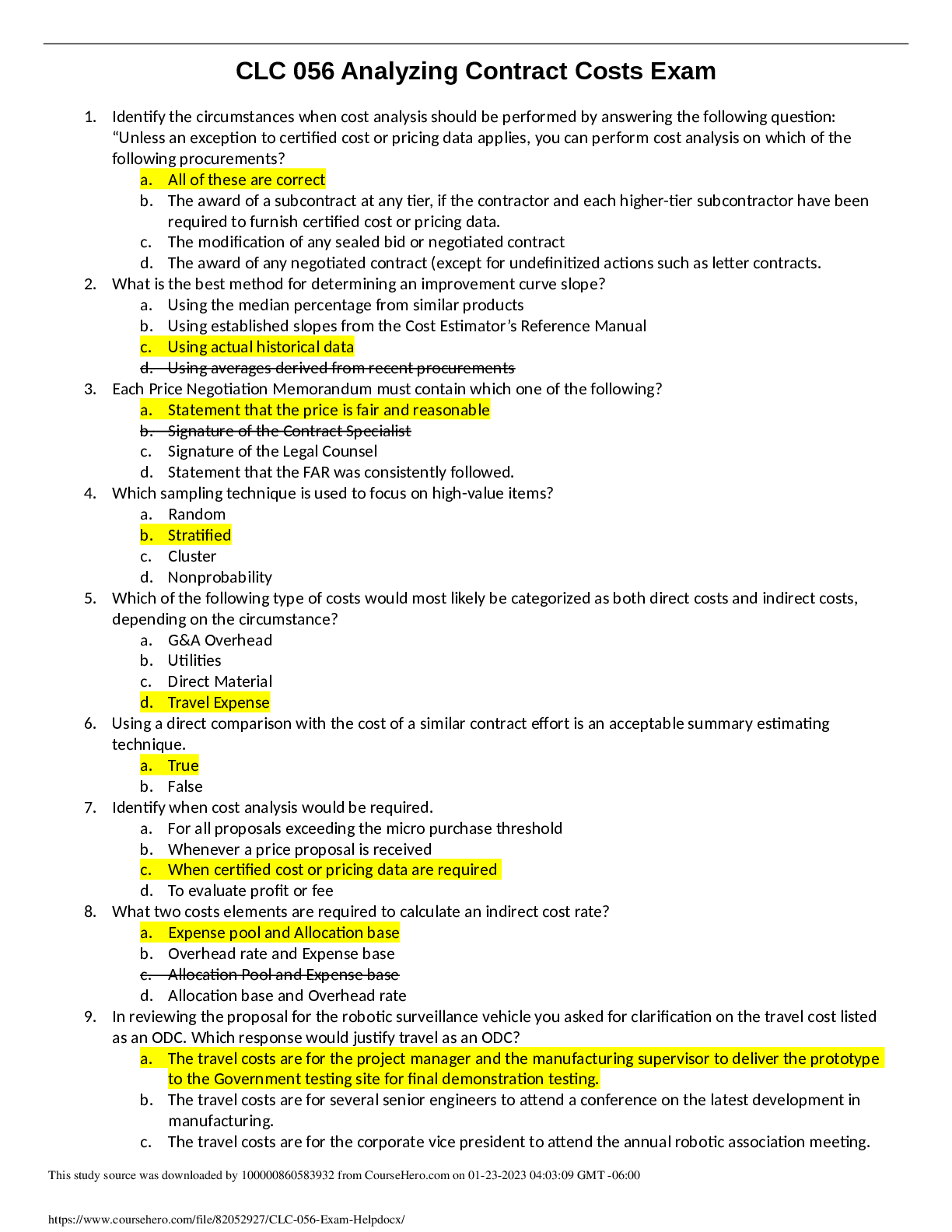
4.) What two costs elements are required to calculate an indirect cost rate?
[Identify the process of calculating indirect cost rates]
[Remediation Accessed: N]
Expense pool and Allocation base
Allocation base and Overhead rate
Overhead rate and Expense base
Allocation Pool and Expense base
Billing Phase
Forward Pricing Phase
Beginning Payment Phase
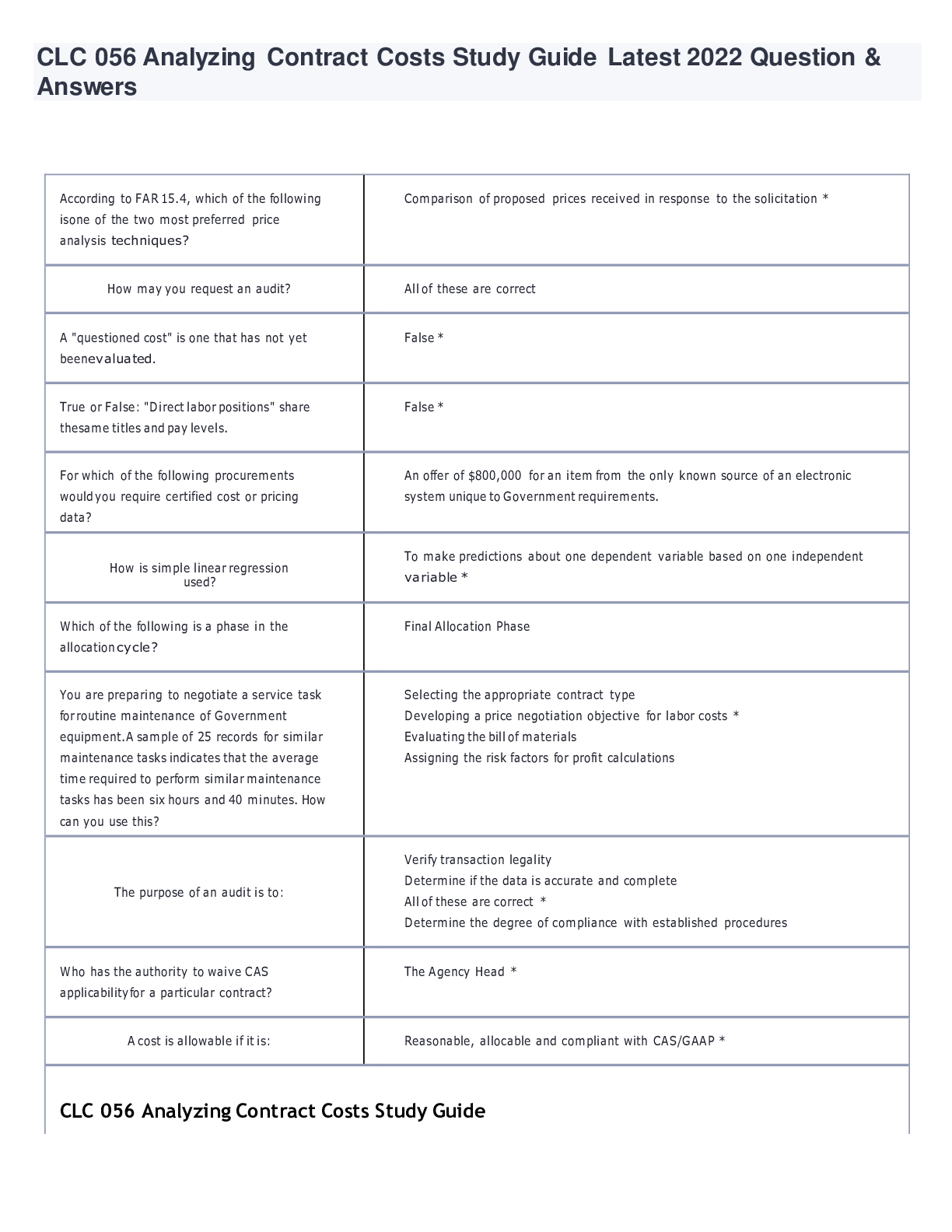
Final Allocation Phase
Comparing the proposed costs of a new computer database with the historical costs of all recent contracts in your office
Calculating the mean cost of one individual unit in a production run of 10,000 units
Estimating the cost of a new armored vehicle based on historical costs of similar procurements
Analyzing the accuracy of a should-cost analysis generated by a DCMA Industrial Engineer
7.) Which regression method would be used when there is more than one independent variable? [Identify the different regression analysis methods]
[Remediation Accessed: N]
Multivariate regression
Segmented regression
Curvilinear regression
Simple linear regression
8.) Identify the situation where you would use simple linear regression.
9.) Which variable is also considered the independent variable?
Y
Z
X
R
10.) Which of the following situations would the use of improvement curve analysis likely be useful in evaluating proposed costs?
[Identify situations where improvement curve analysis would be appropriate]
[Remediation Accessed: N]
Fabrication of a single jet engine frame assembly
Assembly of two prototype aerial refueling airplanes
Assembly line repair of a turret assembly for an M1/A2 Abrams tank
Fabrication of a new aircraft carrier
11.) What is the first step in conducting improvement curve analysis?
Determine the Theoretical value of unit #1
Collect the historical data
Calculate the slope of the curve
Calculate the rate of improvement
15,800
8,400
62,200
33,600
Division-wide allocation base amounts
Percentage of land, building, and profit distributions
Company-wide allocation base amounts
Proposal allocation base amounts
14.) Which of the following statements is true concerning profit/fee calculations? [Identify the factors affecting profit/fee analysis]
[Remediation Accessed: N]
Profit/fee is calculated differently depending on DPAS rating of the contract
Profit/Fee is calculated once for the basic contract and must not be recalculated on subsequent modifications
Profit/fee objectives are a product of risk
Profit/fee objectives are reduced by the cost efficiency factor
15.) When calculating profit/fee, how is the “performance risk (composite)” calculated? [Calculate a profit/fee using the appropriate structured approach]
[Remediation Accessed: N]
By adding the assigned weights and assigned values of the technical and management/cost control elements
By multiplying the assigned values of the technical and management/cost control elements
By adding the assigned weight and assigned value of the technical and management/cost control elements and dividing the sum by 2
By multiplying the assigned weight by the assigned value of the technical and the management/cost control element, and adding the two together
15%
1%
10%
6%
17.) Which of the following factors is critical to a successful negotiation?
The negotiation should be competitive
Avoid being too friendly, in case the negotiations get difficult
Effectively prepare, plan, and communicate
Set your opening position extremely low to give room to negotiate
Win-Lose-Win
Lose-Lose
Win-Lose
Win-Win
19.) What is an important driver to a successful negotiation?
Ensure your position is heard
Obtain the lowest price for the government
Listen to understand
Maintain position of power
Whether to solicit to large business, or set aside for small business only
The profit/fee percentage objective
Selection of contract type
The selection of a the awardee
21.) Each Price Negotiation Memorandum must contain which of the following?
Statement that the price is fair and reasonable
Signature of the Legal Counsel
Signature of the Contract Specialist
Statement that the FAR was consistently followed
Comparison of proposed prices with Independent Government Estimates (IGE)
Comparison with competitive published price lists
Comparison of proposed prices received in response to the solicitation
Use of parametric estimating methods to highlight significant inconsistencies
Defective Pricing
Data other than cost or pricing data
Exception to certified cost or pricing data
CICA Violation
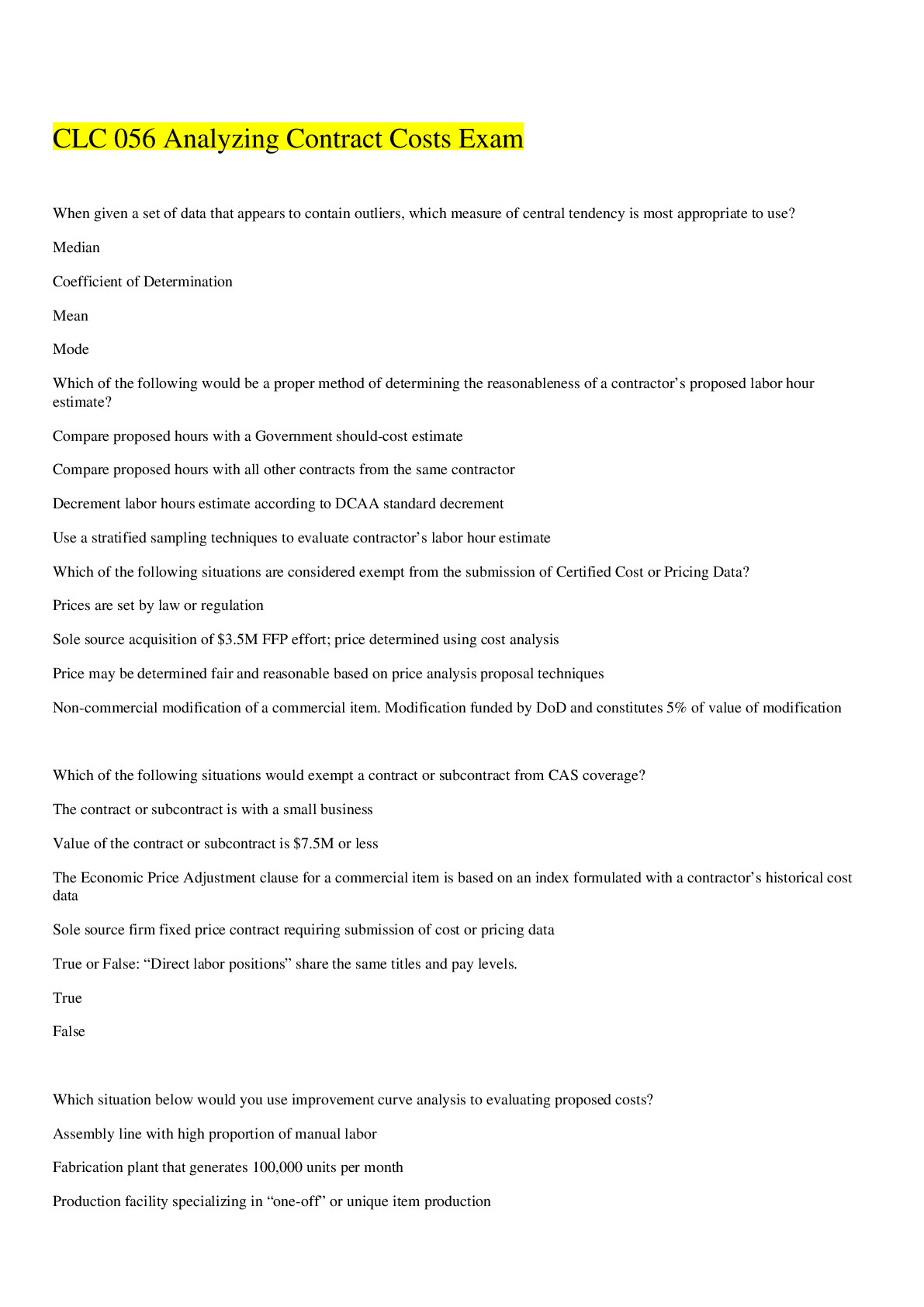
Prices are set by law or regulation
Price may be determined fair and reasonable based on price analysis proposal techniques
Non-commercial modification of a commercial item. Modification funded by DoD and constitutes 5% of value of modification
Sole source acquisition of $3.5M FFP effort; price determined using cost analysis
They must certify that they relied on that certified cost or pricing data in the Price Negotiation Memorandum
They acknowledge their reliance on that cost or pricing data by signing the Price Negotiation Memorandum
They are not required to certify that they relied on that cost or pricing data in the Price Negotiation Memorandum
They must have had legal counsel review the cost or pricing data prior to negotiations
Value of the contract or subcontract is $7.5M or less
The contract or subcontract is with a small business
Sole source firm fixed price contract requiring submission of cost or pricing data
The Economic Price Adjustment clause for a commercial item is based on an index formulated with a contractor’s historical cost data
27.) Which contract clause is inserted in contracts that are subject to full CAS coverage?
FAR 52.230-3 Disclosure and Consistency of Cost Accounting Practices
FAR 52.230-2 Cost Accounting Standards
FAR 52.230-5 Cost Accounting Standards – Educational Institutions
FAR 52.230-1 Cost Accounting Standards Notices and Certification
28.) What is the definition of a Disclosure Statement? [Identify the purpose of a Disclosure Statement]
[Remediation Accessed: N]
Certified record of all internal contractor rates and factors
Confidential document identifying all potential conflicts of interest that may arise as a result of a particular contract award
A statement submitted by the contractor identifying the basis of estimate for each individual cost element contained in their proposal
Written description of a contractor’s cost accounting practices and procedures
29.) A cost is allowable if it is:
[Determine if a cost is allowable]
[Remediation Accessed: N]
According to the terms and conditions of the contract, compliant with CAS/GAAP and certified to be accurate, current and complete
Consistent, uniform, and reasonable
Reasonable, allocable and compliant with CAS/GAAP
Established, disclosed and allocated
30.) A cost is allocable if it:
Results in an inequitable allocation of costs.
Is distributed equally among the benefiting contracts
Is incurred specifically for the contract
Is reasonable and allowable
31.) Which of the following is the best method for determining if a proposed cost is reasonable? [Determine if a cost is reasonable]
[Remediation Accessed: N]
Performing a quantitative analysis of the proposed cost using multivariate regression
Comparing with other competitive proposals received in response to the solicitation
Evaluating the conditions surrounding the procurement. In cases of National Emergency or Contingency, any cost within 50% of the IGE is considered reasonable
Ensuring the proposed cost is no more than 25% greater than the last known procurement of the
item
32.) When is it most appropriate to document or model a contractor’s proposal?
When the value, importance, and complexity warrant
Anytime you award a competitive contract
When analyzing multiple commercial supply proposals
Whenever there are values in excess of $1M included in the proposal
33.) When is it most appropriate to document or model a contractor’s proposal?
[Identify the required cost elements in FAR Table 15-2]
[Remediation Accessed: N]
When the value, importance, and complexity warrant
Anytime you award a competitive contract
When analyzing multiple commercial supply proposals
Whenever there are values in excess of $1M included in the proposal
34.) The cost accounting systems that are used by a contractor manufacturing a number of identical units for multiple customers are: [Identify the two commonly used systems for cost accounting]
[Remediation Accessed: N]
Process Cost System
Job Order Accounting
Cost Accounting Standards
Generally Accepted Accounting Practice
35.) The purpose of an audit is to:
Determine if the data is accurate and complete
All of these are correct
Determine the degree of compliance with established procedures
Verify transaction legality
36.) How may you request an audit? [Identify the process for requesting an audit and the key players involved with the process]
[Remediation Accessed: N]
By mail
All of these are correct
By e-mail
By telephone call
37.) Select the item below that would likely be categorized as a Direct Material cost.
Rail transportation used to get the materials to the offeror's facility
Extra material or items that are left over from the contract and cannot be used
Washers and seals used in the assembly process for all products
The purchase of 104 motor assemblies needed to manufacture a product
38.) Which of the following is true about analyzing summary cost estimates?
Using a direct comparison with the cost of a similar contract effort is an acceptable summary estimating technique
The effects of price inflation are not considered in determining if direct comparisons were properly developed and applied
If a summary level estimate is as good as a detailed analysis, it is still required to use a detailed analysis
As the dollars and percentage of total costs increase, the emphasis on obtaining a detailed estimate decreases
39.) Identify when cost analysis is required.
On all proposals exceeding the Simplified Acquisition Threshold
To evaluate each individual proposal cost element including FCCOM and profit or fee
Whenever a cost proposal is received
To evaluate the reasonableness of individual cost elements when certified cost or pricing data are required
40.) Identify the correct definition of “Cost Realism Analysis.”
The review of a proposal to ensure the contractor has properly documented adherence to their approved estimating system guidelines
The review and evaluation of individual cost elements, excluding profit, in a proposal
The process of examining and evaluating a proposal to ensure all elements of cost are in line with the Independent Government Estimate
The process of independently reviewing and evaluating specific elements of cost, in part to determine whether they reflect a clear understanding of the requirement
41.) Which of the following is known as a “Questioned Cost”?
Costs that have not yet been evaluated
Costs on which audit action has been completed and which are not considered as acceptable as a contract cost
Arithmetic difference between the amount proposed and the sum of the related questioned, unsupported, and unresolved amounts
Costs which the auditor cannot evaluate as allowable or unallowable, because there is not enough information for analysis
42.) Which sampling technique is used to focus on high-value items?
Nonprobability
Stratified
Random
Cluster
43.) Which of the following is an effective use of stratified sampling?
Analyzing 10% of the items selected randomly
Analyzing the items that make up 80% of the total material cost and 10% of the remaining items
Analyzing 20% of the items that are under $25,000
Analyzing 100% of the items
44.) When material prices may vary significantly from current inventory values, which estimating method should be used? [Evaluate the reasonableness of unit cost estimates]
[Remediation Accessed: N]
Historical Quotes
Long Term Agreement Pricing
Inventory Pricing
Current Quotes
Selecting the appropriate contract type
Evaluating the bill of materials
Assigning the risk factors for profit calculations
Developing a price negotiation objective for labor costs
46.) When given a set of data that appears to contain outliers, which measure of central tendency is most appropriate to use? [Differentiate between the measures of central tendency and the methods for measuring dispersion]
[Remediation Accessed: N]
Mean
Coefficient of Determination
Median
Mode
The coefficient of variation is unknown
The population standard deviation is not generally known
Other methods of central tendency are not reliable
The sample mean is used to derive the significance level
48.) How do you apply the decrement factor if you find that the contractor appears to have overestimated the proposal price? [Identify the process for using stratified sampling]
[Remediation Accessed: N]
Multiply the decrement factor by the total cost of all sampled items
Increase the government objective by the decrement factor
Decrease the government objective by the decrement factor
Divide the decrement factor from all sampled items
17
16
17.5
18
Use a stratified sampling techniques to evaluate contractor’s labor hour estimate
Decrement labor hours estimate according to DCAA standard decrement
Compare proposed hours with a Government should-cost estimate
Examine proposed hours on other contracts from the same contractor
51.) Which of these situations warrants the use of a round-table estimate?
A contract is for $900,000 and there have been several similar contracts performed in the past.
Usually, offerors will use comparison estimates for this type of work.
A contract is for a unique item, and there is no historical data available (i.e., detailed drawings, bill of materials, firm specifications).
A contract is for a service that has been provided in the past, and offerors will need to submit data detailing the time it will take for each worker to complete a specific task.
A contract is for a service that has been provided in the past, and offerors will need to submit data detailing the time it will take for each worker to complete a specific task.
52.) Identify the primary issue you should consider when analyzing direct labor categories in a
contractor’s proposal.
[Identify proposed direct labor mix]
[Remediation Accessed: N]
Is the proposed skill mix reasonable for the work required?
Does the contractor compensate their employees for unpaid overtime?
Is the proposed skill mix identical to the independent government estimate?
Does the contractor currently employ workers in all proposed labor categories?
53.) Which of the following is a grouping of all positions that share the same title and pay level? [Identify labor classifications]
[Remediation Accessed: N]
Position description
Position class
Direct labor position
Position classification plan
54.) Which of the following is a grouping of all positions that share the same title and pay level? [Identify types of other direct costs]
[Remediation Accessed: N]
Position description
Position class
Direct labor position
Position classification plan
An offer of $800,000 for an item from the only known source of an electronic system unique to Government requirements
An offer of $525,000 for a catalog-priced commercial item
A single-source offer for $96,000 for Research and Development
A commercial item contract modification which indicates that $398,000 of work will be removed by modification and $390,000 of work will be added.
Analyzing Contract Costs Exam (contains 18 questions)
• Here is your test result.The dots represent the choices you have made.
• The highlighted questions are the questions you have missed.
• Remediation Accessed shows whether you accessed those links.'N' represents links not visited and 'Y' represents visited links.
1.) Which of the following is an indirect cost pool?
Assembly labor
Direct material
Manufacturing labor
General and Administrative Expenses
2.) Identify the formula for calculating indirect cost rates. [Identify the process of calculating indirect cost rates]
[Remediation Accessed: N]
Allocation Base multiplied by Expense Pool
Overhead Rate multiplied by Allocation Base
Allocation Base divided by Expense Pool
Expense Pool divided by Allocation Base
Segmented regression
Local regression
Curvilinear regression
Simple linear regression
Fully automated assembly line
Production facility specializing in “one-off” or unique item production
Fabrication plant that generates 100,000 units per month
Assembly line with high proportion of manual labor
5.) Which of the following is a factor that affects profit/fee calculations?
Magnitude of the contract in dollars
Distribution of equipment percentage
Profit/fee percentage historically paid to contractor
Contract type
6.) When is the working capital adjustment used while calculating profit/fee?
On all fixed price contracts
On all fixed price contracts with financing
On all fixed price contracts with performance based payments
On all fixed price contracts with progress payments
7.) Which of the following situations would require a Disclosure Statement? [Identify the purpose of a Disclosure Statement]
[Remediation Accessed: N]
Anytime a sole-source contract is awarded
Anytime a cost reimbursement contract is awarded
Contractor receives a CAS covered contract or a subcontract valued at $50M in a cost accounting period
Contractor receives a contract valued at $7.5M or greater
8.) A contractor incurs a cost which is determined to be unallowable. Other costs which would not have been incurred “but for” the incurrence of the unallowable costs are:
[Determine if a cost is allowable]
[Remediation Accessed: N]
Indirect costs with are unallowable
Directly associated costs which are allowable
Indirect costs which will be allocated on the basis of benefits received
Directly associated costs and are also unallowable
9.) A contractor submits a cost proposal and includes irrefutable evidence that their proposed costs are exactly what they would incur. Which of the following determinations concerning reasonableness is correct?
[Determine if a cost is reasonable]
[Remediation Accessed: N]
There is no argument as the proposed costs are clearly allowable
The government assumes no presumption of reasonableness to the incurrence of costs by a contractor
The proposed costs are considered reasonable unless the Government can prove otherwise
Irrefutable proof of actual costs shall be accepted by the Government as reasonable
Basis for establishing proposed profit or fee
Forecasts for any planned facility capital improvements
Data showing that adequate price competition for acquisitions exceeding the TINA threshold was obtained
Documentation of agreed to procedures for validating each basis of estimate
11.) The two cost accounting systems that are used by a contractor manufacturing a number of specifically identifiable physical units and whose costs are normally accumulated under separate orders is:
[Identify the two commonly used systems for cost accounting]
[Remediation Accessed: N]
Job Order Accounting
Generally Accepted Accounting Practice
Process Cost System
Cost Accounting Standards
12.) How may you request an audit? [Identify the process for requesting an audit and the key players involved with the process]
[Remediation Accessed: N]
By mail
By e-mail
By telephone call
All of these are correct
13.) Which inventory pricing method is being used when a company recalculates inventory prices every time a new item is added to the inventory?
[Evaluate the reasonableness of unit cost estimates]
[Remediation Accessed: N]
Last In/First Out (LIFO)
Standard Cost
Moving Average
Weighted Average
14.) A measure of the amount of dispersion, or distance, between data points is the: [Differentiate between the measures of central tendency and the methods for measuring dispersion]
[Remediation Accessed: N]
Standard Deviation
Relative dispersion
Coefficient of variation
Absolute dispersion
15.) Identify the first step in conducting stratified sampling.
Identify items for 100% analysis
Develop the decrement factor
Group like items together
Randomly select a sample size equal to 20% of the total number of items
16.) Which of the following labor categories in a contractor’s proposal for Grounds Maintenance would raise concern?
[Identify proposed direct labor mix]
[Remediation Accessed: N]
Quality control manager
Millwright
Project manager
Maintenance technician
17.) Which of the following labor classifications most likely involves fashioning parts from raw materials or purchased materials?
[Identify labor classifications]
[Remediation Accessed: N]
Fabrication
Engineering
Quality Control
Assembly
18.) Which one of the choices below is the correct definition of other direct costs? [Identify types of other direct costs]
[Remediation Accessed: N]
Costs that will benefit the proposed contract as well as other contracts currently in progress
Costs that can be identified with a specific contract and which the offeror does not treat as a direct material cost or a direct labor cost
Costs that have already been charged as direct material costs and direct labor costs for the same
task
Costs that can be identified with a specific contract and which the offeror treats as a direct material cost but not a direct labor cost
Analyzing Contract Costs Exam (contains 8 questions)
• Here is your test result.The dots represent the choices you have made.
• The highlighted questions are the questions you have missed.
• Remediation Accessed shows whether you accessed those links.'N' represents links not visited and 'Y' represents visited links.
1.) Identify the formula for calculating indirect cost rates. [Identify the process of calculating indirect cost rates]
[Remediation Accessed: N]
Overhead Rate multiplied by Allocation Base
Expense Pool divided by Allocation Base
Allocation Base multiplied by Expense Pool
Allocation Base divided by Expense Pool
2.) Which of the following situations would require a Disclosure Statement?
Contractor receives a contract valued at $7.5M or greater
Contractor receives a CAS covered contract or a subcontract valued at $50M in a cost accounting period
Anytime a sole-source contract is awarded
Anytime a cost reimbursement contract is awarded
3.) A cost is allowable if it is:
Established, disclosed and allocated
Consistent, uniform, and reasonable
Reasonable, allocable and compliant with CAS/GAAP
According to the terms and conditions of the contract, compliant with CAS/GAAP and certified to be accurate, current and complete
4.) Which of the following is the best method for determining if a proposed cost is reasonable? [Determine if a cost is reasonable]
[Remediation Accessed: N]
Evaluating the conditions surrounding the procurement. In cases of National Emergency or Contingency, any cost within 50% of the IGE is considered reasonable
Performing a quantitative analysis of the proposed cost using multivariate regression
Ensuring the proposed cost is no more than 25% greater than the last known procurement of the
item
Comparing with other competitive proposals received in response to the solicitation
Weighted Average
Last In/First Out (LIFO)
Moving Average
Standard Cost
6.) Which of the following labor categories in a contractor’s proposal for Grounds Maintenance would raise concern?
[Identify proposed direct labor mix]
[Remediation Accessed: N]
Project manager
Quality control manager
Maintenance technician
Millwright
7.) Which of the following labor classifications most likely involves fashioning parts from raw materials or purchased materials?
[Identify labor classifications]
[Remediation Accessed: N]
Assembly
Engineering
Quality Control
Fabrication
8.) Which one of the choices below is the correct definition of other direct costs?
Costs that have already been charged as direct material costs and direct labor costs for the same
task
Costs that can be identified with a specific contract and which the offeror does not treat as a direct material cost or a direct labor cost
Costs that will benefit the proposed contract as well as other contracts currently in progress
Costs that can be identified with a specific contract and which the offeror treats as a direct material cost but not a direct labor cost
Analyzing Contract Costs Exam (contains 3 questions)
• Here is your test result.The dots represent the choices you have made.
• The highlighted questions are the questions you have missed.
• Remediation Accessed shows whether you accessed those links.'N' represents links not visited and 'Y' represents visited links.
1.) Identify the formula for calculating indirect cost rates.
Allocation Base multiplied by Expense Pool
Expense Pool divided by Allocation Base
Overhead Rate multiplied by Allocation Base
Allocation Base divided by Expense Pool
Is the proposed skill mix identical to the independent government estimate?
Does the contractor compensate their employees for unpaid overtime?
Is the proposed skill mix reasonable for the work required?
Does the contractor currently employ workers in all proposed labor categories?
Position description
Position class
Direct labor position
Position classification plan
[Show More]



.png)
.png)
.png)