Varcarolis: Foundations of Psychiatric Mental Health Nursing, 6th Edition
Chapter 01: Mental Health and Mental Illness Test Bank
MULTIPLE CHOICE
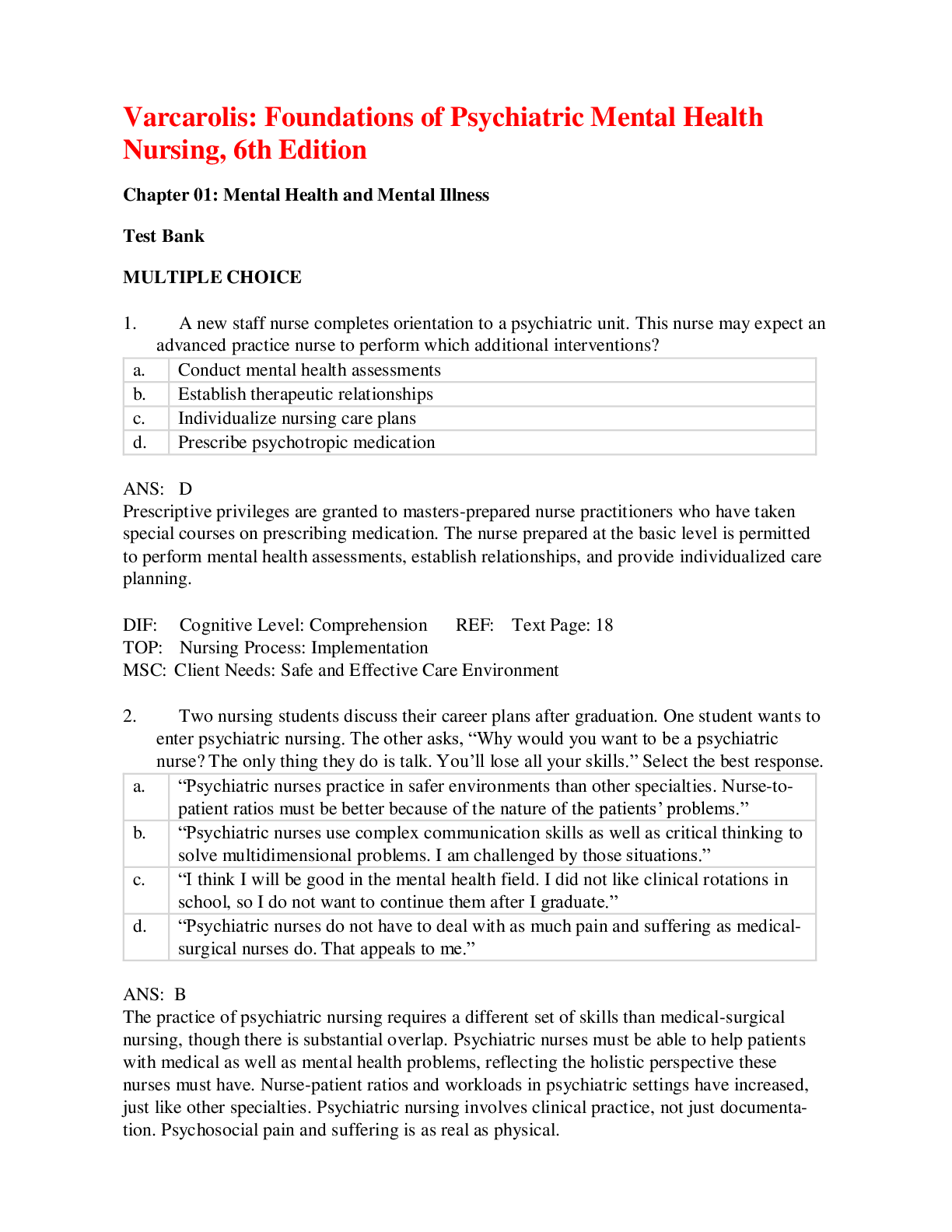
1. A new staff nurse completes orientation to a psychiatric unit. Thi
...
Varcarolis: Foundations of Psychiatric Mental Health Nursing, 6th Edition
Chapter 01: Mental Health and Mental Illness Test Bank
MULTIPLE CHOICE
1. A new staff nurse completes orientation to a psychiatric unit. This nurse may expect an advanced practice nurse to perform which additional interventions?
2. Two nursing students discuss their career plans after graduation. One student wants to enter psychiatric nursing. The other asks, “Why would you want to be a psychiatric nurse? The only thing they do is talk. You’ll lose all your skills.” Select the best response.
3. A new bill introduced in Congress would reduce funding for care of persons with mental illness. Groups of nurses write letters to their elected representatives in opposition to the legislation. Which role have the nurses fulfilled?
4. An informal group of patients discusses their perceptions of nursing care. Which comment best indicates a patient perceived the nurse was caring? “My nurse:
5. Which finding best indicates that a patient has a mental illness? The patient:
6. Which finding best indicates that the goal “Demonstrate mentally healthy behavior” was achieved? A patient:
7. A nurse encounters an unfamiliar psychiatric disorder on a new patient’s admission form. To determine criteria used to establish this diagnosis, the nurse should consult which resource?
8. Which documentation of diagnosis would a nurse expect in a psychiatric treatment setting?
a. I Acute renal failure II 75
III Bipolar disorder I, mixed
IV Loss of disability benefits 2 months ago V None
b. I Schizophrenia, paranoid type II Death of spouse last year
III 60
IV None
V Diabetes, type 2
c. I Polysubstance dependence
II Narcissistic Personality Disorder III 90
IV Hyperlipidemia
V Charges pending for assault
d. I Major Depression
II Avoidant Personality Disorder III Hypertension
IV Home destroyed by hurricane last yearV 80
ANS: D
The DSM-IV-TR profiles psychiatric diagnoses on five axes. Each axis defines a specific aspect of the diagnosis. Axis I identifies major clinical disorders. Axis II details personality and developmental disorders. Axis III identifies general medical conditions. Axis IV details psychosocial and environmental problems. Axis V rates the Global Assessment of Functioning.
DIF: Cognitive Level: Analysis REF: Text Pages: 14-18 TOP: Nursing Process: Analysis
MSC: Client Needs: Safe and Effective Care Environment
9. A nurse explains the multiaxial DSM-IV-TR to a psychiatric technician and includes information that it:
a. focuses on plans for treatment.
b. includes nursing and medical diagnoses.
c. classifies problems in multiple areas of functioning.
d. uses the framework of a specific biopsychosocial theory.
ANS: C
The use of five axes requires assessment beyond diagnosis of a mental disorder and includes relevant medical conditions, psychosocial and environmental problems, and global assessment of functioning. The DSM-IV-TR does not include treatment plans or nursing diagnoses. It does not use specific biopsychosocial theories.
DIF: Cognitive Level: Comprehension REF: Text Pages: 13-16 TOP: Nursing Process: Implementation
MSC: Client Needs: Safe and Effective Care Environment
10. A nurse wants to find a description of diagnostic criteria for anxiety disorders. Which resource would have the most complete information?
a. The ICD-10
b. Nursing Outcomes Classification
c. Diagnostic and Statistical Manual of Mental Disorders
d. The ANA Psychiatric-Mental Health Nursing Scope and Standards of Practice
ANS: C
The DSM-IV-TR details the diagnostic criteria for psychiatric clinical conditions. The other references are good resources but do not define the diagnostic criteria.
DIF: Cognitive Level: Application REF: Text Pages: 13-16 TOP: Nursing Process: Implementation
MSC: Client Needs: Safe and Effective Care Environment
11. Which comment most clearly shows a speaker views mental illness with stigma?
a. “Some mental illnesses are inherited.”
b. “Most people with mental illness are unmotivated.”
c. “Severe environmental stress sometimes causes mental illness.”
d. “Some mental illnesses are brain disorders resulting from changes in how impulses
are transmitted.”
ANS: B
Stigma refers to stereotypical, negative beliefs. With respect to mental health and mental illness, stigma often leads to discrimination and uncaring attitudes. Mental illness has multiple causes, including stress, changes in brain structure or function, and genetic transmission.
DIF: Cognitive Level: Analysis REF: Text Pages: 7, 20
TOP: Nursing Process: Assessment MSC: Client Needs: Psychosocial Integrity
12. Complete this analogy. NANDA : clinical judgment :: NIC :
a. patient outcomes
b. nursing actions
c. diagnosis
d. symptoms
ANS: B
Analogies show parallel relationships. NANDA, the North American Nursing Diagnosis Association, identifies diagnostic statements regarding human responses to actual or potential
[Show More]