Surgical Case 4: Vernon Watkins
Guided Reflection Questions
1. How did the scenario make you feel?
It was challenging. I had to do it severally. At first, I did not know that I needed to do
dosage calculation. Oxygen
...
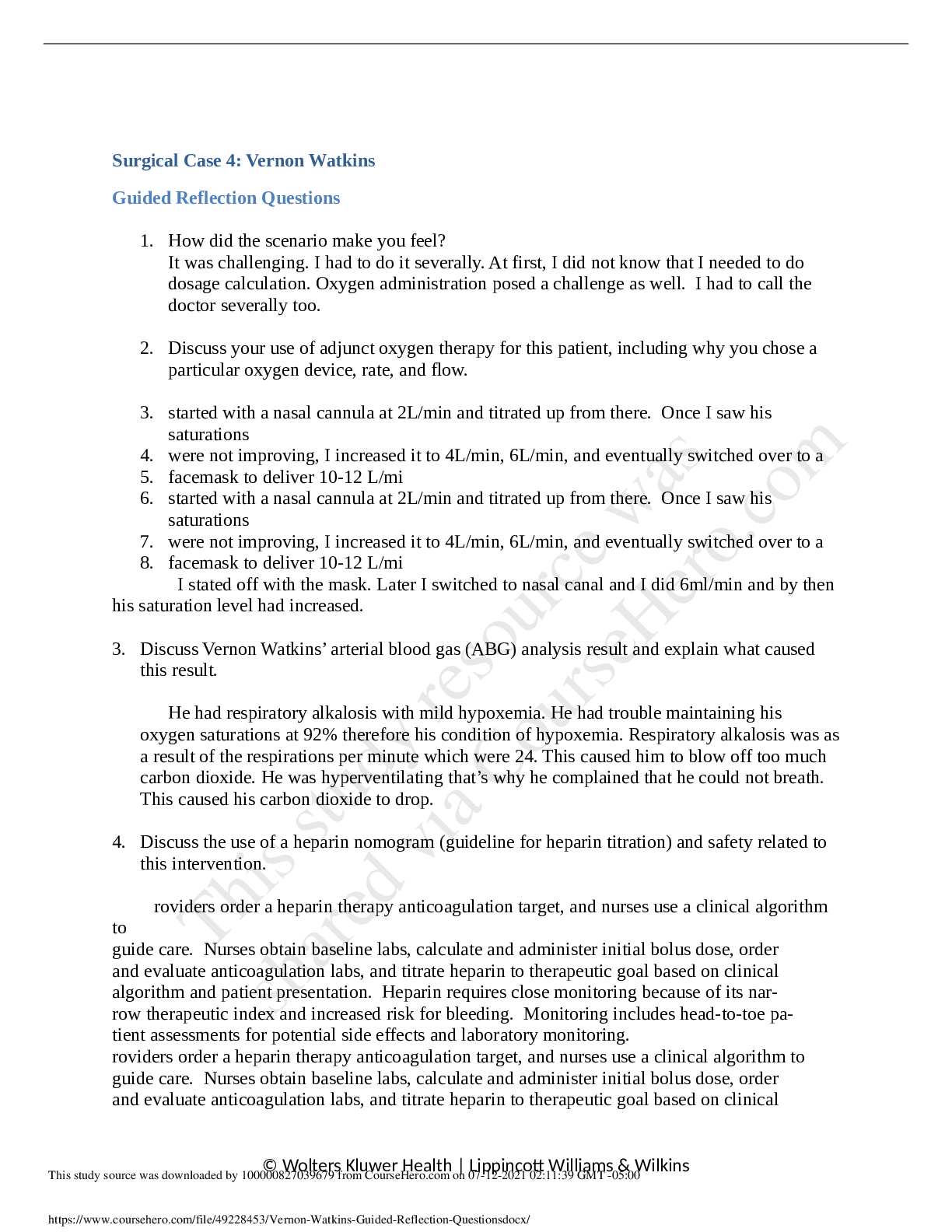
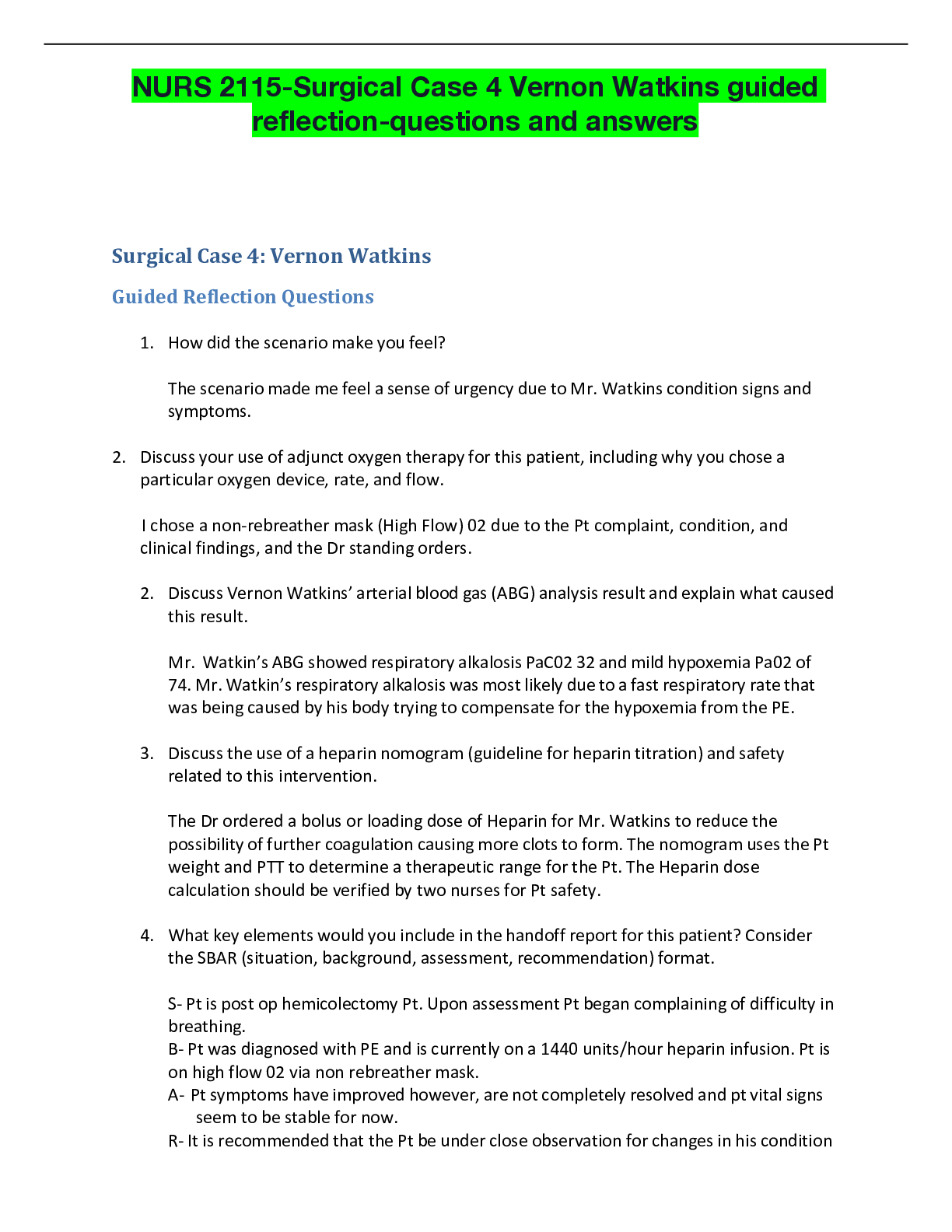
Surgical Case 4: Vernon Watkins
Guided Reflection Questions
1. How did the scenario make you feel?
It was challenging. I had to do it severally. At first, I did not know that I needed to do
dosage calculation. Oxygen administration posed a challenge as well. I had to call the
doctor severally too.
2. Discuss your use of adjunct oxygen therapy for this patient, including why you chose a
particular oxygen device, rate, and flow.
3. started with a nasal cannula at 2L/min and titrated up from there. Once I saw his
saturations
4. were not improving, I increased it to 4L/min, 6L/min, and eventually switched over to a
5. facemask to deliver 10-12 L/mi
6. started with a nasal cannula at 2L/min and titrated up from there. Once I saw his
saturations
7. were not improving, I increased it to 4L/min, 6L/min, and eventually switched over to a
8. facemask to deliver 10-12 L/mi
I stated off with the mask. Later I switched to nasal canal and I did 6ml/min and by then
his saturation level had increased.
3. Discuss Vernon Watkins’ arterial blood gas (ABG) analysis result and explain what caused
this result.
He had respiratory alkalosis with mild hypoxemia. He had trouble maintaining his
oxygen saturations at 92% therefore his condition of hypoxemia. Respiratory alkalosis was as
a result of the respirations per minute which were 24. This caused him to blow off too much
carbon dioxide. He was hyperventilating that’s why he complained that he could not breath.
This caused his carbon dioxide to drop.
4. Discuss the use of a heparin nomogram (guideline for heparin titration) and safety related to
this intervention.
roviders order a heparin therapy anticoagulation target, and nurses use a clinical algorithm
to
guide care. Nurses obtain baseline labs, calculate and administer initial bolus dose, order
and evaluate anticoagulation labs, and titrate heparin to therapeutic goal based on clinical
algorithm and patient presentation. Heparin requires close monitoring because of its narrow therapeutic index and increased risk for bleeding. Monitoring includes head-to-toe patient assessments for potential side effects and laboratory monitoring.
roviders order a heparin therapy anticoagulation target, and nurses use a clinical algorithm to
guide care. Nurses obtain baseline labs, calculate and administer initial bolus dose, order
and evalua
[Show More]











.png)

.png)


