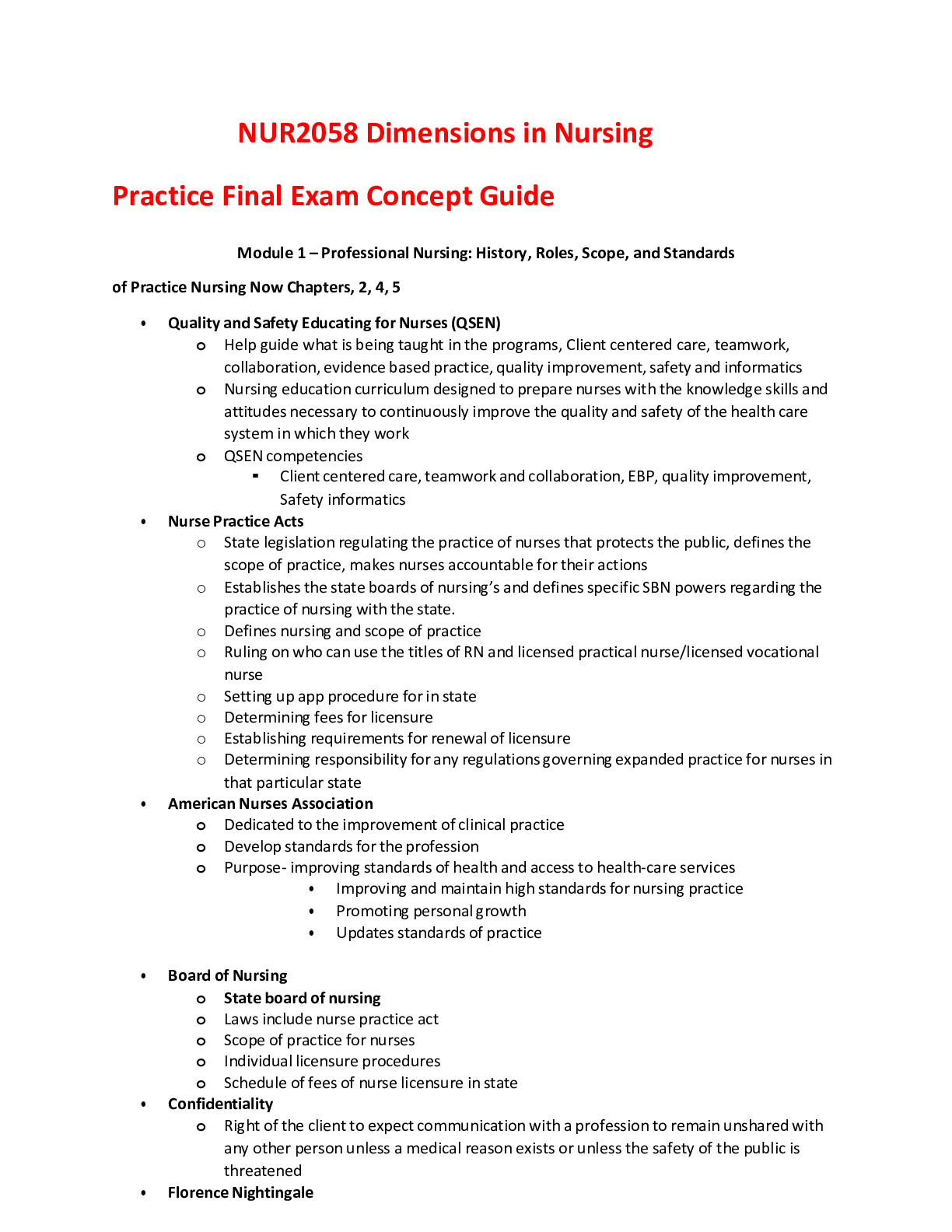
NUR2058 Dimensions in Nursing Practice Final Exam Concept Guide
Module 1 – Professional Nursing: History, Roles, Scope, and Standards of Practice Nursing Now Chapters, 2, 4, 5
• Quality and Safety Educating for Nurses
...
NUR2058 Dimensions in Nursing Practice Final Exam Concept Guide
Module 1 – Professional Nursing: History, Roles, Scope, and Standards of Practice Nursing Now Chapters, 2, 4, 5
• Quality and Safety Educating for Nurses (QSEN)
• Nurse Practice Acts
• American Nurses Association
• Board of Nursing
o State board of nursing
• Confidentiality
• Florence Nightingale
• Impact of Wars on Nursing
o Influencing the development of technology and guiding the direction of health care
o Improving educational standards of nursing care
• Case Management
• Professional Organizations
Module 2 – Professionalism in Nursing Nursing Now Chapters 1, 17
• Professional Nursing Organizations
• Code of Ethics
• Registered Nurse
• Licensed Practical Nurse
• Unlicensed Assistive Personnel (UAP)
Module 3 – Healthcare Delivery Settings Nursing Now Chapter 16
• Telehealth and Telemedicine
• Medicaid
• Medicare
• Private Insurance
• Preferred Provider Organizations (PPO)
• Exclusive Provider Organization (EPO)
• Parish Nursing
Module 4 – Theories and Models of Nursing Nursing Now Chapter 3
• Nursing Models
o Hypothetical representation of something that exists in reality
o Explains a complex reality in a systematic and organized manner
• Nursing Theory
o Explain relationships between observed behaviors and their effects on a clients health
o Goal is to explain a particular nursing action
• Nursing Theory Concepts
o Cultural diversity, spirituality, family, social change
• Lillian Wald
o After working as a hospital nurse, went to medical school
o Opened Henry Street Settlement organized nurses to make home visits,
o Social reformer
o Developed nurses for careers in public health
• Institute of Medicine
o IOM
o Degree to which health services for individuals and populations increase likelihood of desired health outcomes and are consistent with current professional knowledge
Module 5 – Legal and Ethical Dimensions of Nursing Practice Nursing Now Chapters 6, 7, 8
• Civil Law
o law concerned with violation of rights of one individual by another, it includes contract law, treaty law, and tort law
• To Err is Human
o IOM first report published in 2000
o Establish leadership, research tools, protocols enhance safety knowledge
o Develop mandatory national reporting system
o Oversight organizations, implement safety systems at the point of care delivery
• Organ Donation
o Giving organ to help someone who needs a transplant
o Organ donor on license
• Situation-background-assessment-recommendation (SBAR)
o Updating information on a client immediately
o Forms an outline for the communication of critical information
o Developed by the US navy to improve communications
o Incorporated into health care facilities
• Values
o Judgment of worth, quality, or desirability, based on attitude formed from need or experience, strong belief held by individuals about something important to them
• Ethics
o Principles or standards of conduct that govern and individual or group
• Laws
o Formal statement of a society’s beliefs about interaction among and between its citizens; formal rule enforced by society
• Morals
o Right and wrong, internalizes during the early stages of childhood development religious beliefs and societal norms
• Breach of Confidentiality
o Clients trust and confidence are violated by public revelation of confidential or privileged communications without the clients consent
• Felony
o Serious crime that may be punished by a fine of more than $1000 more than 1 year in jail or prison death or a combo
• Misdemeanor
o Less serious crime than a felony; punishable by a fine of less than $1000 or jail term of less than a year
• Medical Power of Attorney
o Designates another person to make health care decisions for a person if the client becomes incompetent or unable to make decisions
• Health Care Proxy
o Medical power of attorney or appointment, document that lets you appoint another person, expresses wishes
• Do Not Resuscitate (DNR)
o Order by a physician to withhold cardiopulmonary resuscitation
• Living Will
o Signed legal document in which individuals make known their wishes about the care they are to receive if they should become incompetent
• Autonomy
o state of being self directed or independent; the ability to make decisions about ones future.
• Fidelity
o The obligation of an individual to be faithful to commitments made to self and others
• Electron Health Records
o Multiple people are able to access
o Reminders to complete task
o Redundancy is reduced
o Requires less storage space
o Easier to research
o Improved communication
o
Module 6 – Critical Thinking and Clinical Judgment Critical Thinking, , and Clinical Judgment Chapters, 1, 2, 4
• Critical Thinking
o Evaluating information asses prevent manage problems
o Focus your thinking to get results you need
o Makes difference between whether you succeed or jail
o Focusing and getting results you need
o Logic, intuition, standards, evidence based practice,
• Clinical Reasoning
o Process you use to think about the issues at the point of care.
o For example: deciding how to prevent and manage patient problems
• Critical Reasoning
o Accuracy and quality of communication
o Guided by standards policies ethics codes and laws
o Based on principles of nursing process, problem solving and scientific method
• Clinical Judgment
o Result of the thinking
o Conclusion
o Process: observation reflexion and analysis of observable
o Refers to the result of outcome of critical thinking or clinical reasoning
o Conclusion decision or opinion you make after thinking about the issues
• Intuition
o Important part of thinking
o Act on gut feelings without evidence
o Understanding of concept based on our knowledge feelings experience
o Can change outcomes of patients
• Nursing Process
o AD PIE
o Assessment diagnosis planning implementation evaluation
Module 7 – Research and Evidence-Based Practice Nursing Now Chapter 24
• Research Design
o Investigates why and how of decision making and not just what when where and why, gathering in depth understanding of human behavior and reasons that govern such behavior
• Research in Nursing
o Methodical Observation- Florence collected objective data
o Development of Research
• Evidence-Based Practice
o Obtain best information available to integrate into their day to day nursing practice
o Scientific basis for a disease or a nursing practice and then integrate data into actions used in practices
o Interventions are based on data from research that demonstrates that they are
appropriate and successful
o Systematic process Uncovering, evaluating, using information from research as the basis for making decisions about and providing client care.
Module 8 – Communication, Collaboration, and Cultural Competence
Nursing Now Chapter 12, 13, 21, 22
• Federal Mediation and Conciliation Service
o Third party
o Mediating between parties
o Works with both sides to reach an agreement
o Nonbinding and either side can reject the settlement
• Cultural Awareness
o Understanding one owns culture values and health care beliefs
o Beliefs about health care
o Cultural belief systems
o Kept guarded because of secrets among members
o Purpose tradition
o Cultural values
• Cultural Considerations
o Condering different cultures opinions
• Cultural Competence Models
o Leads to high quality care to every client regardless of language race or ethnic background
o Nurses from one culture should be able to give culturally competent care to indviduals
from any other culture.
o Healthcare is considered culturally competent
• Cultural Diversity
o People are different
o Acceptance of set attitudes ideologies values beliefs behaviors
• Minority nurses
o Diverse in nursing staff will increase quality of care for the increasing numbers of minority clients
• Communication Process
o Interactive sharing of information
o Sender receiver
o Receiver thinks about the information, understands, forms idea, based on message.
• Conflict Resolution
o Resolving issues
• Discharge Teaching
Module 9 – Quality, Safety, and Nursing Informatics Nursing Now Chapters 15, 16, 18
• Quality Assurance
o Health care attempts to guarantee that when an action is performed by a health care professional it is performed correctly the first time
o Focused on health care outcomes
• Quality Improvement
o Also known as total quality management is based on belief that the organization with higher quality services will capture a greater share of the market than competitors with lower quality services
• Health People 2020
o People live long healthy lives
o National agenda combined with health care reform
• Sentinel Events
o Unexpected occurrence involving death or serious physical or psychological injury
o Serious injury loss of limb or function
o Not all are due to error
o Indicate need for immediate investigation and response
• Adverse events
o Incidents in which harm resulted to a person receiving care
o Infections, falling in injuries, problems with medication
• Root cause analysis
o Type of assessment that tracks events leading to error, identifies faulty systems, and process and develops a plan to prevent further errors
• Nursing Process
o Assessment planning, analysis, diagnosis, implementation, evaluation
• Communication Styles
o Assertive- interpersonal behaviors that permit people to defend and maintain their legitimate rights in a respectful manner that does not violate rights of others
o Aggressive- strongly asserts speakers legitimate rights and opinions
• Used to humiliate dominate control or embarrass
• Protective mechanism
o Verbal Paraverbal Nonverbal- verbal- written or spoken nonverbal body language facial expressions gestures, paraverbal- tone pitch volume diction
• Delegation
o Assignment of specific duties by one individual to another individual
Module 10 – Issues and trends in Nursing and Nursing Practice Nursing Now Chapters 20, 23, 25, 27
• Nurse Navigator
o Focus on one specialty area
o Attempts to iminate barriers serves as an advocate for the client to make moving through the maze
o Works with clients families
o Develops a plan for the client
o Summarize events for clinet
• Disaster Planning
o Assemble a team who can move larger immobile indivudals safely
o Providing a key
o Naming a team members legal health care decision maker
o Go to emergency kit
o Keep commonly used motility assist devices
o Knowing how to get around
o List of elderly persons routines
• Forensic Nursing
o RN who specializes in forensic science and nursing science to apply the nursing process to individual clients their families and the community. Bridging the gap between healthcare system and the criminal justice system
• Elderly – Death and dying
o
• Sexually Assault Nurse Examiner (SANE)
o RN specializes care of victims of sexual assault performing physical and psychological examination collection of physical evidence and therapeutic interventions to minimize trauma
Why nursing theory is important to our practice?
Practice and help to generate further nursing knowledge
Help nurses to understand their purpose and role in the healthcare setting
Advocating for our patients what does it entail
Advocating for policy that assures equal access to effective treatment and the incorporation of patient values and preferences in policy decisions
Lateral violence- “horizontal violence” name-calling, threatening body language hazing, bickering, fault finding negative criticism, verbally abusive
Vertical violence- use of inappropriate coercive power by a superior to harass and bully subordinates
Overt- over act of aggression,
Covert- done in secret, behind the back
Characteristics of expert critical thinker and a non expert-
An expert knows exactly how to handle the situation, knows more information, able to diagnose and observe
Non expert- or novice is someone that is starting to learn and uses information learning.
Beneficence-
Ethical principle based on beliefs that the health care provider should do no harm prevent harm, remove existing harm, and promote the good and well-being of the client.
Nonmaleficence-
Ethical principle that requires the professional to do no harm to the client
Autonomy –
State of being slef-directed or independent; the ability to make decisions about ones future
Justice –
Fairness; giving people their due
RNS delegate tasks, how to delegate and to whom- example charge nurse for the day and just got a patient from bowel reduction- who would you send to do a head to toe assessment- RN nurse
Who created the code of ethics?
American Nurses Association
Who defines the scope of practice?
The state
Isabel Adams Hampton Robb
Dedicated her life to raising the standards of nursing education Grading policy for nursing students
Developed the American Journal of Nursing
Lillian Wald-
Opened henry street settlement Advocate for wellness education Place nurses in public schools
Loretta Ford-
Credited with founding nurse practitioner practice
Importance of interpersonal (communicating between people)
Local health needs, fragmented healthcare practices, present and future health car needs, shortages in the health workforce, collaborative practice, improved health care system
Importance for nurses to join professional organizations
National nursing organizations need the participation and membership of all nurses in order to claim they are truly representative of the profession
Large organization – one voice
Concepts in nursing theory
Client, health, environment, nursing
Wholly compensated Care- person who is able to carry put a few or no self activities
Partially compensated care- can meet most of their needs, but still needs more help
Values- concepts ideas behaviors and significant themes that give meaning to our personal lives
Ethics- system of valued behaviors and beliefs that declare what is right wrong
When is it appropriate to breach confidentiality?
Child or elder abuse, gunshot wound, knife wound rape, communicable, diseases, suspected
crimes
Quantitative Research-
Research that progresses through systematic logical steps specific plan controlled conditions statistical analysis
Qualitative research-
Naturalistic injury, explores human experiences
Conventional medicine
Therapy from outside
Individuals who are seen as being at risk for illness Chemotherapeutic agents
Integrative medicine
Therapy from within
Views wellness as a state, which individuals are in harmony or balance Holistic
[Show More]