NUR 3463Exam 2 Review_original.docx
Standard disclaimer:
• The following is a recommended list of topics to review for exam 2.
• This focused review is not an all-inclusive list things to know about each of the main
...
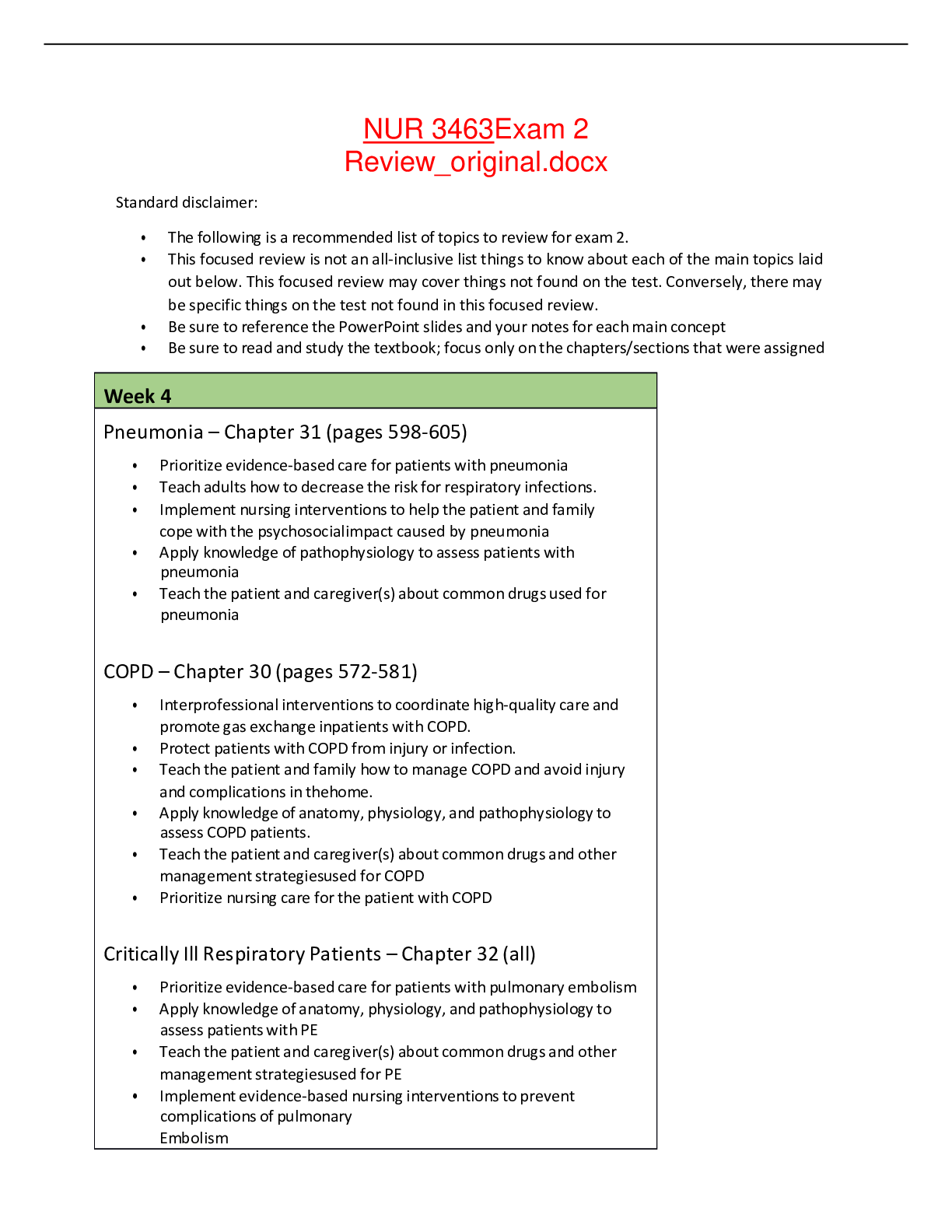
NUR 3463Exam 2 Review_original.docx
Standard disclaimer:
• The following is a recommended list of topics to review for exam 2.
• This focused review is not an all-inclusive list things to know about each of the main topics laid out below. This focused review may cover things not found on the test. Conversely, there may be specific things on the test not found in this focused review.
• Be sure to reference the PowerPoint slides and your notes for each main concept
• Be sure to read and study the textbook; focus only on the chapters/sections that were assigned
Week 4
Pneumonia – Chapter 31 (pages 598-605)
• Prioritize evidence-based care for patients with pneumonia
• Teach adults how to decrease the risk for respiratory infections.
• Implement nursing interventions to help the patient and family cope with the psychosocial impact caused by pneumonia
• Apply knowledge of pathophysiology to assess patients with pneumonia
• Teach the patient and caregiver(s) about common drugs used for pneumonia
COPD – Chapter 30 (pages 572-581)
• Interprofessional interventions to coordinate high-quality care and promote gas exchange in patients with COPD.
• Protect patients with COPD from injury or infection.
• Teach the patient and family how to manage COPD and avoid injury and complications in the home.
• Apply knowledge of anatomy, physiology, and pathophysiology to assess COPD patients.
• Teach the patient and caregiver(s) about common drugs and other management strategies used for COPD
• Prioritize nursing care for the patient with COPD
Critically Ill Respiratory Patients – Chapter 32 (all)
• Prioritize evidence-based care for patients with pulmonary embolism
• Apply knowledge of anatomy, physiology, and pathophysiology to assess patients with PE
• Teach the patient and caregiver(s) about common drugs and other management strategies used for PE
• Implement evidence-based nursing interventions to prevent complications of pulmonary
Embolism
Week 5
Chapter 34 – Arrhythmias
• Important meds for patient with A-fib
• Why is important to treat A-fib…what serious conditions are these patients at risk for if the condition is not treated
• Know common assessment findings for bradydysrhythmias
• Know common assessment findings for tachydysrhythmias
• What important assessments should we perform on a patient who is in sinus bradycardia?
• What should be your first action if your patient’s heart monitor shows no electrical activity (remember, you are not in the room with your patient, you are at the main nursing station)
• Study rhythms from the reference sheet handed out by your instructor
Chapter 38 – MI/CAD
• Life after MI: What are some of the problems that can develop in patients s/p MI and what things are we looking for to catch them early (e.g. heart failure)
• Serious complications after cardiac catheterization and stent placement in MI patients. What
should the nurse be looking out for?
• Know the difference between modifiable and non-modifiable risk factors for heart disease and be able to give examples of each.
• Know what general types of foods patients on a restricted should avoid (e.g. processed
foods…the books gives more examples of different categories of foods to avoid)
• Know patient education priorities for patients taking beta blockers after MI
• What is the blood test we use to determine MI?
• What medications/interventions are used in the acute phase (first few hours) of a myocardial infarction?
• What are the priority interventions for a patient presenting with chest pain?
Chapter 37 – Sepsis/MODS/DIC
• Teach adults how to decrease the risk for sepsis
• Implement evidence-based nursing interventions to prevent complications of sepsis
• Priority interventions for patients admitted for severe sepsis (know the 3 hour bundle)
• Know common assessment findings for patients in both the early phase and later phases of septic shock
• Know what orders the nurse should expect to see for a patient with severe sepsis
Chapter 40 – Anemia/Sickle Cell Anemia/ITP
• What does a low platelet count put patients at risk for?
• Priority actions for the nurse when caring for a patient with known decreased immune function
• Common causes of anemia in premenopausal female patients
• Assessment findings for patients with anemia
• Components of discharge education for patients with thrombocytopenia
• What is the result of stimulation of erythopoietin production in the kidney tissue?
• Modifiable risk factors for anemia
• Know the important things to do before initiating a blood transfusion
• Know how a nurse correctly manages a suspected transfusion reaction
Diabetes Mellitus – Chapter 64
• Know common microvascular and macrovascular complications of DM and how to prevent/monitor for them
• Know prevention strategies for preventing/delaying the onset of microvascular complications
• Know pathophysiology of what happens to glucose regulation and homeostasis in DM
• Be familiar with strategies to prevent injury related to peripheral neuropathy
• Understand the effect of DKA on a patient’s ABG values. How does the body compensate and what effect will that have on ABGs
• Know the different types of insulin (e.g. rapid, short, etc.) and know when the patient is at highest risk for hypoglycemia after a given dose (e.g. peak time)
• Know indications for and patient education around pen-type insulin injectors
• Know basic A&P of the 2 main enzymes secreted by the pancreas (insulin and glucagon)
• Know how to educate your patient about self-blood glucose monitoring
• Expected finding in a patient presenting with DKA
• Priority nursing actions for a patient with symptoms that are consistent with extreme hypoglycemia
• Therapeutic actions of oral antidiabetic medications
Critically Ill Neuro Patients – Chapter 45
• Know treatments for prevention of stroke (i.e. specific drugs and procedures). Know the side effects to watch for with preventative drugs and know the indications/complications of preventative procedures
• Be able to compare/contrast the benefits and limitations of CT vs MRI
• What is the only drug currently approved for treatment of acute ischemic stroke? Know the indications for its use, the complications that can occur after administration, and the RN monitoring protocol during and after administration
• Know how to educate a patient at risk for stroke about health promotion and maintenance
• For stroke assessment, know common symptoms (sensory and motor) of R and L hemisphere strokes and be able to compare/contrast
• Be familiar with specific interventions that the nurse can implement for managing deficits
from both left and right sided strokes
• Know common predisposing factors for embolic stroke
• Know the most important variable that should be assessed in neuro patients on a regular basis. Know early indicators for deterioration and correct interventions if subtle changes are noted
• What is homonymous hemianopsia and how is it managed
Seizures - Chapter 42
• Be able to identify appropriate safety interventions that should be included in the plan of care for patients admitted with seizure
• Understand the components of good health teaching when preparing a patient with epilepsy
for self-management.
• Be familiar with seizure precautions, acute seizure management, and status epilepticus management
• Know the components of the GCS scale
• Know the most important variable that should be assessed in neuro patients on a regular basis. Know early indicators for deterioration and correct interventions if subtle changes are noted
• Know the three phases of seizures (preictal, ictal, and postictal), signs and symptoms of each, and nursing management strategies of each
• What are seizure precautions?
Guillain Barré and Myasthenia Gravis - Chapter 44
• Know the pathophysiology of GBS
• Know the clinical manifestations of GBS
• Know the risk factors that can predispose someone to developing GBS
• Understand recovery from GBS
• What diagnostic tests are done for patients in a myasthenic crisis
• Patient education for the prevention of myasthenic crisis
[Show More]