HESI NURSING SUBJECT AND EXIT TEST PREPARATION INSTRUCTIONS
To prepare for the exam (whether a subject exam or exit exam) use and have the
following materials/resources available:
1) HESI study book from evolve (ISBN#
...
HESI NURSING SUBJECT AND EXIT TEST PREPARATION INSTRUCTIONS
To prepare for the exam (whether a subject exam or exit exam) use and have the
following materials/resources available:
1) HESI study book from evolve (ISBN# 9781416047759)
2) HESI case studies from evolve
3) HESI practice test CD which comes with the HESI book4) HESI Practest 2009 questions from evolve
5) HESI related flashcards, not from evolve
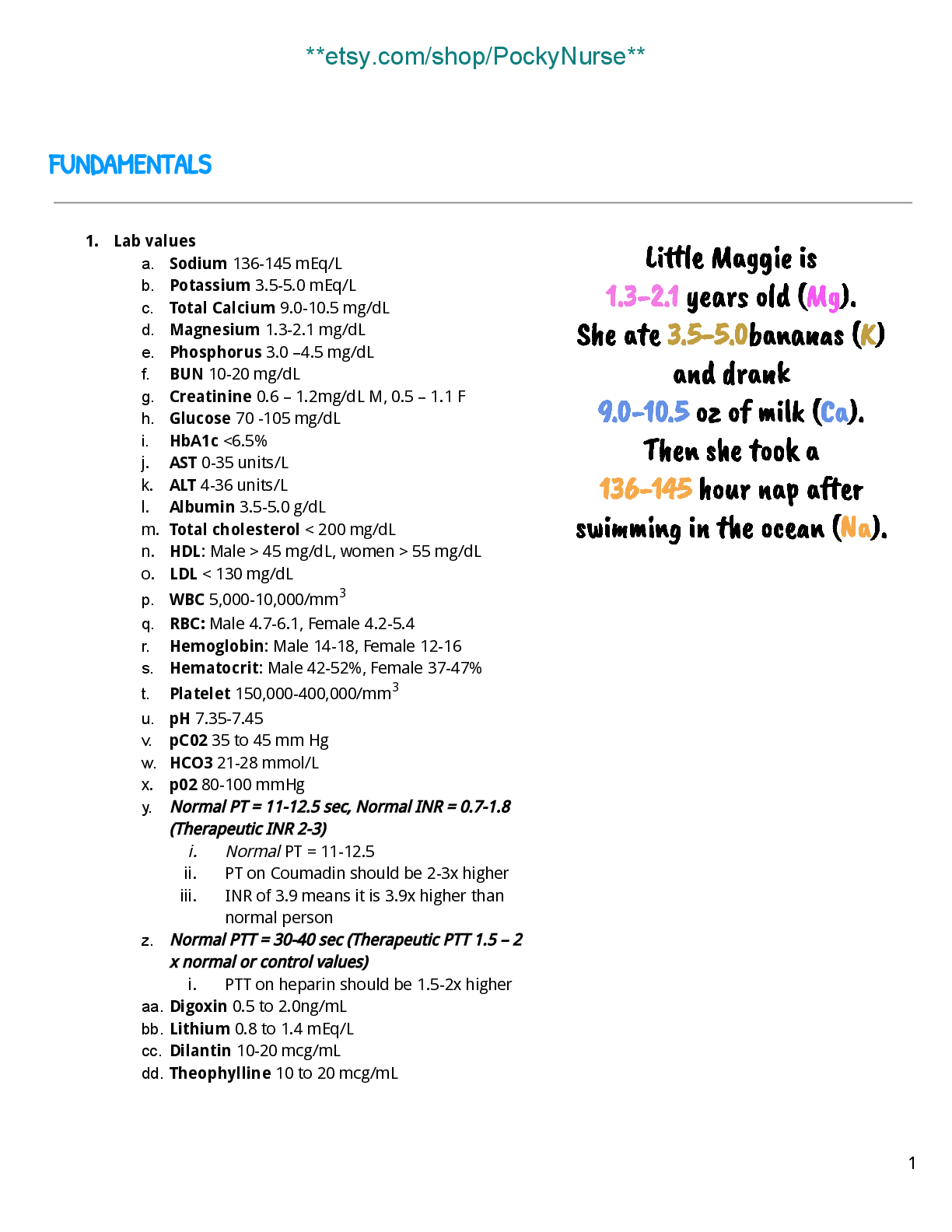
6) HESI study notes compiled by faculty and previous ADN students (lab values,
meds, etc.)
7) HESI related powerpoints for remediation and instructional purposes, not from
evolveTo prepare for the test itself:
1) Become an expert at the nursing process r/t questions, answers, and related
processes
2) Determine my optimum learning style
3) Practice visualization and guided imagery
4) Practice and refine test taking skills5) Stress relief and coping skills developed and utilized
6) Determine areas of weakness in previous HESI exams (via the statistical report
provided after taking the test)
7) Practice the practice tests on the computer until i memorize/understand the
questions and related material (until I have it down cold via repetition)
8) Review the rationales on the Practest questions, case studies, and practice testCD relentlessly (usually start with this first... essentially reverse engineer the
questions starting with the rationales and working backwards)
9) Memorize hints, meds, ranges, lab values, etc. as outlined in the HESI study
book (with an intent to not be caught off guard by material you haven't seen
before and to not forego any easy points)
10-A) Block off two weeks or more to constantly review the HESI book
10-B) Alternatively, study the HESI book as the semester progresses.11) Foregoing studying from other non-evolve resources such as the saunders
book temporarily (rationale: HESI test comes from HESI/Evolve related products,
normally).
12) Host/goto HESI review sessions with other students about to take the test
(rationale: If you can teach it, you get a better understanding=proficiency,
eventually)
Where to get some of the above resources:Austin Community College. Test taking strategies. Available at:
http://www2.austin.cc.tx.us/adnlev2/Tutoring_Web/Documents/Testtaking.htm
Link for the hesi book + practice test 2009:
http://portals.elsevier.com/portal/hesi/ProductAction?isbn=9780323055710
HESI online case studies only:https://evolve.elsevier.com/productPages/s_994.html
HESI case studies + practice test 2009:
https://evolve.elsevier.com/productPages/s_1641.html
HESI study book only:
http://search.barnesandnoble.com/Evolve-Reach-Comprehensive-Review-for-theNCLEX-RNExamination/Hesi/e/9781416047759Sunday Monday Tuesday Wednesday Thursday Friday SaturdayAccountability:
You only have yourself and
your success or failure to
account to.
100 questions (you may have
to get up extra early to
complete them).
Goal: is to complete 800-
1000 questions by Sunday
before 5 p.m.
Do not worry so much about
your grade for the exams—
the most important thing is to
understand why you
answered the question(s)
incorrectly.
Practicum ??
After practicum
No more than 50
questions. It will
not be productive
on a long day.
e.g. 25 MedSurg; 25 Pedi
Do 4 HESI case
studies
Review Meds-Pub
After practicum
50 questions
e.g. 25 Med-Surg;
25 Pedi
Books to have next
to you:
Med-Surg
Lab Ref.
Drug book
Fundamentals
Med. Dictionary
In addition to
reviewing
No Practicum:
200 questions
throughout the day.
Not in one sitting
50-med surg
50-pedi
50-psych
50-women’s health
In addition to
After practicum
50 questions
e.g. 25 MedSurg; 25 Pedi
In addition to
reviewing
No Practicum:
200 questions
throughout the
day. Not in one
sitting
50-med surg
50-pedi
50-psych
50-women’s
health
In addition to
reviewing
No Practicum:
200 questions throughout the day.
Not in one sitting
50-med surg
50-pedi
50-psych
50-women’s health
In addition to reviewing
rationales, go back to your texts
to read up if you were not familiarSAMPLE HESI STUDY AND REMEDIATION SCHEDULE
Note: “Fear” of the unknown only serves us from moving forward. Your self-discipline, commitment to
working hard and faith will help get you through this.Before the test:
The HESI and NCLEX tests use the steps of the nursing process (assessment, nursing
diagnosis, planning, intervention, and evaluation) to evaluate how you critically think
about and apply your knowledge about nursing principles and skills during the care of
patients. Do the following before the test:
1) Review the nursing process and critical thinking. You need to be very familiar
with the stages of the process and the nursing actions associated with each stage,and be prepared to identify whether a certain action is used in the planning or
evaluation phase of the nursing process.
2) Review material which will refresh your knowledge on developmental issues at
all stages of life which will help with pediatric health questions.
3) Use an NCLEX study book to familiarize yourself with the type of questions to
expect and review the answers to understand why they are correct. Know the
common electrolyte values and signs of abnormal levels, common drugs. Don't
read things into the questions or assume things that are not part of the question.After you read the test question only, close your eyes. Think about what the
question said and what you know about it, and only then, look at the answers.
Practice the questions with same time limit used in the NCLEX testing: 90
seconds per question.
During the test be careful about:
1. Reading too much into the questions. Look at what is there, what you know. Unless it
is specified, don't assume that you know the patient's gender, age, diagnoses, situation
or where the interaction is occurring (home, street, nursing unit).2. Reading too much into the answers. See above.
3. Using the answer choices to search your brain for information.
a. Try covering up the answers and read the question. Think about the distracters
(unneeded/ irrelevant information and words like "all of the following”, ”except",
"not", etc).
b. Think about what you know about the subject. If you can't recall anything, look
at the words and think about their meaning (dys=not or abnormal, anti=against),
or what they sound like (sarcoma sounds like carcinoma, so a sarcoma is a type ofcancer), or what body system they might be a part of (autonomic=nervous
system).
c. Then, think again about what you know and look at each answer to see if it
relates to what you know.
4. Becoming anxious. If you are feeling overwhelmed, discouraged, tired: STOP for a
minute or two. Do deep breathing or relaxation or visualization. Use positive,
affirmational self talk- NO negativity! You need your mental energy to concentrate, just
like you do in the hospital when patient care situations get tough, like severe bleeding or
a code.5. Be sure to print out the test analysis at the end to have as proof of completion of the
test and to help guide future review work.
TEST TAKING TIPS:
Initial = Assess
Essential = SafetyBase your Assessment on Malsow’s Hierarchy
Absolute Words– These words tend to make answers wrong:
✓ Deadly Words
✓ All
✓ Wholly
✓ Every
✓ Total✓ Alone
✓ Sole
✓ Lone
✓ Nothing
✓ Always
✓ Forever
✓ Entire
✓ Whole
✓ Completely
✓ Each✓ Only
✓ Any nobody
✓ Never
✓ None
✓ Everywhere
Dangerous Words– are words are strong words. These are words that are strong
but not as absolute as the “deadly” words.
If you see these words look carefully at the answer. There is a strong chance it isincorrect:
✓ Main
✓ Paramount
✓ Primarily
✓ Inevitable
✓ Eliminate
✓ Regardless
✓ Impossible
✓ Too✓ Chief
✓ Avoid
✓ Major
✓ Shall
✓ Will rarely
✓ Lack
Safe Words – Are qualified answers or hedging words make answers correct. These
words are usually “safe” to choose:✓ Usually
✓ Frequently
✓ Potentially
✓ Sometimes
✓ Some
✓ Occasionally
✓ Essentially
✓ Generally
✓ Maybe
✓ Commonly✓ Seldom
✓ Normally
✓ Almost
✓ Probably
✓ May
✓ Partial
✓ Might
✓ Should
✓ Few
✓ Nearly✓ Could
✓ Average
✓ Often
Parts of the question
● The case (scenario) – description of client or what is happening to the client
● The stem – the part that ask the question
● Response – choosing correct response
● Distracters - incorrect but feasible choices
● Key word – determine the key words related to the client, problem orspecific/aspect of the problemClient – age, sex, marital status may be relevant
Who is the focus of the question: nurse, client, spouse, child, family, etc.
Test taking tips & techniques:
UMBRELLA ANSWERS
● Problem solving applies to nursing
● Assess signs & symptoms
● Determining the nursing diagnosis
● Evaluating the outcome criteriaODD MAN WINS ANSWER
● Three obvious incorrect answers leaving the odd man wins
OPPOSITES ANSWERS
● “High blood pressure”, “Low blood pressure”
● “Increase IV drip”, “Stop IV”
● “Turn to the left”, “Turn to the right”
When there are two answers that are opposite, the two automatically eliminates the other
two choices but the downside is which of the two opposite answers is correct.SAME ANSWER DIFFERENT WORDING ANSWERS
● Client has tachycardia, Client has a rapid heart beat
● Client has difficulty breathing, Client has dyspnea
Do not choose these answers, eliminate both, leaving the other two choices to be the
correct answers.
LIKE WORD ANSWERS
● Words in the question are found in the answer
● Caring in the question and the word caring is in the answerMaslow’s HierarchyUse Maslow’s Hierarchy toanswer your questions. Physiology needs will always be your first choice when
answering a question with the exception of Psychological questions.
Priority
● “What actions take priority”
● “What should the nurse do first”
● “What should the nurse do initially”
● “What is essential for the nurse to do?”
COMMUNICATION
[Show More]








.png)