NR 511 Immersion weekend visual aid and script –
Chamberlain College
1
Sanitize hands. Hello, ______ my name is ____ and I will be assessing
you today. I need you sitting up for the exam.
I will begin by inspecting
...
NR 511 Immersion weekend visual aid and script –
Chamberlain College
1
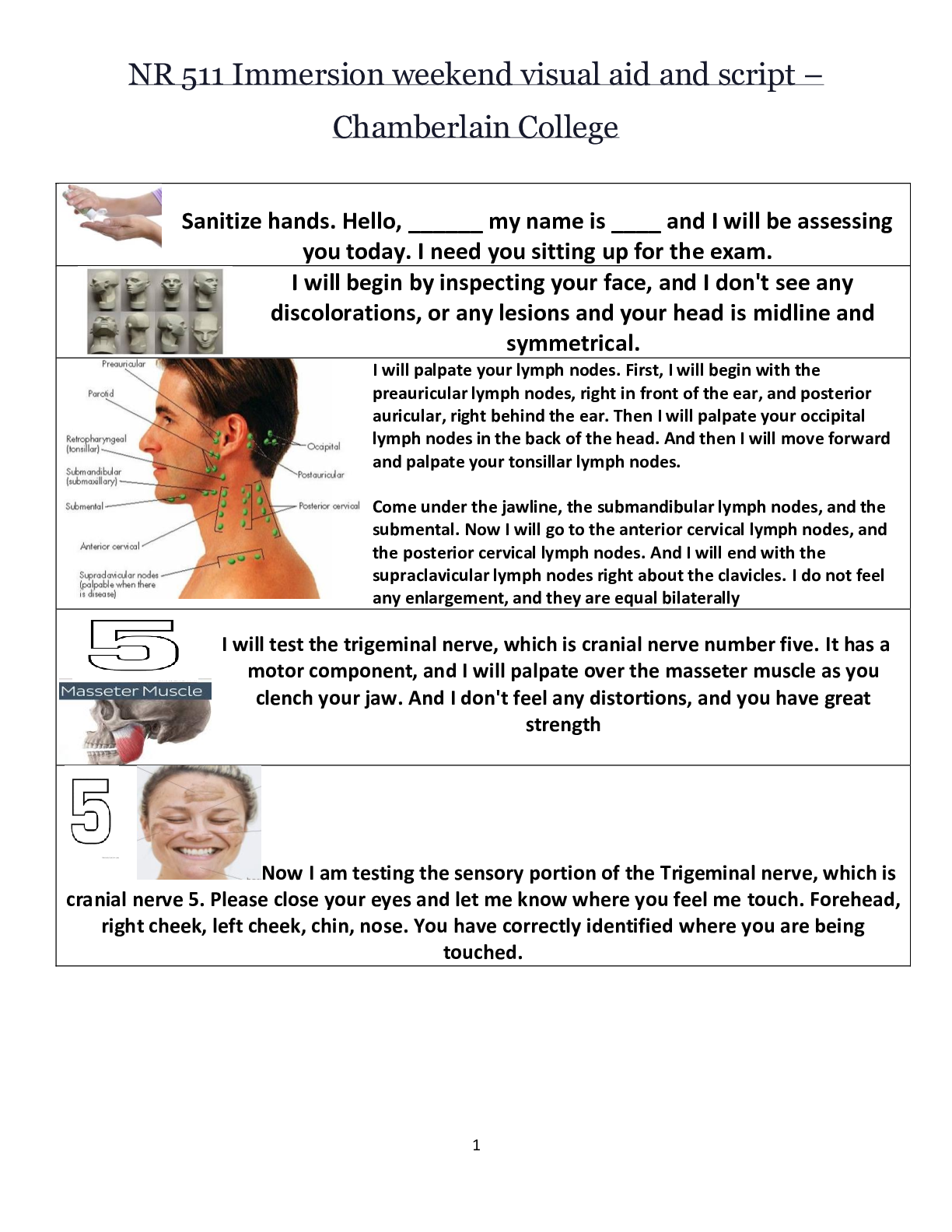
Sanitize hands. Hello, ______ my name is ____ and I will be assessing
you today. I need you sitting up for the exam.
I will begin by inspecting your face, and I don't see any
discolorations, or any lesions and your head is midline and
symmetrical.
I will palpate your lymph nodes. First, I will begin with the
preauricular lymph nodes, right in front of the ear, and posterior
auricular, right behind the ear. Then I will palpate your occipital
lymph nodes in the back of the head. And then I will move forward
and palpate your tonsillar lymph nodes.
Come under the jawline, the submandibular lymph nodes, and the
submental. Now I will go to the anterior cervical lymph nodes, and
the posterior cervical lymph nodes. And I will end with the
supraclavicular lymph nodes right about the clavicles. I do not feel
any enlargement, and they are equal bilaterally
I will test the trigeminal nerve, which is cranial nerve number five. It has a
motor component, and I will palpate over the masseter muscle as you
clench your jaw. And I don't feel any distortions, and you have great
strength
Now I am testing the sensory portion of the Trigeminal nerve, which is
cranial nerve 5. Please close your eyes and let me know where you feel me touch. Forehead,
right cheek, left cheek, chin, nose. You have correctly identified where you are being
touched.NR 511 Immersion weekend visual aid and script –
Chamberlain College
2
Next, I will test your facial nerve, which is cranial nerve number seven.
And I will ask you to do some facial expressions. Please begin with a
smile, and I see that it is symmetrical. Next, frown for me.
Now raise your eyebrows and go ahead and puff up your cheeks, and I
notice they’re equal bilaterally.
And now I want you to pucker your lips, very tight pucker.
All of your expressions are bilaterally symmetrical.
-
-
-
-
-
-
-
-
-
-
-
-
-
-
-
-
-
--
-
-
-
-
-
-
And then external rotation. And go ahead and rest the leg. For purposes of this exam we
will not be testing extension.
Now I'm going to assess range and motion of the knee, flexion and extension. Now I'm going to assess the strength of
your knees. Go ahead and flex your knees. I'm going to place my hands on top and ask you to push up towards them.
Now push back. Very good, and your strength is five out of five and equal.
Go ahead and extend your legs. Now I will do the range of motion of your ankle. Supporting the ankle, dorsiflexion,
plantar flexion, and rotation.
Now I will assess the strength of your ankles. And you will pull up or dorsiflex with resistance. Plantar flexion or push
down with resistance. And that was five out of five and equal as well.
Now I will assess your dorsalis pedis pulses. And they are 2+ and equal.
For the spine examination, I'm going to inspect and
palpate along both sides of the spine for any expected curvatures, alignment, and tenderness. Next, I will do range of
motion of the spine. And so, I will ask you to go ahead and bend over and touch your toes. Now straighten back up and
extend backwards. Now straighten back up and do a lateral flexion to one side and then the other. And now rotation, to
the right and to the left. And you have very good, active range of motion.
I will assess for the Romberg and I'll have you just stand with your arms down by your side.
Close your eyes for about 20 seconds, and I'm looking for any swaying. And there is none.
You can open your eyes. So that would be a negative Romberg.
Now I will assess your gait and ask you to take a few steps
forward. Turn around and a few steps more
[Show More]