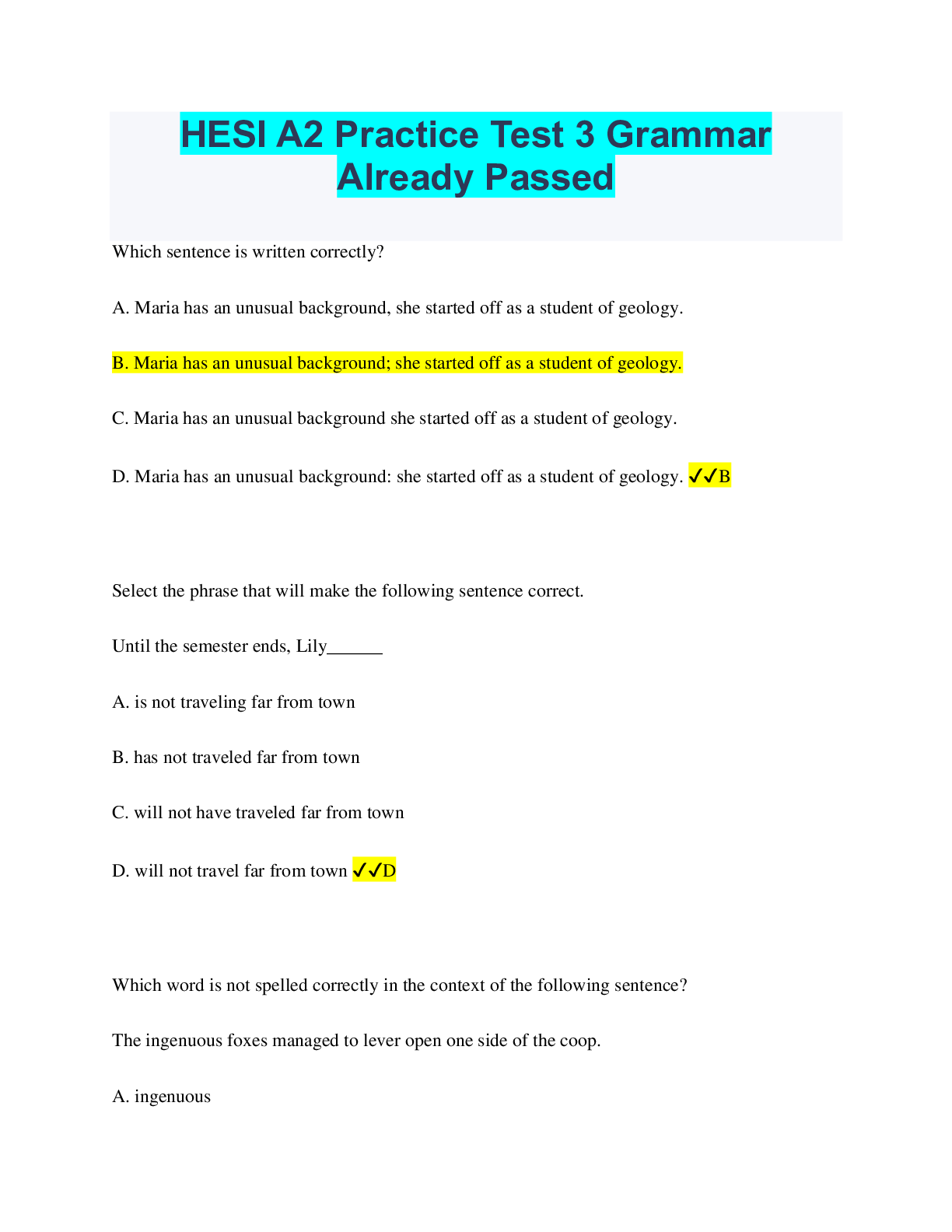
HESI A2 Practice Questions
Document Content and Description Below
HESI A2 Practice Questions
Questions 1 to 4 pertain to the following passage:
Protozoa are microscopic, one-celled organisms that can be free-living or parasitic in
nature. They are able to multiply in humans, a facto
...
[Show More]
Last updated: 3 years ago
Preview 1 out of 5 pages
Instant download
.png)
Buy this Document to get the Full Access Instantly
Provided by Students Who Aced it
We Verify Document Content to Gurantee Accuracy
Reviews( 0 )
Document information
Connected school, study & course
About the document
Uploaded On
Jul 18, 2021
Number of pages
5
Written in
All

Additional information
This document has been written for:
Uploaded
Jul 18, 2021
Downloads
0
Views
315
Topic Tags
Recommended For You
Get more on HESI »

$11
26 Pages
Hesi A2 practice Test 2, Most examined questions with answers....
$11
10 Pages
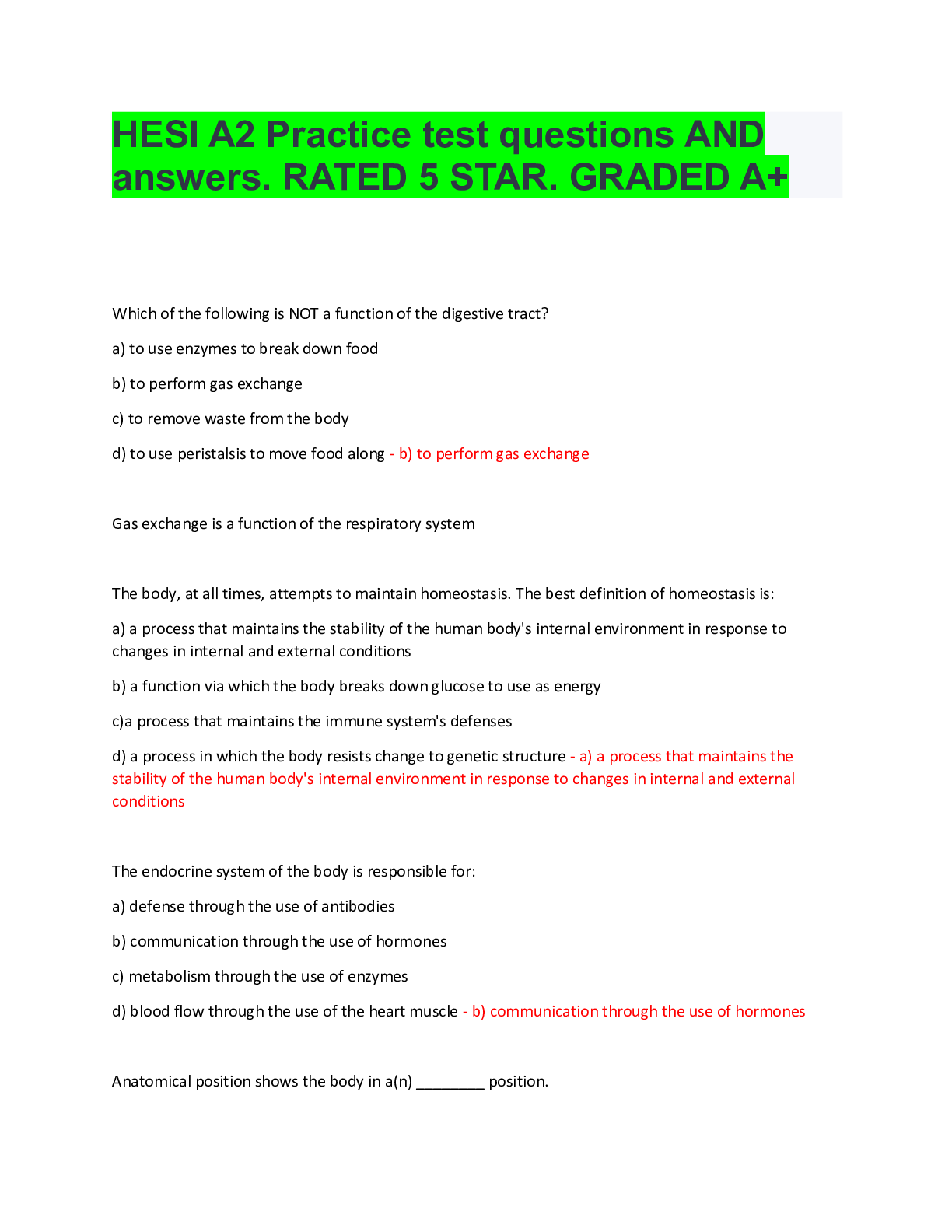
HESI A2 Practice test questions AND answers. RATED 5 STAR. GRA...

$12
10 Pages
HESI A2 Practice test questions. RATED A. 100% PROVEN PASS RAT...

$15
16 Pages
LATEST HESI A2 Practice Test. LATEST REVIEW QUESTIONS AND ANSW...
 Questions, Answers & Rationale, A+ Guide.png)
$25.5
396 Pages
NGN Nursing Med-Surg HESI Exit Exam – Latest 2025 Test Bank wi...
$20.5
84 Pages
HESI PATHOPHYSIOLOGY EXIT EXAM COMPLETE QUESTIONS || TEST BANK...


$6
442 Pages
4 HESI A2 Practice Tests, Third Edition (McGraw-Hill Education...
$8.5
18 Pages
NR 228 Proficiency Study Guide Questions and Answers (Verifi...
![Preview of HESI Critical Care TEST BANK RN 2021 [50 Questions /Answers]](https://scholarfriends.com/storage/Critical_Care_HESI_notes___.png)
$7.5
4 Pages
HESI Critical Care TEST BANK RN 2021 [50 Questions /Answers]

More related documents below