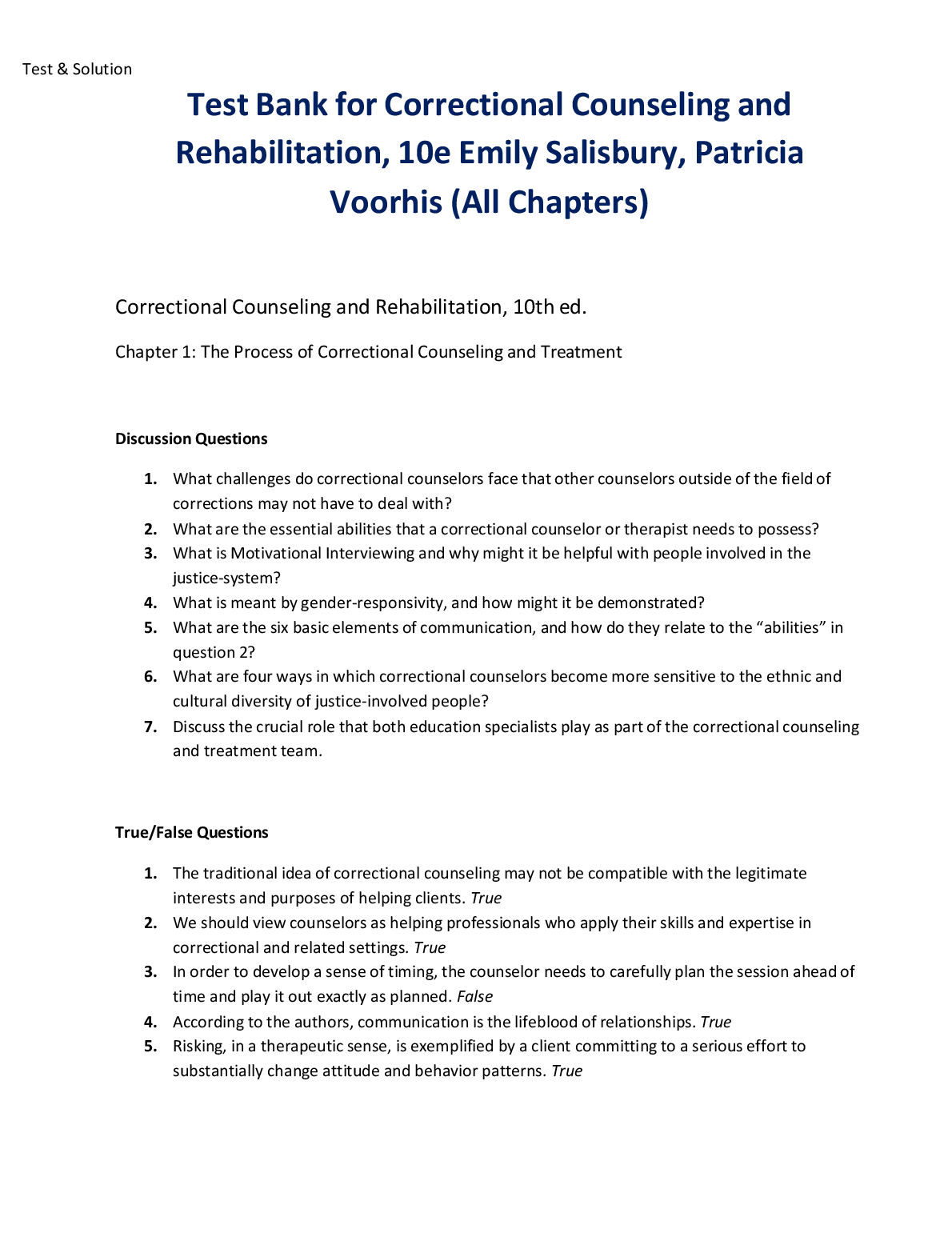
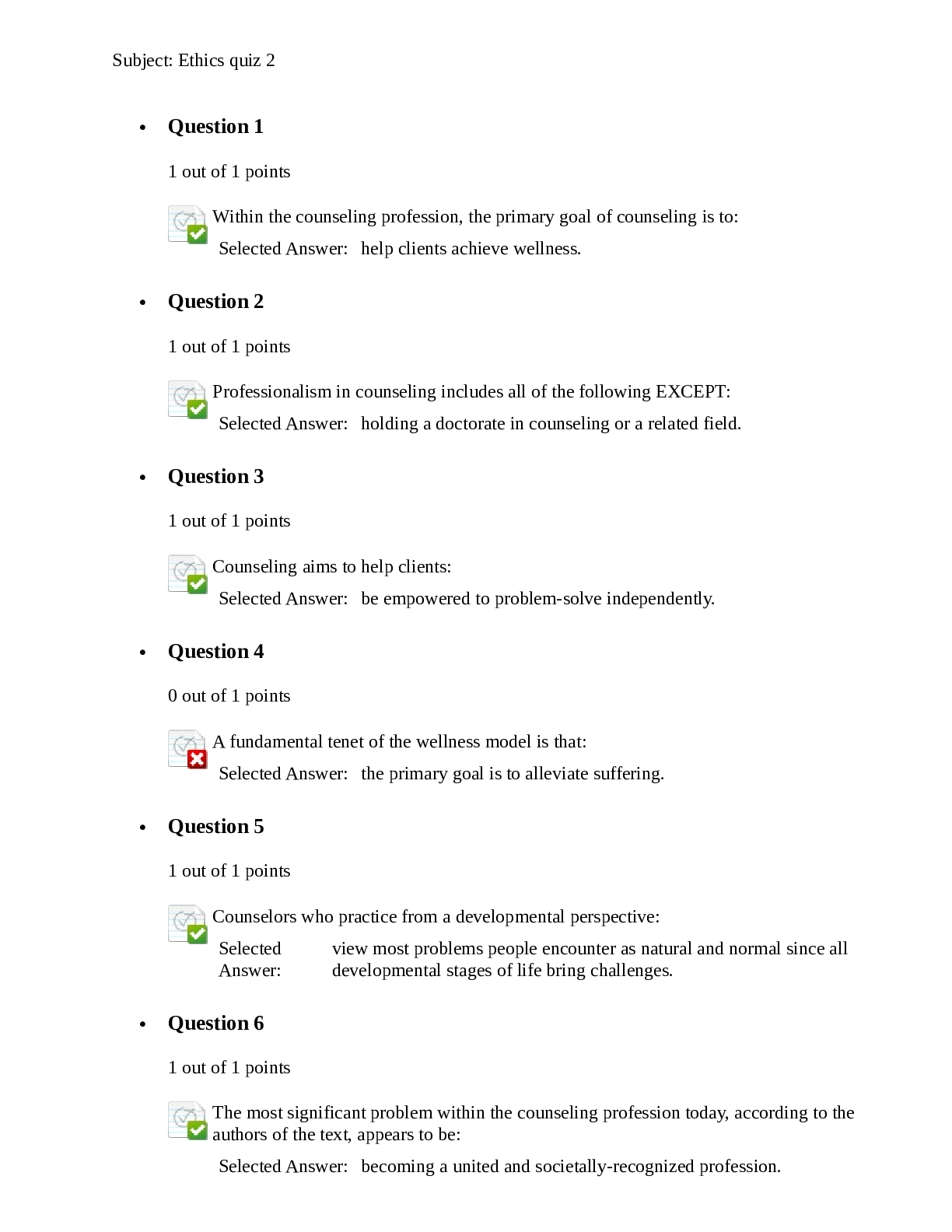
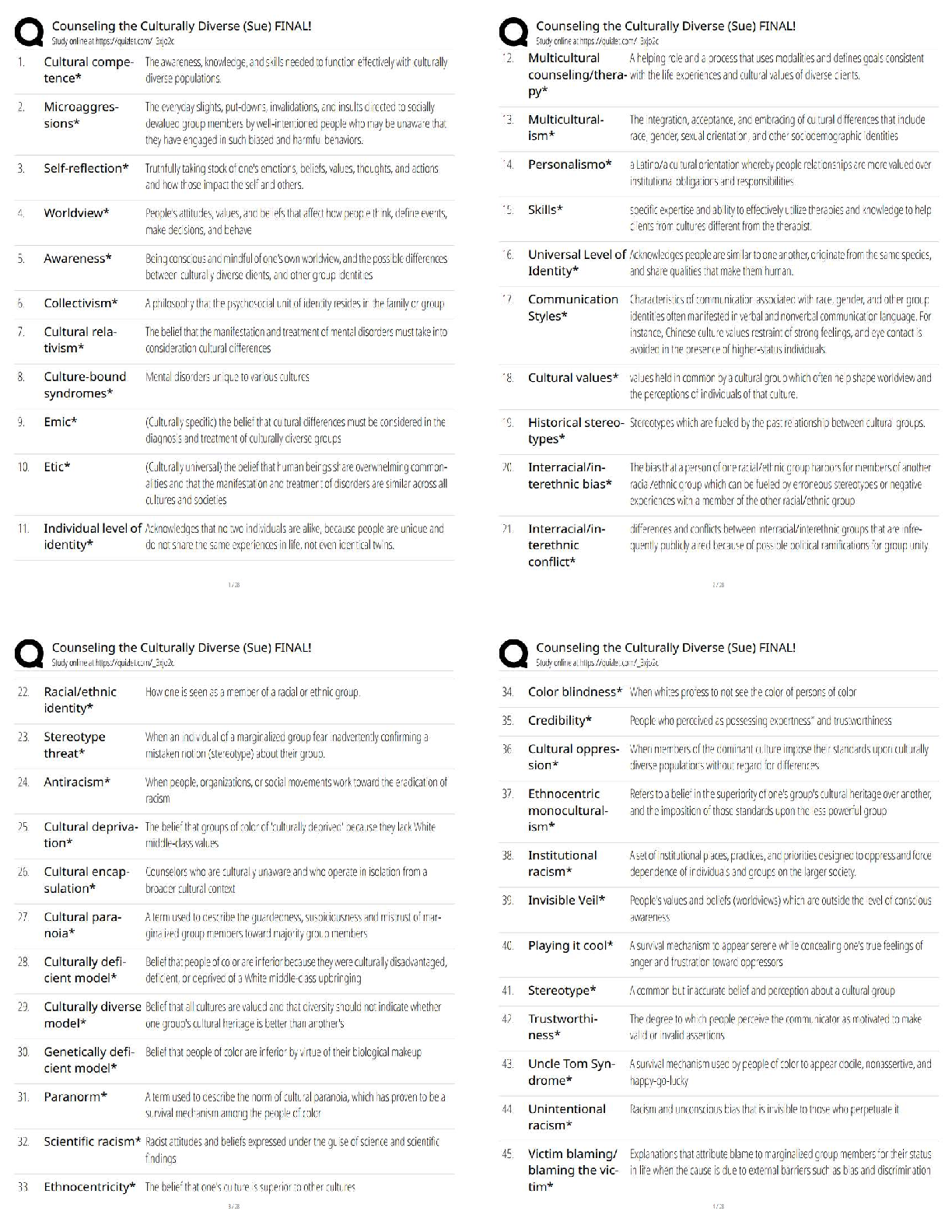
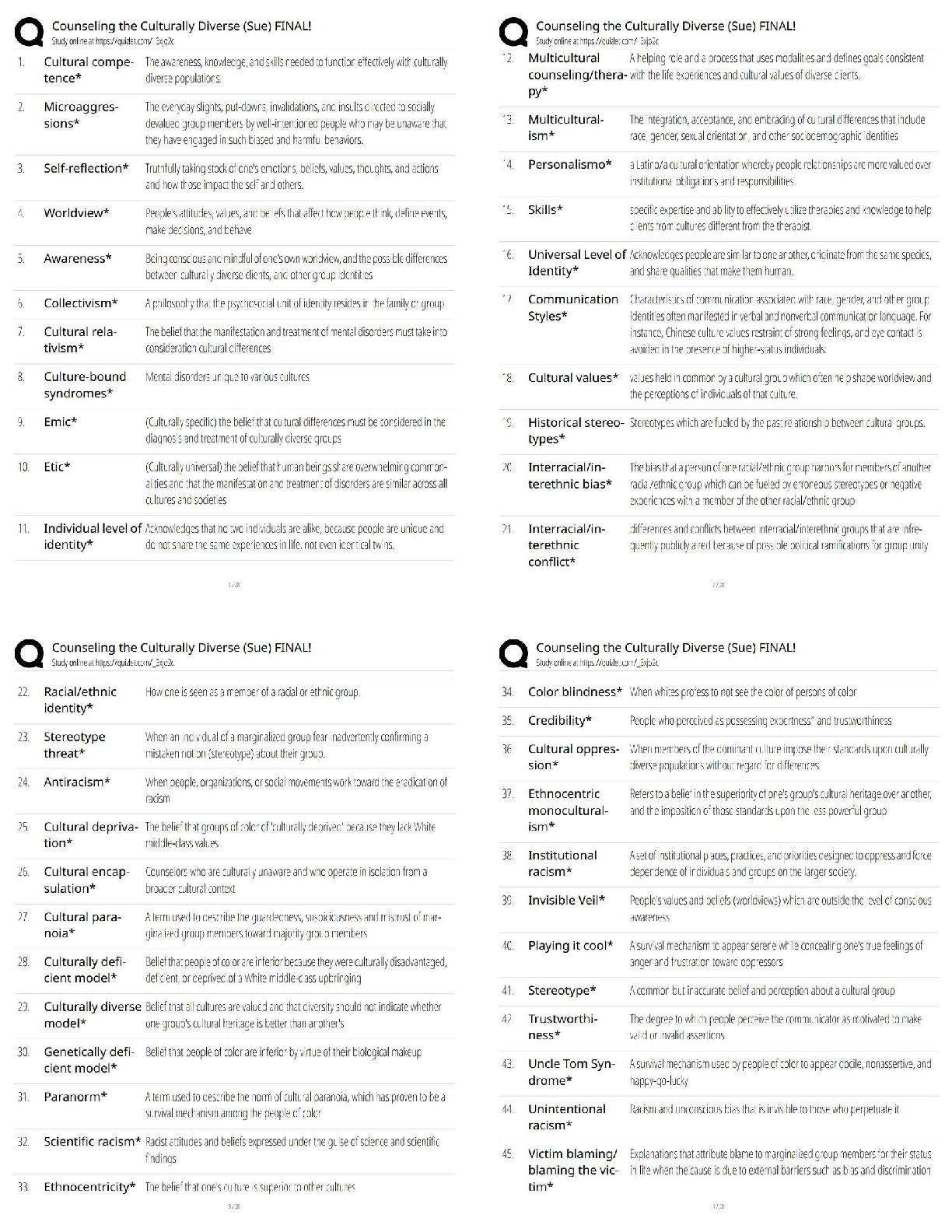
HSMF 611 Quiz 1 Answered (version 2) Liberty University 2021/2021
• Question 1
The profound understanding of the subjective world of a client, defines the term:
• Question 2
Which level is NO
...
HSMF 611 Quiz 1 Answered (version 2) Liberty University 2021/2021
• Question 1
The profound understanding of the subjective world of a client, defines the term:
• Question 2
Which level is NOT a recommended treatment suggestion for cognitive behavior therapy?
• Question 3
Which assertion best describes nonverbal communication:
• Question 4
Which one is a characteristic of an open-ended statement?
• Question 5
When a child comes into a session, ready to talk about many things at once, what is the best strategy for a counselor to use:
• Question 6
Treatment goals that are consistent with child-centered play therapy, may focus on these three problems:
• Question 7
Distress tolerance involves:
• Question 8
A child displays this theme through competency play and illustrates how they feel about themselves.
• Question 9
In order to check your assumptions about a clients’ feelings, thoughts or behaviors you should:
• Question 10
Core problem-solving structure involved five steps; which of these steps is NOT one recommended by the textbook:
• Question 11
Music therapy:
• Question 12
If you add a question to the end of a statement that transform to meaning and intent, you are:
• Question 13
What is the rationale for not using questions in play therapy?
• Question 14
Which assertion is true in regard to emotions being evident in the words individuals use:
• Question 15
What do we know about change:
• Question 16
Which of these represents the reason to use play therapy with younger children:
• Question 17
When a client focuses intensely on the distressful portion of a traumatic memory, moves eyes rapidly from side to side, with the clinician encouraging cognitive reconstruction, this refers to:
• Question 18
As counselors, we need to set clear, measurable goals for our clients. Which goal is most indicative of sound counseling goals?
• Question 19
According to the textbook, what is the critical foundation for growth and change in child-clients?
• Question 20
What do the author’s suggest about giving advice?
• Question 21
The primary focus of family counseling is:
• Question 22
The definition of tracking is:
• Question 23
Which statement accurately reflects the relationship between agreement and empathy?
• Question 24
The integration of the best available research with clinical expertise in the context of client characteristics, culture and preferences, describes what term?
• Question 25
What are three variables that can help us determine emotional development?
• Question 26
Regarding mindfulness-based approaches with children, what is the most important factor to consider:
• Question 27
When a therapist notices that certain actions, patterns, and communication are more prevalent than others, then this is referred to as:
• Question 28
A good way to check a child’s understanding of what you say is to:
• Question 29
The textbook makes recommendations for boundaries regarding the use of
technology for children. Which statement is NOT one of those recommendations?
• Question 30
Characteristics of brief, solution-focused therapies do NOT include:
• Question 31
Tasked with improving child and adolescent self-awareness and growth, what is a feasible end goal:
• Question 32
This strategy helps the play therapist be attentive and accepting of the client, as well as immerse into the child’s world and experience.
• Question 33
What statement illustrates a fundamental difference between positive and rational thinking?
• Question 34
When you need clarification during role-play, what is the recommended strategy to use?
• Question 35
Which statement is a limitation of evidence-supported treatments (ESTs)?
• Question 36
When considering what interventions are safe and appropriate for your client, the textbook suggests:
• Question 37
Considering the empirical evidence, the therapy that produces the best outcomes for emotional and behavioral youth disorders is:
• Question 38
What happens when children develop awareness of where the emotions are experienced in their body?
• Question 39
Children can be in circumstances where they have no stability and the adults in their life are inconsistent, they are likely to illustrate the theme of:
• Question 40
What are good considerations when choosing toys in the playroom?
• Question 41
What do the authors state about using praise in play therapy with children?
• Question 42
Clients may lack readiness because:
• Question 43
Which is not a stage of child-centered play therapy:
• Question 44
The variables that affect change, according to the textbook, are:
• Question 45
What do we understand about children’s questions during play therapy?
• Question 46
The goal of multisystemic therapy (MST) is to:
• Question 47
Which best represents a focus of dialectical behavior skills therapy:
• Question 48
Which statement is NOT a reason to set limitations in play therapy?
• Question 49
Described as helpful for working with diverse populations, allowing a safe vehicle for expression, employs various mediums, and is typically relaxing and soothing:
The best practice to avoid seeming judgmental towards a client is:
[Show More]