NR 511 final part 2.docx
Male GU
14-2 Benign prostatic hypertrophy is a common fi nding as men age. Classically, this condition may begin with diffi culty initiating the urinary stream, hesitancy, urgency, postvoid d
...
NR 511 final part 2.docx
Male GU
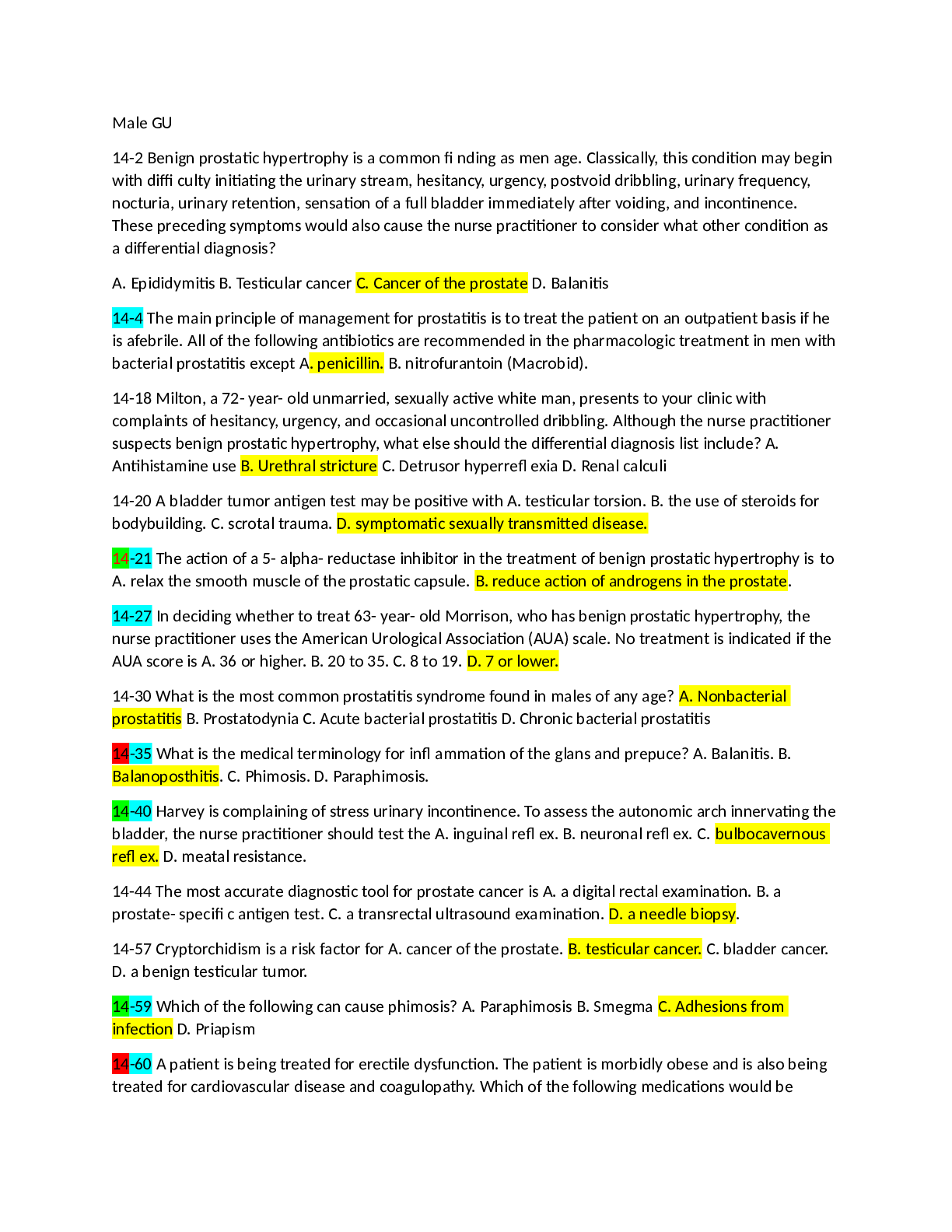
14-2 Benign prostatic hypertrophy is a common fi nding as men age. Classically, this condition may begin with diffi culty initiating the urinary stream, hesitancy, urgency, postvoid dribbling, urinary frequency, nocturia, urinary retention, sensation of a full bladder immediately after voiding, and incontinence.
These preceding symptoms would also cause the nurse practitioner to consider what other condition as a differential diagnosis?
14-4 The main principle of management for prostatitis is to treat the patient on an outpatient basis if he is afebrile. All of the following antibiotics are recommended in the pharmacologic treatment in men with bacterial prostatitis except
14-18 Milton, a 72- year- old unmarried, sexually active white man, presents to your clinic with complaints of hesitancy, urgency, and occasional uncontrolled dribbling. Although the nurse practitioner suspects benign prostatic hypertrophy, what else should the differential diagnosis list include? A. Antihistamine use A bladder tumor antigen test may be positive with A. testicular torsion. B. the use of steroids for bodybuilding. C. scrotal trauma.
14-20 The action of a 5- alpha- reductase inhibitor in the treatment of benign prostatic hypertrophy is to
A. relax the smooth muscle of the prostatic capsule
14-27 In deciding whether to treat 63- year- old Morrison, who has benign prostatic hypertrophy, the nurse practitioner uses the American Urological Association (AUA) scale. No treatment is indicated if the AUA score is A. 36 or higher. B. 20 to 35. C. 8 to 19.
14-30 What is the most common prostatitis syndrome found in males of any age?
14-35 What is the medical terminology for infl ammation of the glans and prepuce?
14-40 Harvey is complaining of stress urinary incontinence. To assess the autonomic arch innervating the bladder, the nurse practitioner should test the
14-44 The most accurate diagnostic tool for prostate cancer is
14-57 Cryptorchidism is a risk factor for
14-59 Which of the following can cause phimosis?
14-60 A patient is being treated for erectile dysfunction. The patient is morbidly obese and is also being treated for cardiovascular disease and coagulopathy. Which of the following medications would be
contraindicated?
14-61 A patient’s chief complaint is heaviness in the scrotum. The nurse practitioner assesses swelling of the testes, along with warm scrotal skin. What differential diagnosis is most probable?
14-65 Most lesions of the penis are nontender and painless. Which of the following conditions begins with a tender, painful lesion?
14-70 Which of the following medications is known to cause nocturia?
14-72 Harris, age 68, is complaining of crooked, painful erections. He has palpable, nontender, hard plaques just beneath the skin of his penis. Based on the chief complaint and assessment, what is the most likely differential diagnosis?
14-74 Morris, age 52, is in a new relationship and is not sure whether his erectile dysfunction is caused by stress about his performance or is organic. What simple test could you suggest to determine if he has the ability to have an erection?
urethral opening is on the dorsal side of the glans. This is referred to as
14-80 A patient is being followed by the nurse practitioner for disease progression or remission after treatment for testicular cancer. Which of the following biochemical markers would be ordered and analyzed?
14-87 Which sexually transmitted diseases are cofactors for HIV transmission?
14-89 A patient’s chief complaint is blood in the urine. The nurse practitioner knows that the most common cause of gross hematuria in the male population is
14-90 Sidney, age 72, presents to the clinic with complaints of a weak urine stream, hesitancy, and painful ejaculation. On digital rectal examination, you note that his prostate is boggy. The most common cause of his symptoms is A.
14-98 Lower urinary tract symptoms (LUTS) in males can present as a constellation of storage or voiding symptoms. Storage symptoms include
14-102 The most common type of hernia in the male population is a
[Show More]