Test bank for Wong's Nursing Care of Infants and Children 11th Edition by Marilyn J. Hockenberry & David Wilson - Complete, Elaborated and Latest Test Bank. ALL chapters(1-34) Included and updated
Pediatric, Nursing,
...
Test bank for Wong's Nursing Care of Infants and Children 11th Edition by Marilyn J. Hockenberry & David Wilson - Complete, Elaborated and Latest Test Bank. ALL chapters(1-34) Included and updated
Pediatric, Nursing, Perspectives, Family, Influences, On, Health, Hereditary, Childhood, Assessment, Pain, In, Children, Communicable, Diseases, Newborn, Promotion, Problems, High, Risk, Infant, Toddler, Preschooler, Early, School, Age, Adolescent, With, Special, Needs, Chronic, Illness.
Section I: Children, Their Families, and the Nurse
Chapter: 1. Perspectives of Pediatric Nursing
Chapter: 2. Social, Cultural, Religious, and Family Influences on Child Health Promotion
Chapter: 3. Hereditary Influences on Health Promotion of the Child and Family
Section II: Childhood and Family Assessment
Chapter: 4. Communication, Physical, and Developmental Assessment of the Child and Family
Chapter: 5. Pain in Children: Significance, Assessment, and Management Strategies
Chapter: 6. Childhood Communicable and Infectious Diseases
Section III: Family-Centered Care of the Newborn
Chapter: 7. Health Promotion of the Newborn and Family
Chapter: 8. Health Problems of the Newborn
Chapter: 9. The High-Risk Newborn and Family
Section IV: Family-Centered Care of the Infant
Chapter: 10. Health Promotion of the Infant and Family
Chapter: 11. Health Problems of the Infant
Section V: Family-Centered Care of the Toddler and Preschooler
Chapter: 12. Health Promotion of the Toddler and Family
Chapter: 13. Health Promotion of the Preschooler and Family
Chapter: 14. Health Problems of Early Childhood
Section VI: Family-Centered Care of the School-Age Child
Chapter: 15. Health Promotion of the School-Age Child and Family
Chapter: 16. Health Problems of the School-Age Child
Section VII: Family-Centered Care of the Adolescent
Chapter: 17. Health Promotion of the Adolescent and Family
Chapter: 18. Health Problems of the Adolescent
Section VIII: Family-Centered Care of the Child with Special Needs
Chapter: 19. Impact of Chronic Illness, Disability, or End of Life Care for the Child and Family
Chapter: 20. The Child with Cognitive, Sensory, or Communication Impairment
Section IX: The Child Who is Hospitalized
Chapter: 21. Family-Centered Care of the Child During Illness and Hospitalization
Chapter: 22. Pediatric Nursing Interventions and Skills
Section X: Childhood Nutrition and Elimination Problems
Chapter: 23. The Child with Fluid and Electrolyte Imbalance
Chapter: 24. The Child with Renal Dysfunction
Chapter: 25. The Child with Gastrointestinal Dysfunction
Section XI: Childhood Oxygenation Problems
Chapter: 26. The Child with Respiratory Dysfunction
Section XII: Childhood Blood Production and Circulation Problems
Chapter: 27. The Child with Cardiovascular Dysfunction
Chapter: 28. The Child with Hematologic or Immunologic Dysfunction
Section XIII: Childhood Regulatory Problems
Chapter: 29. The Child with Cancer
Chapter: 30. The Child with Cerebral Dysfunction
Chapter: 31. The Child with Endocrine Dysfunction
Section XIV: Childhood Physical Mobility Problems
Chapter: 32. The Child with Integumentary Dysfunction
Chapter: 33. The Child with Musculoskeletal or Articular Dysfunction
Chapter: 34. The Child with Neuromuscular or Muscular Dysfunction
Test bank - Wong's Nursing Care of Infants and Children 11th Edition by Hockenberry & Wilson
Test bank for Wong's Nursing Care of Infants and Children 11th Edition by Marilyn J. Hockenberry & David Wilson - ISBN-10 032354939X | ISBN-13 978-0323549394
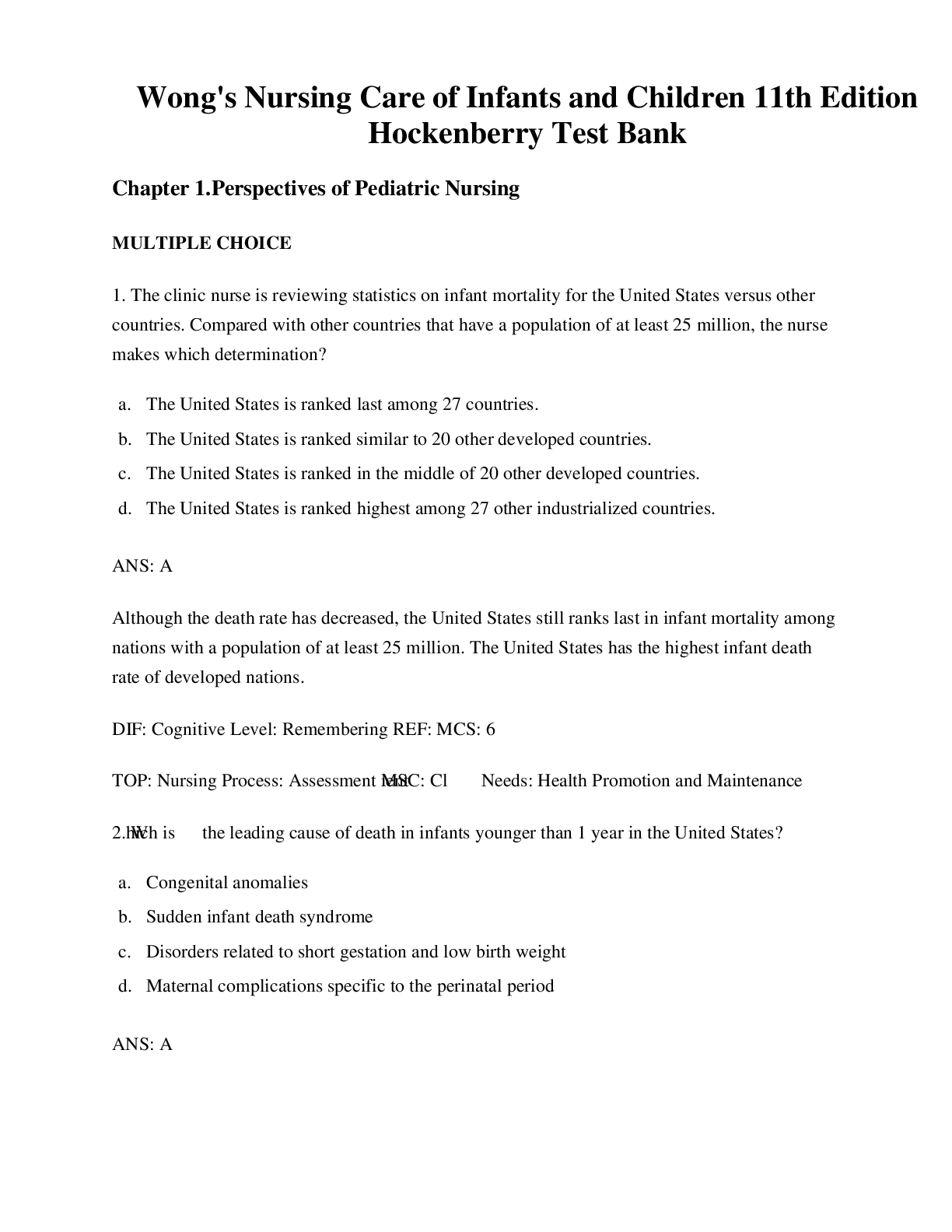
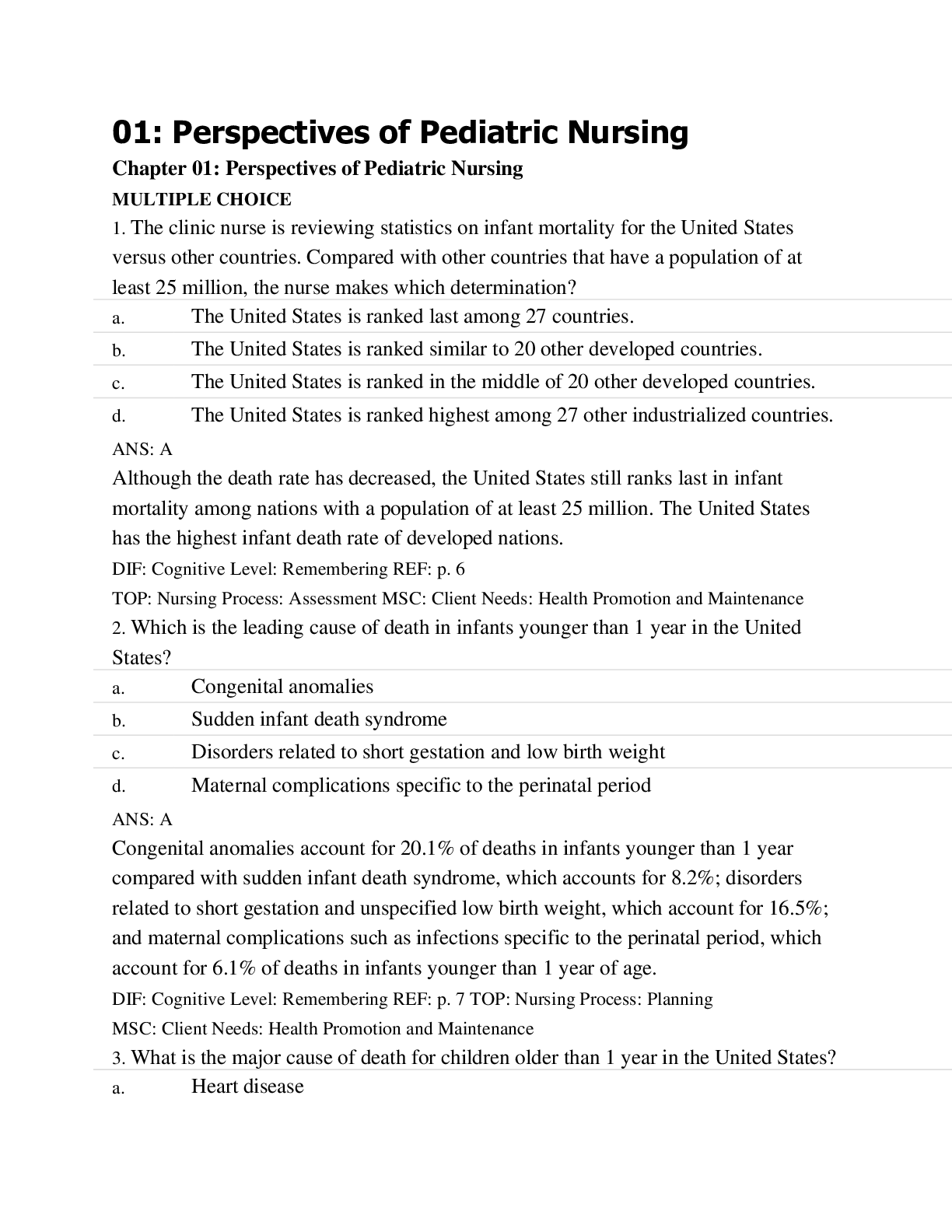
Chapter 1.Perspectives of Pediatric Nursing
MULTIPLE CHOICE
1. The clinic nurse is reviewing statistics on infant mortality for the United States versus
other countries. Compared with other countries that have a population of at least 25
million, the nursemakes which determination?
a. The United States is ranked last among 27 countries.
b. The United States is ranked similar to 20 other developed countries.
c. The United States is ranked in the middle of 20 other developed countries.
d. The United States is ranked highest among 27 other industrialized countries.
ANS: A
Although the death rate has decreased, the United States still ranks last in infant mortality
amongnations with a population of at least 25 million. The United States has the highest
infant death rate of developed nations.
DIF: Cognitive Level: Remembering REF: MCS: 6
TOP: Nursing Process: Assessment iMenStC: Cl Needs: Health Promotion and Maintenance
2.hWich is the leading cause of death in infants younger than 1 year in the United States?
a. Congenital anomalies
b. Sudden infant death syndrome
c. Disorders related to short gestation and low birth weight
d. Maternal complications specific to the perinatal
periodANS: A
Congenital anomalies account for 20.1% of deaths in infants younger than 1 year compared
withsudden infant death syndrome, which accounts for 8.2%; disorders related to short
gestation andunspecified low birth weight, which account for 16.5%; and maternal
complications such as infections specific to the perinatal period, which account for 6.1% of
deaths in infants younger than 1 year of age.
DIF: Cognitive Level: Remembering REF: MCS: 7 TOP: Nursing Process: Planning
MSC: Client Needs: Health Promotion and Maintenance
3. What is the major cause of death for children older than 1 year in the United States?
a. Heart disease
b. Childhood cancer
c. Unintentional injuries
d. Congenital anomalies
ANS: C
Unintentional injuries (accidents) are the leading cause of death after age 1 year through
adolescence. The leading cause of death for those younger than 1 year is congenital
anomalies,and childhood cancers and heart disease cause a significantly lower percentage
of deaths in children older than 1 year of age.
DIF: Cognitive Level: Understanding REF: MCS: 7 TOP: Nursing Process: Planning
MSC: Client Needs: Health Promotion and Maintenance
4. In addition to injuries, what are the leading causes of death in adolescents ages 15 to 19
years?
a. Suicide and cancer
b. Suicide and homicide
c. Drowning and cancer
d. Homicide and heart disease
[Show More]