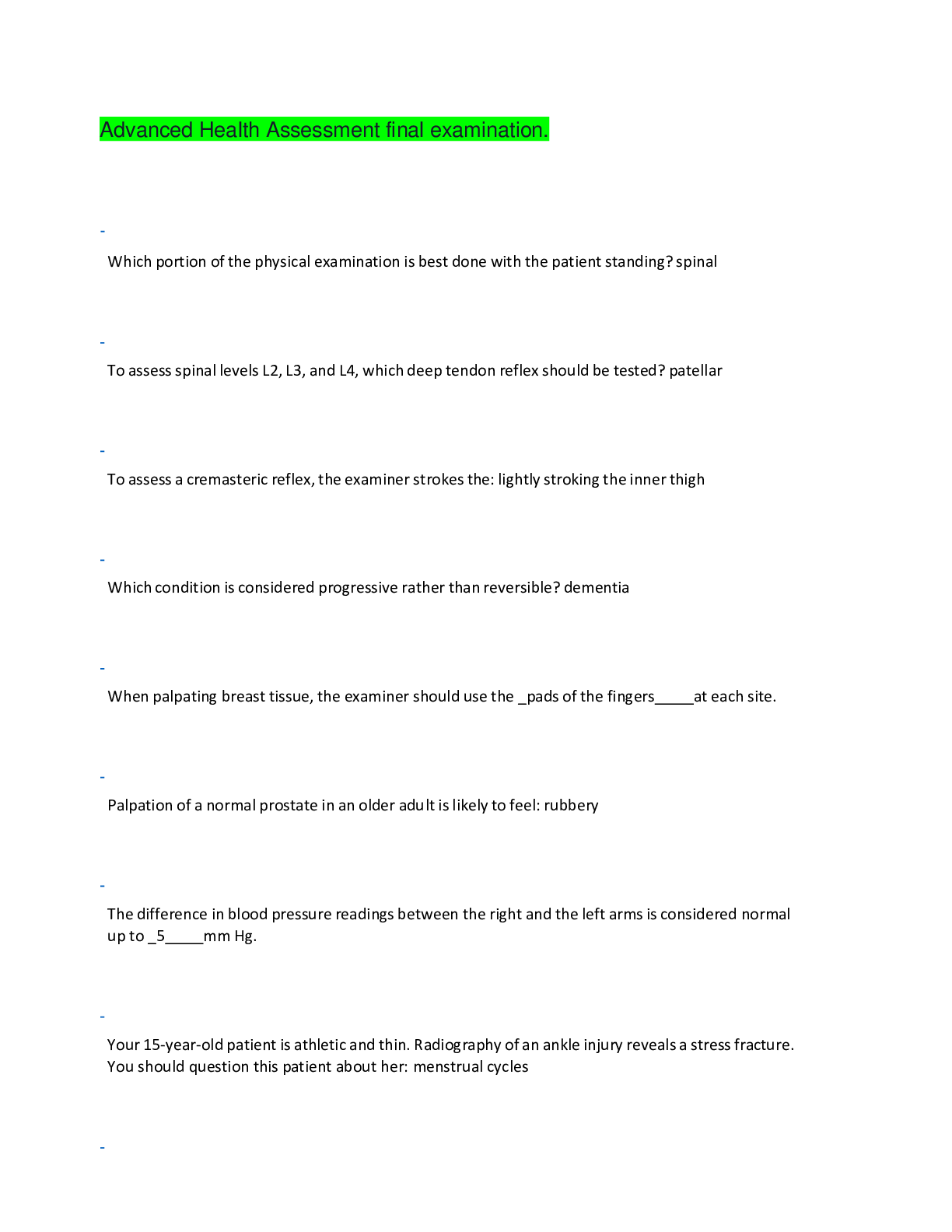
Advanced Health Assessment final examination.
Which portion of the physical examination is best done with the patient standing?
To assess spinal levels L2, L3, and L4, which deep tendon refl
...
Advanced Health Assessment final examination.
Which portion of the physical examination is best done with the patient standing?
To assess spinal levels L2, L3, and L4, which deep tendon reflex should be tested?
To assess a cremasteric reflex, the examiner strokes the:
Which condition is considered progressive rather than reversible?
When palpating breast tissue, the examiner should use the _ at each site.
Palpation of a normal prostate in an older adult is likely to feel:
The difference in blood pressure readings between the right and the left arms is considered normal up to _ mm Hg.
Your 15-year-old patient is athletic and thin. Radiography of an ankle injury reveals a stress fracture. You should question this patient about her:
Cranial nerve XII may be assessed in an infant by:
While collecting personal and social history data from a woman complaining of breast discomfort, you should question her regarding:
An idiopathic spasm of arterioles in the digits is termed:
A 23-year-old white woman has come to the clinic because she has missed two menstrual periods. She states that her breasts have enlarged and that her nipples have turned a darker color. Your further response to this finding is to:
Assessing orientation to person, , and time helps determine:
The rectal past medical history of all patients should include inquiry about:
To hear diastolic heart sounds, you should ask patients to:
Loss of immediate and recent memory with retention of remote memory suggests:
Your patient's chief complaint is repeated pencil-like stools. Further examination should include:
Kawasaki disease is suspected when assessments of a child reveal:
The examiner percusses for diaphragmatic excursion along the:
If pitting edema is unilateral, you would suspect occlusion of a:
Which medical condition would exclude a person from sports participation?
The Mini-Mental State Examination:
.........................................................................................continued...........................................................................................
[Show More]



 (1).png)


