602 Final Study Questions.docx
1. A sexually active 18-years old presents with postcoital spotting, dysuria and a yellow discharge. On exam you find her cervix is erythematous and bleeds with contact. The most likel
...
602 Final Study Questions.docx
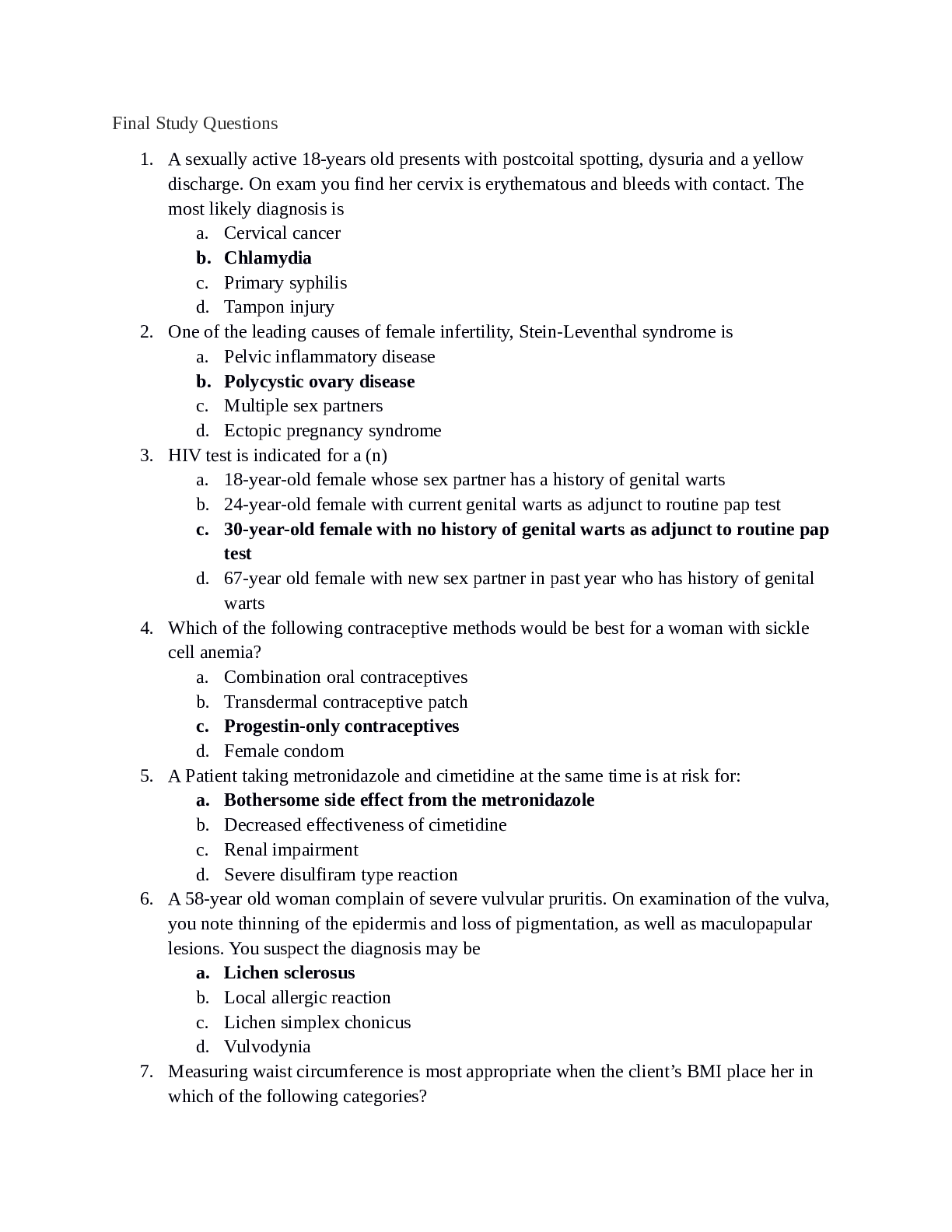
1. A sexually active 18-years old presents with postcoital spotting, dysuria and a yellow discharge. On exam you find her cervix is erythematous and bleeds with contact. The most likely diagnosis is
2. One of the leading causes of female infertility, Stein-Leventhal syndrome is
3. HIV test is indicated for a (n)
4. Which of the following contraceptive methods would be best for a woman with sickle cell anemia?
5. A Patient taking metronidazole and cimetidine at the same time is at risk for:
6. A 58-year old woman complain of severe vulvular pruritis. On examination of the vulva, you note thinning of the epidermis and loss of pigmentation, as well as maculopapular lesions. You suspect the diagnosis may be
7. Measuring waist circumference is most appropriate when the client’s BMI place her in which of the following categories?
8. The levonogestrel releasing IUC may be a better choice then the copper releasing IUC for a woman who:
9. A 30-year old is seen in your office on day 18 of her cycle for her routine annual examination. She has no complaints. Pelvic exam reveals a 9-cm firm, pelvic mass anterior to the uterus. The most likely diagnosis is
10. First line treatment for polycystic ovary syndrome is
11. A 45-year old female presents with complaint of lower abdominal pain with urinary urgency and frequency for the past three months. The pain is worse during sexual intercourse and relieved somewhat when she urinates. Physical exam reveals suprapubic tenderness as well as tenderness along the anterior vaginal wall and urethra. The remainder of her exam is normal. What diagnosis best fits these findings?
12. If you diagnose a cervical gonococcal infection, which other infection is probably present?
13. A 24-year old female presents to your office with a request for combination contraceptives. Her current medications include a bronchodilator for asthma. Management for this client should include advising her that:
14. The CDC recommendation for follow-up of a female treated for PID with a recommended outpatient regimen is:
15. A 16-year old woman has not yet begun menstruating but does have secondary sexual characteristics. She is best described as having:
16. The glands located posteriorly on each side of the vaginal orifice are the:
17. Typical characteristics of vulvodynia include:
Valvovaginal edema and erythema
18. The most common type of invasive breast carcinoma is:
Infiltrating ductal
Medullary Lobular
Infiltrating papillary
19. A dancer from an adult club down the street comes in for a renewal of her birth control pill prescription. She says everything is fine. On exam, you find grayish-white vaginal discharge, greenish cervical discharge, and cervical motion tenderness. All of the following are differential diagnoses except?
Gonorrhea Interstitial cystitis Bacterial vaginosis Chlamydia
20. A 26-year old woman presents with multiple painless, umbilicated papules on her mons pubis. The most likely diagnosis is:
Condyloma acuminate Condyloma lata Lumphogranuloma venereum Molluscum contagiosum
21. A 26- year old female has a Pap test report of ASC-US. This is her first abnormal Pap test. Recommended first steps in follow- up would include:
Colposcopy within the next six months
Co-testing with Pap and HPV tests in one year
Reflex HPV now
Repeat Pap test alone in three years
22. USPSTF recommendations for routine breast cancer screening include:
Biennial mammograms starting at age 50
Breast self-examination starting at age 21
Clinical breast examination annually starting at age 30
Discontinue mammograms at age 65
23. A 22- year old female presents with complaint of malodorous vaginal discharge and vulvar itching. On examination, a watery, yellowish-green vaginal discharge is noted, along with vulvar and vaginal erythema. The most likely findings on a wet mount examination will be:
Clue cells Lactobacilli Pseudohyphae Trichomonads
24. The American cancer society recommends yearly mammogram screening beginning at age: 40
45
50
55
25. According to USPSTF recommendations, an 80 year old female should get A clinical breast examination and screening mammogram annually
A clinical breast examination annually but no screening mammogram Neither a clinical breast examination nor a screening mammogram A screening mammogram biennially but no cervical breast examination
26. A 22 year old female has a Pap test report of HSIL. Recommended first stems in follow up would include:
Colposcopy
Co-test with Pap and HPV tests in one year Reflex HPV test now
Repeat Pap test alone in six months
27. Characteristics of polycystic ovary syndrome include: Hirsutism, thinness, hypoinsulinemia
Menopausal onset, vitiligo
Alopecia, thinness, abdominal cramping
Premenarchial onset, obesity, hyperinsulinemia
28. A 22 year old experiences six months of amenorrhea. Laboratory test results include normal prolactin and thyroid stimulating hormone and negative pregnancy test. The next action will be to:
Administer a progestin challenge test
Measure testosterone
Order a hysterosalpingogram
Order an MRI or CT scan of pituitary gland
29. A 66 year old woman with a history of pruritis presents with an ulceration of the vulva. The most likely diagnosis is:
Chancroid Secondary trauma Syphilis
Vulvar carcinoma
30. A 17 year old client presents at the clinic with the following reason for seeking care: “I have been sick for three days. I feel sick to my stomach and have diarrhea”. Which of the following would be the most appropriate to document as her reason for visit/ chief complaint?
Flulike symptoms Gastrointestinal distress
“I feel sick to my stomach and have diarrhea”
Possible pregnancy, needs further evaluation
31. A 16 year old patient comes to the office because she has never had a menstrual period. She has normal breast development, scant pubic hair, and blind vaginal pouch with no palpable uterus or ovaries. The most likely diagnosis is:
Androgen insensitivity/resistance syndrome
Muscarian agenesis Sheehan’s syndrome Turner’s syndrome
32. Characteristic “strawberry spots” on the cervix may be seen with: Bacterial vaginosis
Chlamydia Herpes genitalis
Trichomoniasis
33. When examining the cervix of a 20 year old female, you note that most of the cervix is pink, but there is a small ring of dark-red tissue surrounding the os. This is most likely:
An endocervical polyp Due to cervical dysplasia Due to cervical infection
The squamoculomnar junction
34. A twenty-one year old woman comes to your practice seeking birth control. She has only recently become sexually active and has consistently used condoms for safe sex. Your history reveals that she does not use tampons during her menses and has very little knowledge about female reproductive anatomy. Based on this information, which of the following birth control methods would be least likely to meet her needs for contraception management?
Combined oral contraceptive pill Depo-provera
Ortho eva patch
Nuva ring
35. Dysfunctional uterine bleeding is usually associated with Pregnancy
Anovulation Genital tumor Inflammation
36. Pelvic findings on examination of a 22- year old nulliparous woman is uterus 7cm in length and ovaries 3cm x 2cm x 1cm. These findings are consistent with
Enlarged uterus and enlarged ovaries Normal size uterus and enlarged ovaries Enlarged uterus and normal size ovaries Normal size uterus and normal size uterus
37. In a premenopausal woman, the biggest heart attack risk factor is
Cigarette smoking
Family History
Sedentary lifestyle Obesity
38. Iris is a 32 y/o married woman with three children. She comes in for information on using copper T IUD for contraception. Which of the following would be a contraindication to using this appliance?
Nulliparity Heart disease
Prior ectopic pregnancy
history of multiple births
39. A nurse practitioner is screening a female for prescribing contraception fir the first time. Which of the following is an absolute contraindication for estrogen-containing contraception?
Migraine headaches Hypertension Theomboembolisms Seizure disorder
40. Mrs. Jackson, age 37, has been on birth control pills for approximately 15 years. She is a smoker, has a blood pressure of 110/70mmHg and has lipid levels within normal limits. You advise that she should
Discontinue the birth control pills because of smoking
41. A 24 year old woman presents with complaint of nontender mass in her breast that does not change with the menstrual cycle. On examination, you notice a freely movable, 0.5cm x 1cm, rubbery nontender mass. The most likely diagnosis is
Fibroadenoma Fibrocystic breast changes Intraductal papilloma Cystosarcoma phyllodes
42. Turner’s syndrome can be suspected when the patient has primary amenorrhea and Blind vaginal pouch with imperforate hymen
Low IQ and visual disturbances
Normal breast development but lack of pubic and axillary hair growth
Short stature and webbed neck
43. Primary dysmenorrhea can best be treated with Dopamine agonists
GnRh agonists Prostaglandin inhibitors Tricyclic antidepressants
44. What is the position of the uterus when the cervix is on the anterior vaginal wall? Midposition
Retroverted Retroflexed Anteverted
45. According to ACOG guidelines, which of the following examination and screening tests should be a part of the routing well-woman visit every year for the females age 30 to 39 years?
Chlamydia test
Clinical breast examination
Mammogram Pap test
46. A woman who is currently pregnant, has has two full-term deliveries, and has had one first trimester abortion would be considered
Gravida 2 Para 2
Gravida 3 para 2
Gravida 3 para 3
Gravida 4 para 2
47. a vaginal pH less than 4.5 is expected finding in a Healthy reproductive age woman Menopausal woman with atropic vaginitis Reproductive age woman with trichomoniasis Healthy prepubertal age girl
48. a 68 year old had her last cervical cancer screening fone at age 65 and results were normal. She has no history of abnormal screenings. She has recently started having sexual intercourse with a new male partner and asks if she should start having cervical cancer screening again. An appropriate answer would be that she
Does not need pap tests but should have HPV testing every five years
Does not need to resume either pap tests or HPV testing
Should resume pap test with HPV co-testing every five years
49. the new ACOG Pap smear guidelines reflect a change in all of the following except The age at which pap smears are initiated
The frequency of pap smear screenings
The follow-up to abnormal pap smear results
The endpoint for pap smear tastings
50. During a vaginal examination, you observe bulging of the anterior wall when you ask the patient to bear down. This is most likely a
Congenital abnormality
Cystocele Rectocele Uterine prolapse
[Show More]