Module 5
Surgical Observation Rotation NUR 2349 – Professional Nursing I
One element of the clinical experience in Nursing 1, NUR 2349 is the observation of a surgical procedure.
Each student, at the discretion of
...
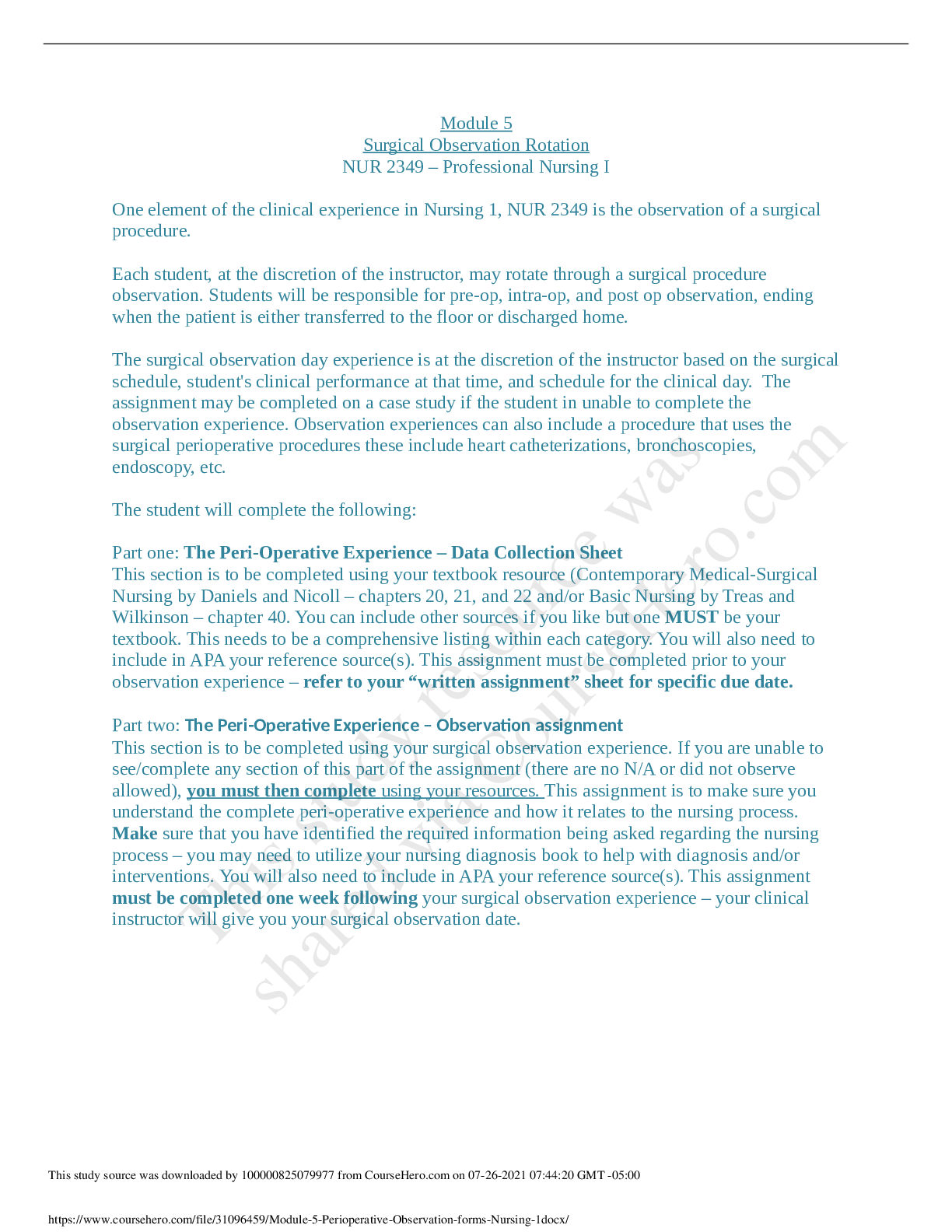
Module 5
Surgical Observation Rotation NUR 2349 – Professional Nursing I
One element of the clinical experience in Nursing 1, NUR 2349 is the observation of a surgical procedure.
Each student, at the discretion of the instructor, may rotate through a surgical procedure observation. Students will be responsible for pre-op, intra-op, and post op observation, ending when the patient is either transferred to the floor or discharged home.
The surgical observation day experience is at the discretion of the instructor based on the surgical schedule, student's clinical performance at that time, and schedule for the clinical day. The assignment may be completed on a case study if the student in unable to complete the observation experience. Observation experiences can also include a procedure that uses the surgical perioperative procedures these include heart catheterizations, bronchoscopies, endoscopy, etc.
The student will complete the following:
Part one: The Peri-Operative Experience – Data Collection Sheet
This section is to be completed using your textbook resource (Contemporary Medical-Surgical Nursing by Daniels and Nicoll – chapters 20, 21, and 22 and/or Basic Nursing by Treas and Wilkinson – chapter 40. You can include other sources if you like but one MUST be your textbook. This needs to be a comprehensive listing within each category. You will also need to include in APA your reference source(s). This assignment must be completed prior to your observation experience – refer to your “written assignment” sheet for specific due date.
Part two: The Peri-Operative Experience – Observation assignment
This section is to be completed using your surgical observation experience. If you are unable to see/complete any section of this part of the assignment (there are no N/A or did not observe allowed), you must then complete using your resources. This assignment is to make sure you understand the complete peri-operative experience and how it relates to the nursing process.
Make sure that you have identified the required information being asked regarding the nursing process – you may need to utilize your nursing diagnosis book to help with diagnosis and/or interventions. You will also need to include in APA your reference source(s). This assignment must be completed one week following your surgical observation experience – your clinical instructor will give you your surgical observation date.
Part one:
The Peri-Operative Experience – Data Collection Sheet
Instructions: Prior to your peri-operative experience – you must complete the following data collection sheet. Identify all patient safety concerns, nursing assessment and interventions, and anesthesia factors in the pre, intra, and post-operative settings.
Name: Shanteria Whitehead Date: 10/11/17
Patient Safety Concerns Nursing assessment and
interventions Anesthesia Concerns
Pre-op 1. Confirm correct surgical site
2. Complete correct documentation such as allergy, blood consent forms
3. Adverse effects of surgery reference chronic illnesses (COPD, congestive HF) 1. Answer questions patient may have about surgery
2. Check vital signs and record baselines
3. Obtain info from patient illness, injury, disorders, past surgeries, weight, alcohol/ drug addiction and allergies
4. Patient medication info.
5. Educate patient about the need to donate blood
6. Teach patient sign of crisis
7. Skin prep instructions
(Daniels & Nicoll, 2012) 1. Patient response to medication may be influenced by substance and herbal remedies.
2. Patient may have issues being awaked due to health issues
(Daniels & Nicoll, 2012)
4. Adverse effects due to current medications
(Daniels & Nicoll, 2012)
Intra-op 1. Patients may be at risk for infections, stroke, burns, nerve damage, skin surface/deep tissue trauma
2. Patients are at risk for blood loss
3. Possible respiratory depression due to the medications 1. Identify patient correctly, check vital signs, administer medication safely
2. Monitor the patient throughout the induction process
3. Monitor quality of care that is provided in the surgical setting
4. Assist in prepping 1. Each person responds different to medications, may possible cause a different level of sedation tat intended. Monitor for sign/symptoms
2. My cause adverse physiological consequences of
(Daniels & Nicoll, 2012) patient for surgery
5. Initiating the time out to verify information to minimize error
(Daniels & Nicoll, 2012) anesthesia such as hyperventilation, hypoxia, hypotension.
3. May cause nausea, vomiting, sore throat, seizure, heart attacks
4. Sedation may place patients at risk for cardiac and respiratory distress
(Daniels & Nicoll, 2012)
Post-op 1. Monitor patient for excessive blood loss
2. Respiratory depression
3. Infection
4. Correct positioning
5. Mobility
6. Signs of Depression (Daniels & Nicoll, 2012) 1. Monitor cardiac and respiratory stability
2. Asses for readiness to transport to another unit (check for level of consciousness, respiratory issues, and activity level)
3. Make decision as to what unit to send the patient depending upon status
4. Assess positioning based on surgery location
5. Assess for blood loss
6. Check all vital signs
7. Assess wound and assess for signs of infection
8. Prove patient education
9. Ambulation/mobility 1. May cause nausea/vomiting, sore throat
2. Assess patient for level of alertness
3. Adverse reactions with daily prescribed medications
4. May cause depression of respiratory and urinary systems
(Daniels & Nicoll, 2012)
(Daniels & Nicoll, 2012)
Reference:
Daniels, R., Nicoll, L. (2012). Contemporary Medical-Surgical Nursing: Second Edition.
Retrieved from
https://ambassadored.vitalsource.com/#/books/9781337341509/
Student Name: Course: Date of Observation:
Part Two:
The Peri-Operative Experience – Observation Assignment
The patient – case study
Provide a brief history of the patient’s current problem which requires surgical intervention. Brief (pertinent) medical history
Brief (pertinent) prior surgical history Brief (pertinent) social history
List all allergies:
Medications Food Contract/dyes Other
Medication Reconciliation (current med list)
Identify and describe the anticipated surgical procedure
Pre-Operative setting
List any pre-op testing and preparations needed before surgery List pre-op labs
Advance directives and informed consents
List three (3) requirements needed to ensure informed consent was obtained/ achieved.
Identify surgical site (verification (marked)/ time out (performed)
List the patient education required to prevent post-operative complications List the nursing focus for preventing post-operative complications
Identify any (or potential) psychological needs or social concerns
List 3 nursing interventions to meet the psychological needs of the surgical patient
Review the current medication reconciliation list – List any medication that cause concerns – provide rationales
List five (5) nursing responsibilities needed to be completed just prior to going to the OR
Intra-Operative Period
List at least four (4) safety considerations needed for the patient to have a successful, positive, and safe outcome.
What kind of anesthesia was used?
Identify the nurse’s role during the intra-operative setting (list duties) Briefly describe your intra-operative observations
Any concerns or complications identified or expressed during the intra-operative setting
Post-Operative Setting
Where did the patient go following the surgery (PACU, short – stay surgery, floor, etc)? Was this the intended location – why or why not?
Briefly describe events observed during the immediate recovery phase
Provide vital signs, medications, and nurse’s assessment (head to toe, post-op site, tubes, etc) of immediate recovery phase. What was the nurse’s first priority and why?
Review post-operative labs. Are there any abnormal or critical labs? If so – what may be some contributing factors?
If so – what may be some appropriate treatments to correct the deficiencies post-operatively?
What post-operative assessment and interventions need to be performed once patient is back on the nursing unit or short-stay unit? List five (5) assessment and intervention.
List 3 potential complications the patient is at risk of developing post-operatively. Ranks from highest to lowest – give rationales.
Provide a list of nursing interventions to prevent the potential complications listed above. Was the patient discharge home? If so; describe your observations of the discharge process?
Peri-operative Experience Grading Rubric NUR 2239C
Name: Date:
Instructor:
Points possible Points received
Part One:
Completes the pre-perioperative assessment form for the pre, intra and post-operative phases of surgery.
For example: (Not inclusive!)
• Identifies appropriate assessments required
• Identifies potential threats to patient
safety
• Identifies possible risk factors for surgery
8
Part Two:
Completes the perioperative experience assessment form for the pre, intra and post- operative phases of surgery.
For example: (Not inclusive!)
• Explains what assessments were completed in each stage of the peri- operative experience
• Identifies the measures that the peri- operative team used to ensure the patients safety.
• Explains the surgical procedure the
patient received and why it was required.
7
Total points possible 15
Additional comments:
[Show More]






, 6e by Russell Hoye, Katie Misener, Michael Naraine, Catherine Ordway.png)