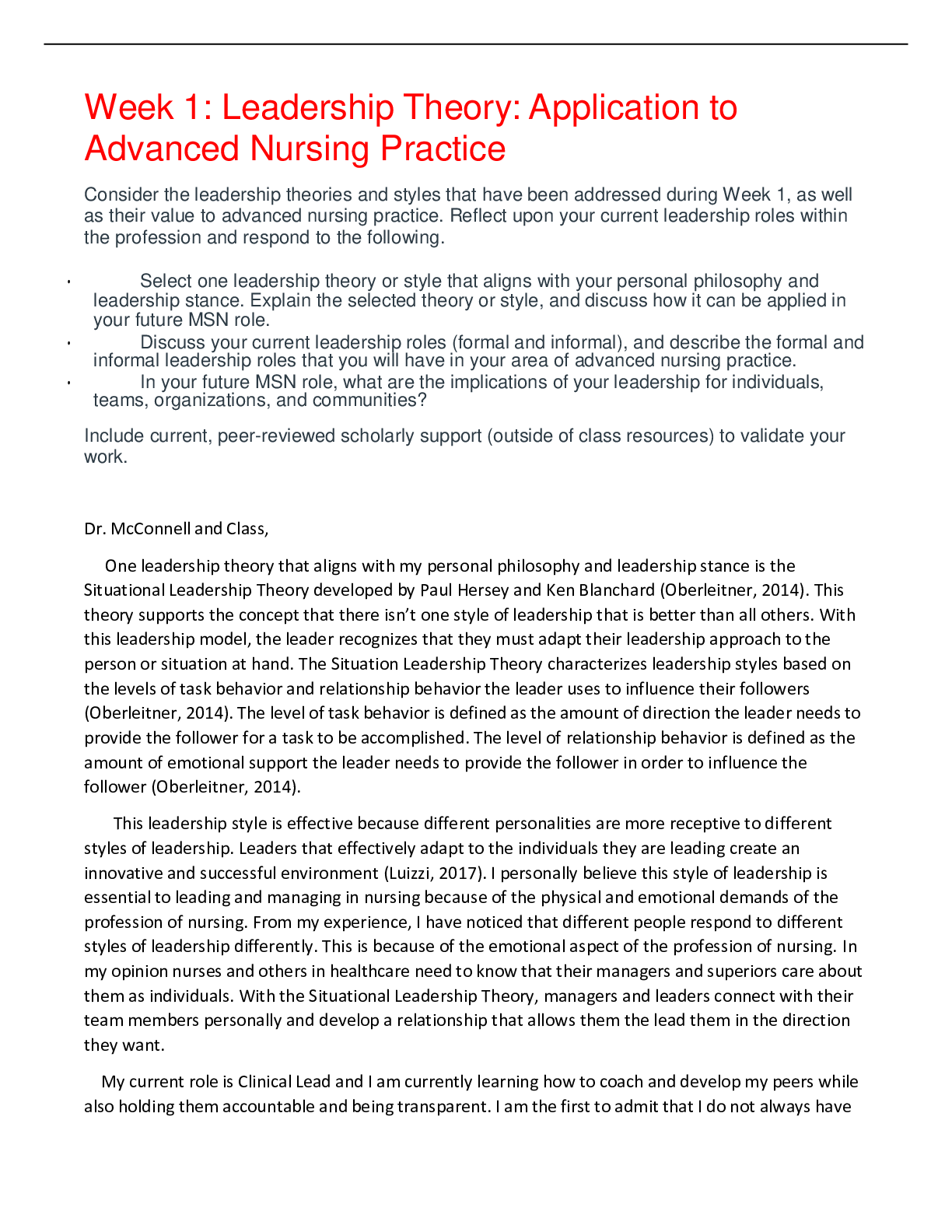
NURSING > DISCUSSION POST > Week 1: Leadership Theory: Application to Advanced Nursing Practice/ SCORE A (All)
Week 1: Leadership Theory: Application to Advanced Nursing Practice/ SCORE A
Document Content and Description Below
Last updated: 3 years ago
Preview 1 out of 3 pages
Instant download
Buy this Document to get the Full Access Instantly
Provided by Students Who Aced it
We Verify Document Content to Gurantee Accuracy
Reviews( 0 )
Document information
Connected school, study & course
About the document
Uploaded On
Jul 26, 2021
Number of pages
3
Written in
All

Additional information
This document has been written for:
Uploaded
Jul 26, 2021
Downloads
0
Views
94
Topic Tags
Recommended For You
Get more on DISCUSSION POST »
Primary Care The Art & Science of Advanced Nursing Practice, 6...

Test Bank For Philosophies and Theories for Advanced Nursing P...

TEST BANK for Philosophies and Theories for Advanced Nursing P...

Philosophies and Theories for Advanced Nursing Practice By Jan...

Philosophies and Theories for Advanced Nursing Practice 3rd Ed...
TEST BANK FOR PHILOSOPHIES AND THEORIES FOR ADVANCED NURSING P...

NR501 / NR 501: Theoretical Basis for Advanced Nursing Practic...
NSG6001 / NSG 6001: Advanced Nursing Practice I Final Study Gu...
NRSG 6000 – Perspectives on Graduate Study for Advanced Nursi...
NR565 / NR 565: Advanced Pharmacology Week 6 & 7 Discussion Bo...

NSG 6001 / NSG6001 ADVANCED NURSING PRACTICE UNIT03CHAPTER 76....
Focused Exam: Bipolar Disorder Shadow Health; Lucas Callahan L...
NSG 6001 / NSG6001 ADVANCED NURSING PRACTICE UNIT01 CHAPTER 5....

NSG 6001 / NSG6001 ADVANCED NURSING PRACTICE UNIT02 SECTION 2....

NR 706 Week 1 Part 1 : Nursing Informatics and Advanced Nursin...

Tanner Bailey Shadow Health EXPERIENCE OVERVIEW Transcript. Ca...

 (1).png)