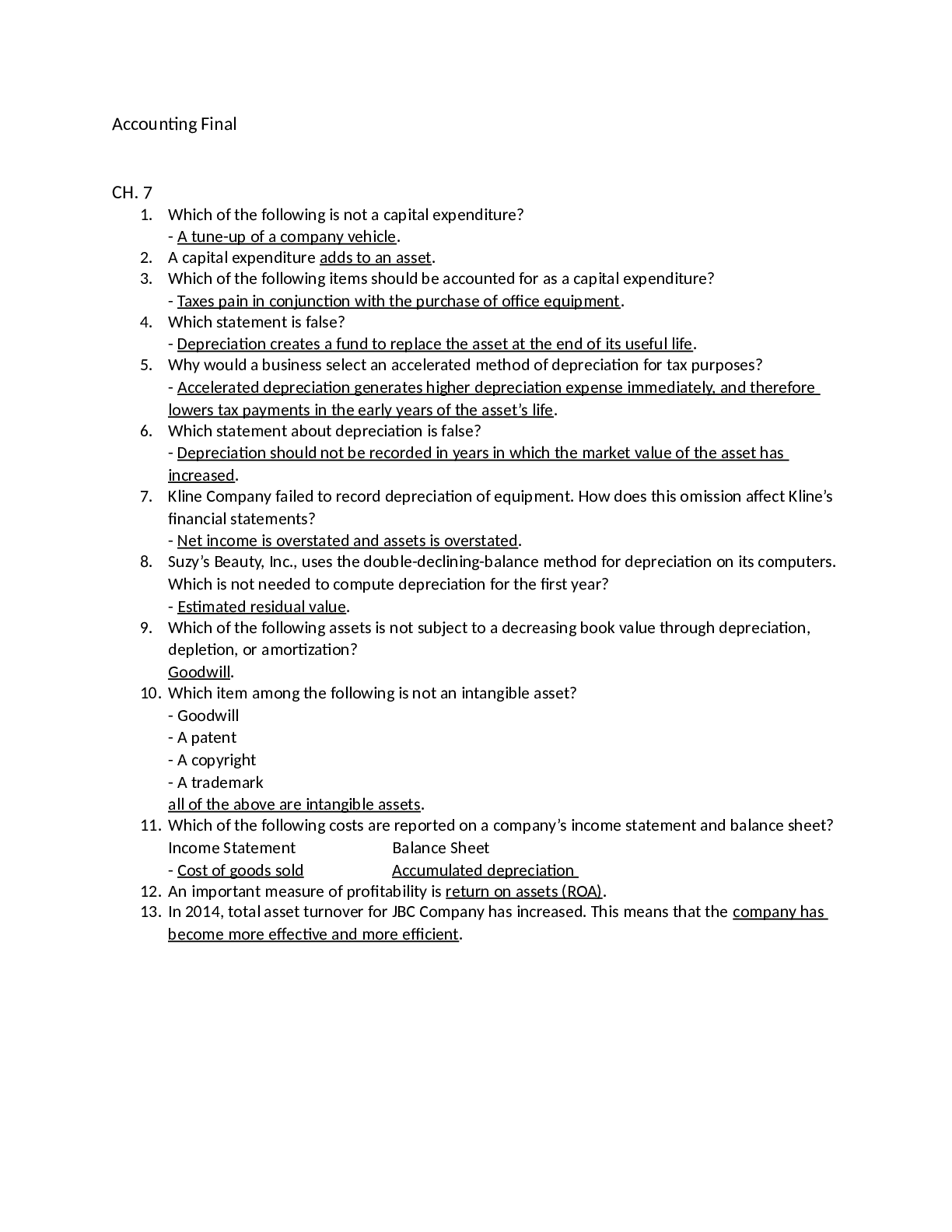
1) In accounting, what is the meaning of capitalized?
A) Capitalized means that a liability account is credited (increased) for the cost of an asset.
B) Capitalized means that an asset account is debited (increased) fo
...
1) In accounting, what is the meaning of capitalized?
A) Capitalized means that a liability account is credited (increased) for the cost of an asset.
B) Capitalized means that an asset account is debited (increased) for the cost of an asset.
C) Capitalized means that the cost of an asset is recorded as a debit (increase) to expense.
D) Capitalized means that a given city has been selected as a government center.
When you purchase/acquire goods or services, you can debit either an expense or an asset account, those
are your only two choices, depending on whether you already received the benefit of the item being
acquired (expense) or if the item being acquired still has future economic benefit (asset).
To “capitalize” is to record an item acquired as an asset.
2) Which of the following would NOT be considered part of the cost of machinery and equipment?
A) Repairs and maintenance after start-up
B) Delivery charges
C) Installation costs
D) In-transit insurance costs
Upon acquisition, you capitalize the cost of the item being acquired (purchase price, sales taxes, shipping
costs to get it delivered to your location) and the costs to get the asset to its intended use (installation
costs).
After that, you can only capitalize costs that add functionality/capacity to the asset or extends its life .
Otherwise, costs to maintain the performance of the assets during its original life are expensed (e.g. you
have to change the oil several times during the 5-year period of a vehicle’s life just to get it to make it to 5
years, this is normal maintenance which is expensed).
3) It is determined that an equipment’s depreciation expense for the year is $8,000. Journal entry to record
this will be:
A) debit Depreciation Expense – equipment $8,000; credit Cash $8,000.
B) debit Accumulated Depreciation – equipment $8,000; credit Cash $8,000.
C) debit Depreciation Expense – equipment $8,000; credit Accumulated Depreciation, $8,000.
D) debit Cash $3,500; credit Depreciation Expense – equipment $8,000.
Recording depreciation expense does not have a cash component.
Recording depreciation expense recognizes the benefit you received for using the asset to generate
revenue. The results of this recognition of use is that the value of the asset is reduced, which is captured
by creating a contra asset called Accumulated Depreciation, which has the sum of all depreciation
expense recorded life-to-date.
Note that contra assets are still assets but with credit balances.
Another Question? What is the net balance of the Asset less the Accumulated Depreciation called?
Book Value = Asset – Accumulated Depreciation
4) A truck costing $65,000 has accumulated depreciation of $60,000. The truck is sold for $2,500. The
journal entry to record this transaction is to:
A) debit Cash for $2,500, debit Accumulated Depreciation – Truck for $60,000, credit Truck for
$65,000, and credit Gain on Disposal for $2,500.
B) debit Accumulated Depreciation – Truck for $60,000, and credit Truck for $65,000.
C) debit Cash for $2,500, debit Truck for $65,000, credit Accumulated Depreciation – Truck for
$60,000 and credit Loss on Disposal for $2,500.
D) debit Cash for $2,500, debit Loss on Disposal for $2,500, debit Accumulated Depreciation –
Truck for $60,000, and credit Truck for $65,000.
Cash 2,500
Loss on Sale 2,500
Accumulated Depreciation 60,000
Truck 65,000
To calculate the gain or less when selling any asset, compare the cash proceeds of the sale ($2,500) with
the book value of the assets sold ($5,000 = $65,000 – 60,000). In this case, the proceeds were $2,500 less
than the book value, so have a loss.
Be careful to eliminate the balance in both the asset and accumulated depreciation accounts in the entry.
Also, the accumulated depreciation account has to be up to date. Let’s say, for example, that the sale took
place in the middle of the year. In that case, you would record depreciation expense for another ½ a year
which updates the accumulated depreciation account balance, and then record the entry for the sale.
5) A new vehicle was purchased on January 1 for $45,000. It has a salvage value of $9,000 and a useful
life of 6 years. To the nearest dollar, how much will be the depreciation expense for the first year using
the straight-line method?
A) $6,000
B) $6,333
C) $7,500
D) $1,500
Cost $ 45,000
Less: Residual (Salvage) Value $ (9,000)
Depreciable Basis $ 36,000 (How much you will depreciate)
Divide by: Life in Years / 6
Depreciation per Year $ 6,000
Depreciation Accumulated Book
Expense Depreciation Value
(Cost - Acc Depr)
Yr 0 (Cost) $ 45,000
Yr1 $ 6,000 $ 6,000 $ 39,000
Yr2 $ 6,000 $ 12,000 $ 33,000
Yr3 - Yr6 $ 6,000
Note how the accumulated depreciation balance increases each year for the additional
depreciation expense recorded that year and the book value then decreases.
[Show More]







.png)
.png)