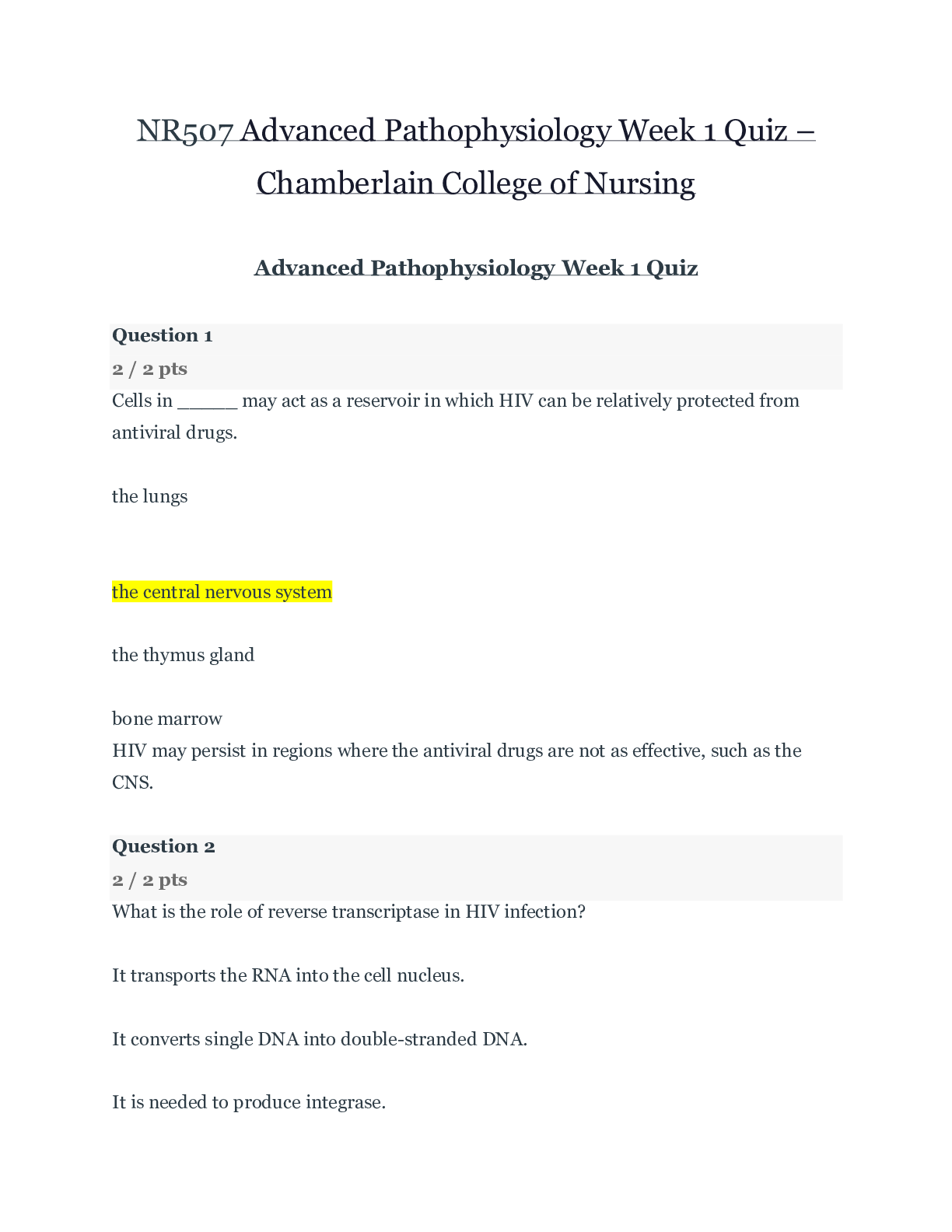
NR507 Advanced Pathophysiology Week 1 Quiz – Chamberlain College of Nursing
Advanced Pathophysiology Week 1 Quiz
Question 1
2 / 2 pts
Cells in _____ may act as a reservoir in which HIV can be relatively protected
...
NR507 Advanced Pathophysiology Week 1 Quiz – Chamberlain College of Nursing
Advanced Pathophysiology Week 1 Quiz
Question 1
2 / 2 pts
Cells in _____ may act as a reservoir in which HIV can be relatively protected from antiviral drugs.
the lungs
Correct!
the central nervous system
the thymus gland
bone marrow
HIV may persist in regions where the antiviral drugs are not as effective, such as the
CNS.
Question 2
2 / 2 pts
What is the role of reverse transcriptase in HIV infection?
It transports the RNA into the cell nucleus.
It converts single DNA into double-stranded DNA.
It is needed to produce integrase.
Correct!
It converts RNA into double-stranded DNA.
One particular family of viruses, retroviruses (e.g., HIV) carries an enzyme reverse transcriptase that creates a double-stranded DNA version of the virus.
Question 3
2 / 2 pts
After sexual transmission of HIV, a person can be infected yet seronegative for _____ months.
Correct!
6 to 14
18 to 20
1 to 2
24 to 36
Antibody appears rather rapidly after infection through blood products, usually within 4 to 7 weeks. After sexual transmission, however, the individual can be infected yet seronegative for 6 to 14 months or, in at least one case, for years.
Question 4
2 / 2 pts
What of the following remains a significant cause of morbidity and mortality worldwide?
Starvation
Cardiovascular disease
Correct!
Infectious disease
Traumatic injury
Despite the wide scale implementation of progressive public health and immunization policies, infectious disease remains a significant cause of morbidity and mortality.
Question 5
2 / 2 pts
Which statement about vaccines is true?
Most bacterial vaccines contain attenuated organisms.
Vaccines provide effective protection for all people against viruses, bacteria, and fungal infections.
Most viral vaccines are made by using dead organisms.
Correct!
Vaccines require booster injections to maintain lifelong protection.
In general, vaccine-induced protection does not persist as long as infection-induced immunity, thus booster injections may be necessary to maintain protection throughout life.
Question 6
2 / 2 pts
Which statement is true about fungal infections?
They result in release of endotoxins.
They occur only on skin, hair, and nails.
Correct!
They are controlled by phagocytes and T lymphocytes.
They are prevented by vaccines.
The host defense against fungal infection includes the fungistatic properties of neutrophils and macrophages. T lymphocytes are crucial in limiting the extent of infection and producing cytokines to further activate macrophages.
Question 7
2 / 2 pts
What disease involves the deposition of circulating immune complexes containing an antibody against host DNA, resulting in tissue damage?
Myasthenia gravis
Pernicious anemia
Correct!
Systemic lupus erythematosus (SLE)
Hemolytic anemia
Deposition of circulating immune complexes containing antibody against DNA produces tissue damage in individuals with SLE.
Question 8
2 / 2 pts
The class of antibody involved in type I hypersensitivity reactions is
Correct!
IgE.
IgA.
IgG.
IgM.
Type I reactions are mediated by antigen-specific IgE and the products of tissue mast cells (see Figure 8-1).
Question 9
2 / 2 pts
In which primary immune deficiency is there a partial to complete absence of T-cell immunity?
Bruton disease
Adenosine deaminase (ADA) deficiency
Correct!
DiGeorge syndrome
Reticular dysgenesis
The principal immunologic defect in DiGeorge syndrome is the partial or complete absence of T-cell immunity.
Question 10
2 / 2 pts
Deficiencies in which element can produce depression of both B- and T-cell function?
Iron
Magnesium
Correct!
Zinc
Iodine
Deficient zinc intake can profoundly depress T- and B-cell function.
Question 11
2 / 2 pts
During an IgE-mediated hypersensitivity reaction, what causes bronchospasm?
Bronchial edema caused by binding of the cytotropic antibody
Smooth muscle contraction caused by histamine bound to H2 receptors
Bronchial edema caused by chemotactic factor of anaphylaxis
Correct!
Smooth muscle contraction caused by histamine bound to H1 receptors
Acting through the H1 receptors, histamine contracts bronchial smooth muscles, causing bronchial constriction; increases vascular permeability, causing edema; and causes vasodilation, increasing blood flow into the affected area (Figures 6-3 and 6-10).
Question 12
2 / 2 pts
A person with type O blood is likely to have high titers of anti-___ antibodies.
A
Correct!
A and B
B
O
Type O individuals, who have neither A or B antigen but have both anti-A and anti-B antibodies, cannot accept blood from any of the other three types.
Question 13
2 / 2 pts
Hypersensitivity is best defined as a(n)
immunologic reaction of one person to the tissue of another person.
Correct!
altered immunologic response to an antigen that results in disease.
undetectable immune response in the presence of antigens.
disturbance in the immunologic tolerance of self-antigens.
Hypersensitivity is an altered immunologic response to an antigen that results in disease or damage to the host.
Question 14
2 / 2 pts
Exhaustion occurs if stress continues and _____ is not successful.
arousal
Correct!
adaptation
alarm
flight or fight
Exhaustion occurs if stress continues and adaptation is not successful, ultimately causing impairment of the immune response, heart failure, and kidney failure, leading to death.
Question 15
2 / 2 pts
What effect does estrogen have on lymphocytes?
Correct!
Depression of T cells and enhancement of B cells
Enhancement of B cells and T cells
Depression of B cells and enhancement of T cells
Depression of B cells and T cells
Estrogens generally are associated with a depression of T-cell–dependent immune function and enhancement of B-cell functions.
Question 16
2 / 2 pts
During a stress response, increased anxiety, vigilance, and arousal is prompted by
Correct!
norepinephrine.
epinephrine.
ACTH.
cortisol.
Norepinephrine release promotes arousal, increased vigilance, increased anxiety, and other protective emotional responses.
Question 17
2 / 2 pts
Stress-age syndrome results in decreased
Correct Answer
immune system.
catecholamines.
ACTH.
You Answered
cortisol.
Immunodepression is one of the characteristic changes seen in stress-age syndrome.
Question 18
2 / 2 pts
Which of the following cancers originate from connective tissue?
Multiple myeloma
Adenocarcinoma
Basal cell carcinoma
Correct!
Osteogenic sarcoma
Cancers arising from connective tissue usually have the suffix "-sarcoma.”
Question 19
2 / 2 pts
Which of the viruses below are oncogenic DNA viruses?
Retroviruses, papovaviruses, and adenoviruses
Correct!
Papovaviruses, adenoviruses, and herpesviruses
Herpesviruses, retroviruses, and papovaviruses
Adenoviruses, herpesviruses, and retroviruses
Papovaviruses, adenoviruses, and herpesviruses are oncogenic DNA viruses; the remaining examples do not fall into this category.
Question 20
2 / 2 pts
Which of the following represents the correct nomenclature for benign and malignant tumors of adipose tissue, respectively?
Adisarcoma, adipoma
Adipoma, adisarcoma
Liposarcoma, lipoma
Correct!
Lipoma, liposarcoma
In general, cancers are named according to the cell type from which they originate (e.g., lip), whereas benign tumors use the suffix “-oma.”
Question 21
2 / 2 pts
In chronic myeloid leukemia (CML), a piece of chromosome 9 fuses to a piece of chromosome 22. This is an example of which mutation of normal genes to oncogenes?
Gene amplification
Point mutation
Chromosome fusion
Correct!
Chromosome translocation
Chromosome translocations, in which a piece of one chromosome is translocated to another chromosome, can activate oncogenes. In a different type of leukemia, CML, a specific chromosome translocation is almost always present. The remaining options are not best depicted by CML.
Question 22
2 / 2 pts
Inherited mutations that predispose to cancer are almost invariably what kind of gene?
Proto-oncogenes
Correct!
Tumor-suppressor genes
Growth-promoting genes
Oncogenes
These inherited mutations that predispose to cancer are almost invariably in tumor-suppressor genes. At present there are no data to support the other options as factors related to how inherited mutations cause cancer.
Question 23
2 / 2 pts
Intestinal polyps are benign neoplasms and the first stage in development of colon cancer. These findings support the notion that
Correct!
an accumulation of mutations in specific genes is required for the development of cancer.
apoptosis is triggered by diverse stimuli including excessive growth.
tumor invasion and metastasis progress more slowly in the gastrointestinal tract.
cancers of the colon are more easily diagnosed in the benign form because they can be visualized during colonoscopy.
It is understood that multiple genetic mutations are required for the evolution of full-blown cancer. The remaining options do not address the progression of benign to metastatic tumors.
Question 24
2 / 2 pts
Which characteristic among women correlates with a high morbidity of cancer of the colon, liver, gallbladder, pancreas, breast, uterus, and kidney?
Woman who smoked for more than 10 years
Women who never had children
Correct!
Women who had a high body mass index
Women older than 45 years of age
A recent hypothesis states that the observed increased incidence of such cancers as breast, endometrium, colon, liver, kidney, and adenomas of the esophagus may be associated with obesity. There are no current data to support the remaining options.
Question 25
2 / 2 pts
Childhood exposure to all of the following risk factors increases susceptibility to cancer except
viruses.
Correct!
cigarette smoke.
drugs.
ionizing radiation.
Childhood exposure to ionizing radiation, drugs, or viruses has been associated with the risk of developing cancer. Although unhealthy, there are no current data to identify cigarette smoke as a risk factor for childhood cancer.
[Show More]




 – Chamberlain College of Nursing.png)
 – Chamberlain College of Nursing.png)