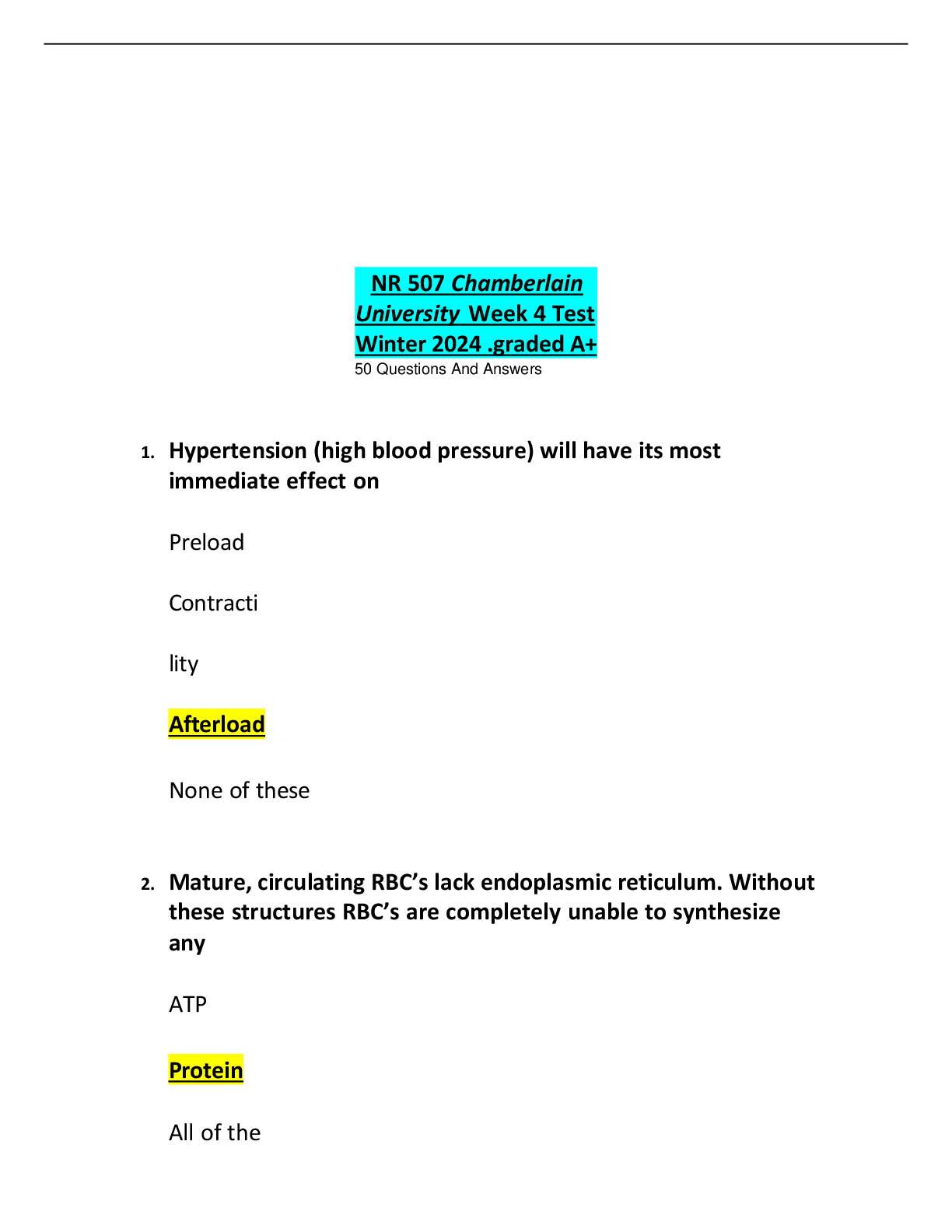
NR507 Advanced Pathophysiology Week 2 Quiz – Chamberlain College of Nursing
Advanced Pathophysiology Week 2 Quiz
Question 1
2 / 2 pts
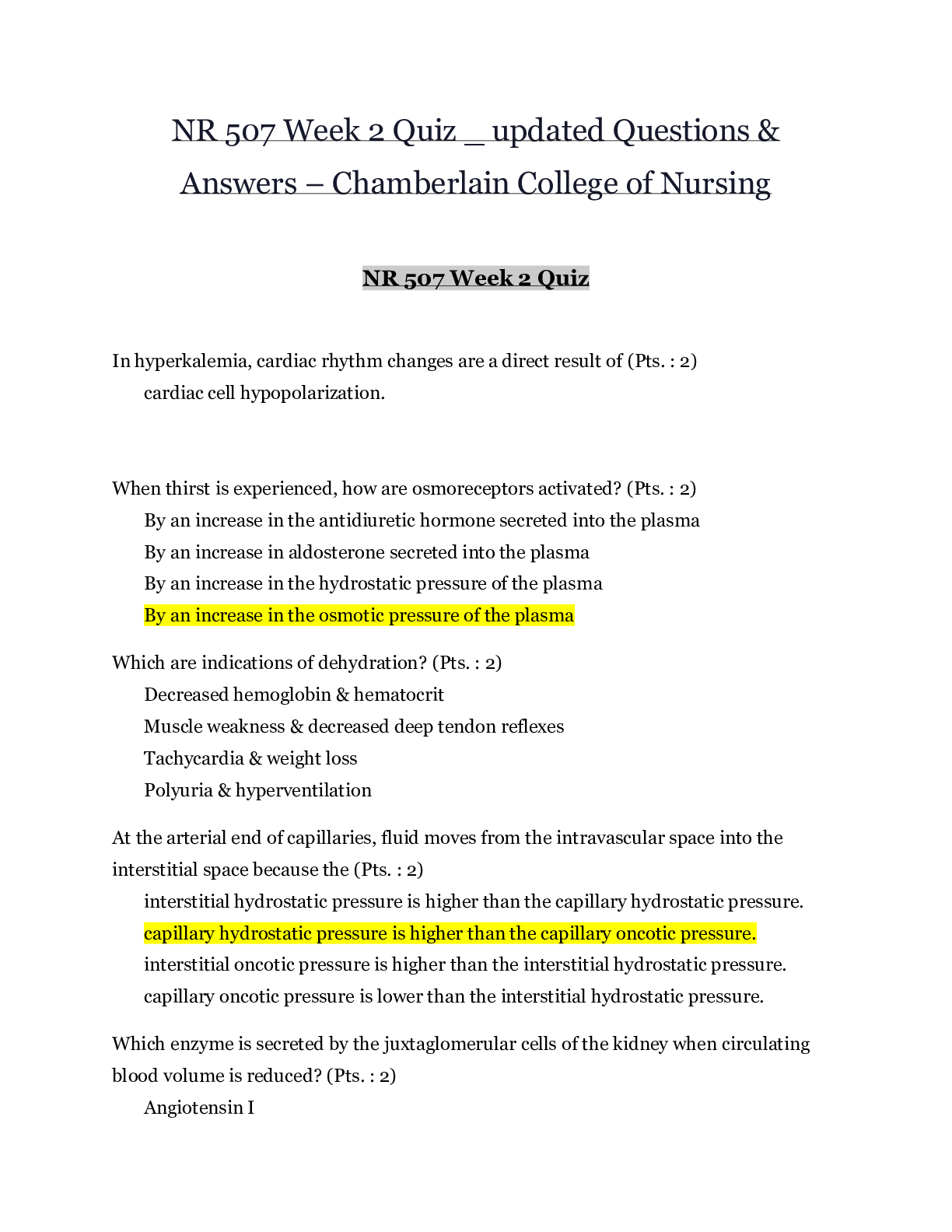
Which are indications of dehydration?
Correct!
Tachycardia and weight lo
...
NR507 Advanced Pathophysiology Week 2 Quiz – Chamberlain College of Nursing
Advanced Pathophysiology Week 2 Quiz
Question 1
2 / 2 pts
Which are indications of dehydration?
Correct!
Tachycardia and weight loss
Decreased hemoglobin and hematocrit
Muscle weakness and decreased deep tendon reflexes
Polyuria and hyperventilation
Marked water deficit is manifested by symptoms of dehydration: headache, thirst, dry skin and mucous membranes, elevated temperature, weight loss, and decreased or concentrated urine (with the exception of diabetes insipidus). Skin turgor may be normal or decreased. Symptoms of hypovolemia, including tachycardia, weak pulses, and postural hypotension, may be present.
Question 2
2 / 2 pts
At the arterial end of capillaries, fluid moves from the intravascular space into the interstitial space because the
interstitial hydrostatic pressure is higher than the capillary hydrostatic pressure.
capillary oncotic pressure is lower than the interstitial hydrostatic pressure.
interstitial oncotic pressure is higher than the interstitial hydrostatic pressure.
Correct!
capillary hydrostatic pressure is higher than the capillary oncotic pressure.
At the arterial end of capillaries, fluid moves from the intravascular space into the interstitial, because capillary hydrostatic pressure is higher than the capillary oncotic pressure.
Question 3
2 / 2 pts
Which enzyme is secreted by the juxtaglomerular cells of the kidney when circulating blood volume is reduced?
Angiotensin II
Aldosterone
Angiotensin I
Correct!
Renin
When circulating blood volume or blood pressure is reduced, renin, an enzyme secreted by the juxtaglomerular cells of the kidney, is released in response to sympathetic nerve stimulation and decreased perfusion of the renal vasculature.
Question 4
2 / 2 pts
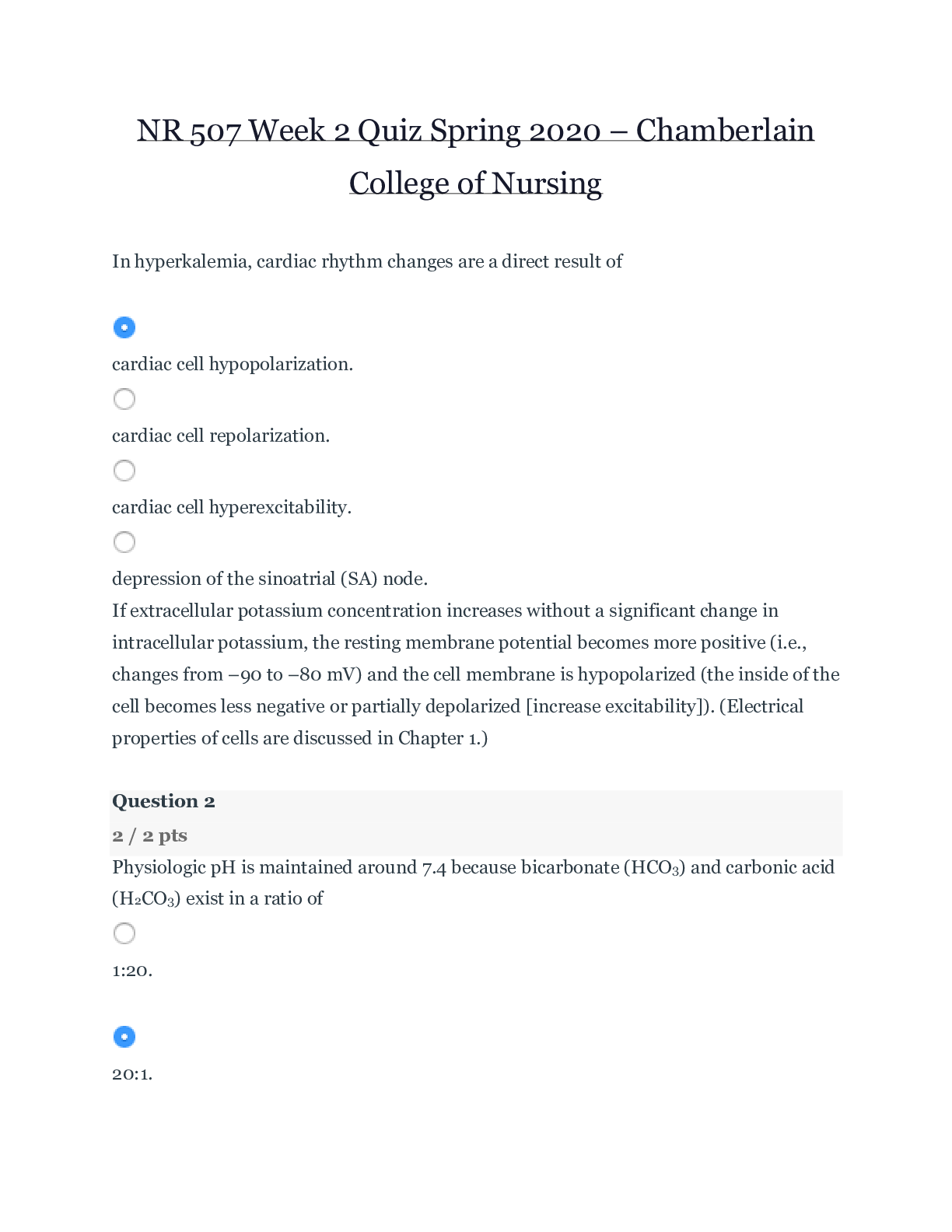
In hyperkalemia, cardiac rhythm changes are a direct result of
Correct Answer
cardiac cell hypopolarization.
cardiac cell repolarization.
You Answered
cardiac cell hyperexcitability.
depression of the sinoatrial (SA) node.
If extracellular potassium concentration increases without a significant change in intracellular potassium, the resting membrane potential becomes more positive (i.e., changes from –90 to –80 mV) and the cell membrane is hypopolarized (the inside of the cell becomes less negative or partially depolarized [increase excitability]). (Electrical properties of cells are discussed in Chapter 1.)
Question 5
2 / 2 pts
Why are infants susceptible to significant losses in total body water (TBW)?
Because they are unable communicate adequately when they are thirsty
Because more than half of an infant’s body weight is water
Correct!
Because an infant’s kidneys are not mature enough to counter fluids losses
Because infants have a slow metabolic rate
Infants are particularly susceptible to significant changes in TBW because of their high metabolic rate and the accelerated turnover of body fluids caused by their greater body surface area in proportion to total body size. Loss of fluids from diarrhea can represent a significant proportion of body weight. Renal mechanisms that regulate fluid and electrolyte conservation may not be mature enough to counter the losses, so dehydration may develop rapidly.
Question 6
2 / 2 pts
Physiologic pH is maintained around 7.4 because bicarbonate (HCO3) and carbonic acid (H2CO3) exist in a ratio of
1:20.
Correct!
20:1.
10:5.
10:2.
The relationship between bicarbonate and carbonic acid is usually expressed as a ratio. When the pH is 7.40, this ratio is 20:1 (bicarbonate/carbonic acid).
Question 7
2 / 2 pts
How does the loss of chloride during vomiting cause metabolic alkalosis?
Loss of chloride causes hydrogen to move into the cell and exchange with potassium to maintain cation balance.
Correct!
Loss of chloride causes retention of bicarbonate to maintain the anion balance.
Loss of chloride causes hypoventilation to compensate for the metabolic alkalosis.
Loss of chloride stimulates the release of aldosterone, which causes the retained sodium to bind with the chloride.
When acid loss is caused by vomiting with depletion of ECF and chloride (hypochloremic metabolic alkalosis), renal compensation is not very effective because the volume depletion and loss of electrolytes (Na+, K+, H+, Cl-) stimulate a paradoxical response by the kidneys. The kidneys increase sodium and bicarbonate reabsorption with excretion of hydrogen. Bicarbonate is reabsorbed to maintain an anionic balance because the ECF chloride concentration is decreased.
Question 8
2 / 2 pts
Which of the following is a true statement?
Hyperventilation results in an increased PaCO2.
Correct!
Hyperventilation causes hypocapnia.
Hyperventilation causes hypercapnia.
Hypoventilation causes hypocapnia.
Hyperventilation is alveolar ventilation that exceeds metabolic demands. The lungs remove CO2 at a faster rate than it is produced by cellular metabolism, resulting in decreased PaCO2 or hypocapnia.
Question 9
2 / 2 pts
_____ is a fulminant form of respiratory failure characterized by acute lung inflammation and diffuse alveolocapillary injury.
Acute pulmonary edema
Pneumonia
Correct!
Acute respiratory distress syndrome (ARDS)
Pulmonary emboli
ARDS is a fulminant form of respiratory failure characterized by acute lung inflammation and diffuse alveolocapillary injury.
Question 10
2 / 2 pts
Clinical manifestations that include unexplained weight loss, dyspnea on exertion, use of accessory muscles, and tachypnea with prolonged expiration are indicative of
Correct!
emphysema.
asthma.
pneumonia.
chronic bronchitis.
Individuals with emphysema usually have dyspnea on exertion that later progresses to marked dyspnea, even at rest (Table 33-3). Little coughing and very little sputum are produced. The individual often is thin, has tachypnea with prolonged expiration, and must use accessory muscles for ventilation. The anteroposterior diameter of the chest is increased (barrel chest), and the chest has a hyperresonant sound with percussion.
Question 11
2 / 2 pts
Which inflammatory mediators are produced in asthma?
Correct!
Histamine, prostaglandins, and leukotrienes
Bradykinin, serotonin, and neutrophil proteases
Neutrophil proteases, bradykinin, and histamine
Lymphokines, serotonin, and prostaglandins
A large number of inflammatory mediators, such as histamine, prostaglandins, and leukotrienes are produced by asthma.
Question 12
2 / 2 pts
A(n) _____ is a circumscribed area of suppuration and destruction of lung parenchyma.
empyema
consolidation
Correct!
abscess
cavitation
An abscess is a circumscribed area of suppuration and destruction of lung parenchyma.
Question 13
2 / 2 pts
Which pleural abnormality involves a site of pleural rupture that act as a one-way valve, permitting air to enter on inspiration but preventing its escape by closing during expiration?
Correct!
Tension pneumothorax
Secondary pneumothorax
Open pneumothorax
Spontaneous pneumothorax
In tension pneumothorax, the site of pleural rupture acts as a one-way valve, permitting air to enter on inspiration but preventing its escape by closing up during expiration. As more and more air enters the pleural space, air pressure in the pneumothorax begins to exceed barometric pressure.
Question 14
2 / 2 pts
Kussmaul respirations may be characterized as a respiratory pattern
commonly observed in chronic obstructive pulmonary disease.
Correct!
with a slightly increased ventilatory rate, large tidal volumes, and no expiratory pause.
commonly observed in pulmonary fibrosis.
with alternating periods of deep and shallow breathing.
Kussmaul respirations are characterized by a slightly increased ventilatory rate, very large tidal volume, and no expiratory pause.
Question 15
2 / 2 pts
High altitudes may produce hypoxemia through
shunting.
Correct!
decreased inspired oxygen.
hypoventilation.
diffusion abnormalities.
The first factor is the presence of adequate oxygen content of the inspired air. Oxygen content is lessened at high altitudes.
Question 16
2 / 2 pts
In ARDS, alveoli and respiratory bronchioles fill with fluid as a result of the
increased capillary hydrostatic pressure that forces fluid into the alveoli and respiratory bronchioles.
Correct!
inactivation of surfactant and the impairment of type II alveolar cells.
compression on the pores of Kohn, thus preventing collateral ventilation.
increased capillary permeability, which causes alveoli and respiratory bronchioles to fill with fluid.
Lung inflammation and injury damages the alveolar epithelium and the vascular endothelium. Surfactant is inactivated, and its production by type II alveolar cells is impaired as alveoli and respiratory bronchioles fill with fluid or collapse.
Question 17
2 / 2 pts
In tuberculosis, the body walls off the bacilli in a tubercle by stimulating
macrophages that release TNF-α.
formation of immunoglobulin G to initiate the complement cascade.
Correct!
apoptotic infected macrophages that activate cytotoxic T cells.
phagocytosis by neutrophils and eosinophils.
In defense, macrophages and lymphocytes release interferon, which inhibits the replication of the microorganism and stimulates more macrophages to attack the bacterium. Apoptotic infected macrophages also can activate cytotoxic T cells (CD8).
Question 18
2 / 2 pts
Clinical manifestations of pulmonary hypertension include
dyspnea on exertion and paroxysmal nocturnal dyspnea.
productive cough and rhonchi bilaterally.
systemic blood pressure greater than 130/90.
Correct!
peripheral edema and jugular venous distention.
Symptoms of fatigue, chest discomfort, tachypnea, and dyspnea on exertion, palpitations, and cough are common. Examination may reveal peripheral edema, jugular venous distention, a precordial heave, and accentuation of the pulmonary compartment of the second heart sound.
Question 19
2 / 2 pts
What is the primary cause of RDS of the newborn?
Correct!
A surfactant deficiency
An immature immune system
Anemia
Small alveoli
RDS is caused primarily by surfactant deficiency and secondarily by a deficiency in alveolar surface area for gas exchange.
Question 20
2 / 2 pts
Cystic fibrosis (CF) is caused by a(n)
Correct!
autosomal recessive inheritance.
infection.
autosomal dominant inheritance.
malignancy.
Cystic fibrosis is an autosomal recessive inherited disorder that is associated with defective epithelial ion transport.
Question 21
2 / 2 pts
An accurate description of childhood asthma is that it is a(n)
pulmonary disease characterized by severe hypoxemia, decreased pulmonary compliance, and diffuse densities on chest x-ray.
obstructive airway disease characterized by atelectasis and increased pulmonary resistance as a result of a surfactant deficiency.
pulmonary disorder involving an abnormal expression of a protein producing viscous mucus that lines the airways, pancreas, sweat ducts, and vas deferens.
Correct!
obstructive airway disease characterized by reversible airflow obstruction, bronchial hyperreactivity, and inflammation.
Asthma is an obstructive airway disease characterized by reversible airflow obstruction, bronchial hyperreactivity, and inflammation.
Question 22
2 / 2 pts
Which of the following types of croup is most common?
Autoimmune
Correct!
Viral
Bacterial
Fungal
In 85% of cases, croup is caused by a virus, most commonly parainfluenza; however, other viruses such as influenza A or RSV also can cause croup.
Question 23
2 / 2 pts
Which of the following statements about the advances in the treatment of RDS of the newborn is incorrect?
Administering glucocorticoids to women in preterm labor accelerates the maturation of the fetus’s lungs.
Supporting the infant’s respiratory function by using continuous positive airway pressure (CPAP). An infant’s respiratory function is supported by using continuous pressure (CPAP).
Treatment includes the instillation of exogenous surfactant down an endotracheal tube of infants weighing less than 1,000 g.
Correct!
Administering oxygen to mothers during preterm labor increases their arterial oxygen before birth of the fetus.
Administration of oxygen to the mother is not a valid treatment of RDS.
Question 24
2 / 2 pts
Chest wall compliance in infants is _____ in adults.
unlike that
lower than
the same as
Correct!
higher than
Chest wall compliance is high in infants, particularly premature infants.
Question 25
2 / 2 pts
The release of fibroblast growth factors affects ARDS by causing
atelectasis and decreased lung compliance.
disruption of alveolocapillary membrane.
pulmonary hypertension.
Correct!
pulmonary fibrosis.
In the fibroproliferative phase, type II alveolar cells proliferate, and there is alveolar septal thickening and collagen deposition. Interstitial fibrosis can be evident as early as 10 days after the initial insult. Similarly, vascular changes may occur, including obliteration of the microcirculation and thickening of the walls of pulmonary arterioles and arteries, which can lead to chronic pulmonary hypertension in survivors.
[Show More]






 – Chamberlain College of Nursing.png)
 – Chamberlain College of Nursing.png)