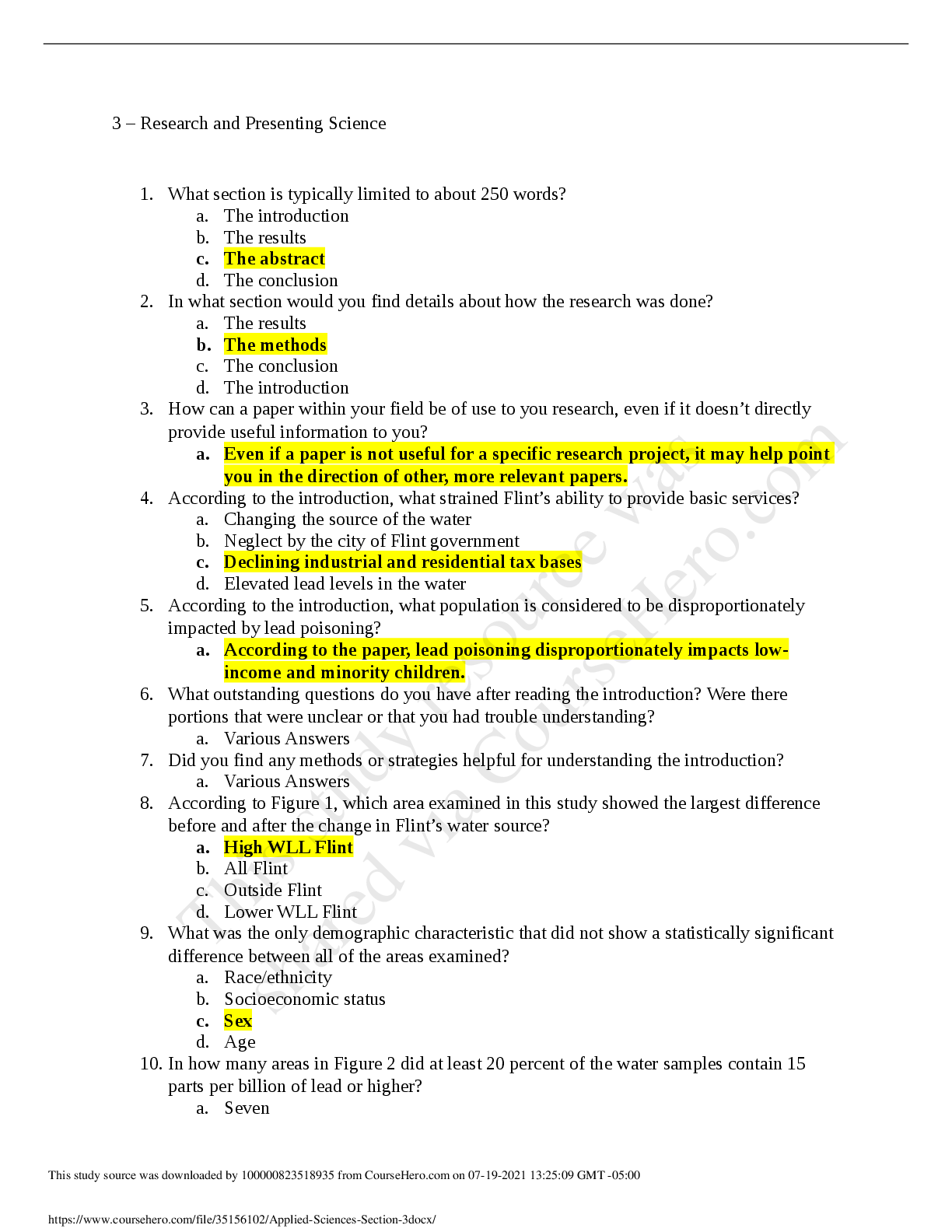
Selected practice questions from Chapters 6 – 8, FIN 335, with Dr.
Graham
From Chapter 6 – Bonds and Bond Value
1. The stated interest payment, in dollars, made on a bond each period is called the bond's:
A) Coupon.
...
Selected practice questions from Chapters 6 – 8, FIN 335, with Dr.
Graham
From Chapter 6 – Bonds and Bond Value
1. The stated interest payment, in dollars, made on a bond each period is called the bond's:
A) Coupon.
B) Face value.
C) Maturity.
D) Yield to maturity.
E) Coupon rate.
Answer: A
2. The principal amount of a bond that is repaid at the end of the loan term is called the bond's:
A) Coupon.
B) Face value.
C) Maturity.
D) Yield to maturity.
E) Coupon rate.
Answer: B
3. The rate of return required by investors in the market for owning a bond is called the:
A) Coupon.
B) Face value.
C) Maturity.
D) Yield to maturity.
E) Coupon rate.
Answer: D
4. The annual coupon of a bond divided by its face value is called the bond's:
A) Coupon.
B) Face value.
C) Maturity.
D) Yield to maturity.
E) Coupon rate.
Answer: E
5. A bond with a face value of $1,000 that sells for less than $1,000 in the market is called a:
A) Par bond.
B) Discount bond.
C) Premium bond.
D) Zero coupon bond.
E) Floating rate bond.
Answer: B
6. A bond with a face value of $1,000 that sells for more than $1,000 in the market is called a:
A) Par bond.
B) Discount bond.
C) Premium bond.
D) Zero coupon bond.
E) Floating rate bond.
Answer: C7. The long-term bonds issued by the United States government are called:
A) Treasury bonds.
B) Municipal bonds.
C) Floating rate bonds.
D) Junk bonds.
E) Zero coupon bonds.
Answer: A
8. A bond that makes no coupon payments (and thus is initially priced at a deep discount to par
value) is called a _______ bond.
A) Treasury
B) municipal
C) floating rate
D) junk
E) zero coupon
Answer: E
9. A bond which, at the election of the holder, can be swapped for a fixed number of shares of
common stock at any time prior to the bond's maturity is called a _____________ bond.
A) zero coupon
B) callable
C) putable
D) convertible
E) warrant
Answer: D
10. The annual coupon payment of a bond divided by its market price is called the:
A) Coupon rate.
B) Current yield.
C) Yield to maturity.
D) Bid-ask spread.
E) Capital gains yield.
Answer: B
11. The price a dealer is willing to accept for selling a security to an investor is called the:
A) Equilibrium price.
B) Auction price.
C) Bid price.
D) Ask price.
E) Bid-ask spread.
Answer: D
12. A bond with a face value of $1,000 has annual coupon payments of $100 and was issued 10 years
ago. The bond currently sells for $1,000 and has 8 years remaining to maturity. This bond's
______________ must be 10%.
I. yield to maturity
II. market premium
III. coupon rate
A) I only
B) I and II only
C) III only
D) I and III only
E) I, II and III
Answer: D13. If you divide a bond's annual coupon payment by its current yield you get the ___________.
A) yield to maturity
B) investors' required rate of return
C) annual coupon rate
D) cost of capital
E) bond price
Answer: E
14. Which of the following statements regarding bond pricing is true?
A) The lower the discount rate, the more valuable the coupon payments are today.
B) Bonds with high coupon payments are generally (all else the same) more sensitive to changes
in interest rates than bonds with lower coupon payments.
C) When market interest rates rise, bond prices will also rise, all else the same.
D) Bonds with short maturities are generally (all else the same) more sensitive to changes in
interest rates than bonds with longer maturities.
E) All else the same, bonds with larger coupon payments will have a lower price today.
Answer: A
15. Your broker offers you the opportunity to purchase a bond with coupon payments of $90 per year
and a face value of $1000. If the yield to maturity on similar bonds is 8%, this bond should:
A) Sell for the same price as the similar bond regardless of their respective maturities.
B) Sell at a premium.
C) Sell at a discount.
D) Sell for either a premium or a discount but it's impossible to tell which.
E) Sell for par value.
Answer: B
16. When pricing bonds, if a bond's coupon rate is less than the required rate of return, then:
A) The holder of the bond is assured of a profit regardless of when the bond is eventually sold.
B) The holder of the bond will realize a capital gain if the bond is held to maturity.
C) The bond sells at par because the required rate of return is adjusted to reflect the discrepancy.
D) The bond sells at a premium if it has a long maturity and at a discount if it has a short
maturity.
E) The bond sells at a discount if it has a long maturity and at a premium if it has a short
maturity.
Answer: B
17. All else the same, a(n) __________ will decrease the required return on a bond.
A) call provision
B) lower bond rating
C) sinking fund
D) increase in inflation
E) increase in the size of a bond issuance
Answer: C
18. Which of the following items generally appears in a corporate bond quote from The Wall Street
Journal?
A) Yield to maturity
B) Original issue price
C) Current yield
D) Name of the trustee
E) Bond rating
Answer: C19. For a discount bond, the current yield is _________ the yield to maturity, and the coupon rate is
_____________ the yield to maturity.
A) less than; less than
B) less than; greater than
C) greater than; less than
D) greater than; greater than
E) equal to; equal to
Answer: A
20. For a premium bond, the required return is less than the:
I. Current yield.
II. Yield to maturity.
III. Coupon rate.
A) I only
B) I and II only
C) II and III only
D) I and III only
E) I, II, and III
21. If investors are uncertain that they will be able to sell a corporate bond quickly, the investors will
demand a higher yield in the form of a(n) ____________.
A) inflation premium
B) liquidity risk premium
C) interest rate risk premium
D) default risk premium
E) increased real rate of interest
Answer: B
22. Dizzy Corp. bonds bearing a coupon rate of 12%, pay coupons semiannually, have 3 years
remaining to maturity, and are currently priced at $940 per bond. What is the yield to maturity?
A) 12.00%
B) 13.99%
C) 14.54%
D) 15.25%
E) 15.57%
Answer: C
Response: $940 = 1000 FV, 60 PMT, 6 N, -940 PV, CPT I/Y = 7.27%;
YTM = 7.27% x 2 = 14.54%
23. Whitesell Athletic Corporation's bonds have a face value of $1,000 and a 9% coupon paid
semiannually; the bonds mature in 8 years. What current yield would be reported in The Wall
Street Journal if the yield to maturity is 7%?
A) 4%
B) 5%
C) 6%
D) 7%
E) 8%
Answer: E
Response:
1000 FV, 45 PMT, 16 N, 3.5 I/Y, CPT PV = $1,120.94; Annual coupon is 45 x 2 = 90.
Current Yield (CY) = $90 / 1,120.94 = 8.03%24. D&G Enterprises issues bonds with a $1,000 face value that make coupon payments of $30 every
3 months. What is the coupon rate?
A) 0.30%
B) 3.00%
C) 9.00%
D) 12.00%
E) 30.00%
Answer: D
Response: coupon rate = ($30 x 4) / 1,000 = 12%
25. Suppose you purchase a zero coupon bond with face value $1,000, maturing in 25 years, for
$180. What is the implicit interest, in dollars, in the first year of the bond's life?
A) $ 2.86
B) $ 9.84
C) $12.78
D) $19.27
E) $30.00
[Show More]


.png)
.png)
.png)

.png)


.png)
.png)
.png)
.png)
 Janice Loftus, Ken Leo, Sorin Daniliuc, Noel Boys, Belinda Luke, Hong Ang, Karyn Byrnes (Test Bank).png)

 Charles Herrick - 100 Q&A About Alcoholism & Drug Addiction-Jones and Bartlett Publishers, Inc.png)