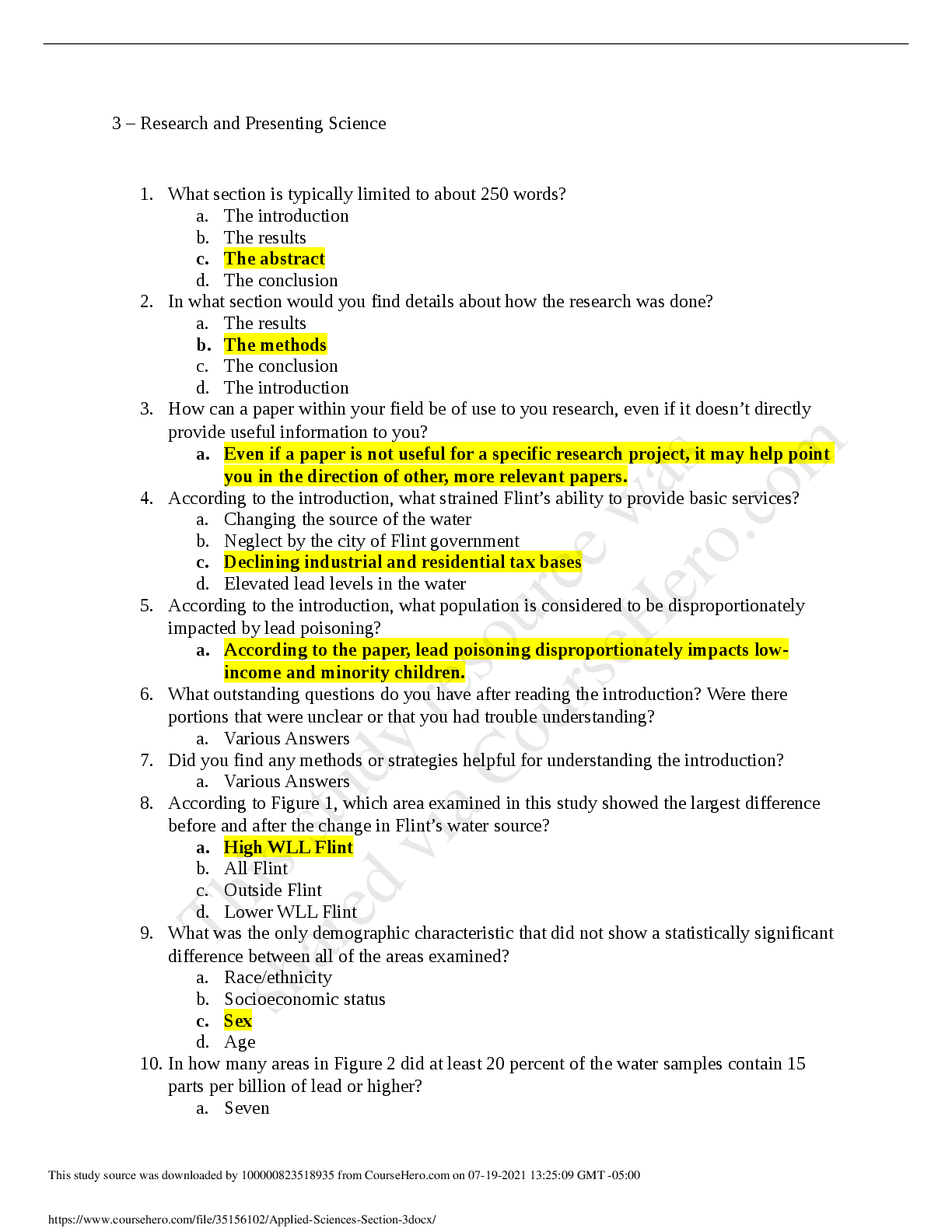
on 1 0.08 / 0.08 points
A graphical representation of a sequences of events that may lead to favorable or unfavorable outcomes is
usually called
Question options:
an event tree
a risk tree
a decision tree
a fault
...
on 1 0.08 / 0.08 points
A graphical representation of a sequences of events that may lead to favorable or unfavorable outcomes is
usually called
Question options:
an event tree
a risk tree
a decision tree
a fault tree
a probability tree
Question 2 0.08 / 0.08 points
SCM Chemicals Inc. opened a sulfate plant in Baltimore. To comply with environmental standards SCM has to
invest $200 per ton. Expected annual revenue is $30 per ton. What interest rate breaks the project even over
a ten-year service life of the plant?
Question options:
5%
6%
7%
8%
9%
Question
3 0.08 / 0.08 points
Delvekio Ltd. wants to purchase a new sewing machine for $9,000. This machine will save $2,000 a year for
the next 10 years. It can then be sold at the end of 10 years for $800. The firm has established a rate of 10%
as a MARR. If expected cash flows are uncertain, what is the minimum cash flow needed to still meet the
required 10% MARR? Use the following table to answer the question:
Cash Flows Value
Present Worth
Factor PW
Purchase price $9,000 1.0000 $9,000
Cost savings $2,000 6.1446 $12,289
Salvage value $800 0.3855 $308
Question options:
$1,415
$1,692
$2,012$1,814
$1,212
Question
4 0.08 / 0.08 points
The break-even analysis should be used
Question options:
if a payback period is long or when the cost of borrowing money
is high.
if the improved tangible benefits form a convincing argument for
new system.
if a project needs to be justified in terms of a benefit-cost ratio.
if a project needs to be justified in terms of cost, not benefits, or
if benefits do not substantially improve a project with a proposed
new system.
if a project is expensive relative to the size of a company or
when large drain on funds would hurt a company.
Question
5 0.08 / 0.08 points
Probabilities are used to quantify uncertainties. In risk analysis several types of uncertainties are generally
distinguished. What type of uncertainty considered by risk analysis is the most difficult to address?
Question options:
uncertainties associated with neglecting systematic variations of
the observed variables
uncertainties associated with limited number of observations or
test results
uncertainties associated with forecasting of future developments
uncertainties associated with neglecting possible correlations
between the observed variables
uncertainties associated with the idealized models for the
description of complicated physical phenomena
Question
6 0.08 / 0.08 points
An engineering project is considering the reinforcement of a concrete beam. From the experience it is known
that the probability that corrosion of the reinforcement occurs is 1%. However, to know more precisely an
inspection is done. The quality of the inspection is characterized by the probability of 80% that the inspection
does correctly indicate corrosion and the probability of 10% that the inspection indicates corrosion when it
does not occur. Latter represents the probability of an error. What is the overall probability of discovering
corrosion at inspection?
Question options:
0.0080.8
0.9
0.001
0.09
Question
7 0.08 / 0.08 points
Suppose that a project scenario analysis was performed, and five scenarios were evaluated in terms of the
project's Present Worth as summarized in the following table:
Scenario PW
1 $10 million
2 $15 million
3 $9 million
4 $12 million
5 $8 million
If all scenarios are equally likely, what is the expected Present Worth of the project?
Question options:
$54 million
$10 million
$10.8 million
$12 million
$15 million
Question 8 0.08 / 0.08 points
Irving Oil is announcing that it plans to build a mega power plant in Saint John, NB. If the total production is
500 megawatt of electricity, total fixed cost of production is $15,000, total variable costs of production is
$30,000, determine the break-even price of electricity per kilowatt of electricity.
Question options:
10 cents
13 cents
12 cents
11 cents
9 cents
Question
9 0.08 / 0.08 points
What basic assumption is behind the scenario analysis?Question options:
probabilities of outcomes are continuously distributed
distribution of a project variable is random
inputs are perfectly correlated
probabilities of different outcomes are known
outcomes are discrete
Question
10 0.08 / 0.08 points
A firm can invest $5 million in a new food processing plant. The plant has an expected life of 20 years and
expected sales of 6 million food cans a year. Fixed costs are $2 million a year and variable costs are $1 per
can. The product will be priced at $2 per can. A corporate tax rate is 40% and a MARR is 10%. What is the
project Net Present Worth under the base case assumptions?
Note: (P/A, 10%, 20) = 8.51 and ignore the tax effect on the first cost
Question options:
$20.4 million
$25.6 million
$29.0 million
$46.1 million
$15.4 million
Question 11 0.08 / 0.08 points
The sensitivity graph of a project is presented as follows:
What project variable has the least impact on the performance measure?
Question options:Fixed Costs (FC)
Operation and Maintenance Costs (O&M)
Minimum Acceptable Rate of Return (MARR)
Variable Costs (VC)
Salvage Value (SV)
Question 12 0.08 / 0.08 points
A decision tree of a project is represented by the following graph:
What is the outcome of an alternative A if the expected monetary value of the project is $4.56?
Question options:
$10.3
$8.4
$2.5
$5.0
$2.0
Question
13 0.08 / 0.08 pointsA decision tree of a project is given as follows:
What is the equivalent decision tree?
Question options:Question 14 0 / 0.08 points
The cumulative distribution function (CDF) provides
Question options:
the probability that a discrete random variable, X, is equal to
the value of an outcome x and is given as
where xi is an i outcome of a random variable X, and m is the
total number of possible discrete outcomes
the probability that a discrete random variable, X, is less than
or equal to the value of an outcome x and is given as
where xi is an i outcome of a random variable X, and m is the
total number of possible discrete outcomes
the probability that a discrete random variable, X, is less than
the value of an outcome x and is given as
where xi is an i outcome of a random variable X, and m is total
number of random variables
the probability that a discrete random variable, X, is greater
than the value of an outcome x and is given aswhere xi is an i outcome of a random variable X, and m is total
number of possible discrete outcomes
the probability that a discrete random variable, X, is equal to
the value of an outcome x and is given as
where xi is an i outcome of a random variable X, and m is total
number of possible discrete outcomes
Question
15 0.08 / 0.08 points
Which of the following questions should not be answered by the sensitivity analysis?
Question options:
if an interest rates change, what will be the effect?
if mutually exclusive projects have different lives which of them
should be accepted?
if the cost overrun exceeds 10% should this project be
rejected?
would a 5% cost reduction still allow a project to be accepted?
if an economic forecast shows that the inflation rate will climb
up how would this hurt a project?
Question
16 0.08 / 0.08 points
Which of the following is an example of a discrete random variable?
Question options:
demand for water by households
capacity of electric equipment
annual consumption of gasoline
number of sunny days per week
price of a share
Question 17 0.08 / 0.08 points
Sensitivity analysis is aimed at
Question options:
establishing the effects of estimated input values on a project'skey parameters.
establishing the level of data inaccuracies.
gaining a better understanding of how cash flows, project life,
interest rate and inflation rate affect the outcomes of a project.
predicting the plausibility of the key project factors.
establishing the range of variations of the key project
parameters.
Question
18 0.08 / 0.08 points
In a sensitivity graph what do the slopes of the lines show?
Question options:
how sensitive the PW is to changes in each of the inputs: the
steeper the slope, the less sensitive the PW is to a change in a
particular variable
how sensitive the cash flows expressed in actual dollars are to
changes in each of the inputs: the steeper the slope, the more
sensitive thy are to a change in a particular variable
how sensitive the PW is to changes in each of the inputs: the
steeper the slope, the more sensitive the PW is to a change in a
particular variable
how sensitive the Benefit-Cost Ratio is to changes in each of
the inputs: the steeper the slope, the more sensitive the
Benefit-Cost Ratio is to a change in a particular variable
how sensitive the Benefit-Cost Ratio is to changes in each of
the inputs: the steeper the slope, the less sensitive the BenefitCost Ratio is to a change in a particular variable
Question
19 0.08 / 0.08 points
Delvekio Ltd. wants to purchase a new sewing machine for $9,000. This machine will save $2,000 a year for
the next 10 years. It can then be sold at the end of 10 years for $800. The firm has established a rate of 10%
as a MARR. If the expected useful life is uncertain, how long does the sewing machine need to last in order
for the investment to still be acceptable? Use the following tables to answer the question:
Cash Flows Value
Present Worth
Factor PW
Purchase price $9,000 1.0000 $9,000
Cost savings $2,000 6.1446 $12,289
Salvage value $800 0.3855 $308
Net present value $3,597
Years (P/A. 10%, N)4 3.17
5 3.79
6 4.36
7 4.87
Question options:
4 years
7 years
6 years
5 years
8 years
Question
20 0.08 / 0.08 points
As a rule, the scenario analysis
Question options:
is always correlated with a firm's other assets or stocks in
general.
does not require qualitative judgement.
measures stand-alone risk, so ignores risk diversification.
does not provide a range of possible outcomes.
measures project's impacts on uncertainty about firm's future
earnings.
Question
21 0.08 / 0.08 points
A firm developed a new product. The market price of this product is $10 per unit, variable cost is $6 per unit,
total fixed costs are $100,000. Suppose that a firm wants to have $2 profit per unit. How many units should
be produced to generate $2 profit per unit sold?
Question options:
50,000
10,000
65,000
25,000
40,000
Question
22 0.08 / 0.08 points
The results of a scenario analysis for a project is as follows:Case Probability Unit Sales Net Present Worth
Worst 25% 80,000 $30
Base 50% 100,000 $20
Best 25% 120,000 $60
Calculate the Expected Net Present Worth:
Question options:
$20.0
$28.4
$36.7
$55.0
$32.5
Question
23 0.08 / 0.08 points
A company is considering developing a new product. Preliminary accounting cash flow forecast is as follows:
Cash Flow Value
Market price (per unit) $150
Variable costs (per unit) $100
Fixed costs and depreciation $200,000
Corporate tax rate 30%
How many units of this product should be produced to reach an accounting break-even point?
Question options:
2,000 units
32,000 units
16,000 units
4,000 units
8,000 units
Question 24 0.08 / 0.08 pointsUsing the following graphs calculate how many units should be produced to break the project even?
Note: Vertical axis shows dollar values per unit produced
Question options:
700
400
800
500
600
Question
25 0.08 / 0.08 points
Break-even analysis is useful when dealing with
Question options:
a changing variable.
a variable with a high probability of occurring.
many variables at a time.
an accurately forecasted variable.a constant variable.Uncertainty
on 1 0.08 / 0.08 points
Delvekio Ltd. wants to purchase a new sewing machine for $9,000. This machine will save $2,000 a year for the next
10 years. It can then be sold at the end of 10 years for $800. The firm has established a rate of 10% as a MARR. If
the expected useful life is uncertain, how long does the sewing machine need to last in order for the investment to still
be acceptable? Use the following tables to answer the question:
Cash Flows Value
Present Worth
Factor PW
Purchase price $9,000 1.0000 $9,000
Cost savings $2,000 6.1446 $12,289
Salvage value $800 0.3855 $308
Net present value $3,597
Years (P/A. 10%, N)
4 3.17
5 3.79
6 4.36
7 4.87
Question options:
4 years
7 years
6 years
5 years
8 years
Question
2
0.08 / 0.08
points
A construction project should be undertaken. Costs of construction depend on weather. Historical weather data shows
that in the fall the weather is warm 20% of the time, it is cold 30% of the time and the remainder is something in
between. During warm weather cost is expected to be $225,000, during cold weather - $295,000, in between -
$250,000. What is the expected cost of construction?
Question options:
$230,500
$225,500
$242,500
$245,500
$258,500
Question 3 0 / 0.08
pointsOne of the following is consistent with scenario analysis. Which one?
Question options:
impact on PW and/or IRR when one input is fixed and other inputs change
up or down.
impact on PW and/or IRR when one input is changed up and other inputs
change down.
impact on PW and/or IRR when one input is changed up or down and other
inputs remain unchanged.
impact on a project's input when IRR remains unchanged
impact on a project's inputs when IRR of a project is changed up or down.
Question
4
0.08 / 0.08
points
A decision tree of a project is represented by the following graph:
What is the outcome of an alternative A if the expected monetary value of the project is $4.56?
Question options:
$10.3
$8.4
$2.5
$5.0
$2.0
Question
5
0.08 / 0.08
pointsUsing the following graphs calculate how many units should be produced to break the project even?
Note: Vertical axis shows dollar values per unit produced
Question options:
700
400
800
500
600
Question
6
0.08 / 0.08
points
The probability of 6 while rolling a dice is equal to 1/6 is an example of
Question options:
classic or symmetric probability
probability as frequency
subjective probabilityobjective probability
axiomatic probability
Question 7 0.08 / 0.08
points
A decision tree of a project is given as follows:
What is the equivalent decision tree?
Question options:Question
8
0.08 / 0.08
points
A firm developed a new product. The market price of this product is $10 per unit, variable cost is $6 per unit, total
fixed costs are $100,000. Suppose that a firm wants to have $2 profit per unit. How many units should be produced to
generate $2 profit per unit sold?
Question options:
50,000
10,000
65,000
25,000
40,000
Question
9
0.08 / 0.08
points
A firm can invest $5 million in a new food processing plant. The plant has an expected life of 20 years and expected
sales of 6 million food cans a year. Fixed costs are $2 million a year and variable costs are $1 per can. The product
will be priced at $2 per can. A corporate tax rate is 40% and a MARR is 10%. What would the project's Net Present
Worth be if variable costs increased by 20%?
Note: (P/A, 10%, 20) = 8.51 and ignore the tax effect on the first cost
Question options:
$9.3 million
$30.8 million
$14.5 million
$11.8 million
$13.8 millionQuestion 10 0.08 / 0.08
points
Sensitivity analysis is aimed at
Question options:
establishing the effects of estimated input values on a project's key
parameters.
establishing the level of data inaccuracies.
gaining a better understanding of how cash flows, project life, interest rate
and inflation rate affect the outcomes of a project.
predicting the plausibility of the key project factors.
establishing the range of variations of the key project parameters.
Question
11
0.08 / 0.08
points
Which of the following is an example of a discrete random variable?
Question options:
demand for water by households
capacity of electric equipment
annual consumption of gasoline
number of sunny days per week
price of a share
Question 12 0.08 / 0.08
points
A graphical representation of a sequences of events that may lead to favorable or unfavorable outcomes is usually
called
Question options:
an event tree
a risk tree
a decision tree
a fault tree
a probability tree
Question 13 0.08 / 0.08
points
Break-even analysis is useful when dealing with
Question options:a changing variable.
a variable with a high probability of occurring.
many variables at a time.
an accurately forecasted variable.
a constant variable.
Question 14 0 / 0.08
points
The cumulative distribution function (CDF) provides
Question options:
the probability that a discrete random variable, X, is equal to the value of
an outcome x and is given as
where xi is an i outcome of a random variable X, and m is the total number
of possible discrete outcomes
the probability that a discrete random variable, X, is less than or equal to
the value of an outcome x and is given as
where xi is an i outcome of a random variable X, and m is the total number
of possible discrete outcomes
the probability that a discrete random variable, X, is less than the value of
an outcome x and is given as
where xi is an i outcome of a random variable X, and m is total number of
random variables
the probability that a discrete random variable, X, is greater than the value
of an outcome x and is given as
where xi is an i outcome of a random variable X, and m is total number of
possible discrete outcomes
the probability that a discrete random variable, X, is equal to the value ofan outcome x and is given as
where xi is an i outcome of a random variable X, and m is total number of
possible discrete outcomes
Question
15
0 / 0.08
points
Consider the following two alternatives:
Alternative A
Probability PW of alternative A
0.1 $15 million
0.5 $5 million
0.4 $6 million
Alternative B
Probability PW of alternative B
0.1 $10 milliom
0.2 $5 million
0.3 $4 million
0.4 $6 million
What alternative should be chosen and what is its expected Present Worth?
Question options:
A and $5.6 million
B and $6.4 million
A and $6.4 million
B and $5.6 million
Both are of equal value of $5.4
Question 16 0.08 / 0.08
points
For a given decision tree what is the optimal decision strategy?
Question options:
a strategy which results in the highest profit or lowest cost at any given
point in time
a strategy which results in the highest alternative's outcome if we maximize
profit and the lowest alternative's outcome if we minimize costa strategy which results in the highest EV if we maximize profit and the
lowest EV if we minimize cost
a strategy which results in the highest probability of an outcome if we
maximize profit and the lowest probability of an outcome if we minimize
cost
a strategy which minimizes the risks resulted from uncertainties in possible
outcomes
Question
17
0.08 / 0.08
points
Probabilities are used to quantify uncertainties. In risk analysis several types of uncertainties are generally
distinguished. What type of uncertainty considered by risk analysis is the most difficult to address?
Question options:
uncertainties associated with neglecting systematic variations of the
observed variables
uncertainties associated with limited number of observations or test results
uncertainties associated with forecasting of future developments
uncertainties associated with neglecting possible correlations between the
observed variables
uncertainties associated with the idealized models for the description of
complicated physical phenomena
Question
18
0.08 / 0.08
points
As a rule, the scenario analysis
Question options:
is always correlated with a firm's other assets or stocks in general.
does not require qualitative judgement.
measures stand-alone risk, so ignores risk diversification.
does not provide a range of possible outcomes.
measures project's impacts on uncertainty about firm's future earnings.
Question
19
0.08 / 0.08
points
Suppose that a project scenario analysis was performed, and five scenarios were evaluated in terms of the project's
Present Worth as summarized in the following table:
Scenario PW
1 $10 million
2 $15 million
3 $9 million4 $12 million
5 $8 million
If all scenarios are equally likely, what is the expected Present Worth of the project?
Question options:
$54 million
$10 million
$10.8 million
$12 million
$15 million
Question 20 0.08 / 0.08
points
Which of the following is not a break-even point of a project?
Question options:
the price level at which income equals expense
the market price of a financial instrument that just equals the purchase
price plus cost of carry for an investor owning that instrument
the expense level at which expense equals income
the price level of a call option that equals the sum of the exercise price plus
the premium paid to acquire the option
the maximum interest rate that a firm can pay from available cash flow and
still have enough cash flow to make all required principal and interest
payments
Question
21
0.08 / 0.08
points
The break-even analysis should be used
Question options:
if a payback period is long or when the cost of borrowing money is high.
if the improved tangible benefits form a convincing argument for new
system.
if a project needs to be justified in terms of a benefit-cost ratio.
if a project needs to be justified in terms of cost, not benefits, or if benefits
do not substantially improve a project with a proposed new system.
if a project is expensive relative to the size of a company or when large
drain on funds would hurt a company.
Question
22
0 / 0.08
pointsIn general, risk is defined as
Question options:
the probability that an event will occur divided by its monetary
consequences.
the distribution of probabilities of different consequences of an activity.
the probability of an undesirable outcome.
the most likely outcome of the event
the probability that an event will occur multiplied by its monetary
consequences.
Question
23
0.08 / 0.08
points
The two major weaknesses of a sensitivity analysis are
Question options:
ignoring an impact of uncertainty in identified variable on PW or IRR of a
project.
ignoring intuition of an analyst and ignoring relationship among variables.
ignoring identification of variables and ignoring relationship among
variables.
ignoring breakeven information and ignoring relationship among variables.
ignoring likelihood of changes in variables and ignoring relationship among
variables.
Question
24
0.08 / 0.08
points
A company is considering developing a new product. Preliminary accounting cash flow forecast is as follows:
Cash Flow Value
Market price (per unit) $150
Variable costs (per unit) $100
Fixed costs and depreciation $200,000
Corporate tax rate 30%
How many units of this product should be produced to reach an accounting break-even point?
Question options:
2,000 units
32,000 units
16,000 units
4,000 units8,000 units
Question 25 0.08 / 0.08
points
The results of a scenario analysis for a project is as follows:
Case Probability Unit Sales Net Present Worth
Worst 25% 80,000 $30
Base 50% 100,000 $20
Best 25% 120,000 $60
Calculate the Expected Net Present Worth:
Question options:
$20.0
$28.4
$36.7
$55.0
$32.5
[Show More]

.png)





 Charles Herrick - 100 Q&A About Alcoholism & Drug Addiction-Jones and Bartlett Publishers, Inc.png)