1.
(Points: 1) The following five alternatives are being compared in terms of the present worth of
costs:
ALTERNATIVE EXPECTED VALUE VARIANCE
A 4,000 16,000
B 3,000 18,000
C 6,000 14,000
D 5,000 16,000
E 3,000 14
...
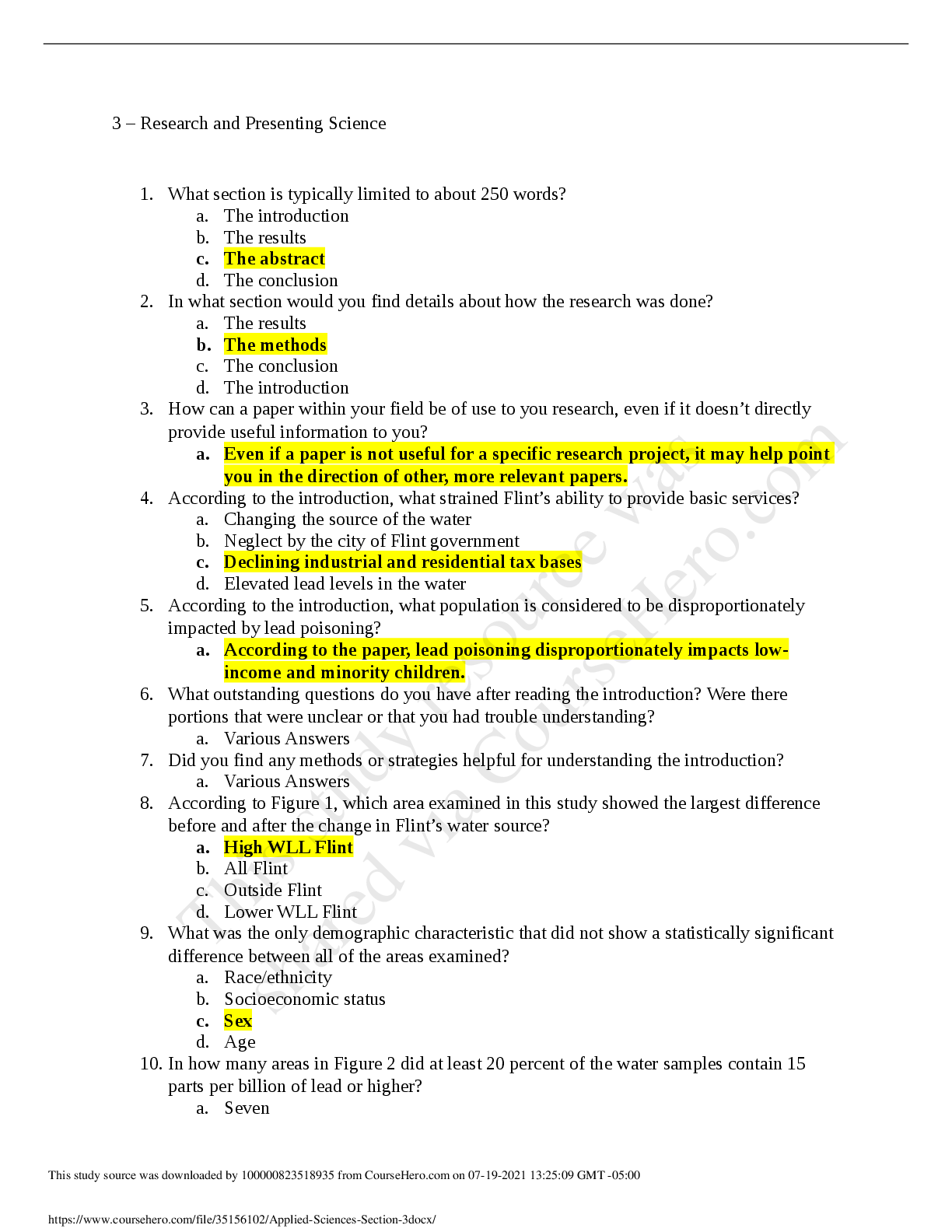
1.
(Points: 1) The following five alternatives are being compared in terms of the present worth of
costs:
ALTERNATIVE EXPECTED VALUE VARIANCE
A 4,000 16,000
B 3,000 18,000
C 6,000 14,000
D 5,000 16,000
E 3,000 14,000
Which one is the best according to the mean-variance dominance criterion?
a. B
b. C
c. A
d. E
e. D
2.
(Points: 1) The expected case scenario means
a. the worst case scenario
b. the most likely scenario
c. the most pessimistic scenario
d. the most optimistic scenario
e. the best case scenario
3.(Points: 1) If interest rate is 10%, the depreciation rate is 10%, service life is 10 years and first
cost is $10 million then EAC(Capital) is
a. $1.409 million
b. $1.060 million ?
c. $1.000 million
d. $1.977 million
e. $1.349 million
4.
(Points: 1) It is known that the inflation rate over next three years is expected to be 5% in the
first year, 10% in the second and 15% in the third. In such a case, average expected annual
inflation rate is
a. 10.00%
b. 15.00%
c. 10.08%
d. 5.00%
e. 9.92%
5.
(Points: 1) Suppose that first cost of an asset is $1 million, the depreciation rate is 10%,
service life is 10 years, the tax rate is 35% , the CCA rate is 30% and the after-tax interest rate is
15%. In this case, the present worth of the salvage value with tax effects incorporated is
a. $0.268 million
b. $0.066 million
c. $0.005 milliond. $0.020 million
e. $0.153 million
6.
(Points: 1) Which of the following statements is correct?
a. To account for tax effects it is necessary to multiply first cost by the tax benefit factor
b. To account for tax effects it is necessary to multiply salvage value by the tax benefit factor
c. To account for tax effects it is necessary to multiply annual savings by the tax benefit
factor
d. To account for tax effects it is necessary to multiply first cost by one munis the tax benefit
factor
e. To account for tax effects it is necessary to multiply anuual savings by one munis the tax
benefit factor
7.
(Points: 1) Capital costs are
a. always sunk costs
b. equally spread over the service life of an asset
c. fixed costs that do not directly depend on the level of production
d. costs of administrative overhead
e. variable costs that directly depend on the level of production
8.
(Points: 1) Sunk costs are
a. non-recoverable portion of capital costsb. costs at the end of an asset's service life
c. operating and maintenance costs
d. opportunity costs
e. external costs
9.
(Points: 1) It is known that demand for a public park is given by the following expression:
MWTP = 2 - 0.5N
where MWTP is marginal willingness to pay in dollars per visit and N is visitation rate in
millions of visits. If admission to the park is free, what is the park's value?
a. $2 million
b. $1 million
c. $5 million
d. $3 million
e. $4 million
10.
(Points: 1) As a result of sensitivity analysis, you ended up with the slope of the sensitivity
graph with respect to first cost equal to -50. It means that
a. An increase in first cost by $1 decreases the present worth of a project by 50%
b. An increase in first cost by 1% decreases the present worth of a project by $50
c. An increase in first cost by $1 decreases the present worth of a project by $50
d. An increase in first cost by 1% decreases the present worth of the first costs by $50e. An increase in first cost by 1% decreases the present worth of a project by 50%
11.
(Points: 1) In general, Monte Carlo Method is
a. simulation of a project's dynamics on the basis of a generator of random numbers
b. simulation of all project's cash flows in a prespecified interval
c. simulation of the PW of a project given the PDFs of the project's inputs
d. simulation of the PDF of a project's economic performance measure given the PDFs of the
project's inputs
e. simulations of a project's risk on the basis of constrained optimization
12.
(Points: 1) Suppose that your income in 2005 was $35,000. If annual inflation rate has been
2% since 2005, what was your income in 2005 in terms of 2010 dollars?
a. $31,700
b. $31,500
c. $32,334
d. $37,885
e. $38,643
13.
(Points: 1) It is known that in 2010 the price of oil was $60 per barrel and it was $9 per barrel
in 1998. In order for these two values to be equivalent, what annual rate of inflation should we
assume?
a. 13%b. 7%
c. 17%
d. 10%
e. 20%
14.
(Points: 1) Future annual revenue generated by a project is a random variable. Probability
distribution function is given as follows
Values, $$/year Probability
10,000 0.1
20,000 0.4
30,000 0.1
40,000 0.3
50,000 0.1
What is the probability of annual revenue being higher than $30,000/year?
a. 0.4
b. 0.3
c. 0.1
d. 0.5
e. 0.6
15.
(Points: 1) Suppose that you need to accumulate $10,000 in three years in todays dollars. What
monthly amount in nominal (actual) dollars should your save if your real rate of return is 5% and
expected annual inflation rate is 3%?a. $268.96
b. $281.96
c. $258.04
d. $275.14
e. $246.14
16.
(Points: 1) Which of the following is not an example of a sensitivity analysis?
a. Sensitivity graphs
b. Scenario analysis
c. Internal Rate of Return calculations
d. Monte Carlo Method
e. Break-even analysis
17.
(Points: 1) In order to define equivalent annual cost operating the following information is
needed
a. interest rate, service life and salvage value
b. salvage value, service life and first cost
c. interest rate, first cost and salvage value
d. interest rate, service life and maintenance costs
e. interest rate, salvage value and annual revenue18.
(Points: 1) To incorporate tax effects into annual savings it is necessary to
a. multiply annual savings by one minus the tax rate
b. multiply by the tax benefit factor
c. divide annual savins by one minus the tax rate
d. multiply annual savings by the tax rate
e. divide annual savings by the tax rate
19.
(Points: 1) It was calculated that a bridge will require $10 million in first costs and $0.5
milllion every year in maintenance and operating costs. CVM revealed that 2 million people
identified themselves as potential bridge users. Average willingness to pay for crossing the
bridge was defined as $5 with 1 million potential crossings per year. If we assume infinite time
horizon for the bridge, what is the benefit-cost ratio of this project under 5% annual interest rate?
a. 1.00
b. 5.00
c. 10.00
d. 0.10
e. 0.20
20.
(Points: 1) Average corporate tax rate in Canada is
a. 30%
b. 36%c. 40%
d. 46%
e. 26%
21.
(Points: 1) In order to define equivalent annual cost capital the following information is
needed
a. interest rate, service life, first cost and salvage value
b. salvage value, service life, first cost and annual revenue
c. interest rate, service life, first cost and maintenance costs
d. interest rate, salvage value, first cost and annual revenue
e. interest rate, service life, salvage value and annual revenue
22.
(Points: 1) Suppose that as a result of a public project evaluation the following information
was obtained:
- PW of the project's capital costs = $9 million
- PW of the project's operating costs = $5 million
- PW of the project's benefits = $20 million
What is the BCRM for this project?
a. 1.07
b. 0.42
c. 2.20
d. 0.67
e. 1.6723.
(Points: 1) Which of the following statements is correct?
a. CPI is the average price of a fixed basket of consumer goods and services relative to base
year
b. Inflation increases the purchasing power of money
c. Inflation rate is given by the CPI
d. Inflation rate is the opportunity cost of money
e. Inflation is a measure of changes in relative prices
24.
(Points: 1) One of the following is not a remedy for market failures. Which one?
a. Monetary policy
b. Regulation by the government
c. Litigation
d. Government provision of a public service
e. Taxation of negative externalities
25.
(Points: 1) Break-even analysis implies that
a. a project's benefits are lower or equal to the project's costs in terms of present worth
b. the present worth of a project is positive
c. a project's benefits are higher than the project's costs in terms of present worth
d. a project's costs are exactly equal to the project's benefitse. the present worth of a project is equal to zero
26.
(Points: 1) Which of the following is an example of market failure?
a. Long distance telephone service
b. Fire protection
c. CNN broadcasting
d. Extraction of natural gas
e. Cellular telephone services
27.
(Points: 1) Which of the following is the best technique to measure a project's risk?
a. Sensitivity graph
b. Decision tree analysis
c. Scenario analysis
d. Monte Carlo simulation
e. Break-even analysis
28.
(Points: 1) In general, an increase in salvage value __________ and an increase in the interest
rate ________ the present worth of a project
a. decreases, decreasesb. does not affect, decreases
c. decreases, increases
d. increases, decreases
e. increases, increases
29.
(Points: 1) The after tax IRR is
a. always smaller that the before tax IRR
b. always greater than the before tax IRR
c. equal to the before tax IRR minus the inflation rate
d. equal to the before-tax IRR
e. equal to the before tax IRR plus the inflation rate
30.
(Points: 1) When transportation experts say
there is a 0.5% chance of an accident
this is an example of
a. relative (frequency) probability
b. axiomatic probability
c. classical probability
d. subjective probabilitye. conditional probability
31.
(Points: 5) An automobile-manufacturing company is considering purchasing
an industrial robot to do spot welding, which is currently done by skilled labour. The initial cost
of the robot is $218,780, and the annual labour savings are projected to be $90,827. The robot is
a Class 43 property with a CCA rate of 30%. The robot will be used for seven years, at the end of
which the firm expects to sell it for $28,144. The company's marginal tax rate is 35% and the
after-tax MARR is 10%. Calculate the annual worth of this investment.
(Don't use the $ sign in your answer and round it to 2 decimal points)
Answer
32.
(Points: 5) The purchase of a car requires a $20,245 loan to be repaid in
monthly installments for four years at 12% annual real interest rate. If annual inflation rate is 2%,
find the exra amount to be paid in 20th month due to inflation.
(Don't use the $ sign in your answer and round it to 2 decimal points)
Answer
33.
(Points: 5) The University has just invested $9,443 in a new desktop publishing
system. From past experience, annual cash returns are estimated as
A(t) = $8000 - $4000(1+0.15)t-1
S(t) = $6000(1 - 0.5)t
where A(t) stands for the net cash flow in period t and S(t) stands for the salvage value at the end
of year t, and t 1
If the MARR is 12%, compute the annual equivalent cost in year 2.
20
2
19(Don't use the $ sign in your answer and round it to 2 decimal points)
Answer
34.
(Points: 5) The city of Fredericton operates automobile parking facilities and is
evaluating a proposal to erect and operate a structure for parking in the city's downtown area.
Two designs for a facility to be built have been identified (all values are in thousands of dollars):
Design A Design B
Cost of site $283 $119
Cost of building $2,392 $656
Annual fee collection $830 $750
Annual maintenance
cost
$410 $360
Service life 30 years 30 years
Calculate the incremental (A-B) benefit-cost ratio if annual interest rate is 10%
(Round your answer to 2 decimal points)
Answer
35.
(Points: 5) A small manufacturing firm is considering purchasing a new boring
machine to modernize one of its production lines. Two types of boring machine are available on
the market. The machines are described by the following characteristics:
Item Machine A Machine B
First cost $7,234 $8,805
Service life 8 years 10 years
Salvage value $569 $1,026
Annual O&M costs $729 $606
CCA rate 30% 30%
Determine the break-even annual O&M costs for machine A so that the present worth of machine
A is the same as that of machine B. Use a MARR (after tax) of 10% and a marginal tax rate of
30%.
24
45(Don't use the $ sign in your answer and round it to 2 decimal points)
Answer
36.
(Points: 5) The present worth of an investment project is described by the
following equation:
PW = 20X + 8XY
where X and Y are statistically independent discrete random variables with the following PDFs:
PDF of X
Value Probability
$21 0.6
$82 0.4
PDF of Y
Value Probability
$32 0.4
$72 0.6
Calculate the mean of the project's PW
(Don't use the $ in your answer and round it to 2 decimal point)
Answer
11
[Show More]

.png)













 Charles Herrick - 100 Q&A About Alcoholism & Drug Addiction-Jones and Bartlett Publishers, Inc.png)