Concentration of Salicylic Acid in Acne Cleanser
Goals
The major goal of this experiment is to find both the concentration of salicylic acid in Clean and
Clear acne cleanser and to determine the Ka of salicylic acid.
...
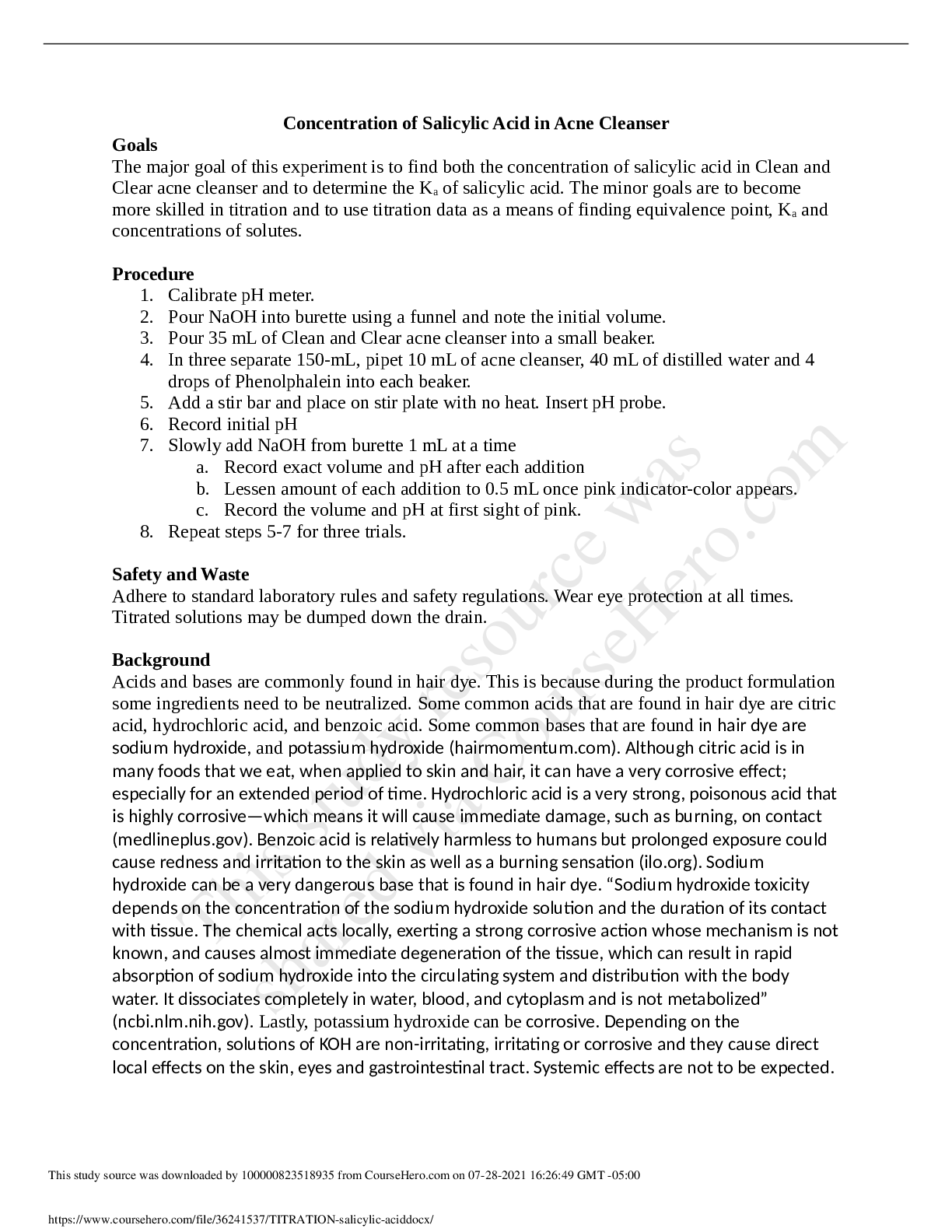
Concentration of Salicylic Acid in Acne Cleanser
Goals
The major goal of this experiment is to find both the concentration of salicylic acid in Clean and
Clear acne cleanser and to determine the Ka of salicylic acid. The minor goals are to become
more skilled in titration and to use titration data as a means of finding equivalence point, Ka and
concentrations of solutes.
Procedure
1. Calibrate pH meter.
2. Pour NaOH into burette using a funnel and note the initial volume.
3. Pour 35 mL of Clean and Clear acne cleanser into a small beaker.
4. In three separate 150-mL, pipet 10 mL of acne cleanser, 40 mL of distilled water and 4
drops of Phenolphalein into each beaker.
5. Add a stir bar and place on stir plate with no heat. Insert pH probe.
6. Record initial pH
7. Slowly add NaOH from burette 1 mL at a time
a. Record exact volume and pH after each addition
b. Lessen amount of each addition to 0.5 mL once pink indicator-color appears.
c. Record the volume and pH at first sight of pink.
8. Repeat steps 5-7 for three trials.
Safety and Waste
Adhere to standard laboratory rules and safety regulations. Wear eye protection at all times.
Titrated solutions may be dumped down the drain.
Background
Acids and bases are commonly found in hair dye. This is because during the product formulation
some ingredients need to be neutralized. Some common acids that are found in hair dye are citric
acid, hydrochloric acid, and benzoic acid. Some common bases that are found in hair dye are
sodium hydroxide, and potassium hydroxide (hairmomentum.com). Although citric acid is in
many foods that we eat, when applied to skin and hair, it can have a very corrosive effect;
especially for an extended period of time. Hydrochloric acid is a very strong, poisonous acid that
is highly corrosive—which means it will cause immediate damage, such as burning, on contact
(medlineplus.gov). Benzoic acid is relatively harmless to humans but prolonged exposure could
cause redness and irritation to the skin as well as a burning sensation (ilo.org). Sodium
hydroxide can be a very dangerous base that is found in hair dye. “Sodium hydroxide toxicity
depends on the concentration of the sodium hydroxide solution and the duration of its contact
with tissue. The chemical acts locally, exerting a strong corrosive action whose mechanism is not
known, and causes almost immediate degeneration of the tissue, which can result in rapid
absorption of sodium hydroxide into the circulating system and distribution with the body
water. It dissociates completely in water, blood, and cytoplasm and is not metabolized”
(ncbi.nlm.nih.gov). Lastly, potassium hydroxide can be corrosive. Depending on the
concentration, solutions of KOH are non-irritating, irritating or corrosive and they cause direct
local effects on the skin, eyes and gastrointestinal tract. Systemic effects are not to be expected.
[Show More]