ATI – NCLEX Predictor Remediation Study Notes
Renal Calculi - Pain: Flank pain → Kidney or Ureter (if pain radiates → stones in ureter or bladder)
Performing Ear Irrigation: Sterile technique, warm meds, pull up & b
...
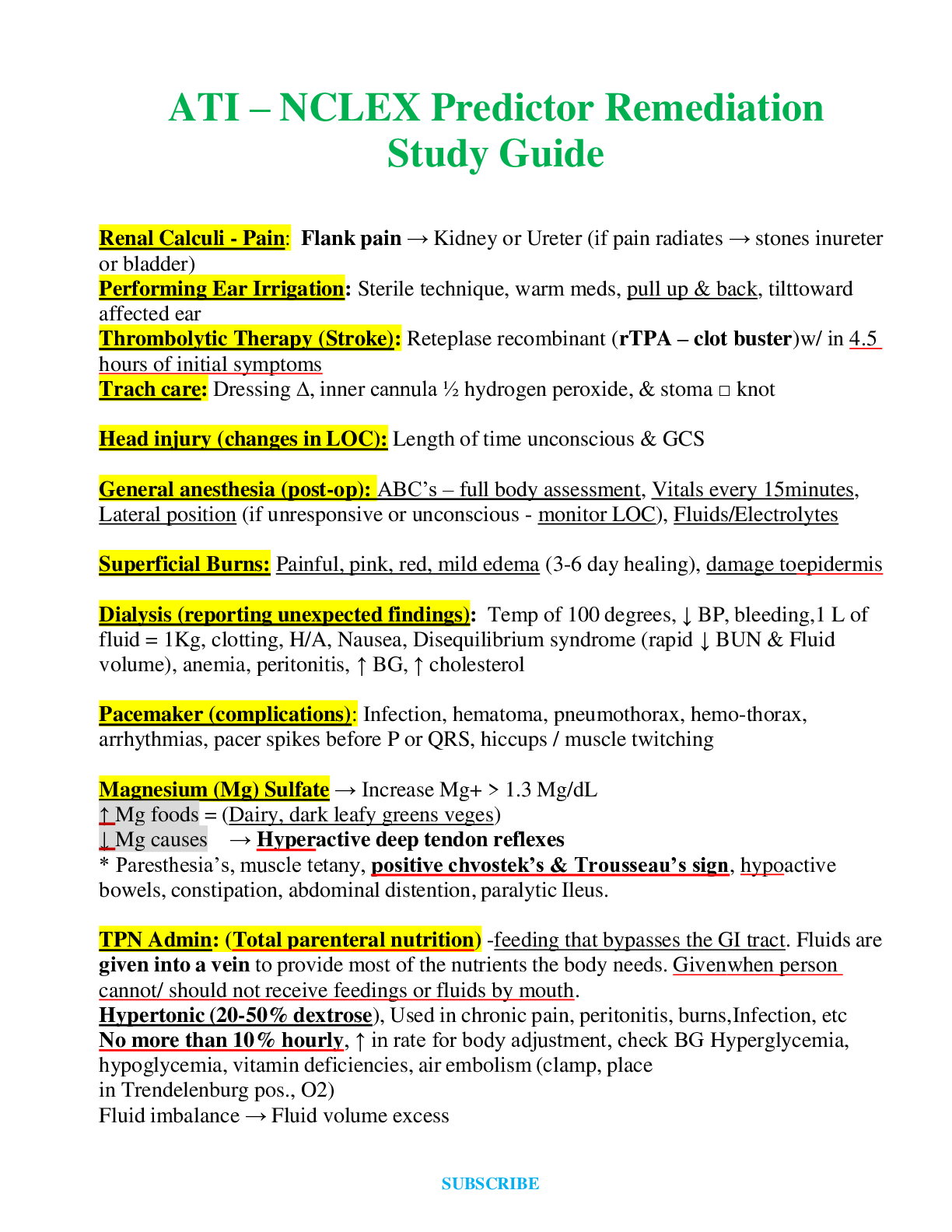
ATI – NCLEX Predictor Remediation Study Notes
Renal Calculi - Pain: Flank pain → Kidney or Ureter (if pain radiates → stones in ureter or bladder)
Performing Ear Irrigation: Sterile technique, warm meds, pull up & back, tilt toward affected ear
Thrombolytic Therapy (Stroke): Reteplase recombinant (rTPA – clot buster) w/ in 4.5 hours of initial symptoms
Trach care: Dressing ∆, inner cannula ½ hydrogen peroxide, & stoma □ knot
Head injury (changes in LOC): Length of time unconscious & GCS
General anesthesia (post-op): ABC’s – full body assessment, Vitals every 15 minutes, Lateral position (if unresponsive or unconscious - monitor LOC), Fluids/Electrolytes
Superficial Burns: Painful, pink, red, mild edema (3-6 day healing), damage to epidermis
Dialysis (reporting unexpected findings): Temp of 100 degrees, ↓ BP, bleeding, 1 L of fluid = 1Kg, clotting, H/A, Nausea, Disequilibrium syndrome (rapid ↓ BUN & Fluid volume), anemia, peritonitis, ↑ BG, ↑ cholesterol
Pacemaker (complications): Infection, hematoma, pneumothorax, hemo-thorax, arrhythmias, pacer spikes before P or QRS, hiccups / muscle twitching
Magnesium (Mg) Sulfate → Increase Mg+ > 1.3 Mg/dL
↑ Mg foods = (Dairy, dark leafy greens veges)
↓ Mg causes → Hyperactive deep tendon reflexes
* Paresthesia’s, muscle tetany, positive chvostek’s & Trousseau’s sign, hypoactive bowels, constipation, abdominal distention, paralytic Ileus.
TPN Admin: (Total parenteral nutrition) -feeding that bypasses the GI tract. Fluids are given into a vein to provide most of the nutrients the body needs. Given when person cannot/ should not receive feedings or fluids by mouth.
Hypertonic (20-50% dextrose), Used in chronic pain, peritonitis, burns, Infection, etc
No more than 10% hourly, ↑ in rate for body adjustment, check BG
Hyperglycemia, hypoglycemia, vitamin deficiencies, air embolism (clamp, place in Trendelenburg pos., O2)
Fluid imbalance → Fluid volume excess
Wound Culture specimen: Sterile field, press / rotate over wound surface inside the wound (center) in drainage
Diabetes Mellitus (Nephropathy): Kidney damage d/t prolonged ↑ BG & dehydration
Monitor I & O, Creatinine, BP
Avoid Soda, alcohol, acetaminophen/NSAIDS / 2 – 3 L fluid from food / beverages
Kidney Biopsy (Post op):
Monitor VS → Client receives sedation
Assess dressings & urinary output (hematuria-blood in urine)
Labs: HgB & Hct values, Admin PRN pain meds, Complications hemorrhage / infection
Thyroidectomy (Post Op): Needs Thyroid hormone replacement
Client in high fowler’s position, Respiratory (trach supplies) present, Check for laryngeal nerve damage
Pain management, Hypocalcemia / Tetany can occur
Prioritization: Apply knowledge to Standards to determine priority action
Systemic before Local – “Life before Limb”
Acute before Chronic
Actual Problems before Potential Future
Listen carefully to clients & Don’t Assume
Recognize & Respond - Trends vs. Transient findings
Recognize indications - Emergencies vs. Expected
Delegate to LPN: Monitoring Findings, Reinforcing teaching, performing trach care, suctioning, checking NG tube patency, administer tube feedings, inserting urinary catheter, administering meds (No IV)
Delegate to AP: ADLs, Bathing, Grooming, Dressing, toileting, Ambulating, feeding w/out swallowing precautions, positioning, routine tasks, bed making, specimen collection, I & O, VS for stable clients, monitoring clinical manifestations after initial RN assess/eval.
Paracentesis (prep) - take out fluid from belly (peritoneal fluid) Have client VOID
Bariatric Surgery: (weight loss surgery) – Semi fowlers, 6 small meals/day, liquid/pureed food for first 6 weeks (not to exceed 1cup), Vitamin / mineral supplements, & 2 servings of protein daily.
Ostomy (in small intestine) Avoid odorous & gas foods (dark green veges, dairy, fish, eggs, beans, corn), yogurt ↓ gas
Avoid ↑ fiber foods for first 2 months, ↑ fluid intake
Dumping Syndrome: Happens within 15mins of eating.
Sx: cramps, diarrhea, tachycardia, dizziness, fatigue, hypoglycemia
Interventions: small frequent meals, drink liquids 1hr b4/after
Parkinson’s disease: Tremor, muscle rigidity, bradykinesia (slowness in movement), postural instability
Stages:
1. Unilateral shaking / tremor of one limb
2. Bilateral limb involvement, difficulty walking/balance
3. Slowed physical movements
4. Akinesia & Rigidity make ADL’s difficult
5. Unable to stand/walk, dependent of cares, dementia
Assault: threat Battery: touching
Hypoglycemia Sx: Shakiness, confusion, sweating, tachycardia, diaphoresis, palpitations, H/A, lack of coordination, blurred vision, seizures, coma
Oral Hypoglycemic Agents: promote insulin release from pancreas (Type2 DM)
Glipizide (Glucotrol), Chlorpropamide (Diabines), Glyburide (Diabinese), Metformin (Glucophage).
* Med for insulin overdose = Glucagon
Radiation Adverse Effects: Skin changes, hair loss, debilitating fatigue, 30 minute visits / stays 6ft away / private room
Infection control in clients home: good hygiene, avoid crowded areas, avoid raw foods (veges/meats), avoid cleaning litter boxes, clean home and avoid sick family.
Client evacuation in response to fire: greatest good for the greatest amount of people
Client in seclusion: 18 yo+ → 4 hours, 9 – 17 yo →2 hours, 8 yo & younger →1 hour
Conduct Disorders: lack of remorse, bullies, threatens, low self-esteem, tempers, physical cruelty, destroys property, truant, and shoplifts
Manic Phase: ↑ mood, irritable, lasts at least a week, euphoria, agitation, restless, ↑ in talking, flight of ideas, grandiose view of self, impulsive, manipulative, poor judgement, attention seeking.
Paranoid: distrust / suspiciousness
Schizoid: emotional detachment, disinterest in relationships, indifferent to praise/criticism, uncooperative
Schizotypal: odd beliefs, eccentric appearance, magical thinking, perceptual distortions
Antisocial: disregard for others, lack of empathy, unlawful, failure to accept responsibility, manipulative, impulsive, seductive
Borderline: instability of affect, identity & relationships, splitting behaviors, fear of abandonment, self-injurious, impulsive
Histrionic: attention seeking, seductive, flirtatious
Narcissist: arrogant, constant admiration, lack of empathy
Avoidant: anxious, wants close relationships, fear of rejection
Dependent: dependency on another individual
OCD: perfectionist, orderly, and control
Clozapine (Anti-psychotic Atypical )
Adverse effects: metabolic syndrome, orthostatic hypotension, anti-cholinergic effects, agitation, dizziness, sedation, mild EPS, ↑ prolactin levels(galactorrhea, amenorrhea, gynecomastia), & sexual dysfunction
Anti-lipemic Agents: (Statins) – treats high levels of fats/cholesterol in blood -called lipid-lowering drugs
Monitor liver enzyme levels (hepatotoxicity) and muscles – monitor CK levels (myopathy & peripheral neuropathy)
Med interactions: Fibrates (Genfibrozil) - ↑ myopathy risk, Erythroycin & Ketoconazole, Amiodarone, & Cyclosprine = Grapefruit juice can ↑ statin levels
Gentamicin (effects urine output) -causes ototoxicity w/ diuretics, digoxin, lithium, ototoxic meds, NSAIDs, & anti-hypertensives
Long term therapy for RA: DMARDs (methotrexate, etanercept, infliximab, adalimubrab, Azathioprine, Cyclosporine)
** Slow joint degradation
Glucocorticoids (Prednisone) & NSAIDs provide symptom relief from inflammation & pain
Bulb Syringe (for babies): Mouth first, then nose, depress. Then insert into mouth, avoid center of mouth- may stim. gag reflex.
Priority action to an allergic response:
Mild rashes/hives – Benadryl
Anaphylaxis - treat with epi, bronchodilators, and anti-histamines
Provide respiratory support & notify HCP
Losartan (ARBs -Anti-Hypertensive (HTN) & kidney disease) - Cough & hyperkalemia are for ace inhibitors.
Side Effects: Angioedema, hypotension, dizziness
Tracheostomy Care: 2 xtra tubes, adequate humidification, oral care every 2 hours, trach care every 8 hours, sterile suctioning, surgical asepsis to remove / clean inner cannula, secure trach ties before removing old, square knot, clean from stoma outward
Appropriate Doc.: Subjective/objective data, Accurate/concise, Complete/current, Organized/ date/ time/ blk ink
Crutch safety: Support bodyweight at hand grips with elbows at 30 degrees, Position crutches on unaffected side when sitting or rising from a chair
Varicella (chicken pox) Transmission: Direct contact, droplet, from person with shingles, 10-21 days, 1-2 days before lesions appear and all lesions have sabs
Scoliosis: Lateral curvature of spine & spinal/truncal rotation that causes ribs asymmetry. Curve needs to be at least 10 degrees One leg shorter than the other. Asymmetry in scapula, ribs, flanks, shoulders, hips.
Screening for Idiopathic Scoliosis: During pre-adolescence - Observe child from back
Bend at waist with arms handing down & observe for asymmetry of ribs and flank
Measure truncal rotation with a scolio-meter
Use Cobb technique to determine degree of curvature
Use riser scale to determine skeletal maturity
↓ Cardiac output (interventions): Maintain bedrest, Semi fowler’s/ fowler’s position while awake, Sleep w/ pillows
Cardiac output positioning for optimal output: Left lateral side, Semi fowlers, Supine with wedge under one hip
Infant car seat: Position infant in car seat at 45 degree angle, Safety restraints loose and low on abdomen
Correct use of Condoms: On erect penis, empty space at tip for sperm reservoir (May be used with spermicidal gel to ↑ effectiveness), Protects against STI’s, only water soluble lube with latex condoms
Amnio-infusion for Oligohydramnios: (not enough amniotic fluid around fetus)
Infusion or NS or LR into amniotic cavity to reduce severity of variable decelerations caused by cord compression
Scant amount or absence of amniotic fluid, Membranes must have ruptured to perform - Warm fluid
Rhogam for Clients who are RH-Negative: (Antibodies from human plasma injected into RH+ mother to protect fetus)
Chadwick’s sign – violet/blue color or cervix & vaginal mucosa Goodell’s sign – softening of cervical tip
HSV (Herpes simplex virus): direct contact transmission to fetus is greatest during vaginal birth if woman has active lesions, Lesions & tender lymph nodes, Obtain cultures from women who have HSV or are at or near term
Urinary frequency Interventions: ↓ fluid intake b-4 bed, Use perineal pads, and Kegel exercises ↓ stress incontinence
Buddhist Dietary practices: vegetarian, nuts, legumes (dried peas/cooked beans), No eggs, no milk products
Notifiable Communicable diseases: anthrax, botulism, cholera, diphtheria, gonorrhea, hep A/B/C, HIV, legionaries, lymes, malaria, mumps, pertussis, polio, syphilis, tetanus, TSS, TB, Typhoid fever, VRSA, At risk populations, transmissions routes
Anterior Pituitary Hormones: Stimulate growth - Caution in DM patients – can cause hyperglycemia (Somatropin)
Anti-Convulsants: Tx- seizures (caphe) Petit Mal (Valet)
Carbamazepine, valproic acid, ethosuximide, Phenytoin/phenobarbital – adverse effects = yellowing of skin, nystagmus, teratogenicity, osteomalacia, H/A, vertigo, ataxia
Ophthalmic Agents:
Beta Blockers: ↓ aqueous humor production (betotopic, betaxon, betagan, betimol)
Prostaglandin Analogs: ↑ aqueous humor outflow (xalantan, travatan)
Alpha Adrenergic Agonists: ↓ aqueous humor & ↑ outflow (Alphagan)
Direct Acting Cholinergic Agonist: ↓IOP & ↑ outflow of AH (Pilocarpine)
Side effects for Ophthalmic Agents: Blurred vision, angle closure glaucoma, dry eyes, photophobia, ocular pressure, can cause systemic effects, ciliary muscle constriction
Mixing Insulin: (Clear before Cloudy)
Air into NPH (Cloudy), Air into Regular (Clear), Draw up Regular (Clear), Draw up NPH (Cloudy)
* Hypoglycemia is most likely to occur during peak.
Obstetric History: (GTPAL) Gravida, Term, Preterm, Abortions, Living Children
Pre-Term Infant: Anticipated Problems (TRIES) Temperature regulation (poor), Resistance to infections (poor), Immature Liver, Elimination problems (Necrotizing Enterocolitis), Sensory-Perceptual Functions (Retinopathy)
Fetal Heart Rate: (VEAL CHOP)
Variable Decels Cord Compression
Early Decels Head Compression
Accelerations O2 (Baby is well-oxygenated)
Late Decels Placental Utero Insufficiency
Pregnant Client - Med. Surg Floor: (FETUS)
Fetal heart tones (document every shift)
Emotional Support
Temperature (Measure maternal)
Uterine Activity/Contractions (early-low back pain)
Sensations of fetal movement
Placenta Previa: low implantation of the placenta / Bright red bleeding present that is painless. Place mother on bedrest in side lying position / Weigh perineal pads
Abuptio Placenta: Premature separation of the placenta - Dark red bleeding may or may not be present with sharp stabbing pain
Start fluid replacement, oxygen by mask, monitor FHR, keep in lateral position, pregnancy must be terminated - birth or C-Section
Endocrine Agents: Thyroid Hormones (Hypothyroidism)
Synthetic form of thyroxine (T4), ↑ metabolic rate, body temp, oxygen use, renal perfusion, blood volume, & growth processes. (Levothyroxine, Thyroid, Liothronien, Anti-thyroid meds (hyperthyroidism), graves, thyrotoxicosis, propythiouracil (PTU)
Cholecystitis: (Inflammation of Gall Bladder) ↓ fat intake, NO - coffee, broccoli, cauliflower, cabbage, onions/ legumes
Compartment Syndrome: Sx: (5 Ps) Pain, Pallor, Pulse ↓ or absent, ↑ BP, Paresthesia (tingling hands, feet)
Acute Renal Failure: Can cause HypoNatremia, HyperKalemia, HypoCalcemia, & HyperPhosphatemia
Shock Sx: (Chord Item) Anti-Platelets: Aspirin, Plavix (clopidogrel)
Cold, clammy skin, Hypotension, Oliguria, Drowsiness, ↑bleeding risk, prevent MI/stroke, taken PO
Rapid/shallow breathing, Irritability, Tachycardia Watch for hemorrhagic stroke (weakness, Dizziness, H/A)
Elevated or reduced CVP, Multi-Organ damage Avoid NSAIDs, Heparin, warfarin, corticosteroids
Anti-Platelets: Aspirin, Plavix (clopidogrel)
↑bleeding risk, prevent MI/stroke, taken PO Herb/Botanical Therapy
Watch for hemorrhagic stroke (weakness, Dizziness, H/A) Echinacea (common cold), Ginger root (↓ nausea, RA)
Avoid NSAIDs, Heparin, warfarin, corticosteroids Ginko Biloba (↑ vasodialation, dementia, alzheimers)
HypoCalcemia Sx: (CATS) Valarian (↑ GABA to prevent insomnia) – don’t use in MH,
Convulsions, Arrhythmias, Tetany, Stridor / Spasms Or pregnancy. Black cohosh (estrogen sub)-↑ anti HTN
Nephrotic Syndrome meds& hypoglycemia
Serum Proteins in urine, Diet with sufficient protein Peptic Ulcer Disease
Diet low in sodium Avoid frequent meals/snacks, alcohol, smoking, NSAIDs,
Nephrolithiasis (kidney stones) Coffee, spicy foods, & caffeine
↑ Fluid Consumption is primary intervention Lactose Intolerance
HypoKalemia Sx: (6 L’s) Distention, Cramps, Flatus, Diarrhea
Lethargy, Leg Cramps, Limp Muscles HypoGlycemia Sx: (TIRED)
Low Shallow Respirations Tachycardia, Irritability, Restlessness, Excessive Hunger
Lethal Cardiac Dysrhythmias Depression / Diaphoresis
Lots of urine (polyuria)
End Stage Renal Disease: GFR <25mL/min Pre-End Stage Renal Disease
Serum creatinine rises, dialysis or transplant required ↑ in serum creatinine
↑ protein, ↓phosphorus, ↓potassium, ↓sodium Limit protein & phosphorous (meat, dairy, pb, dried peas,
Fluid restricted diet Beans, cola, chocolate beer)
Protein needs ↑ once dialysis begins Restrict sodium to maintain BP
Vitamin D deficiency occurs
Arterial occlusion (4 P’s) HTN Care: (Diuretic)
Pain, Pulselessness, Pallor, Paresthesia Daily weight, I&O’s, urine output, response of BP,
CHF Treatment: (MADD DOG) Electrolytes, take pulse, Ischemic Episodes (TIA’s)
Morphine, Aminophylline, Digoxin, Diuretics, Oxygen Complications (CVA, CAD, CHR, CRF)
Gases (ABG’s)
Labs: Normal Values: Normal Values:
Creatinine 0.6-1.2 Males 0.5-1.1 Females
RBC 4.7-6.1 Males 4.2-5.4 Females
Hematocrit 42-52 Males 37-47 Females
Urine Specific Gravity 1.0-1.030
APTT 40 Sec.
Digoxin 0.5-2.0
Lithium 0.8-1.4
Anti-Emetics (-tron, -zine): Can cause sedation. Metoclopramide (Reglan)- monitor for EPS
PPI’s (-zole): can cause Vit. B12 deficiency
Erectile Dysfunction agents (-fil): Can cause H/A, flushing, back pain, muscle aches, & temporary vision changes.
* Don’t take if have heart problems, BP issues, or stroke.
Anti-Enemics:
Liquid iron can cause teeth staining, dilute w/ water or juice.
Iron – given IM (Z-track method)
Oral Iron – avoid Vit. C. (antacids by 2 hours, empty stomach 1 hr before meals)
* Black stools are common. Encourage intake of high iron foods.
Anti-Coagulants: prevents of blood coagulation/clotting
Heparin Sodium – admin = IV or SQ (Antidote=Protamine Sulfate) - Normal APTT = 60-80 seconds
Enoxaparin (Lovenox) – admin = SQ, longer ½ life
* Administer with MI or DVT
* ↑ bleeding risk
Avoid: Corticosteriods, NSAIDs, Vit. K, PO Hypoglycemics.
Coumadin – admin = PO (Antidote = Vit. K)
Avoid: using with low platelets, foods high in Vit. K, Tylenol, glucocorticoids, aspirin, use while pregnant
Monitor: INR & patient
HypoNatremia: ↓ Sodium - Sx: confusion, restlessness, lethargy, seizures, coma - Treat: fluid restriction
HypoKalemia: ↓ Potassium - Sx: poor muscle strength, slow reflexes, flat T waves (cardiac dysrhythmias) - Treat: PO or IV Potassium supplement
HyperNatremia: ↑ Sodium - Sx: Postural hypotension - Treat: Fluids (drink/IV)
HyperKalemia: ↑Potassium - Sx: Twitching, contraction, paralysis, peaked T waves (cardiac dysrhythmias) - Treat: Kayexalate, Loop diuretic, Insulin
HypoCalcemia: ↓ Calcium - Sx: twitching, muscle cramps, Trousseau/Chvostaks - Treat: dietary supplement, antacids, and vitamins
HyperCalcemia: ↑ Calcium - Sx: muscle weakness, fatigue, slow GI - Treat: diuretic, 3-4L fluid daily, weight bearing, and calcitonin
Antidotes:
Bethanechol/Neostigmine = Atropine
Atropine = Phyosostigmine
Digoxin = Digibind
Warfarin = Vitamin K
Heparin = Protamine Sulfate
Insulin Induced Hypoglycemia = Glucagon
Acetaminophen = Acetylcysteine (mucomyst)
Ace Inhibitors (-pril): HF, HTN, MI, and Diabetic Neuropathy
Side effects: orthostatic hypotension, dry cough, hyperkalemia, NSAIDs ↓ therapeutic effects
Alpha Adrenergic Blockers (-zosin): Dilate Veins/Arteries (Prazosin, Doxazosin)
ARBS (-sartan): Produce vasodilation by blocking Angiotensin II. (Losartan)
CCB’s (-dipine): Vasodilation by blocking calcium channels. (Nifedipine, Amlodipine, verapamil, Diltiazem)
Avoid: drinking grapefruit juice – can lead to toxicity
Electrolytes:
Sodium: Administer Isotonic IV therapy (NS/LR)
Potassium: Maintains electrical excitability of muscle conduction of nerve impulses (NEVER given IV PUSH)
Calcium: Muscoskeletal, neuro / cardio function, implement seizure precautions
Magnesium: Skeletal muscle contraction & blood coagulation.
Monitor: BP, Pulse, Respirations
Anti-Gout Meds: Gout is a type of arthritis. Buildup of Uric Acid.
First line: NSAIDs / Prednisone, Colchicine (GI distress potential – take with food)
Allopurinol: prevents uric acid production
Drug interactions: salicylates, loop diuretics, alcohol, warfarin
Food interactions: anchovies, yeast, organ meat, legumes, mushroom, spinach, asparagus, cauliflower
Anti-Reabsorptives : slow bone removal or improve bone mass. (Menopausal women)
Bisphosphonates (Alendronate – Fosamax).
Can cause severe esophagitis. Take on empty stomach w/8oz of water & sit upright for 30 minutes.
Anti-Neoplastics: Cancer meds
Side effects: soreness, difficulty swallowing, diarrhea, stomach pain, low platelets, anemia, sensitive skin, excess tear formation
Mental Status Exam: LOC, physical appearance, behavior, & cognitive/intellectual abilities
Anxious / depressed: open ended supportive statements
Suicidal: direct yes/no questions to assess risk
Panicked: use gentle reality orientation
Confused: Provide reality orientation
Delusions/Hallucinations/Paranoia: Acknowledge, don’t reinforce
Obsessive Compulsive Behavior: Communicate after behavior
Personality/Cognitive Disorder: Be calm and matter of fact
Aggressive/Violent: set boundaries, limits, short simple sentences
Psychiatric Meds:
SSRI’s: Citalopram, Fluoxetine, Sertraline (avoid St John’s Wort)
TCA’s: Amitriptyline (anticholinergic effects “cant’s” – orthostatic Hypotension
MAOI’s: Phenelzine, Hypertensive Crisis
Atypical: bupropion (appetite suppression, H/A, Dry mouth)
SNRI’s: Venlafaxine / Duloxetine (nausea, weight gain, sexual dysfunction)
RN delegate surgical asepsis responsibilities to UAP's? Only under RN supervision
When should traditional hand washing be used instead of using alcohol-based sanitizer?
Hands are visibly soiled, touching bodily fluids, Before/after applying sterile gloves, After using sanitizer 10+ times
Contradictions of good hand hygiene Nail polish, Long nails, using lotions, Wearing jewelry
Potential routes of entry into the body for blood borne pathogens?
Mucous membranes, Puncture wounds, Burns on hands, Blood
Personal Protective Equipment (PPE) is the single most effective way to prevent the transmission of infection
Two potential sites for nosocomial infections: hospital & Homecare
Causes of nosocomial infections: suppressed immune system, Failure to follow isolation precautions or aseptic technique, Hospital error
A physician is preparing to perform a lumbar puncture. The suspected diagnosis is bacterial meningitis. What type of precaution is needed? Standard precautions
A 70 y. male develops new diarrhea and a high WBC while in the hospital recovering from MV Replacement surgery which was complicated by a CVA. He is bed bound and incontinent of stool. What do you suspect is the cause for his diarrhea? A bacterial, nosocomial infection
Medical abbreviation: CBR, BR complete bedrest, bedrest
Frequent bathing for the older client is necessary to prevent skin breakdown. False
A bath can be helpful in soaking a client's pelvic area in warm water to decrease inflammation. sitz
3 guidelines for providing patient-centered care when addressing a client's hygiene needs
Be respectful to cultural values, Ask the pt in what order they would like to complete their hygiene routine.
Provide hygienic care as often as necessary (but not too often) and as gently as necessary.
What should be included in documentation of a bath? Date and time, Type of bath, Abnormal findings/pt reaction
When might the RN need to collaborate a colleague for personal care? If a patient is not ambulatory and is too heavy to be moved alone
What are the components of the Braden scale? Sensory perception, moisture, activity, mobility, nutrition, friction & shear - High score indicates low risk.
Trochanter roll -Keeps hips in a neutral position
Hemiparesis Weakness on one sign of the body
Hemiplegia - Paralysis on one side of the body
Prone position - Lying on the abdomen
Sim's position - Lying on left side w/ left leg straight and right knee bent
Foot drop - Gait w/ drop of the forefoot
Fracture pan - A bedpan used for someone w/ a hip fracture
Fecal impaction - Dry, hard stool stuck in the rectum
Hand roll - Hand placed in the palm to prevent fractures
WNL - Within normal limits
BRP - bathroom privileges
BUS - Bladder ultrasonic scanner
Factors to consider when delegating to UAP - Scope of practice, Facility, state regulations, Level of experience, Pt safety
Hazards of immobility on CV system & interventions DVT: elastic stockings, SCD's, Orthostatic BP: give pt time between position changes
Hazards of immobility on pulmonary system & interventions PE: TED host, Inadequate expansion of the chest: place pt in orthopneic position Pneumonia: clean/sterile technique, pneumovax
Intervention for each: early and frequent ambulation
Hazards of immobility on renal system & interventions-UTI, problems with continence, altered BP: monitor I/O's, assist w/ voiding as needed
Hazards of immobility on integumentary system & interventions
Skin breakdown: repositioning, monitor nutrition status, reduce moisture, and provide hygiene care
Hazards of immobility on musculoskeletal system & interventions
Stiff joints: ROMs/ambulation
Muscle atrophy: ROMs/ambulation
Ca2+ imbalance: nutrition measures
Risk factors for skin breakdown
Poor nutrition, bedrest, obesity, using an SPM machine, increased friction and shear
4 areas prone to skin breakdown-Tailbone, Heels, Elbows, Hips
Intervention most effective in preventing flaccidity in a hospitalized patient? Early ambulation after surgery
After application of sequential compression devices (SCDs) on a patient, what assessment finding is essential for the nurse to include in documentation? Lower extremity circulatory status
Components of Morse Fall Scale- History of falls, secondary diagnosis, ambulatory aid, IV/hep lock, gait/transferring, mental status
Scores:
45+ = high risk 25-44 = moderate risk 0-24 = low risk
TB Injection - Max amt: 0.1 cc, site: forearm, Angle: 15-20 degrees, Length: 1/4 - 1/2 in, Aspiration? No
SQ injections - Max amt: 2 cc, Usual site: Upper arm, stomach, Angle: 45 degrees, Length: 1/2 - 1 in, Aspiration? Yes
IM injections - Max amt: 5 cc Usual site: deltoid (1 cc), gluteus med/max or vastus lateralis (5 cc), Angle: 90 degrees, Length: 1 - 1.5 in, Aspiration? Yes
What factors affect a BG result? Having fasted or eaten, time of day, level of activity, stress, illness, menstruation
client most at risk for hypoglycemia? In the morning before breakfast
Considerations for pt's on blood thinners such as warfarin, asprin, heparin, coumadin, etc?
Monitor platelet levels (labs)
Watch for bleeding/reduce risks of bleeding
Monitor vitals (esp. BP)
Assess skin
Monitor mobility status
benzodiazepines to older adults? No, benzo's increase the risk of accidents and mental deficits
FUO - fever of unknown origin
qhs - at bedtime
ac - before meals
Contraindications for opening capsules and mixing with food? EC: enteric coated & ER: extended release
Rapid acting insulin
Generic & brand names: Inslin aspart (NovoLog), insulin glulisine (Apidra), insulin lispro (Humalog)
Onset: 15 min
Peak: 30 - 90 min
Duration: 3-5 hr
Short acting insulin - Insulin regular (Humulin R, Novolin R)
Onset: 30 - 60 min
Peak: 2 - 4 hr
Duration: 5 - 8 hr
Intermediate-acting insulin- Insulin NPH (Humulin/Novolin N)
Onset: 1 - 3 hr
Peak: 8 hr
Duration: 12 - 16 hr
Long-acting insulin- insulin glargine (lantus), insulin detemir (levemir)
Onset: 1 hr
Peak: no clear peak
Duration: 20 - 26 hr
Signs of infiltration -Edema, pallor, decreased skin temperature around the site, and pain
Signs of phlebitis - Pain, increased skin temperature, and redness along the vein
Signs of extravasation (infiltration w/ dislodged IV catheter) - Pain, stinging or burning at the site, swelling, and redness
Nursing interventions for infiltration, phlebitis, and extravasation
Infiltration: D/C IV, elevate extremity, apply warm compress
Phlebitis: D/C IV, apply warm/moist compress
Extravasation: D/C IV, apply cool compress, administer antidote if needed, document degree of extravasation
INT -intermittent (catheter)
The 6 rights of medication administration
1. Right drug
2. Right dose
3. Right route
4. Right pt
5. Right time
6. Right documentation
3 nursing interventions r/t routine care of peripheral IV
1. Check insertion site frequently
2. Change tubing every 96 hr
3. Use good hand hygiene + standard precautions
Factors to consider when choosing the best IV location Age, condition of veins, circulation status, length of IV therapy
What is the smallest gauge IV catheter used to infuse blood? 20-22: RBS' might get crushed when using a smaller cath.
4 techniques to improve the chances of good IV access
1. Trim hair around the area
2. Gently stroke the area from the distal to proximal end
3. Place a warm blanket over the extremity
4. Palpate gently
At what range of rate should you administer maintenance fluids? 75-150
Does the secondary/piggyback IV bag hang above or below the primary bag? Below
What gauge catheters should you use for IV access? (smaller the gauge, larger the hole)
24: children
22: older adults (esp women)
20: healthy adult
16-18: trauma pt's
What is included in an IV start kit? Tourniquet, alcohol wipes, gauze, tape
Will also need: IV catheter, saline flushes, extension tubing
Cardiac tamponade - Fluid in the pericardial sac
Tunneled catheter - A catheter surgically inserted into a trench
Delegation: central lines - Care/dressing changes cannot be delegated to UAP. UAP may observe central lines and report concerns.
What are PICC lines (ARM) used for? Used for long-term IV access
What are multi lumen central catheters used for? Monitoring central venous pressure, sampling blood, and simultaneous administration of multiple IV solutions/drugs
Hickman catheter - Used for chemotherapy or blood withdrawal
Nursing interventions associated w/ routine care of a central IV
1. Clamp the central line when not in use
2. Maintain patency by flushing
3. Avoid excessive force w/ small syringes
4. Never use a syringe smaller than 10 mL
List potential central IV complications and nursing interventions associated w/ each
1. Infection: hand hygiene, scrub the hub, and use aseptic technique
2. Pneumothorax: monitor vitals, admin O2 if needed, notify the provider of warning signs
3. Air embolism: check the line frequently, keep catheters clamped, don't inject air; if embolism occurs: clamp catheter, admin O2, and place pt of left side in Trendelenburg (supine w/ feet elevated)
Which activity is important to include in the plan of care for a client with a PICC?
Use sterile technique when changing the PICC dressing.
UA - urinary analysis for culture & sensitivity
What are two ways the nurse may obtain a C&S? Sterile collection from Foley - Sterile collection from straight cath
Midstream urine collection
Clean the peritoneal area
Collect a midstream sample after urinating for several seconds
What color does a fecal sample containing occult blood turn? Blue
A UA that is positive for hemoglobin, WBCs, and nitrites indicates: UTI
3 strategies for preventing UTI in the client after insertion of an indwelling catheter.
Provide peritoneal care every 6 hours
Change out the catheter every 8 hours
Drain the collection bag PRN (when full and before ambulation)
Remove the Foley post-op day 2
*********************************************CONTINUED 53 pages>***********************************************
[Show More]



.png)