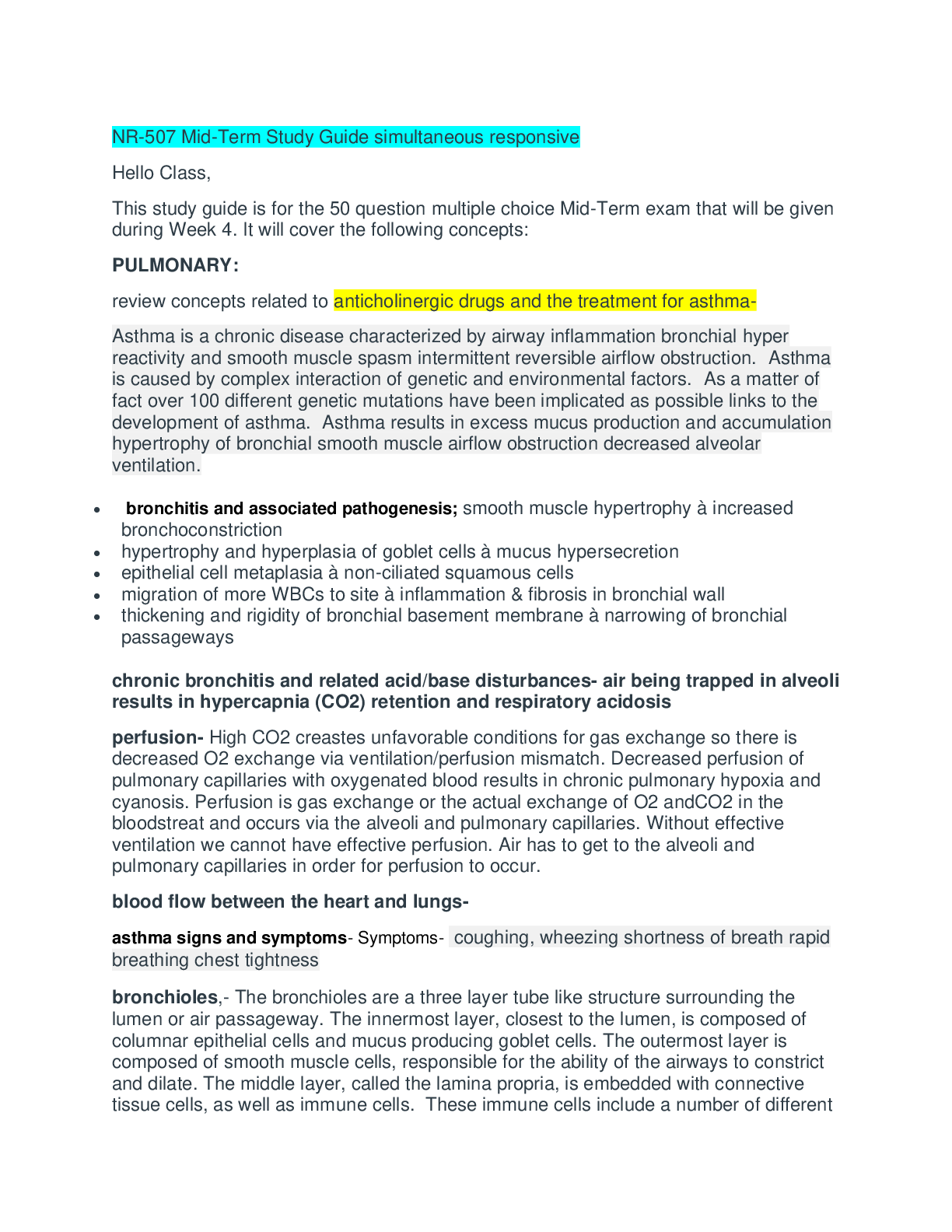
NR511 Final Exam Study Guide (ASSURED A)
Week 1
1. Define diagnostic reasoning
-To solve problems, to promote health, and to screen for disease or illness all require a
sensitivity to complex stories, to contextual
...
NR511 Final Exam Study Guide (ASSURED A)
Week 1
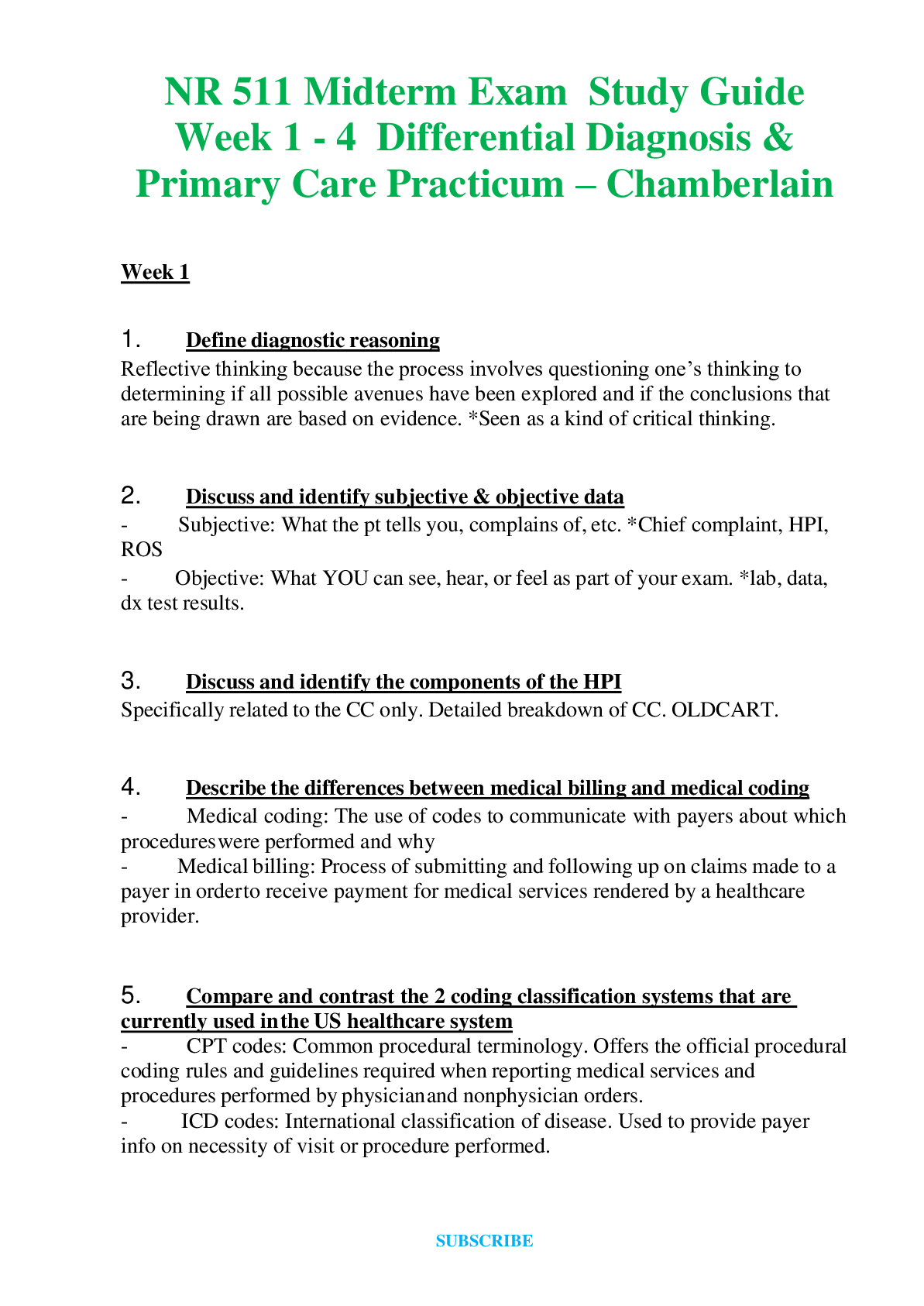
1. Define diagnostic reasoning
-To solve problems, to promote health, and to screen for disease or illness all require a
sensitivity to complex stories, to contextual factors, and to a sense of probability and
uncertainty.
-Diagnostic reasoning can be seen as a kind of critical thinking. Critical thinking involves
the process of questioning one’s thinking to determine if all possible avenues have
been explored and if the conclusions that are being drawn are based on evidence.
Diagnostic reasoning then includes a systematic way of thinking that evaluates each
new piece of data as it either supports some diagnostic hypothesis or reduces the
likelihood of others.
2. Discuss and identify subjective & objective data
-Subjective:
-reports
-complains of
-tells you in response to your questions.
-Includes ROS, CC, and HPI
-Objective:
-what you can see, hear, or feel as part of your clinical exam.
-It also includes laboratory data and test results.
3. Discuss and identify the components of the HPI
-O: Onset of CC
-L: Location of CC
-D: Duration of CC
-C: Characteristics of CC
-A: Aggravating factors for CC
-R: Relieving factors for CC
-T: Treatments tried for CC
-S: Severity of CC
4. Describe the differences between medical billing and medical coding
Medical coding: is the use of codes to communicate with payers about which procedures were
performed and why.
-Medical billing: is the process of submitting and following up on claims made to a payer in
order to receive payment for medical services rendered by a healthcare provider.
2
5. Compare and contrast the 2 coding classification systems that are currently used
in the US healthcare system
-The CPT system offers the official procedural coding rules and guidelines required
when reporting medical services and procedures performed by physician and non�physician providers.
-CPT codes are recognized universally and also provide a logical means to be able to
track healthcare data, trends, and outcomes.
-ICD-10 codes are shorthand for the patient’s diagnoses, which are used to provide the
payer information on the necessity of the visit or procedure performed.
6. Discuss how specificity, sensitivity & predictive value contribute to the
usefulness of the diagnostic data
-Specificity of a test, we are referring to the ability of the test to correctly detect a specific
condition.
-Predictive value is the likelihood that the patient actually has the condition and is, in part,
dependent upon the prevalence of the condition in the population.
-When a test is very sensitive, we mean it has few false negatives.
7. Discuss the elements that need to be considered when developing a plan
Acknowledge the list
-Negotiate what to cover
-Be Honest
-Make a follow-up
8. Describe the components of Medical Decision Making in E&M coding
- There are three key components that determine risk-based E&M codes.
-History
-Physical
-Medical Decision Making (MDM) E&M coding requires a medical decision
maker
-Medical decision making is another way of quantifying the complexity of the thinking that is
required for the visit.
-Complexity of a visit is based on three criteria:
-Risk
-Data
-Diagnosis
3
-Now, medical decision making is a special category. Why is this so important? Well,
the MDM score gives us credit for the excess work involved in management of a more complex
patient.
9. Correctly order the E&M office visit codes based on complexity from least to
most complex
99212 - 99214
10. Discuss a minimum of three purposes of the written history and physical in
relation to the importance of documentation
-It is an important reference document that gives concise information about a patient's
history and exam findings.
-It outlines a plan for addressing the issues that prompted the visit. This information
should be presented in a logical fashion that prominently features all data immediately
relevant to the patient's condition.
-It is a means of communicating information to all providers who are involved in the care
of a particular patient.
-It is an important medical-legal document
-It is essential in order to accurately code and bill for services.
[Show More]




.png)