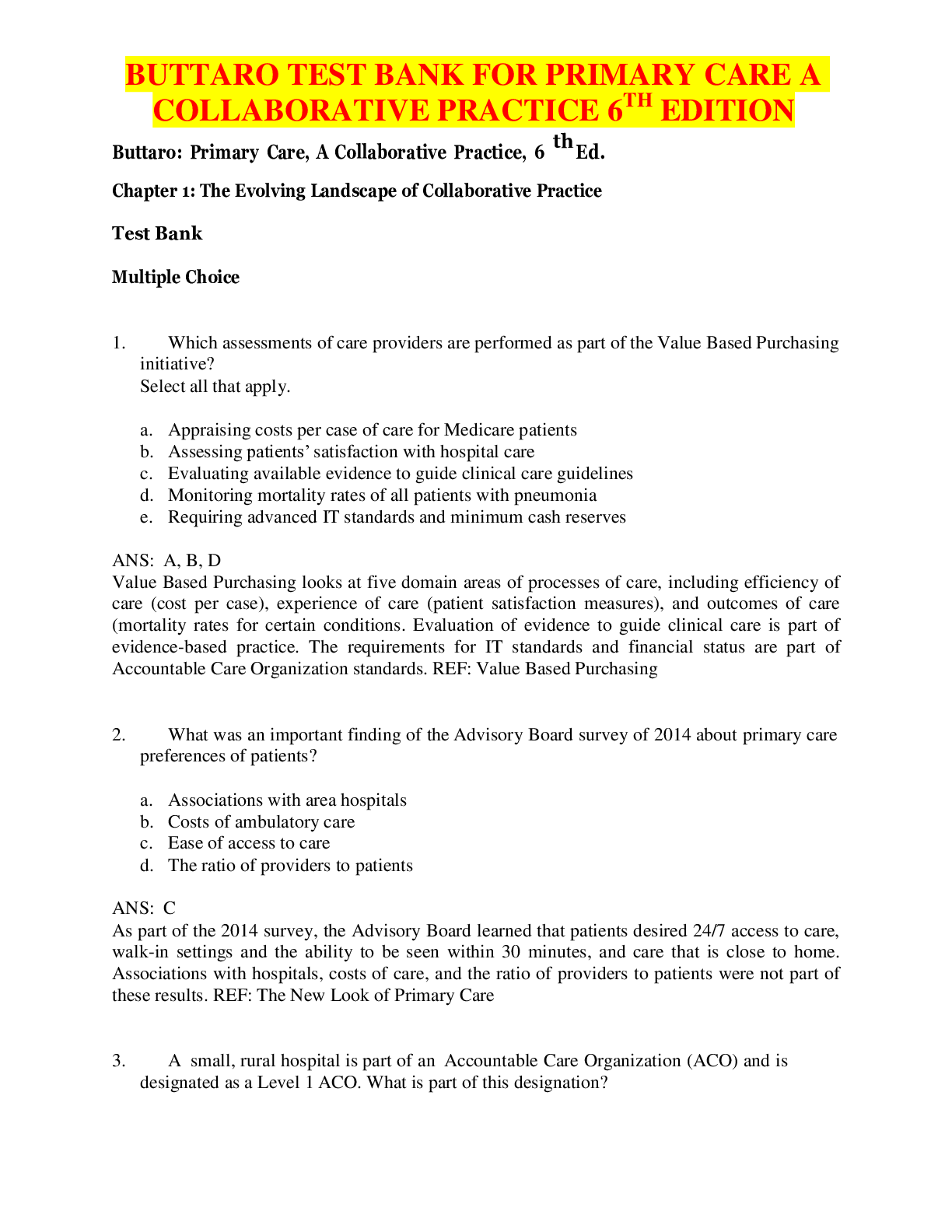
Buttaro: Primary Care, A Collaborative Practice, 6th Ed.
Chapter 1: The Evolving Landscape of Collaborative Practice
Test Bank
Multiple Choice
1. Which assessments of care providers are performed as part of the Value
...
Buttaro: Primary Care, A Collaborative Practice, 6th Ed.
Chapter 1: The Evolving Landscape of Collaborative Practice
Test Bank
Multiple Choice
1. Which assessments of care providers are performed as part of the Value Based Purchasing
initiative?
Select all that apply.
a. Appraising costs per case of care for Medicare patients
b. Assessing patients’ satisfaction with hospital care
c. Evaluating available evidence to guide clinical care guidelines
d. Monitoring mortality rates of all patients with pneumonia
e. Requiring advanced IT standards and minimum cash reserves
ANS: A, B, D
Value Based Purchasing looks at five domain areas of processes of care, including efficiency of
care (cost per case), experience of care (patient satisfaction measures), and outcomes of care
(mortality rates for certain conditions. Evaluation of evidence to guide clinical care is part of
evidence-based practice. The requirements for IT standards and financial status are part of
Accountable Care Organization standards. REF: Value Based Purchasing
2. What was an important finding of the Advisory Board survey of 2014 about primary care
preferences of patients?
a. Associations with area hospitals
b. Costs of ambulatory care
c. Ease of access to care
d. The ratio of providers to patients
ANS: C
As part of the 2014 survey, the Advisory Board learned that patients desired 24/7 access to care,
walk-in settings and the ability to be seen within 30 minutes, and care that is close to home.
Associations with hospitals, costs of care, and the ratio of providers to patients were not part of
these results. REF: The New Look of Primary Care
3. A small, rural hospital is part of an Accountable Care Organization (ACO) and is
designated as a Level 1 ACO. What is part of this designation?
www.testbanktank.coma. Bonuses based on achievement of benchmarks
b. Care coordination for chronic diseases
c. Standards for minimum cash reserves
d. Strict requirements for financial reporting
ANS: A
A Level 1 ACO has the least amount of financial risk and requirements, but receives shared
savings bonuses based on achievement of benchmarks for quality measures and expenditures.
Care coordination and minimum cash reserves standards are part of Level 2 ACO requirements.
Level 3 ACOs have strict requirements for financial reporting. REF: Accountable Care
Organizations
www.testbanktank.comth
Buttaro: Primary Care, A Collaborative Practice, 6� Ed.
Chapter 2: Translating Research Into Clinical Practice
Test Bank
Multiple Choice
1. Which is the most appropriate research design for a Level III research study?
a. Epidemiological studies
b. Experimental design
c. Qualitative studies
d. Randomized clinical trials
ANS: B
The experimental design is the most appropriate design for a Level III study. Epidemiological
studies are appropriate for Level II studies. Qualitative designs are useful for Level I studies.
Randomized clinical trials are used for Level IV studies. REF: Level III Research/Experimental
Design
2. What is the purpose of clinical research trials in the spectrum of translational research?
a. Adoption of interventions and clinical practices into routine clinical care
b. Determination of the basis of disease and various treatment options
c. Examination of safety and effectiveness of various interventions
d. Exploration of fundamental mechanisms of biology, disease, or behavior
ANS: C
Clinical research trials are concerned with determining the safety and effectiveness of
interventions. Adoption of interventions and practices is part of clinical implementation.
Determination of the basis of disease and treatment options is part of the pre-clinical research
phase. Exploration of the fundamental mechanisms of biology, disease, or behavior is part of the
basic research stage. REF: Translational Science Spectrum
3. What is the purpose of Level II research?
a. To define characteristics of interest of groups of patients
b. To demonstrate the effectiveness of an intervention or treatment
c. To describe relationships among characteristics or variables
d. To evaluate the nature of relationships between two variables
www.testbanktank.comANS: C
Level II research is concerned with describing the relationships among characteristics or
variables. Level I research is conducted to define the characteristics of groups of patients. Level
II research evaluates the nature of the relationships between variables. Level IV research is
conducted to demonstrate the effectiveness of interventions or treatments. REF: Level II
Research
www.testbanktank.comth
Buttaro: Primary Care, A Collaborative Practice, 6 Ed.
Chapter 3: The Patient, the Provider, and Primary Care: An Integrated Perspective
Test Bank
Multiple Choice
1. A patient takes glucosamine chondroitin to help control osteoarthritis pain. Which
medications, taken in conjunction with this medication, are of concern?
a. Anticholinergic drugs
b. Beta blocker medications
c. Blood-thinning agents
d. Narcotic analgesics
ANS: C
Glucosamine chondroitin can prolong bleeding if taken with other blood-thinning agents. It does
not have anticholinergic effects, cardiac effects or analgesic effects. REF: Alternative Therapies
for Common Chronic Conditions/Joint Pain
2. The provider learns that a patient is taking herbal supplements for a variety of reasons.
What is an important point to discuss with this patient about taking such supplements?
a. Because they are not FDA approved, they are not safe
b. Dietary supplements are safer than most prescription medications
c. Many supplements lack clear clinical evidence of efficacy
d. Supplements should not be taken with prescription medications
ANS: C
Many dietary supplements lack clinical evidence to support their use. Even though they are not
FDA approved, federal law mandates that the products are safe and cannot make misleading
claims about use. Supplements are not necessarily safer than prescription drugs. Supplements
may be taken with prescription medications as long as the effects, side effects, and drug
interactions are known. REF: Alternative Therapies for Common Chronic Conditions
3. Which dietary supplements have shown some effectiveness in reducing blood pressure in
patients with hypertension?
Select all that apply.
a. Chromium picolinate
b. Cinnamon
www.testbanktank.comc. CoQ10
d. Garlic extract
e. L-arginine
ANS: C, D, E
CoQ10, garlic extract, and L-arginine have demonstrated effectiveness in reducing blood
pressure in some studies. Chromium picolinate and cinnamon have been studied for effects on
glucose tolerance and fasting glucose. REF: Alternative Therapies for Common Chronic
Conditions/Prehypertension and Hypertension
www.testbanktank.comth
Buttaro: Primary Care, A Collaborative Practice, 6� Ed.
Chapter 16: Lifestyle Management
Test Bank
Multiple Choice
1. A 60-year-old patient who leads a sedentary lifestyle has expressed an interest in
beginning an aerobic exercise program. What will the provider include when counseling this
patient about this program?
a. Begin with a 45 to 60 minute workout
b. Include a 1 to 2 minute warm up before exercise
c. Maintain a heart rate between 80 and 128 beats per minute
d. Stretching should be performed prior to activity
ANS: D
The heart rate should be kept between 50% and 80% of the maximum heart rate (220 minus the
patient’s age = 160), which is 80 to 128 beats per minute. Patients who are not conditioned
should begin with a 20 minute workout; conditioned individuals may increase up to 60
minutes. The warm up should be 3 to 6 minutes and longer if it is cold. Stretching is
performed after the activity when the muscles are warm. REF: Exercise
2. Routine screening blood tests at an annual physical exam reveal a fasting glucose level of
125 mg/dL and a hemoglobin A1C of 6.2%. What will the provider do, based on these
results?
a. Evaluate the patient for impaired glucose tolerance
b. Reassure the patient that these are normal values
c. Suggest that the patient begin an exercise program
d. Tell the patient that these results indicate diabetes
ANS: A
The fasting blood glucose level is normal, but the HgA1C indicates impaired glucose tolerance.
If the HgA1C were greater than 6.4%, the patient would be diagnosed with diabetes. Until the
results are evaluated, suggestions for treatment are not indicated. REF: Diabetes
3. The primary care provider is screening a patient using the CAGE criteria. What will the
provider include in this assessment?
Select all that apply.
[Show More]