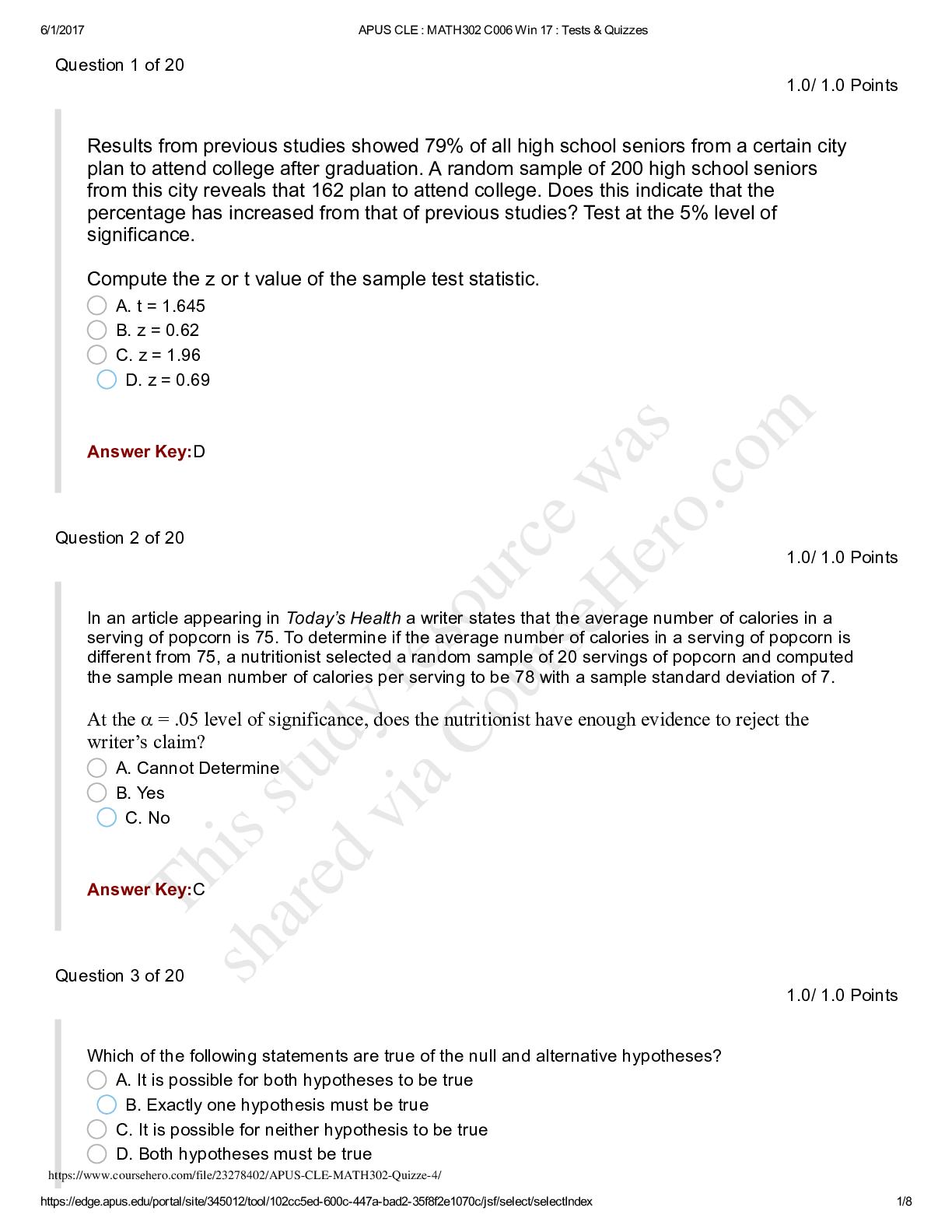
Eastern Gateway Community –
MGT 201Test 4 Lessons 11 12.docx
1. What is the confirmation bias?
When someone pay attention only to positive information about someone, disregarding negative
information
When someone pa
...
Eastern Gateway Community –
MGT 201Test 4 Lessons 11 12.docx
1. What is the confirmation bias?
When someone pay attention only to positive information about someone, disregarding negative
information
When someone pays too much attention to past information
When someone is prone to give more attention to the negative information
When someone pays attention only to information that supports his current opinions
2. Corporate social responsibility (CSR), also known as corporate _____, involves integrating social and
environmental concerns into a company’s operations.
action
citizenship
community
personhood
3. _____ is the process through which we take in and process information from our surroundings.
Awareness
Perception
Thought
Vision
4. Surveys have shown that ethics is the main factor that affects a company’s _____.
actions
culture
reputation
success
5. In what settings does physical health have a significant impact on employee productivity?
In almost no work settings
In basically all work settings
Only in work settings that require significant physical exertion
Only when an employee has a terminal illness
6. True or false: Generally, people deal with issues where they can best see the consequences quickly.
True False
7. The costs of unethical behavior can include _____. Select all that apply.
loss of employee talent
fees charged to customers
reduced customer loyalty
criminal or civil prosecution
8. The Sarbanes-Oxley Act requires companies to have a code of ethics if they _____.
have more than fifty employeeshave any type of business license
are listed on a public stock exchange
are incorporated in more than one state
9. The factors that determine ethical intensity include _____. Select all that apply.
minimum standards for behavior
significance of the consequences
the greatest benefit for the maximum number of people
social consensus that a proposed decision is negative or positive
10. The responsibilities of a company’s _____ in modeling ethical behavior include enforcing an ethics
program.
executives
lower management
senior management
non-management employees
11. Which statement regarding the relationship between work life and personal life is accurate?
Employees should seek to keep these two areas entirely distinct from one another.
Stress in one of these areas generally counterbalances and offsets stress in the other area.
Employees should not try to distinguish between these two areas, which is impossible to do.
The two areas often compete with one another for individuals’ time, energy, and attention.
12. What is the correct relationship the employees should pursue between work life and personal life?
A proper balance between work life and personal life should always be maintained.
Work life should always be given priority because without an income your personal life would suffer
dramatically.
Personal life should always be given priority, and work life should never be allowed to interfere with or
affect personal life in any way.
There is no way to properly distinguish between work life and personal life; any attempt to do so will
prove harmful in the end.
13. Good business ethics involves _____. Select all that apply.
truthful advertising
providing customers with low prices
increasing profits for shareholders
adhering to laws related to fair employment
14. Paying attention to only a portion of the available information and disregarding the rest is known as
_____.
willful ignorance
selective perception
perception bias
attribution bias
15. Employee attitude is often impacted by whether the employee feels the workplace is a place where
everyone is treated with equal respect and given equal opportunities, which is a significant aspect of
_____.interactional justice
organizational commitment
organizational justice
procedural justice
16. _____ are described as the stable, enduring goals that one has for life.
Personality traits
Vision statements
Priorities
Values
17. Why are exit interviews often extremely helpful practices?
Exit interviews are often the only setting in which employees get to interview and question their
managers.
It provides an opportunity for managers to be more grueling, knowing they will not have to deal with
any offense they give to the exiting employee.
Exiting employees are often bitter and unduly harsh in assessment.
Many employees are only willing to be completely open about issues once they are leaving the
organization.
18. A code of ethics, also known as a _____, is a policy statement of a company’s values, responsibilities,
and conduct expectations.
code of conduct
code of behavior
statement of values
statement of beliefs
19. Which of the following is true about employee productivity and physical health?
Physical health is a significant factor only in jobs that require high levels of physical exertion.
Physical health is never a significant factor in productivity.
Physically healthy employees are more productive.
Physical health is the most significant factor of all in predicting an employee’s likely productivity levels.
20. Practicing CSR through philanthropy may include which of the following?
Donating towards a scholarship for underprivileged students
Starting a recycling program at the corporate offices
Offering incentives for employees to volunteer in the community
Sourcing all materials for manufacturing from ethical companies
21. Which of the following is a criticism that is sometimes made against the use of the Myers-Briggs
Type Indicator?
The same individual receives a different type classification from test to test too often.
The test is biased towards certain personality types.
The test assumes too high of an education level to be useful.
The test does not make strong enough distinctions between personality types.
22.Incentives for reporting corporate crimes may include _____. Select all that apply.
cash rewards
reduced finessupervised release
immunity from crimes
23. Which of the following is an example of a stereotype?
A businessman looking for investors in his startup decided not to partner with his cousin because he
accepts the advice that business relations with family members often do not work out well.
A store manager decides to focus only on applications he receives from young women because he
knows they are better suited for the customer service role he is trying to fill.
A resident immigrant businessman who has not mastered English prefers to work with those who speak
his native language so that he can communicate better with them.
A manger undertaking a performance review of his employees focuses much more on negative aspects
of their performance than on positive aspects and it results in more negative reviews than would be fair.
24. A company can be held legally responsible for its employees’ unethical behavior if _____.
the behavior went against company policy
the behavior included any type of criminal activity
the behavior occurred while the employee was at work
the behavior was associated with the employee’s position
25. What term refers to the important practice of placing employees in roles that correspond to their
interests, preferences, and skills?
Correspondence training
Employee-to-job fit
Screening
Interview sensitivity
26. What is true about the relationship between personal life and work life for employees?
For the good of the employee, personal life and work life should be kept entirely distinct.
It is not a good idea to try to distinguish between work life and personal life.
It is not possible to separate personal life and work life completely.
Many employees use the concept of a balance between work and personal life as an excuse not to work
hard for the organization.
27. Which of the following is true concerning employee attitude?
Organizations have become increasingly aware of the importance of attitude and are investing
significant time and effort into promoting positive attitudes.
Organizations are beginning to realize that, though attitude is very important, they have little ability to
control or influence employee attitude.
Organizations have come to accept the fact that intelligence, skill, and other natural traits that cannot
be taught are far more important than attitude.
Most organizations recognize employee attitude as an important factor in the workplace but do little to
influence or evaluate it.
28. Which of the following is true about stress in the workplace?
An appropriate amount of stress is likely important to a healthy environment.
The ideal, if possible, is to remove all stress from the workplace.
Stress is generally overemphasized, and stress levels are not as important as many think.The higher the stress levels, the more productive employees are likely to be.
29. The word “ethics” is defined as _____.
principles of conduct or moral behavior
the decisions made by managers and employees
the factors that affect a company’s reputation
how behavior affects a company’s culture
30. What trait can often become a helpful overall indicator of how healthy the organizational
environment is?
Whether employees understand the corporate vision
Pay equity amongst employees
Nature of interpersonal relationships between employees
Stress levels
31. When an employee acts unethically, the company can be held responsible if _____.
the action is against the law
the action is within the scope of company policy
the employee acts within the scope of employment
the employee acts in a way that affects customers or shareholders
32. Who developed the concept of the “big five” personality traits?
Myers-Briggs
Shalom Schwartz
Hans Eysenck
Lewis Goldberg
33. True or false: By establishing and enforcing a compliance and ethics program, a company can
completely prevent fraud and shield itself from the repercussions of the unethical and illegal acts of its
employees.
True False
34. What goal should organizations have for interpersonal relationships between employees?
Organizations should be content if they are able to avoid any major conflict.
Organizations should promote close friendships in order to increase productivity.
Organizations should try not to allow employees to become too attached to one another.
Organizations should only hire individuals who already have close friendships within the organization.
35. Why are ethics necessary in business? Select all that apply.
It saves money for both the company and its customers.
It prevents the external constituents of an organization from harm.
It benefits the organization internally by helping to ensure its success.
It inspires other companies to behave ethically in their practices as well.
36. How the benefits are shared or distributed among the individuals in a group is a question of _____.
personal virtueindividual rights
distributive justice
legal and regulatory requirements
37. What are the two purposes of sentencing?
Just punishment and deterrence
Compliance and consistency
Implementation and evaluation
Anonymity and confidentiality
38. Which of the following is an important part of organizational justice?
Whether the organization is treated fairly by the government
Whether appropriate barriers of separation are in place between managers and general employees
Whether employees are given fair opportunity for advancement
Whether the organization provides good employee-to-job fit
39. The minimum standards for behavior under a code of ethics are determined by _____.
ethical intensity
distributive justice
rules of compliance
legal and regulatory requirements
40. In the context of the Rokeach Value Survey, what type of value refers to the modes of conduct that
are considered appropriate and right, such as honesty, integrity, and even ambition?
Ethical values
Moral values
Instrumental values
Terminal values
41. How are whistleblowers protected under the law?
A company cannot fire a legitimate whistleblower for telling the truth.
A company must raise the pay of whistleblowers if they bring truths to the public.
The law requires whistleblowers to be compensated if they lose their jobs.
The law gives whistleblowers immunity from going to jail even if they break the law.
42. True or false: The ethics program designed by the U.S. Sentencing Commission has become the
model for every corporate ethics program.
True False
43. A certain employee has a reputation for being difficult to get along with, somewhat emotionally
imbalanced, and unpredictable in his moods. However, he also has an unusually high ability to see things
realistically and is a dynamic and productive worker when he is engaged in a project. What personality
trait is strongly represented in this employee?
Extraversion
Conscientiousness
Neuroticism
Openness44. True or false: The more people who are involved in an instance of unethical behavior, the lower the
ethical intensity.
True False
45. Do organizations have their own cultures?
No, it is not possible for an organization to create their own culture.
Yes, every organization has its own culture.
Only if they make an intentional effort to create one.
Most organizations do, but some are successfully able to avoid this undesirable trait.
46. The important principle of employee-to-job fit applies in which situation(s)?
Hiring new employees
Reassigning roles to existing employees
Both hiring new employees and reassigning roles to existing employees
Neither hiring new employees nor reassigning roles to existing employees
47. The principle of utilitarianism seeks _____.
the fairness of all possible outcomes
conformity to a standard of righteousness
the greatest benefit for the maximum number of people
the pursuit of outcomes that will benefit the self in the long run
48. A company wants to hire an agent to represent its interests in another country that it is targeting for
corporate expansion. What value might be particularly important for candidates for that role to have?
Benevolence
Security
Extroversion
Universalism
49. One benefit of an ethical business is that the employees’ _____ is/are better in ethical companies.
benefits
efforts
morale
turnover
50. Is it always a good idea to hire the most generally skilled and talented candidate?
Yes, because many skills and talents cannot be quickly learned by employees who do not have them.
Yes, because skills and talents are the most significant indicator of how productive an employee will be.
No, because the general skills and talents will not always make the candidate a good fit for the
particular role being filled.
No, because skills and talents are of relatively minor importance in predicting an employee’s
productivity.
51. True or false: Personality tests and questionnaires are effective tools in determining whether a
candidate will be ethical.
True False
52. Conformity to a standard of righteousness is known as _____.personal virtue
individual rights
religious injunction
utilitarianism
53. A(n) _____ is a general opinion or assumption about a class of individuals who share a particular
trait.
attribution
bias
prejudice
stereotype
54. What stance should organizations take in regard to cases of interpersonal conflict between
employees?
The organization should leave employees to handle their own personal conflicts.
There is rarely any need to worry about this in professional workplaces.
The organization should take a hard stance and never allow any interpersonal conflict to be
countenanced.
The organization should have a plan for resolving tensions and disagreements.
55. Corporate social responsibility can take which of the following forms? Select all that apply.
Philanthropy
Volunteerism
environmental efforts
employee minimum wages
56. What is the name of the bias where managers show favoritism to those within their favored circle?
Ingroup bias
Clique bias
Positivity bias
Discrimination bias
57. Kelly’s coworker usually volunteers for the most difficult roles in team projects and puts in aboveaverage effort. This week, however, Kelly and her coworker were assigned a project alone together, and
Kelly sees that things seem different. The coworker is not volunteering for any of the responsibilities, is
not completing the tasks she eventually accepts, and is putting in far below-average effort to the
project. Kelly is convinced that this sub-par performance and effort is due to the coworker’s personal
dislike for Kelly. In making this judgment, Kelly exhibits _____.
attribution
bias
perception
stereotyping
58. Which law was passed in 2002 to eliminate unethical behavior on the corporate level?
The Williams Act
The Sarbanes-Oxley Act
The Model Business Corporation Act
The Investor Protection and Securities Reform Act59. Reducing a company’s carbon footprint is an example of taking responsibility through _____.
volunteerism
philanthropy
environmental efforts
ethical labor practices
60. Which of the following is a common bias?
Positivity bias
Optimism bias
Negativity bias
Generosity bias
61. True or false: Exhibiting good business ethics is essential to the survival and success of a company.
True False
62. Which of the big five personality traits is the only one that is consistently linked to career success
over time?
Agreeableness
Conscientiousness
Extraversion
Openness
63. Eric had a rather poor first half of the year at work due to a number of factors, some of which were
related to his poor choices and attitude. However, his circumstance improved in the second half of the
year, as did his attitude. His performance was very strong and impressive. Now that he is facing his
annual review and evaluation from his manager, he finds that the manager is very complimentary and
positive on his work for the year. Eric is glad that the first half of the year seems to have been almost
forgotten. He was even told by his manager that “everything” he has done for him has been excellent
this year. What bias does the manager seem to be exhibiting?
First-impression bias
Positivity bias
Recency bias
Spillover bias
64. The main moral and ethical guide for many people is referred to as _____.
personal virtue
distributive justice
religious injunction
long-term self-interest
65. The ethical or unethical decisions of _____ can reflect the most in a company’s reputation.
customers
employees
managersshareholders
66. Incentives for reporting corporate crimes may include _____.
cash rewards
public recognition
avoiding incarceration
immunity from prosecution
67. True or false: In business, a manager must treat all ethical issues with the same importance.
True False
68. What personality trait refers to how willing and eager an individual is to try new experiences and
consider new ideas?
Adventurousness
Agreeableness
Extraversion
Openness
69. Which of the following is normally NOT identified as a stakeholder in a company?
Customers
Employees
Lawmakers
Shareholders
70. Which of the following would be classified as a “terminal value” in the Rokeach Value Survey?
Integrity
Comfort
Kindness
Ambition
71. It is often only in _____ that employees are willing to be fully honest about their feelings.
attitude surveys that are not anonymous
exit interviews
face-to-face discussions
job interviews
72. Which of the following are compliance steps from the Federal Sentencing Guidelines? Select all that
apply.
Conducting training programs and disseminating relevant information
Establishing standards and procedures to prevent and detect criminal conduct
Ensuring that minimum sentencing requirements for corporate crimes are met
Giving those who have violated ethical guidelines a second chance when appropriate
73. Federal Sentencing Guidelines ensure that an ethics program is being followed by _____.
conducting training programs
establishing standards and proceduresperiodically evaluating its effectiveness
apprising senior management about the program
74. An employee who has low job satisfaction because he does not like his current role can still have
high _____ if he believes in and identifies with the values and mission of his company.
attribution
employee-to-job fit
organizational commitment
skill development
75. Those affected by the consequences of unethical business practices include _____.
just customers
just shareholders
just the general public
all the above
76. What is most often the appropriate organizational response when employee stress levels are
unreasonably high?
Provide employee training in how to manage the high stress levels
Hire only employees who excel under high-stress situations
Make changes that lower employee stress to reasonable levels
Organizations are not responsible to manage stress; employees are
77. Consulting companies offer ethical compliance systems for client organizations that integrate all of
the following EXCEPT _____.
compliance
ethics
governance
risk
78. When we attempt to explain the unseen causes and motives behind the activity we actually can see,
this is known as _____.
attribution
bias
judgmentalism
prejudice
79. True or false: The reputation of a company reflects the ethical or unethical decisions of all of its
employees combined.
True False
80. Consulting companies offer ethical compliance systems for client organizations that integrate which
of the following? Select all that apply.
Compliance
Ethics
Governance
Risk
[Show More]





![Preview of Comprehensive Stress Management, 15th Edition By Jerrold S. Greenberg | [eBook][PDF]](https://browseimages.nyc3.digitaloceanspaces.com/paper-images/2023/Jul/25/f6jJmm9G2023-07-25-06-5964bf4899d5598.png)

 (Diane Pacitti etc.png)