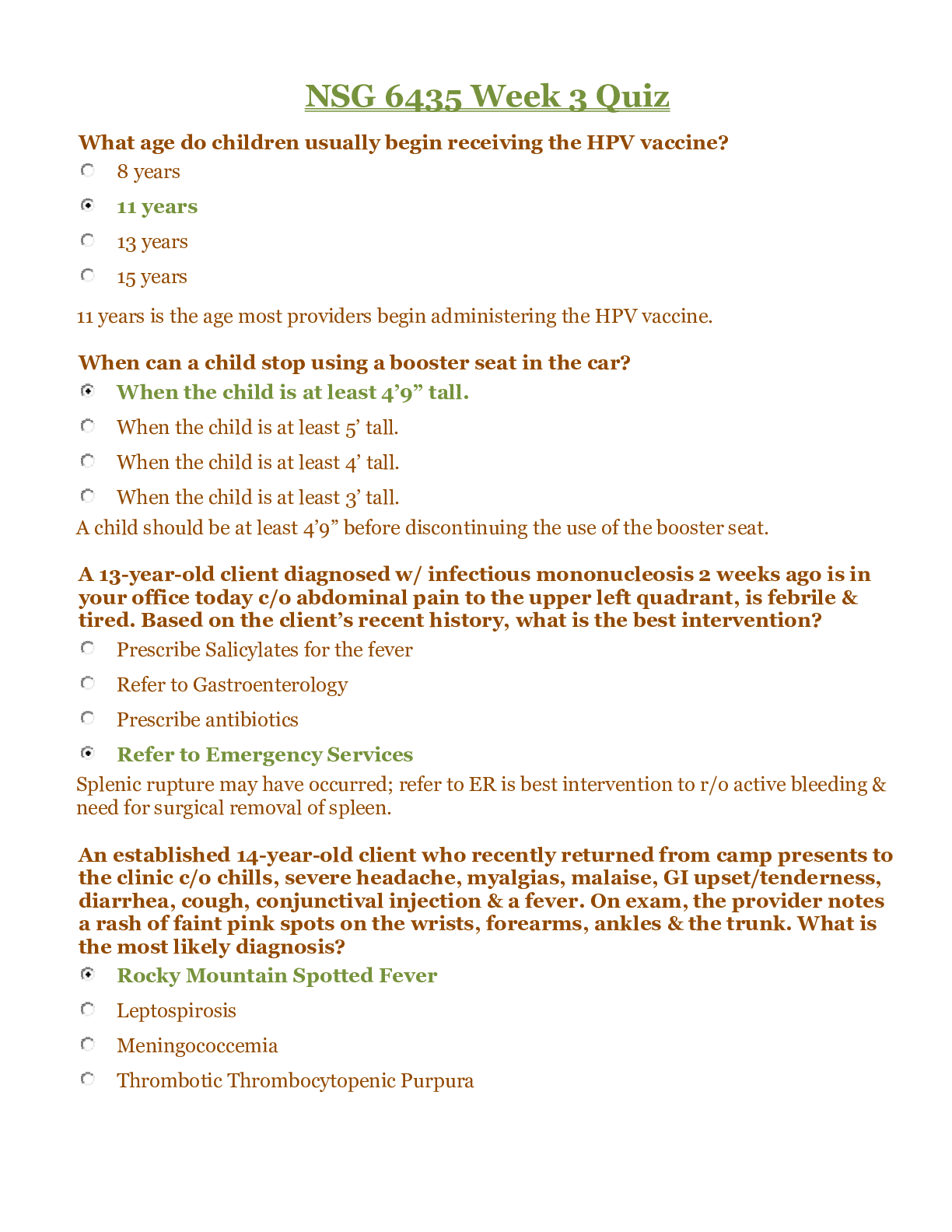
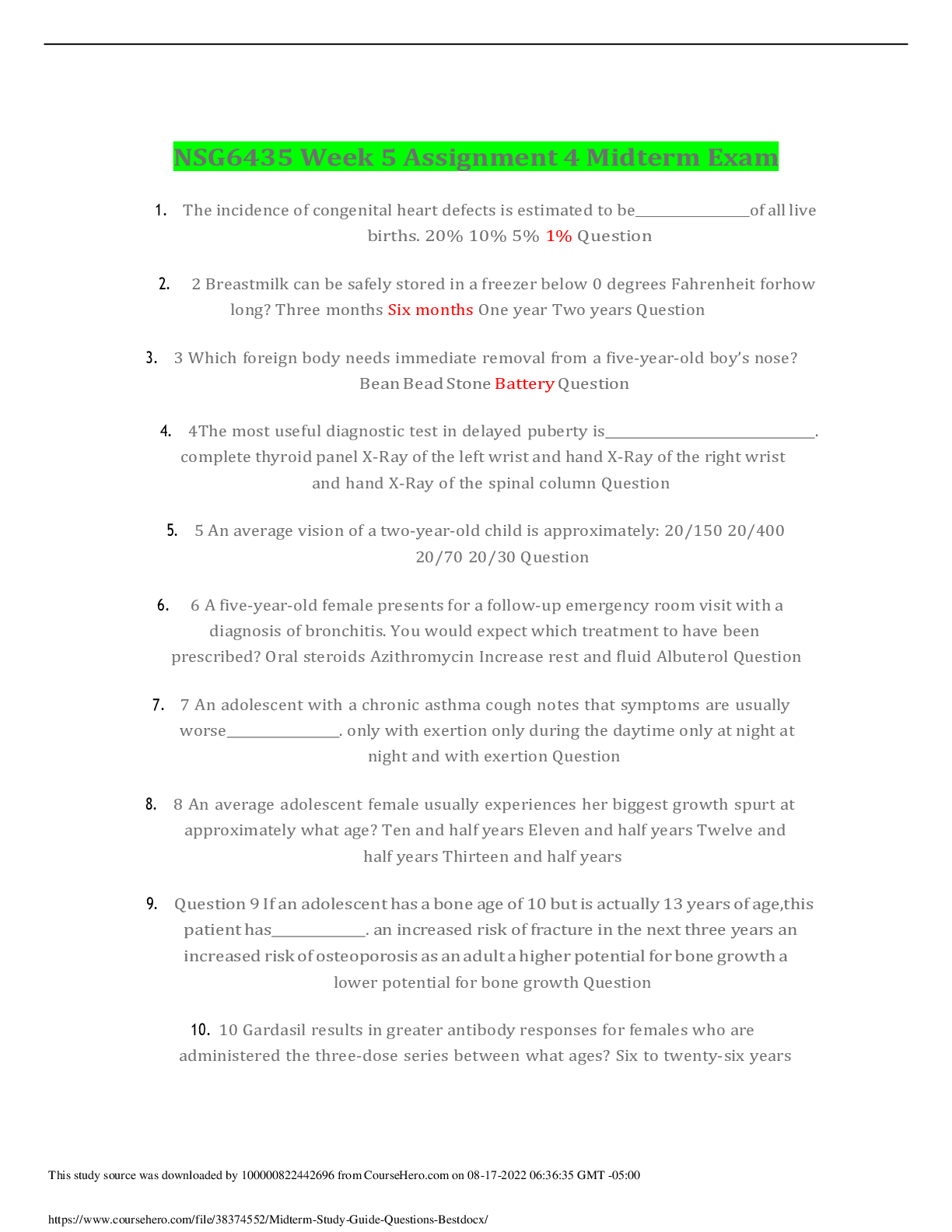
What age do children usually begin receiving the HPV vaccine?
8 years
11 years
13 years
15 years
11 years is the age most providers begin administering the HPV vaccine.
When can a child stop using
...
What age do children usually begin receiving the HPV vaccine?
8 years
11 years
13 years
15 years
11 years is the age most providers begin administering the HPV vaccine.
When can a child stop using a booster seat in the car?
When the child is at least 4’9” tall.
When the child is at least 5’ tall.
When the child is at least 4’ tall.
When the child is at least 3’ tall.
A child should be at least 4’9” before discontinuing the use of the booster seat.
A 13-year-old client diagnosed w/ infectious mononucleosis 2 weeks ago is in your office today c/o abdominal pain to the upper left quadrant, is febrile & tired. Based on the client’s recent history, what is the best intervention?
Prescribe Salicylates for the fever
Refer to Gastroenterology
Prescribe antibiotics
Refer to Emergency Services
Splenic rupture may have occurred; refer to ER is best intervention to r/o active bleeding & need for surgical removal of spleen.
An established 14-year-old client who recently returned from camp presents to the clinic c/o chills, severe headache, myalgias, malaise, GI upset/tenderness, diarrhea, cough, conjunctival injection & a fever. On exam, the provider notes a rash of faint pink spots on the wrists, forearms, ankles & the trunk. What is the most likely diagnosis?
Rocky Mountain Spotted Fever
Leptospirosis
Meningococcemia
Thrombotic Thrombocytopenic Purpura
A client w/ chickenpox who cannot stop itching presents to the clinic requesting relief. What can the provider do to help this client? (SATA)
Prescribe calamine lotion
Prescribe oral antihistamines
Prescribe Salicylates
Recommend oatmeal baths
All choices are accurate except Salicylates are contraindicated because of Reye Syndrome.
An infant can complete hand-to-hand transfers at what age?
90 days
120 days
7 months
11 months
Object transfer occurs by 7 months of age.
Which is the most appropriate anticipatory guidance for the child diagnosed w/ fracture through the growth plate?
No sports until pain has resolved
Use crutches to ambulate until healed
Rest, ice, compress & elevate the affected area
Exercise affected area using active range-of-motion exercises
Treatment of slipped capital femoral epiphysis is aimed at preventing further slippage. Since the goal is no weight bearing & avoiding flexion of the hip, no sports are recommended. Ice would not change the problem in the femoral head, & ROM & exercise are contraindicated.
The provider learns that the family of a client recently rescued a cat from the outside. To prevent the risk of toxoplasmosis, which anticipatory guidance is most appropriate?
Feed cat well balanced & high-quality food.
Wear shoes at all times in the home.
Thoroughly wash hands after changing cat litter.
Bathe cat on a bi-weekly basis
Transmission of toxoplasmosis occurs through handling of cat feces. Pregnant women should avoid contact w/ cat litter & others should wash hands thoroughly when handling cat litter.
A 9-day-old client presents to the clinic who is sluggish, has a temp of 97°F, HR 105, cool extremities & loss of appetite, presents to the clinic. What should the provider do?
Recommend parents to allow the client to sleep
Reassure parents that this is normal & client will return to baseline in 7 days
Recommend formula feeding
Refer to ER to rule out sepsis
The provider understands that a client w/ a HX of hemolytic anemia & a recent diagnosis of erythema infectiosum (5th disease), is at risk for which complication?
Arthritis
Papular-purpuric “gloves & socks” syndrome
Chronic Infection
Aplastic crisis
________________________________________
[Show More]