CONCEPT MAP WORKSHEET
DESCRIBE DISEASE PROCESS AFFECTING PATIENT (INCLUDE PATHOPHYSIOLOGY OF DISEASE PROCESS)
Coronary artery disease- Increased blood levels of low-density lipoprotein (LDL) irritate or damage th
...
CONCEPT MAP WORKSHEET
DESCRIBE DISEASE PROCESS AFFECTING PATIENT (INCLUDE PATHOPHYSIOLOGY OF DISEASE PROCESS)
Coronary artery disease- Increased blood levels of low-density lipoprotein (LDL) irritate or damage the inner layer of coronary vessels. LDL enters the vessel after damaging the protective barrier, accumulates, and forms a fatty streak.
Smooth muscle cells move to the inner layer to engulf the fatty substance, produce fibrous tissue, and stimulate calcium deposition. The cycle continues, resulting in transformation of the fatty streak into fibrous plaque and, eventually, a coronary artery disease (CAD) lesion evolves .Oxygen deprivation forces the myocardium to shift from aerobic to anaerobic metabolism, leading to accumulation of lactic acid and reduction of cellular pH. The combination of hypoxia, reduced energy availability, and acidosis rapidly impairs left ventricular function. The strength of contractions in the affected myocardial region is reduced as the fibers shorten inadequately, resulting in less force and velocity. Wall motion is abnormal in the ischemic area, resulting in less blood being ejected from the heart with each contraction.
Plaques can rupture due to disruption of the fibrous cap, leading to acute events.
DIAGNOSTIC TESTS (REASON FOR TEST AND RESULTS)
ECG
Corniary Calcium test
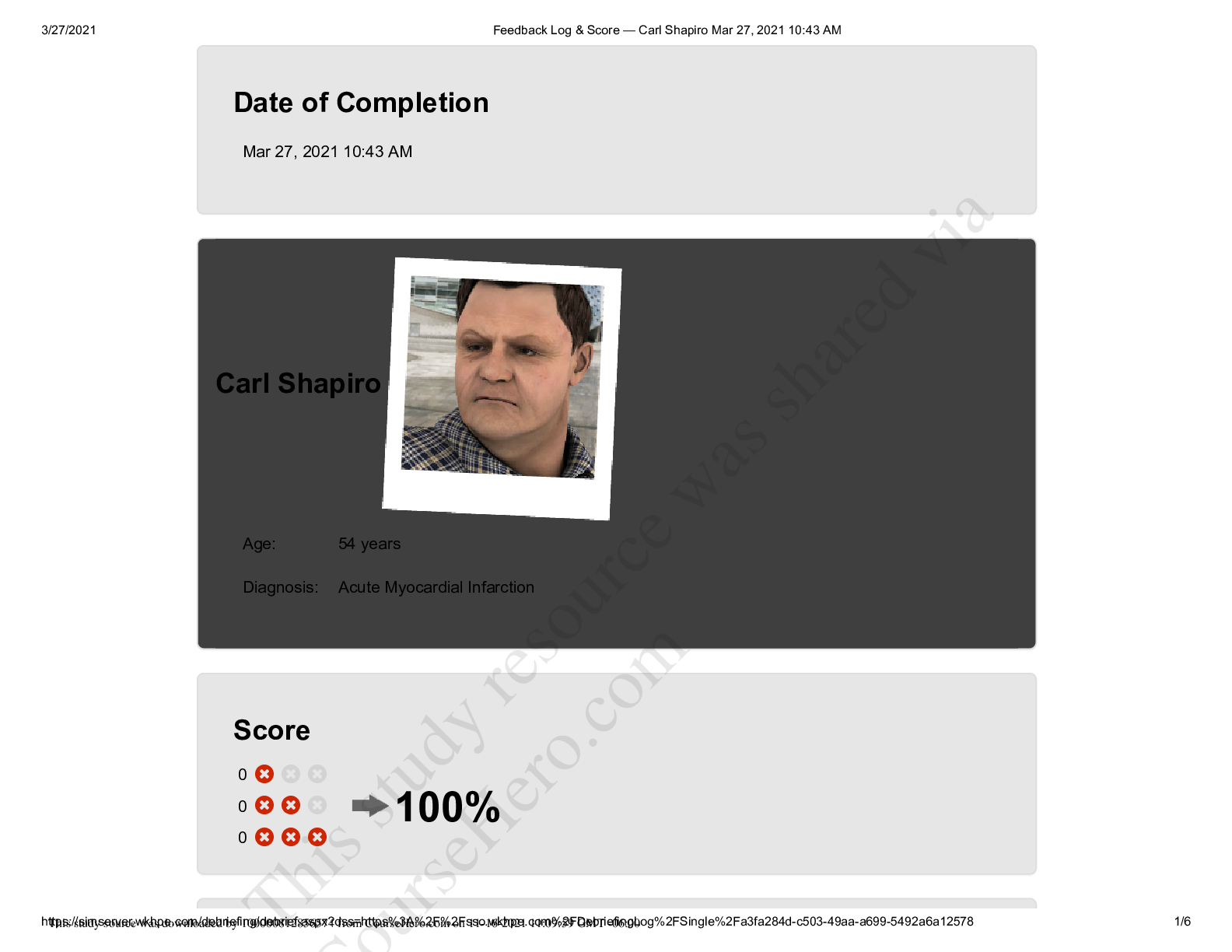
Shapiro, Carl DOB: 7/19/1965
Admitted:4/17/2020
ANTICIPATED
PHYSICAL FINDINGS
-Cool extremities
-Diaphoresis
Age: 54 yr old -Arteriovenous nicking of the eye
-Obesity
-Hypertension; hypotension
-Tachycardia
ANTICIPATED NURSING INTERVENTIon
Ask the patient to grade the severity of the pain on a scale of 1 to 10. Provide pain management interventions and assess effectiveness.
-Keep nitroglycerin available for immediate use. Instruct the patient to call for help immediately whenever feeling pain and before taking nitroglycerin.
-Obtain a 12-lead ECG if the patient experiences angina. Obtain vital signs every 5 to 10 minutes if the patient experiences chest pain.
-Place the patient in a position of comfort with the head of the bed elevated or in Fowler position to allow for maximum chest expansion.
-Encourage the patient to take slow, deep breaths.
-Provide for rest periods; cluster care activities to promote rest. Encourage the use of energy-conservation measures.
-Observe for signs and symptoms that may signify worsening of condition.
INTRODUCTION Good morning my name is Nicole Findlay Im a registered nurse.
Your name, position (RN), unit you are working on
SITUATION Mr. Shapiro is a 54 year old male. Mr.
Shapiro came to the hospital with complaints of chest pain, diaphoresis, and shortness of breath.
Patient’s name, age, specific reason for visit
BACKGROUND Mr. Shapiro was admitted on 4/17/2020 and diagnosed with Coronary Artery Disease on admission. His current orders are Morphine 2mg IV push PRN for chest pain every 10 minutes x3 every 2 hours, chest x- ray, basic metabolic panel, complete blood count, troponin and CK- MB every 8 hours x3. Continuous ECG and Spo2 monitoring
Patient’s primary diagnosis, date of
admission, current orders for patient
ASSESSMENT On 4/17/2020 and diagnosed with Coronary
Artery Disease on admission. His current orders are Morphine 2mg IV push PRN for chest pain every 10 minutes x3 every 2 hours, chest x- ray, basic metabolic panel, complete blood count, troponin and CK- MB every 8 hours x3. Continuous ECG and Spo2 monitoring
Current pertinent assessment data using head to toe approach, pertinent diagnostics, vital signs
RECOMMENDATION I recommend the patient be continuously monitored for signs of cardiac problems. I suggest having defibrillation on stand by
Any orders or recommendations you may have for this patient
TIENT EDUCATION WO RKSHEET
Clinical Worksheet
• Do not drink and ask before taking OTC meds
NAME OF MEDICATION, CLASSIFICATION, AND INCLUDE PROTOTYPE
MEDICATION: nitroglycerin
CLASSIFICATION: Vasodilator, Nitrate
PROTOTYPE: nitroglycerin (glyceryl trinitrate)
SAFE DOSE OR DOSE RANGE, SAFE ROUTE
Aerosol (translingual): 0.4 mg/metered spray
Injection: 5 mg/mL; 100 mcg/mL; 200 mcg/mL; 400 mcg/mL
Ointment: 0.4%; 2%
PURPOSE FOR TAKING THIS MEDICATION
used to prevent chest pain in people with a certain heart condition (coronary artery disease).
This medication belongs to a class of drugs known as nitrates. Angina occurs when the heart muscle is not getting enough blood.
PATIENT EDUCATION WHILE TAKING THIS MEDICATION
Caution patient to take nitroglycerin regularly, as prescribed, and to have it accessible at all times.
• Alert: Advise patient that stopping drug abruptly may cause coronary artery spasm.
• Teach patient how to give the prescribed form of nitroglycerin.
This study source was downloaded by 100000815110306 from CourseHero.com on 08-03-2021 16:26:40 GMT -05:00
Assig
Clinical Worksheet
ned vSim:
Initi CS als: Diagnosis:
Coronary Artery Disease
Length of Stay: unknown HCP: Isolation: IV
Locat
Age: 54 F:M
Code Status:full code
Allergies: N/A
Consults: Fall Risk:
yes
R. Arm
n/a
Why is your patient in the hospital (Answer in your own words and include the History of
The pt came to the hospital with complaints of chest pain, diaphoresis, and shortness of breath
Health History/Comorbities (that relate to this hospitalization):
Pt was diagnosed with coronary artery disease. Secondary diagnosis include hypertension and angina. Pt is a current smoker ½ a pack a day, pt is a current drinker 1-3 drinks per week.
Shift Goals/ Patient Education Needs:
1. Control Pain to a adequate level 2.monitor O2
3. Given medications as ordered
4. Monitor Heart Rhythm
Path to Discharge:
Participate as part of a multidisciplinary team to coordinate discharge planning efforts. The team may include a bedside nurse, social worker, care manager, nutritionist, speech therapist, respiratory therapist, pulmonologist, and infectious disease specialist. Assess the patient's and family's understanding of diagnosis, treatment, prognosis, follow-up, and warning signs for which to seek medical attention.
Path to Death or Injury:
Cardiac arrhythmias, Myocardial infarction (MI), Heart failure, Angina, Cardiomyopathy, Sudden cardiac death
Alerts:
What are you on alert for with this patient? (Signs & Symptoms)
1. Low o2
2. Cardiac Arrythmias
3. Angina
What Assessments will focus on for this patient? (How will I identify the above signs &Symptoms?)
1. EEG
2. Cardiac assessment
4. Skin assessment
List Complications may occur related to dx, procedure, comorbidities:
1. Non medical compliance
2. spepsis
3. sudden cardiac arrest
What nursing or medical interventions may prevent the above Alert or complications?
1. Obtain a 12-lead ECG if the patient experiences angina. Obtain vital signs every 5 to 10 minutes if the patient experiences chest pain
2. Administer prescribed medications, including antiplatelet agents, ACE inhibitors, and lipid-lowering agents.
3. Monitor vital signs and keep nitroglycerin available for immediate use. Instruct the patient to call for help immediately whenever feeling pain and before taking nitroglycerin.
1. How did the scenario make you feel?
The scenario was different from any other one I have completed so far. I guess I was not expecting for the patient to become unresponsive. I panicked at first because I wasn’t sure exactly what to do, but then I realized the proper course of action. It felt good to
have followed mostly the correct steps throughout the scenario.
2. What could have been the causes of Carl Shapiro’s ventricular fibrillation?
The lab results revealed that his troponin and CK-MB were high, which are indicative of damage to his heart tissues. The patient also has a history of smoking and obesity.
3. When performing CPR for Carl Shapiro, what are quality indicators you are performing resuscitation correctly? Chest compression fraction >80% Compression rate?of 100-120/min.
Compression depth of at least 50 mm (2 inches) in adults and at least 1/3 the AP dimension of the chest in infants and children.
No excessive ventilation.
-High-quality CPR includes compressing hard and fast, allowing complete recoil after each compression, reducing hands-off time by minimizing interruptions in compressions, switching providers every 2 minutes, and avoiding excessive ventilation
4. Discuss safety aspects during defibrillation.
Do not touch the patient during defibrillation (clearing bed at least twice before defibrillating), do not allow any objects to touch the bed, ensure the patient is dry before using the AED, do not use AED over a pacemaker, ensure the AED is functional, ensure pads are in correct position, ensure patient does not have nitroglycerin patch, ensure there are no flammable substances (remove oxygen from the bed).
5. If Carl Shapiro would have had return of spontaneous circulation (ROSC), what would your next interventions be?
Assess the carotid pulse, administer epinephrine, administer amiodarone
6. What key elements would you include in the handoff report for this patient?
Consider the SBAR (situation, background, assessment, recommendation) format.S- This is XX, Carl Shapiro experienced VFIB, code team was called, emergency response measures were implemented to include CPR and AED shock. B- 54-year-old male. He was seen in the Emergency Department at 1:30 p.m. for complaints of chest pain, diaphoresis, and
aspirin and two doses of sublingual nitroglycerin. Chestpain improved with nitroglycerin administration A- Patient started breathing spontaneously again R- Recommend patient cardiac status is closely monitored
7. If Carl Shapiro’s family members had been present at the bedside during the arrest, describe what you could have done to support them during this crisis. The patient is the main concern during this situation, but I would ensure they were escorted out of the room so the focus could be on the patient, but if they insisted to stay I would reassure them that we are doing everything we can to ensure his health and safety.
[Show More]