Week 1:
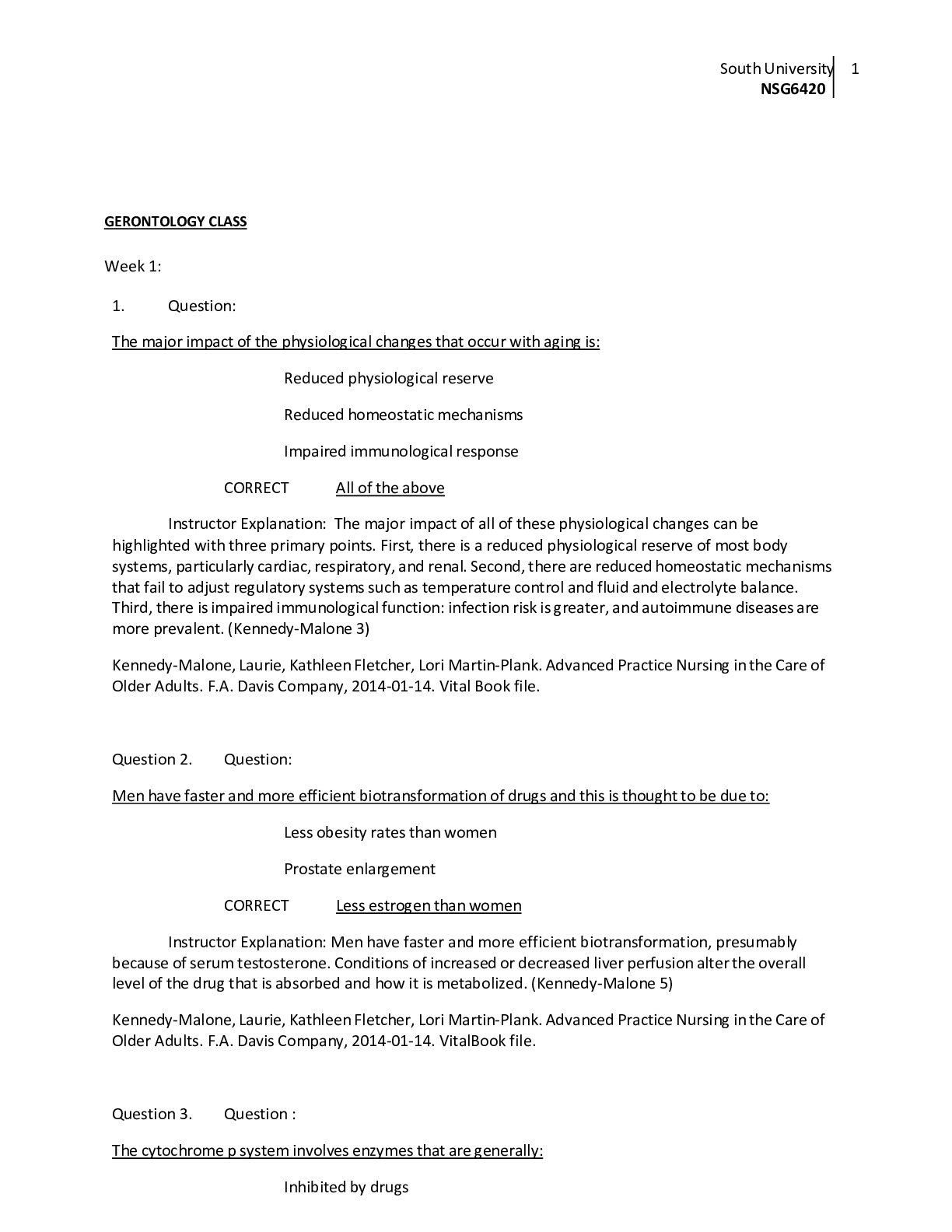
1. Question:
The major impact of the physiological changes that occur with aging is:
Reduced physiological reserve Reduced homeostatic mechanisms Impaired immunological response
Question 2. Question:
...
Week 1:
1. Question:
The major impact of the physiological changes that occur with aging is:
Reduced physiological reserve Reduced homeostatic mechanisms Impaired immunological response
Question 2. Question:
Men have faster and more efficient biotransformation of drugs and this is thought to be due to:
Less obesity rates than women Prostate enlargement
Question 3. Question :
The cytochrome p system involves enzymes that are generally:
Inhibited by drugs
Induced by drugs
Question 4. Question :
Functional abilities are best assessed by:
Self-report of function
CORRECT Observed assessment of function
A comprehensive head-to-toe examination Family report of function
Instructor Explanation: Two well-established tools used to evaluate function in older adults are the Katz Activities of Daily Living Scale (Katz et al., 1963) and the Lawton and Brody scale for Instrumental Activities of Daily Living (Lawton & Brody, 1969). It is important to be cautious about self- report of function (rather than direct observation of function) and to ask, “Do you …?” instead of “Can you …?” in order to determine if patients actually perform the activity. (Kennedy-Malone 40)
Kennedy-Malone, Laurie, Kathleen Fletcher, Lori Martin-Plank. Advanced Practice Nursing in the Care of Older Adults. F.A. Davis Company, 2014-01-14. VitalBook file.
Question 5. Question :
Iron Deficiency Anemia (IDA) is classified as a microcytic, hypochromic anemia. This classification refers to which of the following laboratory data?
Hemoglobin and Hematocrit
CORRECT Mean Corpuscular Volume (MCV) and Mean Corpuscular Hemoglobin (MCH)
Serum ferritin and serum iron
Total iron binding capacity and transferrin saturation
Instructor Explanation: RBC indices reveal an MCV (mean corpuscular volume/RBC size) that will be decreased to <80 fL in adults; MCH (mean corpuscular hemoglobin/RBC color) will show hypochromia or pale cells; RBC distribution width (RDW)/volume variation will be increased.
(Kennedy-Malone page 519)
Kennedy-Malone, Laurie, Kathleen Fletcher, Lori Martin-Plank. Advanced Practice Nursing in the Care of Older Adults. F.A. Davis Company, 2014-01-14. VitalBook file.
Question 6. Question :
When interpreting laboratory data, you would expect to see the following in a patient with Anemia of Chronic Disease (ACD):
Hemoglobin <12 g/dl, MCV decreased, MCH decreased Hemoglobin >12 g/dl, MCV increased, MCH increased
.........................................................CONTINUED.........................................
[Show More]