Name: Date:
Student Exploration: Equilibrium and Concentration
Vocabulary: chemical equilibrium, concentration, equilibrium, equilibrium constant, reaction quotient, reversible reaction
Prior Knowledge Q
...
Name: Date:
Student Exploration: Equilibrium and Concentration
Vocabulary: chemical equilibrium, concentration, equilibrium, equilibrium constant, reaction quotient, reversible reaction
Prior Knowledge Questions (Do these BEFORE using the Gizmo.)
Gary has $5,000 in his bank account and earns a modest salary. Every month he pays for rent, food, utilities, and entertainment.
A. How will Gary’s account change if he saves more than he spends?
B. How will Gary’s account change if he spends more than he saves?
C. What happens if Gary spends exactly as much as he saves?
Gizmo Warm-up
If Gary spends exactly as much as he earns, his savings will be in equilibrium. Equilibrium occurs when two opposing processes occur at the same rate, leading to no net change. In the Equilibrium and Concentration Gizmo, you will investigate how equilibrium can occur in chemical reactions.
To begin, check that Reaction 1 is selected. Set Moles NO2
to 8 and Moles N2O4 to 0.
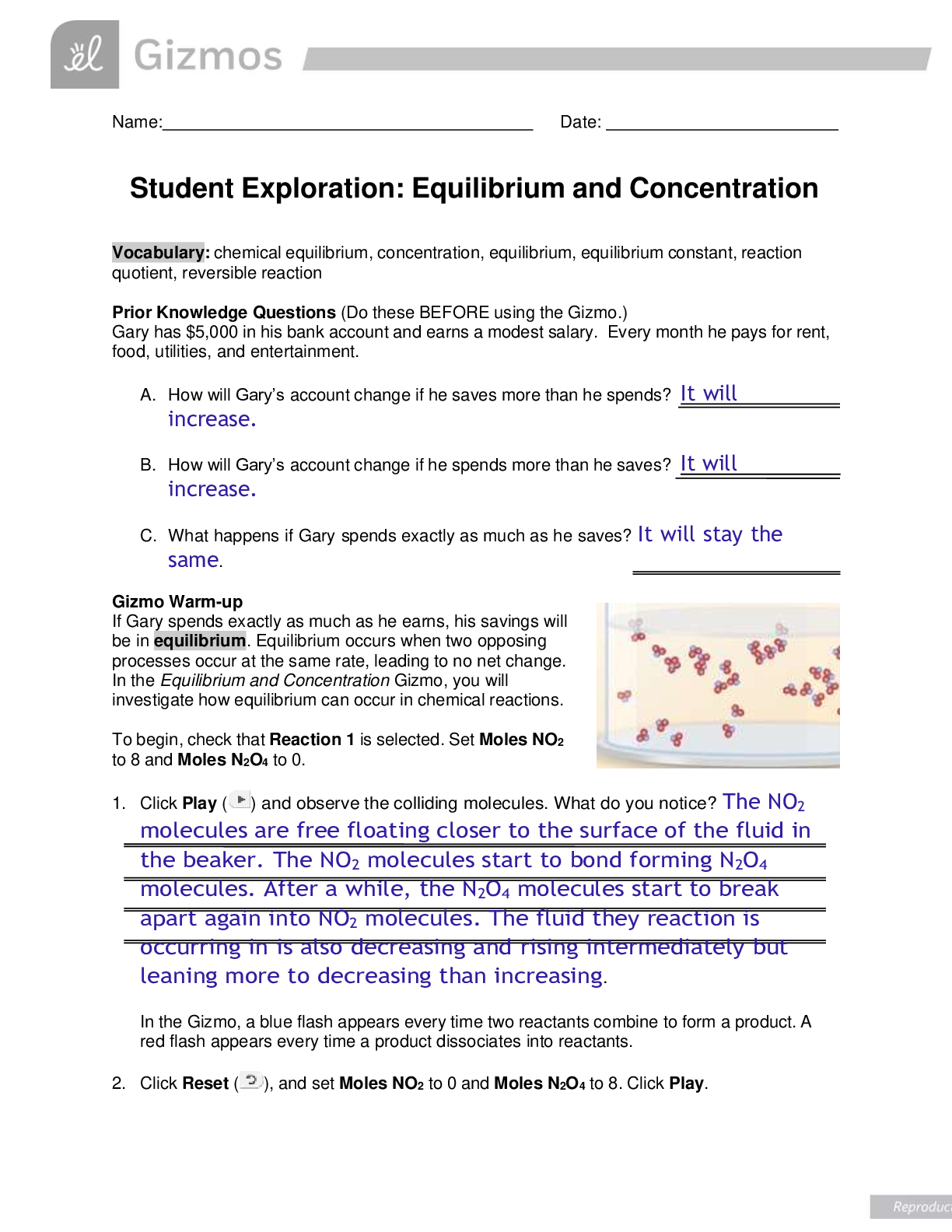
1. Click Play ( ) and observe the colliding molecules. What do you notice?.
In the Gizmo, a blue flash appears every time two reactants combine to form a product. A red flash appears every time a product dissociates into reactants.
2. Click Reset ( ), and set Moles NO2 to 0 and Moles N2O4 to 8. Click Play.
What do you notice now?
3. When a reaction can proceed in either direction, it is a reversible reaction. Based on what you have observed, is the synthesis of NO2 into N2O4 a reversible reaction? Explain.
Activity A:
Reversible reactions
Get the Gizmo ready:
● Click Reset. Reaction 1 should be selected.
● Set Moles NO2 to 8 and Moles N2O4 to 0.
● Move the Sim. speed slider all the way to the right.
Question: What are the characteristics of reversible reactions?
1. Predict: Suppose you began with 8 moles of NO2 in the chamber. What do you think will happen if you let the reaction go for a long time
2. Test: Click Play. Select the BAR CHART tab and check that Moles is selected. Observe the bar chart for about 30 seconds. As time goes by, what do you notice about the bars representing moles NO2 and moles N2O4?
3. Observe: Click Pause ( ). Select the GRAPH tab. Click the (–) zoom control on the horizontal axis until you can see the whole graph. What do you notice
This situation, in which the overall amounts of reactants and products does not change significantly over time, is called a chemical equilibrium.
4. Record: On the BAR CHART tab, turn on Show data values. How many moles of NO2 and
N2O4 are there right now? Moles NO2 Moles N2O4
5. Calculate: Suppose all the NO2 molecules were synthesized into N2O4. Given the equation
2NO2 ⇄ N2O4, how many moles of N2O4 would be produced?
1 mol N2 O4
8 mol NO2
1 mol N2 O4
= 4 mols N O
(1 )(2 mols NO ) 2 4
6. Experiment: Click Reset. On the INITIAL SETTINGS tab, set Moles NO2 to 0 and Moles N2O4 to 4. Click Play. Click Pause when the bars of the bar chart stop moving very much.
A. List the current amounts of each substance: Moles NO2 Moles N2O4
B. How do these results compare to starting with 8 moles of NO2?
(Activity A continued on next page)
Activity A (continued from previous page)
7. Summarize: In each trial, you started with the same amounts of nitrogen and oxygen. In this situation, did the equilibrium amounts change depending on the direction of the reaction?
8. Set up the Gizmo: Click Reset and select the EXPERIMENT tab on the left. On the INITIAL SETTINGS tab on the right, select Reaction 2. Set Moles NO to 5, Moles NO2 to 5, and Moles N2O3 to 0. What are the reactants and product of this reaction?
Reactants: Product:
(Note: In this reaction, some of the NO2 reactants combine to form N2O4, as in reaction 1.)
9. Observe: Recall that a blue flash appears every time two reactants combine to form a product. A red flash appears every time a product dissociates into reactants. Click Play.
A. At first, do you notice more blue flashes or red flashes?
B. What do you notice about the frequency of blue and red flashes as time goes by?
.
C. Click Reset. This time, start the experiment with 0 moles of NO and NO2 and 5 moles of N2O3. Click Play. What do you notice about the red and blue flashes now?
10. Explain: Think about how the numbers of blue and red flashes reflect the rates of the forward (reactants products) and reverse (products reactants) reactions.
A. What happens to the rate of the forward reaction as the reactants are consumed?
B. What happens to the rate of the reverse reaction as the products are produced?
C. Why do reversible reactions always result in chemical equilibria?
t
Activity B:
The equilibrium constant
Get the Gizmo ready:
● Click Reset. Select Reaction 1.
● Set Moles NO2 to 2 and Moles N2O4 to 7.
Introduction: When investigating the rates of reactions, it often is useful to consider the concentrations of reactants rather than the total number of moles. Concentrations are often expressed in moles per liter, or mol/L. Brackets are used to signify concentration. For example, “[H2] = 5.0 M” means the concentration of hydrogen gas in a chamber is 5.0 moles per liter.
Question: What are the characteristics of reactions in equilibrium?
1. Record: On the BAR CHART tab, select Concentration. Check that Show data values is on. If necessary, use the arrows to adjust the scale of the chart.
A. What are the current concentrations of each compound?
[NO2 [N2O4]
B. Click Play and wait for equilibrium to become established. Click Pause. What are the approximate equilibrium concentrations?
[NO2] [N2O4]
2. Calculate: The value Kc represents the ratio of products to reactants in a reaction at equilibrium. The greater the amount of products relative to reactants, the higher the resulting value of Kc. For a general reaction between gases: aA(g) + bB(g) ⇌ cC(g) + dD(g), Kc is calculated as follows:
[ C ]c [ D] d
Kc =
[ A]a [ B]b
For the current reaction, 2NO2 ⇌ N2O4, we have:
Based on the current concentrations of NO2 and N2O4, what is Kc?
Show your work here:
K = [N2 O4 ]
= [5.30 mol/L]
c
[NO4 ]
[ 12.70 mol/L]
K = 5.30 mol/L
c 161.29 mol2 / L2
(Activity B continued on next page)
Activity B (continued from previous page)
3. Gather data: Experiment with a variety of initial concentrations of NO2 and N2O4. For each set of initial concentrations, use the Gizmo to determine the equilibrium concentrations of each substance. In the last column, find Kc for that trial. Run three trials for each set of initial conditions.
.............................................................................continued...................................................................................
[Show More]