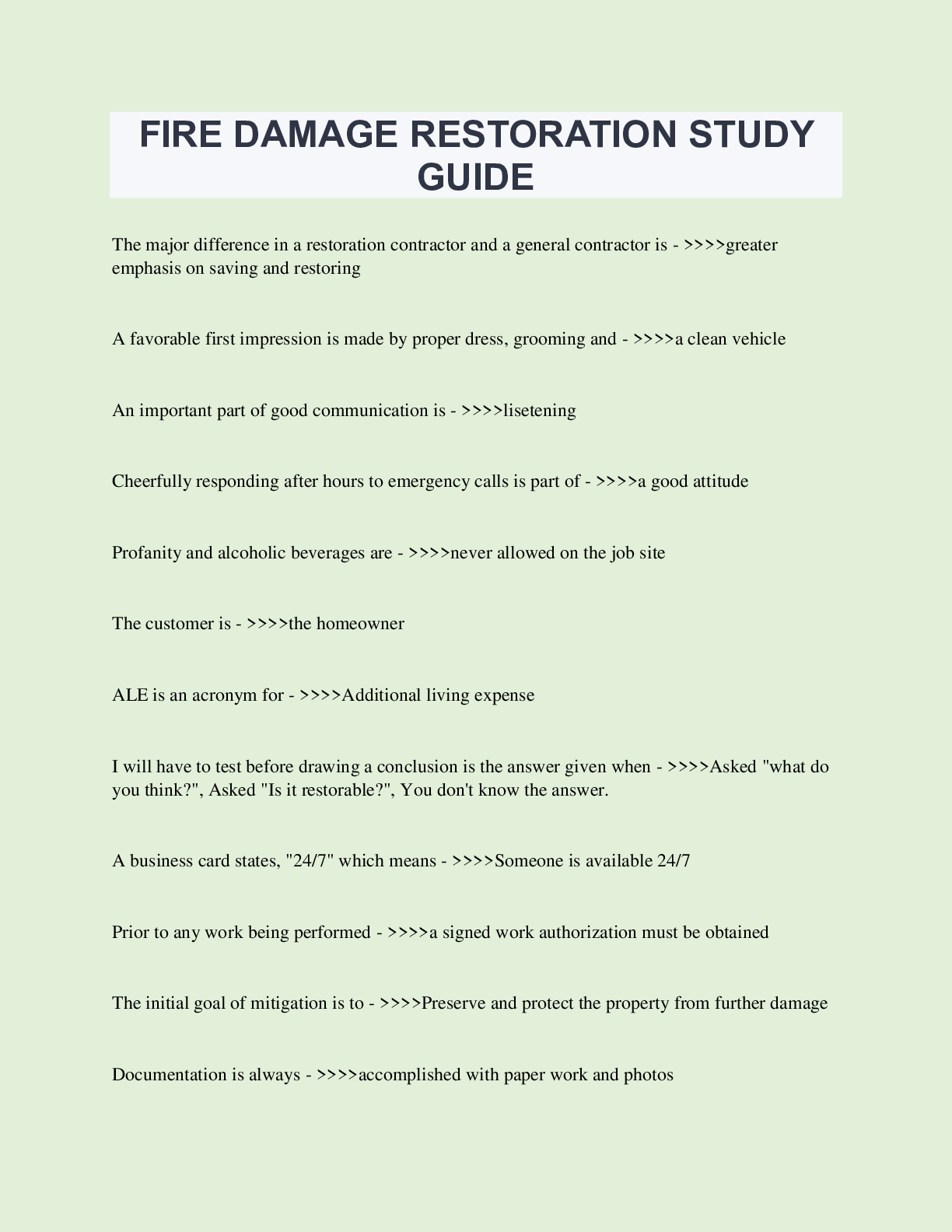
FIRE DAMAGE RESTORATION STUDY
GUIDE
The major difference in a restoration contractor and a general contractor is - >>>>greater
emphasis on saving and restoring
A favorable first impression is made by proper dress, gr
...
FIRE DAMAGE RESTORATION STUDY
GUIDE
The major difference in a restoration contractor and a general contractor is - >>>>greater
emphasis on saving and restoring
A favorable first impression is made by proper dress, grooming and - >>>>a clean vehicle
An important part of good communication is - >>>>lisetening
Cheerfully responding after hours to emergency calls is part of - >>>>a good attitude
Profanity and alcoholic beverages are - >>>>never allowed on the job site
The customer is - >>>>the homeowner
ALE is an acronym for - >>>>Additional living expense
I will have to test before drawing a conclusion is the answer given when - >>>>Asked "what do
you think?", Asked "Is it restorable?", You don't know the answer.
A business card states, "24/7" which means - >>>>Someone is available 24/7
Prior to any work being performed - >>>>a signed work authorization must be obtained
The initial goal of mitigation is to - >>>>Preserve and protect the property from further damage
Documentation is always - >>>>accomplished with paper work and photos
Our immediate concern on a fire loss is - >>>>Health and safety
Freeze protection - >>>>is part of protecting the property
Corrosion control - >>>>is the removal of acidic reseidues
Emergency board -up is - >>>>to be done with durable materials
Nail-pops are - >>>>often found in areas without fire or smoke damage
A fire's heat-line ca - >>>>Affect the restorability of surfaces
The least expensive restoration option is - >>>>Cleaning
Warm is attracted to - >>>>Cooler surfaces
Before cleaning or attempting to restore an item, usually you would consult with all interested
parties if the cost of restoration exceeds what percentage of the cost of replacement. - >>>>50%
Prior to 1978 paint formulation contained a heavy metal commonly referred to as lead -
>>>>1978
A mineral used in the past as a fire retardant and still commonly found in older homes is known
as - >>>>Asbestos
When asbestos is suspected in building materials - >>>>send a sample for testing prior to
demolition
Cleaning or replacing curtain rods are always written - >>>>as either depending on the direction
of the adjuster
The three basic components of a fire are - >>>>fuel, oxygen, heat
The product of incomplete combustion is - >>>>soot
smoke particulates range in size from .1 microns to - >>>>4 micorns
Demolition and sanding during a restoration project - >>>>can stir up lead paint
During a fire the temperature in the structure can exceed - >>>>1400 degrees Fahrenheit
When plastic burns the residue can - >>>>easily smear and smudge
Prolonged combustion time - >>>>can have a direct relation on the amount
of soot produced
The most soot residue is produced by - >>>>an oxygen starved fire
The higher the temperature - >>>>the more the air expands
for every 10 degrees Fahrenheit the volmue of air - >>>>doubles
While thousands of gases form during a fire, - >>>>they fall into 2 categories
When soot combines with moisture - >>>>Acids are formed
Polycyclic aromatic hydrocarbons contained in soot - >>>>may be carcinogenic
In the presence of acid and oily soot - >>>>walls and other surfaces can yellow permanently
Acidic residues will stain grout, fiberglass and counter tops within - >>>>hours
Some surfaces may require cleaning - >>>>at the beginning and end of the project
A difficult to remove film is formed on some surfaces - >>>>this requires an acid wash
Protein soot - >>>>can present a difficult cleaning and odor problem
smoke tags - >>>>can be the result of burned plastic
Deodorization should be - >>>>On-going from start to finish
Deodorization begins - >>>>in the room where the fire began
the most difficult odor to deal with is - >>>>psychological, heightened awareness
odor becomes more apparent with elevated temperature and - >>>>high humidity
the universal first step in deodorization is - >>>>remove the source
Ozone is - >>>>an oxidizing gas
smoke aprticulates rang in size from - >>>>.1 micorns to 4 microns
after the source of odor has been removed - >>>>the source area must be cleaned
thermal fogging produces a deodorization particulate - >>>>of .5 microns
the last resort in deodorizing is - >>>>sealing
masking an odor - >>>>temporarily replaces a bad odor with a pleasant one
introducing a pairing agent - >>>>involves chemically altering a malodor to produce an odorless
compuound
most deodorants - >>>>contain a combination of masking and pairing agents
deodorant blocks and gels are usually - >>>>masking agents
wet fogging with particulates ranging from 8 micorns to 15 miincorns is - >>>>accomplished
with an ULV fogger
When thermal fogging the - >>>>fire department should always be notified
When thermal fogging - >>>>PPE personal protective equipment should be worn
Oily fall-out can be the result of - >>>>over fogging the structure
An electrical device that produces O³ - >>>>an ozone generator
natural rubber products - >>>>can be oxidized by ozone
The most effective deodorization - >
[Show More]


.png)

.png)
.png)
.png)
.png)

.png)
.png)







![Preview of [SOLVED] EDCO 740 / EDCO740 Quiz 1 (LATES 2021/2022 Graded A)](https://scholarfriends.com/storage/EDCO_740_Quiz_1.png)