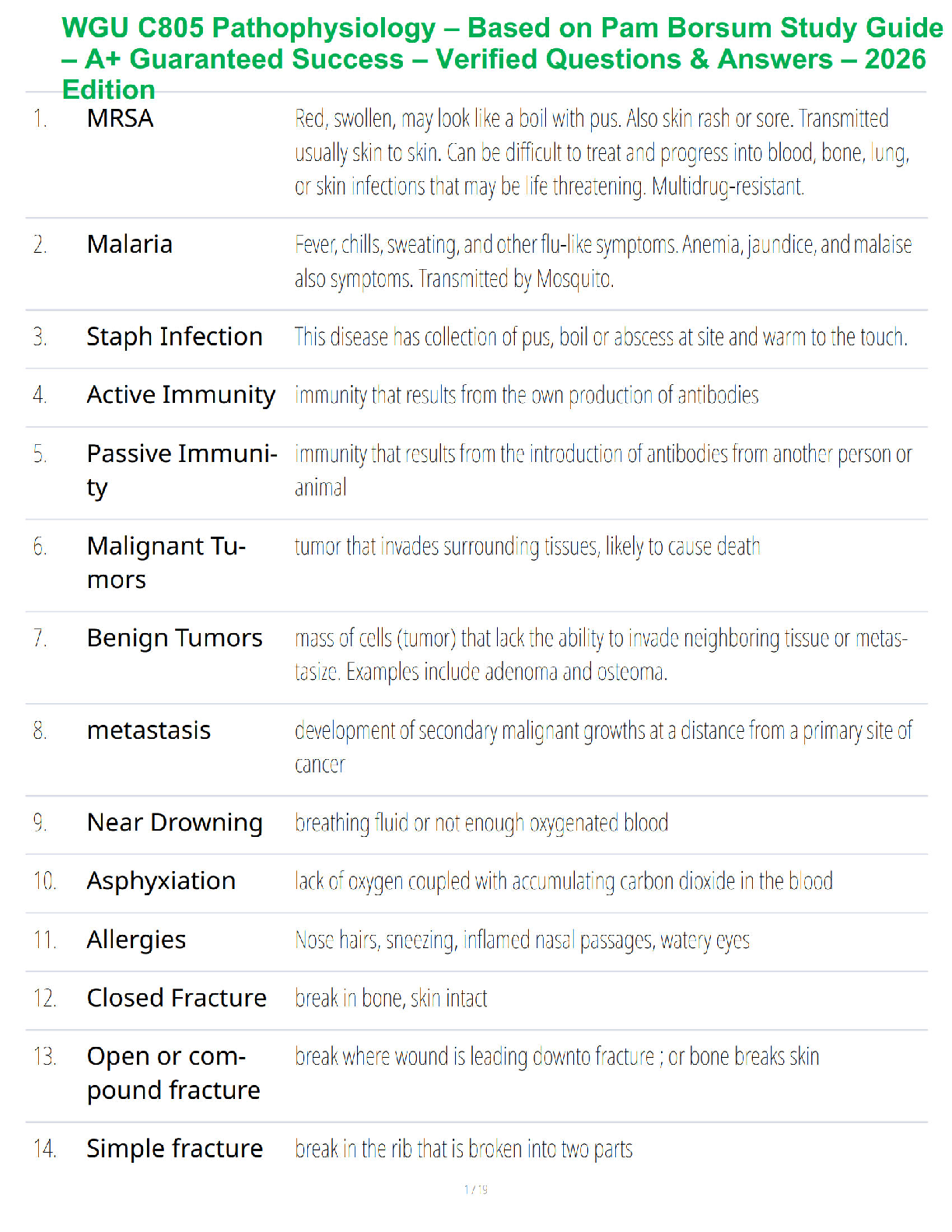
MRSA - ANSWER "antibiotic-resistant form of Staph infection that commonly develops on the skin; red, swollen, rash; transmitted usually skin to skin;
multi-drug resistant organism difficult to treat can progress into b
...
MRSA - ANSWER "antibiotic-resistant form of Staph infection that commonly develops on the skin; red, swollen, rash; transmitted usually skin to skin;
multi-drug resistant organism difficult to treat can progress into blood, bone, lung, or skin infections, can be life-threatening"
Malaria - ANSWER fever, chills, sweating and other flu like symptoms; transmitted by mosquitos; anemia, jaundice, fever, and malaise due to the destruction of RBCs
Staph Infection - ANSWER caused by a Staphylococcus (or "staph") bacteria; range from a simple boil to antibiotic-resistant infections to flesh-eating infections; symtoms include red, swollen skin w/ pus, and warm to touch
Active Immunity - ANSWER immunity that results from the own production of antibodies
Passive Immunity - ANSWER immunity that results from the introduction of antibodies from another person or animal; immunizations
Malignant Tumors - ANSWER metastatic capabilities; slow growth; distorted shape; abnormal cells; cancerous tumors; develop when cells grow uncontrollably; can grow quickly and spread throgh they body by metastasis
Benign Tumors - ANSWER abnormal cells; remain localized; rarely reoccur; slow grwoth; distorted shape; types of benign tumors; Adenoma, Osteoma, Nevi/Moles, Fibroids, Myomas, Lipomas; mass of cells (tumor) that lack the ability to invade neighboring tissue or metastasize
Non-Hodkin's lymphoma - ANSWER cancer that originates in your lymphatic system; develops from lymphocytes - WBCs. Painless, swollen lymph nodes in your neck, armpits, or groin
Metastasis - ANSWER development of secondary malignant growths at a distance from a primary site of cancer; commonly develops when cancer cells break away from the main tumor and enter the bloodstream or lymphatic system
Near Drowning - ANSWER Respiratory distress; breathing fluid or not enough oxygenated blood; the larynx (a part of the air passage) closes involuntarily, preventing both air and water from entering the lungs
Asphyxiation - ANSWER lack of oxygen coupled with accumulating carbon dioxide in the blood, may result from carbon monoxide poisoning, near drowning, hypoventilation, airway obstruction, or inhalation of toxic fumes.
Allergies - ANSWER nose hairs, sneezing, inflamed nasal passages, watery eyes.
Second Degree Burn - ANSWER Skin appears red and swollen, very painful, w/ skin blisters
Closed fractures - ANSWER break in bone, skin intact
Open or Compound fracture - ANSWER break where the wound is leading down to fracture or bone breaks skin
Comminuted fracture - ANSWER shattering fracture
Colles fracture - ANSWER break in the end of the radius in wrist; often occurs when the wrist is extended to break a fall
Greenstick fracture - ANSWER bone partially bent or split, occurs with soft bones
Common dislocations - ANSWER shoulder, hip, jaw, knee, spine, and elbow
Sprains - ANSWER stretching/tearing of ligaments
Strain - ANSWER stretching/tearing of muscle or tissue
Rickets - ANSWER only occurs in children (growth plates have not fused); softening and weakening of bones in children, usually because of an extreme and prolonged vitamin D deficiency
Osteomyelitis - ANSWER softening of your bones, most often caused by severe vitamin D deficiency. The softened bones of children and young adults with osteomalacia can lead to bowing during growth, especially in weight-bearing bones of the legs.
Gout - ANSWER disease of the uric acid metabolism, typically joint pain in big toe; deposits will build up around joints; characterized by, kidney stones, urea in blood and renal dysfunction
Herniated disk - ANSWER common on site l4-l5; disc pushes on nerves causing discomfort in lower back; symptoms include severe back pain, paresthesia
Plantar fasciitis - ANSWER inflammation of a thick band of tissue that connects the heel bone to the toes
Paget's Disease - ANSWER high rate of bone turnover, bone is replaced by coarse/irregular bone; hydroxyproline enlargement and thickening of the bone
Lordosis - ANSWER curving inward of the lower back; also called sway back. Affects lumbar/lower spine
Kyphosis - ANSWER forward rounding of the back; also called hunchback, affects upper thoracic
Scoliosis - ANSWER sideways curvature of the spine
Osteoporosis - ANSWER bones become brittle and fragile
Osteoarthritis - ANSWER flexible tissue at the ends of bones wears down; bone on bone sound can be heard, minimal inflammation
Fibromyalgia - ANSWER widespread chronic pain in muscles, ligaments, or tendons; there will be tender points on the body
Myasthenia gravis - ANSWER weakness and rapid fatigue of muscles under voluntary control; drooping eyelids, difficulty swallowing, difficulty speaking; caused by an error in the transmission of nerve impulses to muscles.
Rheumatoid Arthritis - ANSWER chronic inflammatory disorder affecting many joints, including those in the hands and feet
Acne Vulgaris - ANSWER occurrence of inflamed or infected sebaceous glands, characterized by red pimples or black heads
Furuncle/Boils - ANSWER skin abscesses( pus-filled boil) that result from staphylococcal infection; affect a hair follicle and surrounding tissue; painful
Carbuncle - ANSWER groups of furuncles that join together under the skin; affect the deeper layers, and they can lead to scarring; painful
Fever blisters - ANSWER HSV-1 are oral herpes; most common causes sores around mouth and lips; also called cold sores; pale vesicles appearing individually or in clusters
Impetigo - ANSWER highly contagious skin infection that causes red sores on the faces; mainly affects children; caused by skin infected w/ staphylococcus bacteria
Herpes Zoster/Shingles - ANSWER reactivation of the chickenpox virus in the body
Seborrheic Dermatitis - ANSWER common skin disease causes an itchy red rash w/ flaky scales; aka dandruff, cradle cap, seborrhea
Eczema - ANSWER patches of skin become rough and inflamed, with blisters that cause itching and bleeding, sometimes resulting from a reaction to irritation
Decubitus Ulcers - ANSWER bed sores from lying in one position too long so that the circulation in the skin is compromised by the pressure
Keratosis pilaris - ANSWER skin colored bumps that may form rough patches, typically cosmetic condition
Plantar Warts - ANSWER small growths, usually appear on the heels/feet; caused by human papillomavirus
Urticaria (wheal) - ANSWER hives, generally caused by allergic immune response/body releasing histamine; round and red, can cover a small/large area; causes inflammation and fluid to produce under the skin
Rosacea - ANSWER condition that causes redness and often small, red, pus-filed bumps on the face
Scabies - ANSWER contagious, intensely itchy kin condition caused by a tiny burrowing mite
Skin cancer/Basal Cell - ANSWER often appears as a slightly transparent bump on the skin, though it can take other forms; occurs most often on areas of the skin that are exposed to the sun, such as your head and neck.
Tinea pedis - ANSWER fungal infection that usually beings between the toes; aka athletes foot
Vitiligo - ANSWER disease that causes the loss of skin color in blotches
Transients CVA's (Mini-strokes) or Ischemic Stroke - ANSWER accounts for 70-80% of brain attacks; impaired conciousness; hemiparesis; interruption of blood flow; temporary blockage of blood flow to the brain - occlusion of blood vessels
Hemorrhagic CVA's (Strokes) - ANSWER Ruptrue of blood vessel causes bleeding inside the brain; Higher fatality rates;n Impaired consciousness; Hemiparesis
Hematoma - ANSWER solid swelling of clotted blood within the tissues
Subdural Hematoma - ANSWER subnormal blood pressure and temperature; pool of blood between the brain and its outermost covering; slurred speech, difficulty walking, and dilated pupils
Cerebral Concussion - ANSWER temporary loss of consciousness; period of amnesia; dilated pupils; hostillity and combativeness; brain injury caused by a blow to the head or a violent shaking of the head and body; injuries can have both temporary and lasting effects
Cerebral Contusion - ANSWER convulsion; brain injury that causes blood to collect under the skin; range from relatively minor to life-threatening
Head Trauma - ANSWER any sort of injury to your brain, skull, or scalp
Amyotrophic Lateral Sclerosis/ALS/Lou Gehrig's - ANSWER nervous system disease that weakens muscles and impacts physical function
Alzheimer Disease - ANSWER progressive disease that destroys memory and other important mental functions
Bells Palsy - ANSWER Sudden weakness in the muscles on one half of the face
Peripheral neuropathy - ANSWER weakness, numbness, and pain from nerve damage, usually in the hands and feet; causes Vitamin B12 deficiency & lead poisioning
Parkinson Disease - ANSWER disorder of the central nervous system that affects movement, often including tremors, slow progression
Bradykinesia - ANSWER Slowness of movement and is one of the cardinal manifestations of Parkinson's disease
Multiple Sclerosis/MS - ANSWER disease in which the immune system easts away at the protective covering of nerves; transient motor and sensory disturbances; communication problems between your brain and the rest of your body
Meniere's Disease - ANSWER inner ear disorder that causes episodes of vertigo, dizziness, with ringing and buzzing in the ear and hearing loss.
Untreated Ear Infections (Otitis Media) - ANSWER inflammation of the middle ear, if not treated, serious consequences can occur such as temporary or permenant hearing loss
Otosclerosis - ANSWER growth of new bone that is fixed; permenant hearing loss;
Glaucoma - ANSWER condition of increased pressure withing the eyeball, causing gradual loss of sight
Cataracts - ANSWER condition in which the lens of the eye becomes progressively opaque, resulting in blurred vision
Retinal Detachment - ANSWER when part of the eye (the retina) pulls away from supportive tissue
[Show More]

.png)



.png)