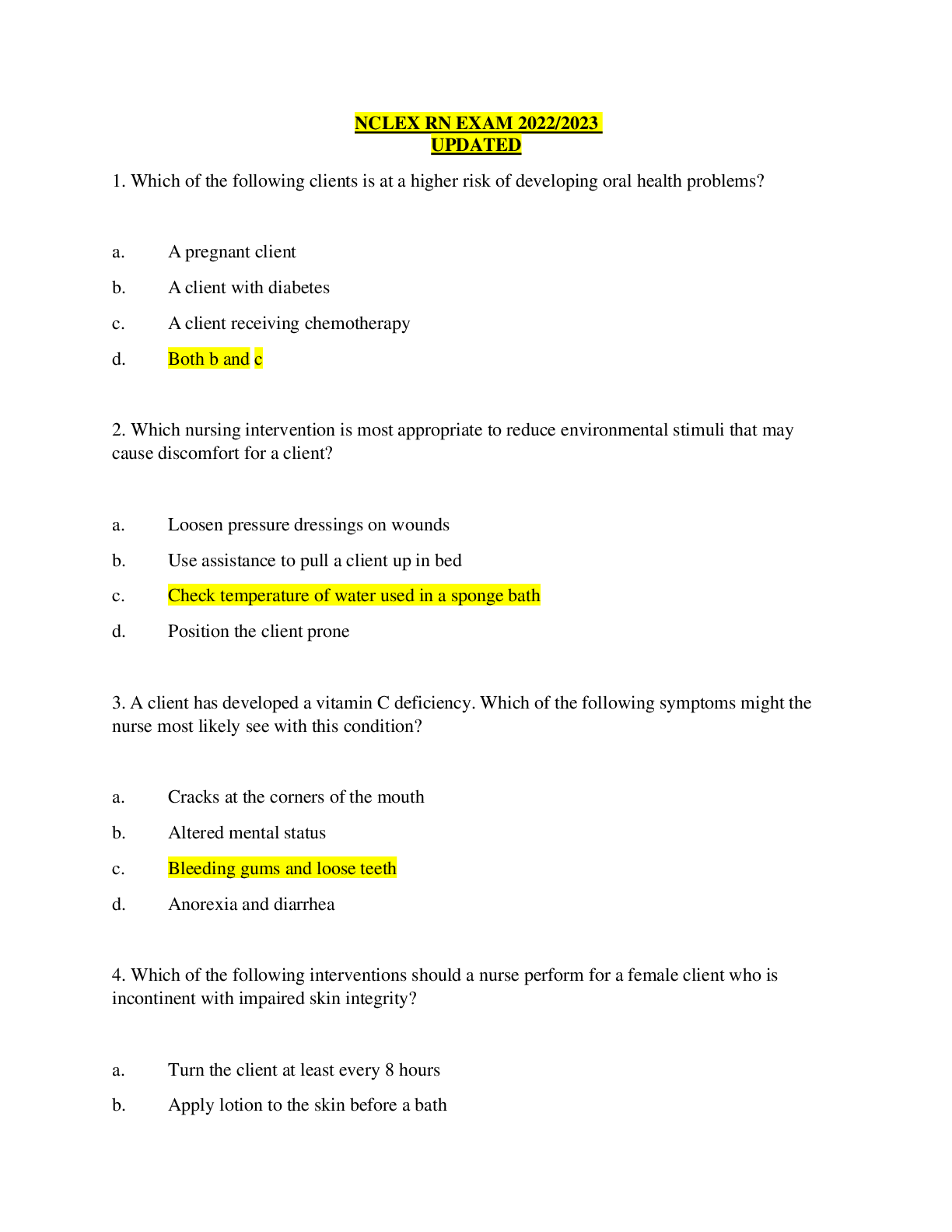
A client newly diagnosed with Parkinson disease (PD) is being discharged. Which instruction is best for the nurse to provide to the client's spouse? a. Administer medications promptly on schedule to ... maintain therapeutic drug levels. b. Speak loudly for better understanding. c. Complete activities of daily living for the client. d. Provide high-fiber, high-carbohydrate foods. A client has Parkinson's disease (PD). Which nursing intervention best protects the client from injury? a. Suggesting that the client obtain assistance in performing activities of daily living (ADLs) b. Encouraging the client to watch the feet when walking c. Monitoring the client's sleep patterns d. Discouraging the client from activity A client with dementia and Alzheimer's disease is discharged to home. The client's daughter says, "He wanders so much, I am afraid he'll slip away from me." What resource does the nurse suggest? a. Safe Return Program b. Alzheimer's Wandering Association c. Lost Family Members Tracking Association d. National Alzheimer's Group A client presents to the clinic with a migraine and is lying in a darkened room with a wet cloth on the head after receiving treatment. In preparation for dismissal home, what does the nurse do next? a. Assess the client's vital signs. b. Remove the cloth because it can harbor microorganisms. c. Turn on the lights for a neurologic assessment. d. Allow the client to remain undisturbed. Which is the most effective way for a college student to minimize the risk for bacterial meningitis? a. Get the meningococcal vaccine. b. Avoid large crowds. c. Take prophylactic antibiotics. d. Take a high dose vitamin C daily. The nurse is teaching a client, newly diagnosed with migraines, about trigger control. Which statement made by the client demonstrates good understanding of the teaching plan? a. "It is okay to drink a few wine coolers." b. "I must not miss meals." c. "I can still eat Chinese food." d. "I need to use fake sugar in my coffee." A client with Parkinson disease (PD) is being discharged home with his wife. To ensure success with the management plan, which discharge action is most effective? a. Writing up a detailed plan of care according to standards b. Involving the client and his wife in developing a plan of care c. Telling his wife what the client needs d. Setting up visitations by a home health nurse The home health nurse is checking in on a client with dementia and the client's spouse. The spouse confides to the nurse, "I am so tired and worn out." What is the nurse's best response? a. "Make sure you take some time off and take care of yourself too." b. "Establishing goals and a daily plan can help." c. "That's not a very nice thing to say." d. "Can't you take care of your spouse?" The nurse is caring for a client with advanced Alzheimer's disease. Which communication technique is best to use with this client? a. Providing the client with several options to choose from b. Waiting for the client to express a need c. Assuming that the client is not totally confused d. Writing down instructions for the client A client is admitted into the emergency department (ED) with frontal-temporal pain, preceded by a visual disturbance. The client is upset and thinks it is a stroke. What does the nurse suspect may be occurring? a. Classic migraine b. Stroke c. Meningitis d. West Nile virus A female client with newly diagnosed migraines is being discharged with a prescription for sumatriptan (Imitrex). Which comment by the client indicates an understanding of the nurse's discharge instructions? a. "St. John's wort can also be taken to help my symptoms." b. "Birth control is not needed while taking sumatriptan." c. "Sumatriptan can be taken as a last resort." d. "I must report any chest pain right away." A client admitted with cerebral edema suddenly begins to have a seizure while the nurse is in the room. What does the nurse do first? a. Start an intravenous (IV) line. b. Administer phenytoin (Dilantin). c. Draw the client's blood. d. Establish an airway. The nurse is administering the intake assessment for a newly admitted client with a history of seizures. The client suddenly begins to seize. What does the nurse do next? a. Documents the length and time of the seizure. b. Forces a tongue blade in the mouth. c. Restrains the client. d. Positions the client on the side. A client is admitted with bacterial meningitis. Which nursing intervention is the highest priority for this client? a. Assessing neurologic status at least every 2-4 hours [Show More]
Last updated: 3 years ago
Preview 1 out of 17 pages
Buy this document to get the full access instantly
Instant Download Access after purchase
Buy NowInstant download
We Accept:
Can't find what you want? Try our AI powered Search
Connected school, study & course
About the document
Uploaded On
Aug 05, 2021
Number of pages
17
Written in
All
This document has been written for:
Uploaded
Aug 05, 2021
Downloads
0
Views
70
Scholarfriends.com Online Platform by Browsegrades Inc. 651N South Broad St, Middletown DE. United States.
We're available through e-mail, Twitter, and live chat.
FAQ
Questions? Leave a message!
Copyright © Scholarfriends · High quality services·