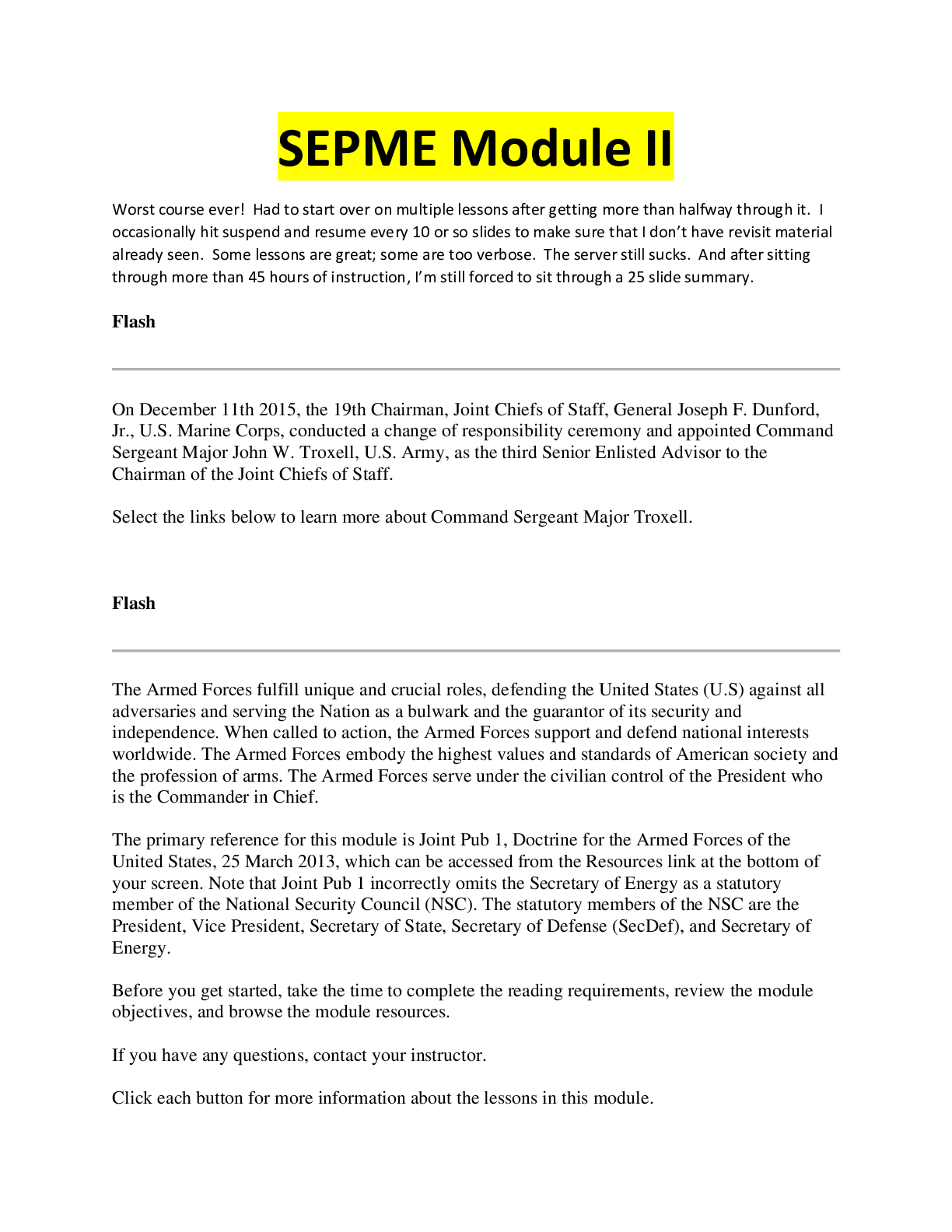
1. The First Washington Conference, code name ARCADIA, established the Joint Chiefs of Staff. (WWII Conference)
2. The 1986 Goldwater-Nichols Act clarified the chain of command and civilian control of the U. S. Military
...
1. The First Washington Conference, code name ARCADIA, established the Joint Chiefs of Staff. (WWII Conference)
2. The 1986 Goldwater-Nichols Act clarified the chain of command and civilian control of the U. S. Military.
3. The Chairman of the Joint Chiefs of Staff provides a channel of communication between the President/ SECDEF
and the Combatant Commanders. True
4. National Security Agency (NSA) provides the following support:
Solutions, products, and services Signals intelligence Information systems security
5. The North American Aerospace Defense Command (NORAD) is operated by Canada and the United States.
6. The Missile Defense Agency (MDA) agency works with the Combatant Commanders (CCRs) of United States
Northern Command (USNORTHCOM), United States Pacific Command (USPACOM) and United States Strategic
Command (USSTRATCOM)
7. Irregular Warfare is a violent struggle among state and non-state actors for legitimacy and influence over the
relevant population(s). It favors indirect and asymmetric approaches, though it may employ the full range of
military and other capacities, in order to erode an adversary’s power, influence, and will.
8. The ability of the U.S. to achieve its national strategic objectives is dependent on the effectiveness of the U.S.
Government in employing the instruments of national power, which are Diplomatic, Informational, Military, and
Economic (DIME) .
9. The President of the United States provides guidance for developing, applying, and coordinating the instruments
of national power it achieve objectives that contribute to national security in the National Security Strategy (NSS).
10. The National Military Strategy (NMS), signed by the Chairman of the Joint Chiefs of Staff, provides guidance for
distributing and applying military power to attain national strategic objectives. It describes the Armed Forces’ plan
to achieve military objectives in the near term and provides the vision for ensuring they remain decisive in the
future.
11. The statutory members of the National Security Council are President, Vice President, Secretary of State,
Secretary of Defense, and Secretary of Energy.
12. The National Security Council is the President’s principal forum for considering national security policy matters
with his senior national security advisors and cabinet official.
13. The operational chain of command runs directly from the President to the Secretary of Defense and then to the
Combatant Commanders.
14. The non-operational chain of command runs directly from the President to the Secretary of Defense and then
to the Secretaries of the Military Departments and then to the Service Chiefs.
15. The Chairman of the Joint Chiefs of Staff outranks all other officers of the Armed Forces. This office is the
principal military advisor to the President, the National Secretary Council, and the Secretary of Defense.
16. A Unified or Specified Command with a broad continuing mission under a single commander established and
so designated by the President, through the Secretary of the Defense and with the advice and assistance of the
Chairman of the Joint Chiefs of Staff is called a Combatant Command.
17. A Joint Task Force is a joint force that is constituted and so designated by the SecDef, a Combatant Commander,
a Subordinate Unified Commander, or an existing JTF Commander to accomplish mission with specific, limited
objectives and which do not require overall centralized control of logistics. It is dissolved when the purpose for
which it was created has been achieved or when it is no longer required.
18. The term Joint Force Commander refers exclusively to Combatant Commander, Subordinate Unified
Commander, and Joint Task Force Commander.
19. Joint Force Air Component Commander (JFACC), Joint Force Land Component Commander (JFLCC), and Joint
Force Maritime Component Commander (JFMCC) are all examples of Functional Component Commanders.
20. Subordinate Unified Commands are established by Combatant Commanders when authorized by the SecDef
through the CJCS to conduct operations on a continuing basis in accordance with the criteria set forth for Unified
Commands. They may be established on a geographic area basis such as United States Forces Japan or on a
functional basis such as Special Operations Command, Pacific.
21. Combatant Commanders exercise Combatant Command (command authority) over assigned forces. This is the
broadest command authority and may not be delegated or transferred.
22. Operational Control (OPCON) is the authority to perform those functions of command over subordinate forces
involving organizing and employing commands and forces, assigning tasks, designating objectives, and giving
authoritative direction necessary to accomplish the mission. It includes authoritative direction over all aspects of
military operations and Joint training necessary to accomplish missions assigned to the command.
23. The four categories of support are general, mutual, direct, and close.
24. Command authority over assigned or attached forces or commands, or military capability or forces mad
available for tasking, that is limited to the detailed direction and control of movements or maneuvers within the
operational area necessary to accomplish missions or tasks assigned is known as Tactical Control (TACON).
25. The command authority established by a superior commander between subordinate commander when one
organization should aid, protect, complement, or sustain another force is called Support.
26. The instruments of national power are Diplomacy, Information, the Military, and Economics (DIME) .
27. The relevance of the interagency process at the strategic level to the Combatant Commander and the U.S.
military is that the process yields America’s major national security policy decisions. True. The interagency process
at the strategic level yields America’s major national security policy decisions.
Joint Interagency Coordination Group (JIACG) - Provides commanders with an increased capability to coordinate
with other U.S. Government agencies.
Annex V – The part of the CCDR’s Operation Plan that specifies not only the capacities that military planners have
determined the military may need, but also the interagency partners’ shared understanding of the situation, as well
as the common objectives required to resolve the situation.
DIME -The four most basic elements of national power.
Foreign Policy Advisor (POLAD) -Providing U.S. Government foreign policy perspectives and diplomatic
considerations, and the State Department.
Interagency Coordination- The interaction that occurs between agencies of the U.S. Government, including the
Department of Defense (DoD), for the purpose of accomplishing an objective.
28. The National Security Council (NSC) is the principal policy-making forum responsible for the nation’s security
strategy.
29. The interagency process is criticized as being time- consuming and cumbersome, and there isn’t anyone in
charge, except the President.
30. The Chairman of the Joint Chiefs of Staff and the Director of National Intelligence are the Statutory Advisors of
the National Security Council.
31. The National Security Council comprises Principals, Deputies, and Interagency Policy committees for
coordination and making decisions on national security issues.
32. The Chairman of the Joint Chiefs of Staff is the principal military advisor to the President, the National Security
Council, and the Secretary of Defense.
33. The National Security Council is the principal forum for advising the president with respect to the integration of
domestic, foreign and military policies relating to national security and for coordinating these policies among
various government agencies.
34. The concept of unified action highlights the synergistic application of all the instruments of national power and
includes the actions of non-military forces.
35. U.S. military forces are authorized under certain conditions to provide assistance to U.S. civil authorities for
disasters, catastrophes, infrastructure protection, and other emergencies. This assistance is known as civil support
within the defense community because the assistance will always be in support of a lead federal agency.
36. It is imperative that the Combatant Commander or JTF Commander coordinate closely with the ambassador on
military activities in a particular country because, while not authorized to command military forces, he or she can
deny military actions.
37. The Country Team provides for rapid interagency consultation and action on recommendations from the field.
DoD is normally represented on the Country Team by the Defense Attaché and the Security Cooperation
Organization.
38. The JIACG is an interagency staff group that establishes or enhances regular, timely, and collaborative working
relationships between other government agencies (e.g., CIA, DOS, FBI) , representatives, and military operational
planners at the combatant commands.
39. NGOs are independent, diverse, flexible, grassroots-focused, primary relief providers that are frequently on the
scene before the U.S. military and will most likely remain long after military forces have departed.
40. In most situations, IGOs and NGOs need logistics, communications, and security.
41. The JTF Commander facilitates unified action and gains a greater understanding of the roles of IGOs and NGOs
and how they influence mission accomplishment by establishing a Civil-Military Operations Center (CMOC).
42. A particular type of operation is not doctrinally fixed and may shift within the range of military operations, for
example a counterinsurgency operation escalating from a security cooperation activity into a major operation or
campaign. True
43.The range of military operations includes military engagement, security cooperation, and deterrence activities;
crisis response and limited-contingency operations; and major operations and campaigns.
44. Crisis response and limited-contingency operations are typically limited in scope and scale and conducted to
achieve a very specific objective in an operational area. They include non-combatant evacuation operations, peace
operations, foreign humanitarian assistance, recovery operation, consequence management, strikes, raids,
homeland defense, and defense support of civil authorities.
45. Various joint operations support deterrence by demonstrating national resolve and willingness to use force
when necessary.
46. The purpose of specifying the objective is to direct every military operation toward a clearly defined, decisive,
and achievable goal.
47. The purpose of mass is to concentrate the effects of combat power at the most advantageous place and time to
produce decisive results.
48. CCDRs and subordinate JFCs must work with U.S. ambassadors (or diplomatic missions). Department of State
and other agencies to best integrate the military actions with the diplomatic, economic, and informational
instruments of national power to promote unity of effort.
49. The purpose of legitimacy is to maintain legal and moral authority in the conduct of operations. It is based on
the actual and perceived legality, morality, and rightness of the actions from the various perspectives of interested
audiences.
50. Deterrence helps prevent adversary action through the presentation of credible threat of counteraction.
Deterrence stems from the belief of potential aggressor that a credible threat of retaliation exists, the
contemplated action cannot succeed, or the costs outweigh the perceived benefits of acting.
51. At the strategic level, Emergency Preparedness (EP) encompasses those planning activities under taken in
advance to ensure DoD processes, procedures, and resources are in place to support the President and Secretary
of Defense (SECDEF) in a designated national security emergency.
52. Combating terrorism involves actions taken to oppose terrorism from wherever the threat exists, and
encompasses Antiterrorism -defensive measures taken to reduce vulnerability to terrorist acts- and
Counterterrorism-offensive measures taken to prevent, deter, preempt, and respond to terrorism.
53. An operation that employs coercive measure to interdict the movement of certain types of designated items
into or out of a nation or specified area is known as enforcement of sanctions.
54. The DoD contribution to a unified action effort to support and augment the development of the capacity and
capability of foreign security forces and their supporting institutions to facilitate the achievement of specific
objectives shared by the USG is called Security Force Assistance (SFA).
55. Operations designed to demonstrate U.S. resolve, and involve the appearance of a credible military force in an
attempt to defuse a situation that, if allowed to continue, may be detrimental to U.S. interest are known as Show of
Force operations.
56. Joint force commanders must integrate and synchronize offensive, defensive, and stability operations that
comprise major operations and campaigns, planning for stability operations should begin when joint operation
planning is initiated.
57. Although defense may be the stronger force posture, it is the offense that is normally decisive in combat.
58. Major operation and campaign plans must feature an appropriate balance between offensive, defensive, and
stability operations in all phases.
59. Joint force commanders strive to isolate enemies by denying them allies and sanctuary. The intent is to strip
away as much enemy support or freedom of action as possible, while limiting the enemy’s potential for horizontal
or vertical escalation.
60. Preplanned, deterrence oriented actions carefully tailored to bring an issue to early resolution without armed
conflicts are known as Flexible Deterrent Options (FDOs) .
61. A joint military operation conducted either as a major operation or a part of a larger campaign to seize and hold
a military lodgment in the face of armed opposition for the continuous landing of forces is called Forcible entry.
These operations may include amphibious, airborne, and air assault operations or any combination thereof.
62. The ultimate measure of success in PB is political, not military. Therefore, JFCs seek a clear understanding of the
national and coalition strategic end state and how military operations support that end state.
63. The responsibility to plan and coordinate U.S. government eff9orts in stabilization and reconstruction has been
assigned to Department of State.
64. Pursuant to Executive Oder 12656, the Department of State is responsible for the protection and evacuation of
American citizens abroad and for safeguarding their property.
65. Military operations that apply military force or threaten its use, normally pursuant to international
authorization, to compel compliance with resolutions or sanctions designed to maintain or restore peace and
orders are known as peace enforcement operation.
66. In foreign humanitarian assistance operations commanders usually establish a civil-military operations center
(CMOC) because it is critical to working with the participating intergovernmental organizations (IGOs) and
nongovernmental organizations (NGOs).
67. Operations conducted to search for, locate, identify recover, and return isolated personnel, sensitive
equipment, items critical to national security, or human remains are known as recovery operations.
68. A military operation to temporarily seize and area, usually through forcible entry, in order to secure
information, confuse an adversary, capture personnel or equipment, or destroy an objective or capability is called a
raid. It ends with a planned withdrawal upon completion of the assigned mission.
69. The North Atlantic Treaty Organization (NATO) is an example of a(n) alliance.
70. Key considerations involved in planning and conducting multinational operations are affected by motives and
values of the organization’s members.
71. Factors that enhance interoperability are a command atmosphere that permits positive criticism and rewards
the sharing of information.
72. Developing and maintaining professional relationships with multinational partners means recognizing that their
training and education may differ,, but does not mean they are less dedicated or professional.
73. The vetting process for participation in multinational operations serves as a mechanism to increase perceived
legitimacy of operations domestically and internationally.
74. Factors affecting military capabilities of nations include leader development and national interest.
75. When employing local national support. Appropriate security measures should be taken to ensure that
contracted linguists do not jeopardize operations through espionage.
76. During the conduct of military operations, multinational personnel must be able to properly control, maintain,
protect, and account for all detainees according to applicable domestic law, regardless of their category.
77. Scenario 1-Lead Nation, Scenario 2- Parallel, Scenario 3- Coalition lead and parallel
78 The primary function of the US. Forces and Special Operations command is to provide forces, each of which is
organized, trained, and equipped to perform specific roles. True.
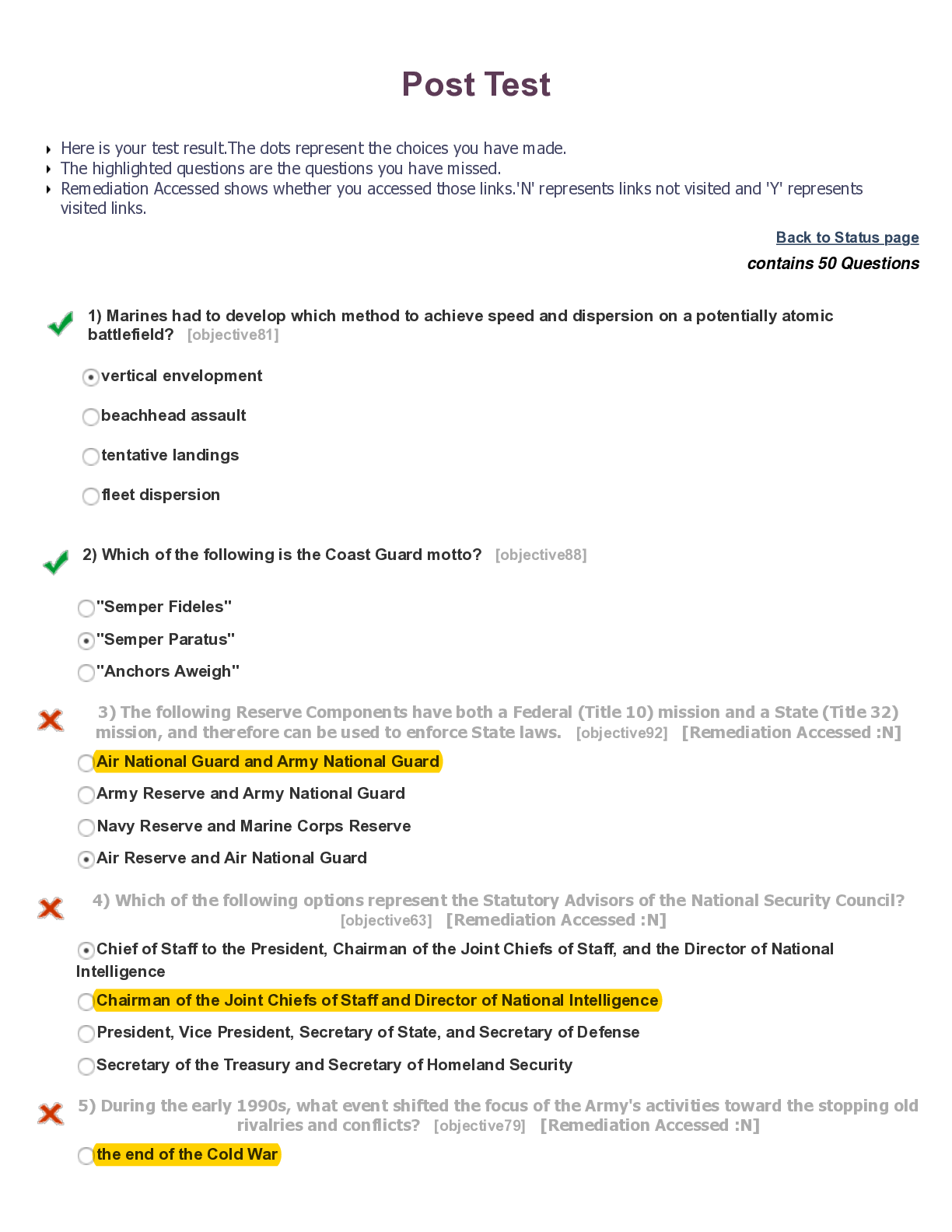
79. What is the Army’s primary role? To train and equip itself for the application of land combat power
80. Army Special Operations missions can include which of the following? Humanitarian assistance, Training of
foreign militaries, Major combat operations
81. What are the fundamental roles of the U.S. Navy, Marine Corps, and the Coast Guard in the implementation of
the National Security Strategy (NSS)? All Answers provide are correct. Secure the US from direct attack, Secure
strategic access and retain global freedom of action, Strengthen existing and emerging alliances and partnerships,
Establish favorable security conditions.
82. These capabilities comprise the core of U.S. maritime power and reflect an increase in emphasis on those
activities that prevent war and build partnerships. Forward presence, deterrence, sea and area control, power
projection, maritime security, and humanitarian assistance and disaster response (HA/DR)
83. Marine Corps forces exploit the Total Force Concept, employing combinations of Active Duty and Reserve
Marines to ensure that missions are effectively and efficiently executed. True.
84. Which of the following are roles of the U.S. Marine Corps according to Title 10 U.S. Code? Develop tactics,
techniques, and equipment use phases of amphibious operations by landing.
85. Which of the following best define the benefits of versatility in aerospace power? Versatility allows aerospace
forces to be employed at the strategic, operational and tactical levels equally effectively. Versatility allow aerospace
forces to achieve objectives simultaneously at all three levels of war in parallel operations.
86. Aerospace Forces produce synergistic effects that are designed not to exceed separately employed individual
forces. False
87. Which of the following are among the Coast Guard’s roles? All answers are correct. Being transferred by
Presidential order to the U.S. Navy for operational purposes, Law Enforcement, Environmental Protection, Ice
Operations, Search and Rescue
88. The Army can trace its origins to colonial America. True
89. Which of the following describes the Army’s regulations including every detail of the Soldier’s life? The Army
Regulations of 1821
90. During the early 1990s, what event shifted the focus of the Army’s activities toward stopping old rivalries and
conflicts? The collapse of the Warsaw Pact
91. Which of the lessons learned during the Mexican War did the Union Navy use. Choices 1 and 2 Move forward
from the sea and seize ports and embargo trade and blockade
92. Which technological advancements turned the tide on the U-boats? All are correct. Long range reconnaissance
planes, escort carriers, destroyers equipped with advanced sonars, direction finding equipment, antisubmarine
weapons
93. Through which of the following strategies has the U.S. Navy retained its traditional roles while expanding into
expeditionary warfare? From the sea and later forward from the sea
94. Why was the participation of the Montfort Point Marines in the amphibious assault at Saipan such a historic
event? It represented the final and full integration of the Armed Forces
95. Which of the following are examples of how the Marine Corps has adapted and ecolced as an expeditionary
force? All the answers are correct. Amphibious operations, MPFs and MAGTFs, close air support, helicopter-borne
vertical envelopment tactics.
96. In the name of strategic mobility, the Marine corps adopted prepositioning for which of the following purposes?
To provide material needed to sustain a brigade for 30 days in a potential combat zone.
97. During the 1930s, which two essential building blocks for an effective air force fell into place? A version of a
long rage, four engine bomber that became reality with the first B17, a comprehensive doctrine of air warfare
98. Which of the following problems faced the newly created Air Force in 1947? Establishing an organization
adapted to air operations, transitioning from propeller driven aircraft to jet aircraft, modifying doctrine, strategy
and tactics to accommodate nuclear weapons and arranging for support services.
[Show More]


.png)
.png)
 (1).png)
 Senior Enlisted Joint Professional Military Education All Correct Answers, GRADED A.png)
 Senior Enlisted Joint Professional Military Education All Correct Answers, GRADED A.png)
 Block 1 to 7.png)

.png)






.png)
.png)

