Business > TEST BANKS > TEST BANK Intermediate Financial Accounting Part 1A (All)
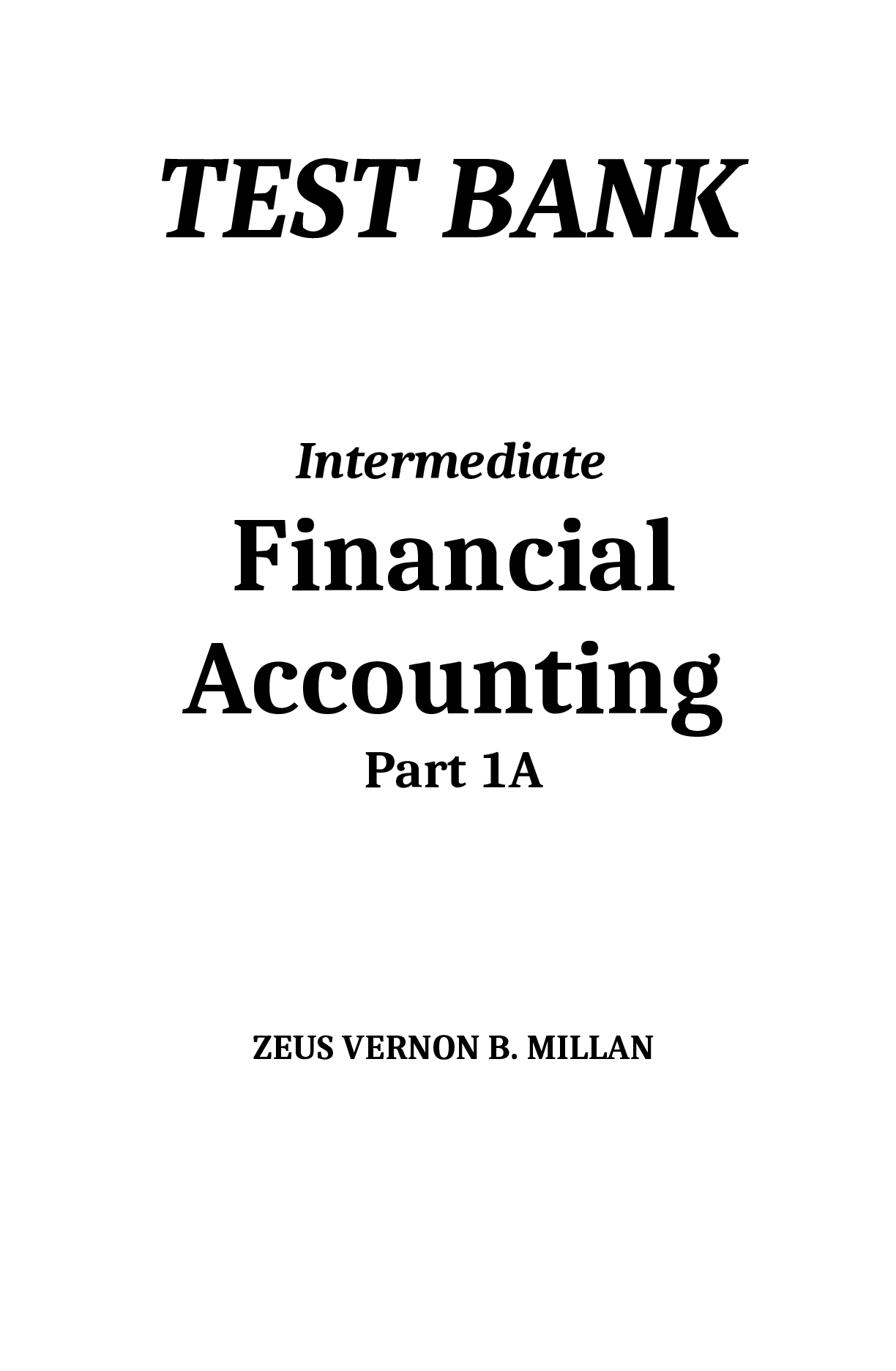
TEST BANK Intermediate Financial Accounting Part 1A
Document Content and Description Below
. Which of the following correctly refer to the various branches of accounting? I. Government accounting deals with accounting for the national government and its instrumentalities, focusing attent ... ion on the custody of public funds and the purpose or purposes to which such funds are committed. II. Institutional accounting deals with handling of accounts managed by a person entrusted with the custody and management of property for the benefit of another. III. Estate accounting deals with the handling of accounts for fiduciaries who wind up the affairs of a deceased person. IV. Social responsibility accounting is the process of measuring and disclosing the performance of firm in terms of community involvement and related criteria. V. Accounting Systems deals with the installation of accounting procedures for the accumulation of financial data; includes designing of accounting forms to be used in data gathering. 15 VI. Cost accounting is the systematic recording and analysis of the costs of material, labor, and overhead incident to production. VII. Fiduciary accounting is the accounting for not-for-profit entities other than the government. a. I, II, III, IV, V, VI, VII c. I, III, IV, V, VI, VII b. I, II, IV, V, VI, VII d. I, III, IV, V, VI 103. Which of the following is not a characteristic of management accounting? a. The level of detail is greater than financial accounting. b. It must be in compliance with the IFRSs. c. There is one primary user group. d. It deals primarily with segments of an organization. (AICPA) 104. Which of the following statements correctly refer to financial reporting and accounting? I. Financial accounting is the process of identifying, measuring, analyzing, and communicating financial information needed by management to plan, evaluate, and control an organization's operations. II. Financial statements are the principal means through which financial information is communicated to those inside an enterprise. III. Users of the financial information provided by an entity use that information to make capital allocation decisions. IV. While objectives for financial reporting exist on an informal basis, no formal objectives have been adopted. V. Financial reports in the early 21st century did not provide any information about a company’s soft assets. a. I, II, III, IV, V b. II, III, IV, V c. III, IV, V d. III 105. General-purpose financial statements are the products of a. financial accounting b. managerial accounting. c. both financial and managerial accounting. d. neither financial nor managerial accounting. (Adapted) 106. The information provided by financial reporting pertains to a. individual business enterprises, rather than to industries or an economy as a whole or to members of society as consumers. b. business industries, rather than to individual enterprises or an economy as a whole or to members of society as consumers. c. individual business enterprises, industries, and an economy as a whole, rather than to members of society as consumers. d. an economy as a whole and to members of society as consumers, rather than to individual enterprises or industries. (AICPA) 107. Financial statements in the early 2000s provide information related to a. non-financial measurements. b. forward-looking data. c. hard assets (inventory and plant assets). d. none of these. (Adapted) 108. Which of the following statements is not an objective of financial reporting? 16 a. Provide information that is useful in investment and credit decisions. b. Provide information about enterprise resources, claims to those resources, and changes to them. c. Provide information on the liquidation value of an enterprise. d. Provide information that is useful in assessing cash flow prospects. (Adapted) 109. One objective of financial reporting is to provide a. information about the investors in the business entity. b. information about the liquidation values of the resources held by the enterprise. c. information that is useful in assessing cash flow prospects. d. information that will attract new investors. (Adapted) 110. Which of the following is true regarding the comparison of managerial to financial accounting? a. Managerial accounting is generally more precise. b. Managerial accounting has a past focus and financial accounting has a future focus. c. The emphasis on managerial accounting is relevance and the emphasis on financial accounting is tim [Show More]
Last updated: 2 years ago
Preview 1 out of 192 pages
Buy this document to get the full access instantly
Instant Download Access after purchase
Buy NowInstant download
We Accept:

Reviews( 0 )
$17.50
Can't find what you want? Try our AI powered Search
Document information
Connected school, study & course
About the document
Uploaded On
Aug 07, 2021
Number of pages
192
Written in
All

Additional information
This document has been written for:
Uploaded
Aug 07, 2021
Downloads
0
Views
78








.png)