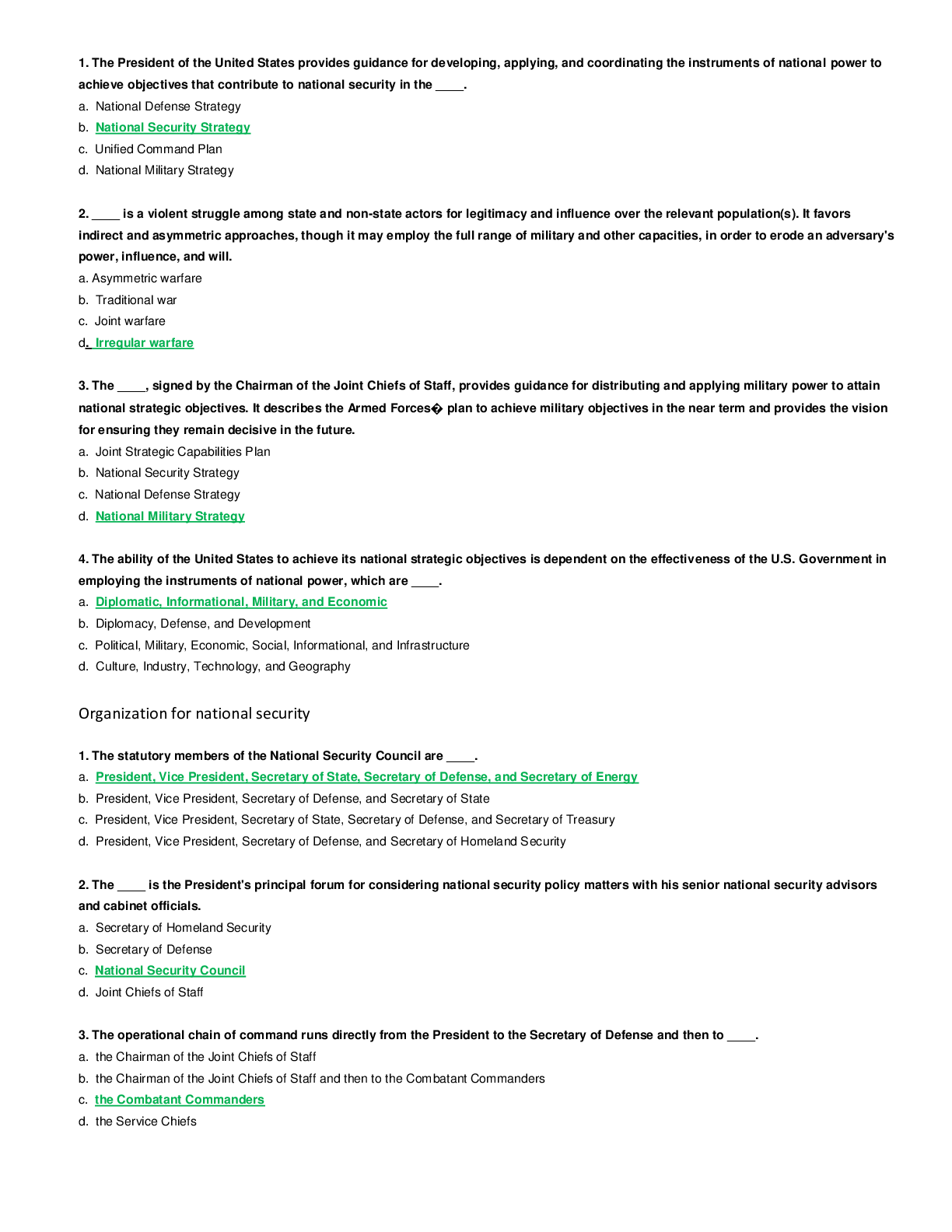
1. The President of the United States provides guidance for developing, applying, and coordinating the instruments of national power to achieve objectives that contribute to national security in the ____.
a. National D
...
1. The President of the United States provides guidance for developing, applying, and coordinating the instruments of national power to achieve objectives that contribute to national security in the ____.
a. National Defense Strategy
b. National Security Strategy
c. Unified Command Plan
d. National Military Strategy
2. ____ is a violent struggle among state and non-state actors for legitimacy and influence over the relevant population(s). It favors indirect and asymmetric approaches, though it may employ the full range of military and other capacities, in order to erode an adversary's power, influence, and will.
a. Asymmetric warfare
b. Traditional war
c. Joint warfare
d. Irregular warfare
3. The ____, signed by the Chairman of the Joint Chiefs of Staff, provides guidance for distributing and applying military power to attain national strategic objectives. It describes the Armed Forces� plan to achieve military objectives in the near term and provides the vision for ensuring they remain decisive in the future.
a. Joint Strategic Capabilities Plan
b. National Security Strategy
c. National Defense Strategy
d. National Military Strategy
4. The ability of the United States to achieve its national strategic objectives is dependent on the effectiveness of the U.S. Government in employing the instruments of national power, which are ____.
a. Diplomatic, Informational, Military, and Economic
b. Diplomacy, Defense, and Development
c. Political, Military, Economic, Social, Informational, and Infrastructure
d. Culture, Industry, Technology, and Geography
Organization for national security
1. The statutory members of the National Security Council are ____.
a. President, Vice President, Secretary of State, Secretary of Defense, and Secretary of Energy
b. President, Vice President, Secretary of Defense, and Secretary of State
c. President, Vice President, Secretary of State, Secretary of Defense, and Secretary of Treasury
d. President, Vice President, Secretary of Defense, and Secretary of Homeland Security
2. The ____ is the President's principal forum for considering national security policy matters with his senior national security advisors and cabinet officials.
a. Secretary of Homeland Security
b. Secretary of Defense
c. National Security Council
d. Joint Chiefs of Staff
3. The operational chain of command runs directly from the President to the Secretary of Defense and then to ____.
a. the Chairman of the Joint Chiefs of Staff
b. the Chairman of the Joint Chiefs of Staff and then to the Combatant Commanders
c. the Combatant Commanders
d. the Service Chiefs
4. The ____ outranks all other officers of the Armed Forces, but may not exercise military command over any of the Armed Forces. He is the principal military advisor to the President, the National Security Council, and the SECDEF.
a. Chairman of the Joint Chiefs of Staff
b. Supreme Allied Commander
c. Combatant Commander
d. War Czar
5. The non-operational chain of command runs directly from the President to the Secretary of Defense and then to ____.
a. the Service Chiefs via the Chairman of the Joint Chiefs of Staff
b. the Secretaries of the Military Departments and then to the Combatant Commanders
c. the Combatant Commanders via the Service Chiefs
d. the Secretaries of the Military Departments and then to the Service Chiefs
1. The ____ is a joint force that is constituted and so designated by the SECDEF, a combatant commander, a subordinate unified commander, or an existing JTF commander to accomplish missions with specific, limited objectives and which do not require overall centralized control of logistics. It is dissolved when the purpose for which it was created has been achieved or when it is no longer required.
a. Combatant Command
b. Subordinate Unified Command
c. Joint Task Force
d. Service Component Command
2. The term joint force commander refers exclusively to the following three (3) types of commanders:
a. combatant commander, subordinate unified commander, and joint task force commander
b. combatant commander, Service component commander, and functional component commander
c. joint task force commander, functional component commander, and subunified commander
d. Service component commander, combatant commander, and joint task force commander
3. A unified or specified command with a broad continuing mission under a single commander established and so designated by the President, through the Secretary of Defense and with the advice and assistance of the Chairman of the Joint Chiefs of Staff is called a ____.
a. joint task force
b. subordinate unified command
c. combatant command
d. component command
4. Joint force air component commander (JFACC), joint force land component commander (JFLCC), and joint force maritime component commander (JFMCC) are all examples of ____.
a. joint task force commanders
b. subunified commanders
c. Service component commanders
d. functional component commanders
5. These commands are established by combatant commanders when authorized by the SECDEF through the CJCS to conduct operations on a continuing basis in accordance with the criteria set forth for unified commands. They may be established on a geographic area basis such as United States Forces Japan or on a functional basis such as Special Operations Command, Pacific.
a. combatant commands
b. subordinate unified commands
c. joint task forces
d. functional component commands
1. Combatant Commanders exercise ____ (command authority) over assigned forces. This is the broadest command authority and may NOT be delegated or transferred.
a. Administrative Control (ADCON)
b. Operational Control (OPCON)
c. Tactical Control (TACON)
d. Combatant Command (COCOM)
2. The four categories of support are ____.
a. general, tactical, operational, and strategic
b. tactical, operational, direct, and common
c. general, mutual, direct, and close
d. reinforcing, mutual, complementary, and close
3. Command authority over assigned or attached forces or commands, or military capability or forces made available for tasking, that is limited to the detailed direction and control of movements or maneuvers within the operational area necessary to accomplish missions or tasks assigned is known as ____.
a. Administrative Control (ADCON)
b. Operational Control (OPCON)
c. Tactical Control (TACON)
d. Combatant Command (COCOM)
4. The command authority established by a superior commander between subordinate commanders when one organization should aid, protect, complement, or sustain another force is called ____.
a. Combatant Command
b. Administrative Control
c. Operational Control
d. Support
5. ____ is the authority to perform those functions of command over subordinate forces involving organizing and employing commands and forces, assigning tasks, designating objectives, and giving authoritative direction necessary to accomplish the mission. It includes authoritative direction over all aspects of military operations and joint training necessary to accomplish missions assigned to the command.
a. Combatant Command
b. Operational Control (OPCON)
c. Tactical Control (TACON)
d. Administrative Control (ADCON)
1. The _______ is the principal forum to advise the President with respect to the integration of domestic, foreign, and military policies relating to national security and for coordinating these policies among various government agencies.
Homeland Security Council
National Security Council
Foreign Affairs Council
National Economic Council
2. _______ are responsible for coordinating with U.S. ambassadors in their AOR across the range of military operations.
JTF commanders
Service component commanders
Geographic combatant commanders
Functional component commanders
3. One way to remember the instruments of national power is by using the acronym, ________.
NSCS
DIME
ANSA
NSPD
4. The _______ is the principal military advisor to the President, the National Security Council, and the Secretary of Defense.
National Security Advisor
Combatant Commander
Director of the Joint Staff
Chairman of the Joint Chiefs of Staff
5. The National Security Council is comprised of the following three levels of formal interagency committees for coordinating and making decisions on national security issues.
Principals, Deputies, and Interagency Policy
Executive, Deputies, and Interagency Coordination
Principals, Deputies, and Interagency Working
Strategic, Operational, and Tactical
6. The ______ acts as the honest "broker" among the many USG agencies to broker disagreements and achieve consensus among agencies on national security issues.
National Security Advisor
Counsel to the President
Vice President
Chief of Staff to the President
7. Within the NSC, the purpose of the ______ is to maintain the day-to-day interagency cooperation; manage the development and implementation of national security policies by multiple agencies; provide policy analysis for consideration by senior committees; and, ensure timely responses to Presidential decisions.
Interagency Working Groups
Principals Committee
Deputies Committee
Interagency Policy Committees
8. Which of the following options represent the Statutory Advisors of the National Security Council?
President, Vice President, Secretary of State, Secretary of Defense
Secretary of the Treasury, Secretary of Homeland Security
Chief of Staff to the President, Chairman of the Joint Chiefs of Staff, Director of National Intelligence
Chairman of the Joint Chiefs of Staff, Director of National Intelligence
1. Successful interagency coordination is a force multiplier that contributes to the achievement of a combatant commander's mission by _________________.
Leading to integrated political-military planning to ensure all resources are brought to bear to resolve problems quickly.
Forging the vital link between the military instrument of national power and the other instruments of national power.
Achieving unity of effort and avoiding duplication of effort among USG agencies, IGOs, and NGOs.
All of the responses.
2. The concept of ______ highlights the synergistic application of all the instruments of national power and includes the actions of non-military organizations as well as military forces.
interagency cooperation
unified action
unity of command
civil military operations
3. DOS assigns a ______ to combatant commanders and, increasingly, to JTF commanders, to provide foreign policy perspectives and to establish linkages with U.S. embassies in the AOR or JOA and with DOS.
Political Advisor (POLAD)
Liaison Officer (LNO)
Joint Interagency Coordination Group (JIACG)
Chief of Mission (COM)
4. U.S. military forces are authorized under certain conditions to provide assistance to U.S. civil authorities for disasters, catastrophes, infrastructure protection, and other emergencies, and this assistance is known as ______ within the defense community because the assistance will always be in support of a lead federal agency.
consequence management
civil defense
civil support
crisis management
5. The supported combatant commander is responsible for developing ______, which covers Interagency Coordination, for each Operation Plan (OPLAN). This enables interagency planners to more rigorously plan their efforts in concert with the military, to suggest other activities or partners that could contribute to the operation, and to better determine any support requirements they may have.
Annex G
Annex I
Annex V
Annex Y
6. It is imperative that the combatant commander or JTF commander coordinate closely with the ______ on military activities in a particular country because, while not authorized to command military forces, he or she can deny military actions.
Ambassador
National Security Advisor
Secretary of State
Foreign Policy Advisor
7. The ______ is an interagency staff group that establishes or enhances regular, timely, and collaborative working relationships between other government agencies (e.g., CIA, DOS, FBI) representatives and military operational planners at the combatant commands.
POLAD
CMOC
JIACG
HAST
8. The Country Team provides for rapid interagency consultation and action on recommendations from the field and DOD is normally represented on the Country Team by the ______ and the ______.
Marine security detachment, security assistance organization
political advisor, joint interagency coordination group
defense attaché, foreign policy advisor
defense attaché, security assistance organization
1. ______ are independent, diverse, flexible, grassroots-focused, primary relief providers that are frequently on the scene before the U.S. military and will most likely remain long after military forces have departed.
IGOs
OGAs
NGOs
FAOs
2. In most situations, IGOs and NGOs need the following military capabilities.
threat assessment, force protection, and airlift
logistics, communications, and security
airlift, sealift, and intelligence
security, transportation, and explosive ordnance disposal
3. The JTF commander facilitates unified action and gains a greater understanding of the roles of IGOs and NGOs and how they influence mission accomplishment by establishing a ______.
Humanitarian Assistance Coordination Center (HACC)
Joint Interagency Coordination Group (JIACG)
Interagency Policy Committee (IPC)
Civil-Military Operations Center (CMOC)
4. The JTF commander should carefully consider where to locate the CMOC. Which of the following are valid considerations in determining the location?
security
force protection
easy access for agencies and organizations
all of the responses are correct
5. The JTF commander cannot dictate cooperation among OGAs, IGOs, and NGOs. In the absence of a formal command structure, JTFs are required to build consensus to achieve ______.
unity of effort
unity of command
command and control authority
synchronization
6. The interagency support provided by a ______, composed of intelligence experts from DIA, CIA, NSA, NGA, and other intelligence agencies, affords the JTF access to national-level databases and to agency-unique information and analysis.
Joint Interagency Coordination Group (JIACG)
Joint Intelligence Operations Center (JIOC)
National Intelligence Support Team (NIST)
Joint Interagency Support Element (JISE)
7. By virtue of their familiarity in a foreign country or region, ______ are a valuable source of information for a JTF commander who may have neither access to nor current information about the affected country or region.
multinational forces
IGOs and NGOs
liaison teams
USG agencies
"Do not repeat the tactics which have gained you one victory, but let your methods be regulated by the infinite variety of circumstances."
- Sun Tzu, The Art of War, C. 500 BC
1. A particular type of operation is not doctrinally fixed and could shift within the range of military operations, for example a counterinsurgency operation escalating from a security cooperation activity into a major operation or campaign.
True
False
2. Combatant commanders and subordinate joint force commanders must work with U.S. ambassadors (or diplomatic missions), Department of State, and other agencies to best integrate the military actions with the diplomatic, economic, and informational instruments of national power to promote ________.
unity of command
joint operations
economy of force
unity of effort
3. The range of military operations includes these three categories of operations: (1) military engagement, security cooperation, and deterrence; (2) crisis response and limited contingency operations; and ________.
major battles and engagements
contingency and crisis operations
major operations and campaigns
traditional and irregular warfare
4. These operations are typically limited in scope and scale and conducted to achieve a very specific objective in an operational area. They include noncombatant evacuation operations, peace operations, foreign humanitarian assistance, recovery operations, consequence management, strikes, raids, homeland defense, and defense support of civil authorities.
military engagement
crisis response and limited contingency operations
security cooperation and deterrence activities
major combat operations and campaigns
5. Various joint operations such as a show of force or sanctions enforcement support ________ by demonstrating national resolve and willingness to use force when necessary.
joint operation planning
prepositioning assets
deterrence
interagency coordination
6. The purpose of specifying the ________ is to direct every military operation toward a clearly defined, decisive, and achievable goal.
center of gravity
critical vulnerability
objective
decisive point
7. The purpose of ________ is to concentrate the effects of combat power at the most advantageous place and time to produce decisive results.
maneuver
mass
objective
offensive
8. The purpose of ________ is to develop and maintain the will necessary to attain the national strategic end state. It is based on the legality, morality, and rightness of the actions undertaken.
perseverance
legitimacy
restraint
security
1. A military operation to temporarily seize an area, usually through forcible entry, in order to secure information, confuse an adversary, capture personnel or equipment, or destroy an objective or capability is called a ________. It ends with a planned withdrawal upon completion of the assigned mission.
peace operation
raid
recovery operation
noncombatant evacuation operation
2. Military operations that apply military force or threaten its use, normally pursuant to international authorization, to compel compliance with resolutions or sanctions designed to maintain or restore peace and order are known as ________ operations.
peacekeeping
peace enforcement
peace building
peace making
3. Pursuant to Executive Order 12656, the ________ is responsible for the protection and evacuation of American citizens abroad and for safeguarding their property.
Department of Defense
Department of Homeland Security
Geographic Combatant Command
Department of State
4. In foreign humanitarian assistance operations, commanders usually establish a ________ because it is critical to working with the participating intergovernmental organizations (IGOs) and nongovernmental organizations (NGOs).
joint operations center (JOC)
joint intelligence operations center (JIOC)
civil-military operations center (CMOC)
media operations center (MOC)
5. Operations conducted to search for, locate, identify, recover, and return isolated personnel, sensitive equipment, items critical to national security, or human remains are known as ________.
noncombatant evacuation operations
recovery operations
foreign humanitarian assistance
consequence management
6. An operation that employs coercive measures to interdict the movement of certain types of designated items into or out of a nation or specified area is known as ________.
antiterrorism
arms control
enforcement of sanctions
show of force
1. Joint force commanders strive to isolate enemies by denying them ________. The intent is to strip away as much enemy support or freedom of action as possible, while limiting the enemy's potential for horizontal or vertical escalation.
movement and maneuver
allies and sanctuary
airfields and seaports
command and control
2. Preplanned, deterrence-oriented actions carefully tailored to bring an issue to early resolution without armed conflict are known as ________.
peacekeeping
flexible deterrent options
diplomatic efforts
smart power
3. Joint force commanders must integrate and synchronize offensive, defensive, and stability operations that comprise major operations and campaigns. Planning for stability operations should begin ________.
near the end of joint operation planning
only after planning for offensive and defensive operations is complete
at the start of Phase IV Stabilize
when joint operation planning is initiated
4. Although ________ may be the stronger force posture, it is the ________ that is normally decisive in combat. Therefore, commanders will normally seek to transition to the decisive operations at the earliest opportunity.
joint, single-Service
offense, defense
defense, offense
attrition, maneuver
5. A joint military operation conducted either as a major operation or a part of a larger campaign to seize and hold a military lodgment in the face of armed opposition for the continuous landing of forces is called ________. These operations may include amphibious, airborne, and air assault operations, or any combination thereof.
joint reception, staging, onward-movement, and integration
forcible entry
full-spectrum superiority
force protection
6. The ultimate measure of success in peace building is ________. Therefore, joint force commanders seek a clear understanding of the national and coalition strategic end state and how military operations support that end state.
political, not military
adversary military culmination
economic sufficiency
security sector reform
7. Major operation and campaign plans must feature a(n) ________ offensive, defensive, and stability operations in all phases.
equal proportion of
similar degree of
appropriate balance between
effective sequencing of
8. The responsibility to plan and coordinate U.S. government efforts in stabilization and reconstruction has been assigned to ________.
Department of State
Department of Defense
Geographic Combatant Command
U.S. Agency for International Development
"Si vis pacem, para bellum."
If you want peace, prepare for war.
1. The two types of joint operation planning are ________. They differ primarily in the amount of available planning time and products.
operational planning and tactical planning
deliberate planning and crisis action planning
conventional planning and time-sensitive planning
strategic planning and operational planning
2. Planning in an adaptive planning environment using APEX supports the systematic, on-demand, creation and revision of executable plans, with up-to-date options, as circumstances require. A premium is placed on _______.
speed
efficiency
feasibility
flexibility
3. Planning activities associated with joint military operations by combatant commanders and their subordinate joint force commanders in response to contingencies and crises are known as ________. It includes planning for the mobilization, deployment, employment, sustainment, redeployment, and demobilization of joint forces.
security cooperation planning
force planning
joint operation planning
strategic planning
4. With respect to strategic planning documents, the SECDEF provides overarching guidance for planning in the ________ and supplementary Strategic Guidance Statements (SGS) for top priority plans.
Guidance for Employment of the Force (GEF)
Joint Strategic Capabilities Plan (JSCP)
National Military Strategy (NMS)
Global Force Management Implementation Guidance (GFMIG)
5. In Deliberate Planning, the strategic planning documents include all of the following except ________.
Guidance for Employment of the Force (GEF)
Joint Strategic Capabilities Plan (JSCP)
Global Force Management Implementation Guidance (GFMIG)
Guidance for Deployment of the Force (GDF)
6. Those headquarters, commands, and agencies involved in joint operation planning or committed to a joint operation are collectively termed the ________. Although not a standing or regularly meeting entity, it consists of the Chairman of the Joint Chiefs of Staff and other members of the Joint Chiefs of Staff, the Joint Staff, the Services and their major commands, the combatant commands and their subordinate commands, and the combat support agencies.
Joint Planning Group (JPG)
Joint Requirements Oversight Council (JROC)
Joint Planning and Execution Community (JPEC)
National Security Council (NSC)
7. APEX activities span many organizational levels, but the focus is on the interaction between ________, which ultimately helps the President and SECDEF decide when, where, and how to commit U.S. military forces.
SECDEF and CJCS
SECDEF and CCDRs
CCDRs and subordinate joint force commanders
CJCS and CCDRs
1. Joint operation planning encompasses a number of elements, including three broad operational activities, four planning functions, and a number of related products. The operational activity of ________ does not apply to Deliberate Planning, but the other two do.
Situational Awareness
Planning
Execution
Strategic Guidance
2. This is a complete and detailed joint plan containing a full description of the CONOPS, all annexes applicable to the plan, and a TPFDD. It is written to level 4 planning detail and identifies the specific forces, functional support, and resources required to execute the plan and provide closure estimates for their flow into the theater.
Commander´s Estimate
Base Plan (BPLAN)
Concept Plan (CONPLAN)
Operation Plan (OPLAN)
3. The primary product of the Plan Development function is an approved ________.
course of action
concept of operations
campaign or contingency plan
commander's estimate
4. Deliberate Planning is normally initiated by a tasking in the ________. It is based on assigned planning guidance, derived assumptions, and apportioned forces.
GEF or JSCP
JPEC or JSCP
GEF or GFMIG
NSS or NMS
5. The seven steps of the ________ follow the sequence of the general problem solving process. It is used for both deliberate planning and crisis action planning.
joint operation planning process
adaptive planning and execution system
campaign planning model
mission analysis process
6. Deliberate Planning encompasses the preparation of plans for non-crisis situations. It is used to develop ________ for a broad range of activities based on requirements identified in the GEF, JSCP, or other planning directive.
strategic estimates and theater strategies
operation orders and security cooperation plans
campaign plans and contingency plans
strategic and military end states
7. Deliberate Planning features a series of periodic ________ that constitute a disciplined dialogue among strategic leaders, specifically the combatant commanders, the CJCS, and the SECDEF, to shape campaign and contingency plans as they are developed and maintained.
staff updates
force planning conferences
strategic symposia
in-progress reviews
8. Contingency plans are best understood as ________ to the overarching global or theater campaign plan.
branches
sequels
supporting plans
extensions
9. After a contingency plan is approved in deliberate planning, supporting combatant commanders, subordinate joint force commanders, component commanders, and combat support agencies prepare supporting plans. These supporting plans are normally reviewed and approved by the ________.
President
SECDEF
Supported Combatant Commander
Chairman of the Joint Chiefs of Staff
1. The ________ is the task or set of tasks, together with the purpose, that clearly indicates the action to be taken and the reason for doing so.
objective
mission
commander's intent
military end state
2. The ________, JSCP, and related Strategic Guidance Statements (for top priority plans) serve as the primary guidance to begin Deliberate Planning. They specify the planning requirements, to include the level of planning detail for the various contingency plans.
UCP
TCP
JOPP
GEF
3. The ________ is an orderly, analytical planning process, which consists of a set of seven (7) logical steps to examine a mission; develop, analyze, and compare alternative courses of action (COAs); select the best COA; and produce a plan or order.
Theater Campaign Plan (TCP)
Global Force Management Implementation Guidance (GFMIG)
Joint Operation Planning Process (JOPP)
Crisis Action Planning (CAP)
4. Assumptions must be continually reviewed to ensure validity. A valid assumption has three characteristics: ________.
logical, realistic, and essential for the planning to continue
acceptable, feasible, and adequate to support further planning
logical and flexible to address changes in the adversary or environment
adaptable, creative, and necessary to continue the planning
5. The process of ________ provides a means for the commander and staff to analyze friendly COAs by comparing them against anticipated adversary COAs, especially against the most likely and most dangerous adversary COAs identified through the JIPOE process. This process attempts to visualize the flow of the operation using the action, reaction, and counteraction method of friendly and opposing force interaction.
mission analysis
COA development
wargaming
COA comparison
6. During COA Comparison, the staff may use any technique that facilitates reaching the best COA recommendation and the commander making the best decision. A common, proven technique is the ________, which uses evaluation criteria to assess the effectiveness of each COA.
synchronization matrix
decision matrix
decision support template
wargaming simulation
1. Operations conducted in hostile, denied, or politically sensitive environments to achieve military, diplomatic, informational, and/or economic objectives employing military capabilities for which there is no broad conventional force requirement are known as ________. These operations often require covert, clandestine, or low visibility capabilities. They differ from conventional operations in degree of physical and political risk, operational techniques, mode of employment, independence from friendly support, and dependence on detailed operational intelligence and indigenous assets.
irregular operations
special operations
conventional operations
extreme operations
2. Elite, highly trained military units that conduct operations that typically exceed the capabilities of conventional forces are known as ________. These Active and Reserve Component forces of the military Services are designated by the Secretary of Defense and specifically organized, trained, and equipped to conduct and support such operations.
general purpose forces
conventional forces
strategic objectives forces
special operations forces
3. Special operations are a(n) ______ part of the geographic combatant commander´s theater campaign plan. The majority of special operations are designed and conducted to enhance the likelihood of success of the overall theater campaign plan.
implied
separate
integral
insignificant
4. Special operations must ________ – not compete with nor be a substitute for – conventional operations. Special operations differ from conventional operations in the degree of physical and political risk, operational techniques, mode of employment, independence from friendly support, and dependence on detailed operational intelligence and indigenous assets.
outperform
overshadow
complement
supplant
1. Special Operations involve the use of small units of specially trained personnel using specialized tactics and equipment to achieve ________ objectives.
tactical
strategic or operational
insignificant
intermediate
2. Short-duration strikes and other small-scale offensive actions conducted as a special operation in hostile, denied, or politically sensitive environments and which employ specialized military capabilities to seize, destroy, capture, exploit, recover, or damage designated targets is called ________. It differs from conventional offensive actions in the level of physical and political risk, operational techniques, and the degree of discriminate and precise use of force to achieve specific objectives.
special reconnaissance
counterterrorism
direct action
unconventional warfare
3. Special operations forces are organized under the ________, a functional combatant command responsible for providing mission capable special operations forces to the geographic combatant commanders.
United States Northern Command (USNORTHCOM)
United States Strategic Command (USSTRATCOM)
United States Special Operations Command (USSOCOM)
United States Transportation Command (USTRANSCOM)
4. Actions conducted as a special operation in hostile, denied, or politically sensitive environments to collect or verify information of strategic or operational significance, employing military capabilities not normally found in conventional forces are called ________. These actions acquire information concerning the capabilities, intentions and activities of an enemy.
strategic reporting
foreign internal defense
special reconnaissance
unconventional warfare
5. After the attacks of 9/11, U.S. Special Operations Command assumed an operational role in leading the DOD effort in ________.
support of the U.S. government response to pandemic influenza
global operations against terrorist networks
cyberspace operations
combating weapons of mass destruction
6. Most special operations forces are ________ oriented. This allows them to maintain a cultural awareness and a language capability for their assigned areas.
politically
mission
regionally
special tactics
7. A broad spectrum of military and paramilitary operations, normally of long duration, predominantly conducted through, with, or by indigenous or surrogate forces who are organized, trained, equipped, supported, and directed in varying degrees by an external source are known as ________. It is a core activity of special operations forces.
unconventional warfare
civil affairs operations
special reconnaissance
direct action
8. Military-political considerations frequently cast Special Operations into clandestine or covert environments; therefore, their activities normally involve oversight at the ________ level.
tactical
joint task force
operational
national
1. The foundation of Army Special Forces is the basic unit, the Operational Detachment Alpha (ODA), also known as the "A-Team." The A-Team is capable of conducting operations in remote and hostile areas for extended periods of time; however, it has minimal ________.
Anti-armor or other heavy weapons
communications assets
regional language skills
airborne qualified soldiers
2. The ________ is the premier light, airborne, infantry unit of the U.S. Army.
101st Airborne Division (Air Assault)
160th Special Operations Aviation Regiment
82nd Airborne Division
75th Ranger Regiment
3. The unique unit that provides support to special operations forces personnel on a worldwide basis with specially equipped helicopters is the ________.
101st Airborne Division (Air Assault)
160th Special Operations Aviation Regiment
3rd Combat Aviation Brigade
106th Special Operations Helicopter Regiment
4. The units that support military commanders by working with civil authorities and civilian populations in the area of operations are known as ________. These forces help minimize civilian interference with military operations, locate civilian resources to support military operations, and support national assistance activities.
foreign area officers
political advisors
civil affairs
special forces
5. The units manned by Special Warfare Combatant-craft Crewmen who operate and maintain state-of-the-art surface craft to conduct coastal patrol and interdiction and support special operations missions are known as ________.
SEAL Platoons
Special Boat Teams
SEAL Delivery Teams
Special Tactics Groups
6. The 193rd Special Operations Wing of the Pennsylvania Air National Guard provides the only ________ platform in the Department of Defense with the EC-130 Commando Solo.
airborne early warning
airborne psychological operations
electronic warfare
combat aviation advisor
7. The Air Force´s Battlefield Airmen or ________ Teams frequently operate with Navy SEALs, Army Rangers, and Special Forces in direct action, airfield seizure, and personnel recovery missions in hostile territory.
Air Commando
Special Tactics
Aero Scout
Special Warfare
8. This MARSOC element trains, advises and assists friendly host nation forces - including naval and maritime military and paramilitary forces - to enable them to support their governments´ internal security and stability, to counter subversion, and to reduce the risk of violence from internal and external threats. It has the capability to form the nucleus of a Joint Special Operations Task Force.
Marine Special Operations Regiment (MSOR)
Marine Air-Ground Task Force (MAGTF)
Marine Expeditionary Brigade (MEB)
Marine Special Operations Support Group (MSOSG)
1. Each geographic combatant command has a ________ to plan and control joint special operations forces in their areas of responsibility. It is a sub-unified command of the geographic combatant command and the source of expertise in all areas of special operations.
Regional Special Warfare Command (RSWC)
Theater Special Operations Command (TSOC)
Joint Special Operations Task Force (JSOTF)
Joint Special Operations Command (JSOC)
2. When required, the joint task force commander may establish a ______, which is a temporary joint special operations forces command formed to conduct special operations in a specific joint operations area.
Theater Special Operations Command (TSOC)
Joint Special Operations Task Force (JSOTF)
Civil-Military Operations Center (CMOC)
Joint Special Operations Command (JSOC)
3. Which one of the following is NOT a limitation of special operations forces?
Are a relatively small force
Possess minimal organic anti-armor and other heavy weapons
Cannot be regenerated rapidly in event of significant losses
Have little to no language or regional expertise
4. Special Operations Forces are a valuable asset for the joint planner; however, they comprise only a small part of the total force - a little over ________ percent of the total force.
10
5
2
15
5. In joint SOF mission planning, a demanding full-up, real-time ________ can mitigate much of the inherent risks of many SOF missions. It is key to the success of complex joint SOF missions.
battle rhythm
rehearsal
training exercise
firing course
6. Which of the following is NOT one of the SOF Truths?
Humans are more important than hardware.
Quantity always beats quality.
SOF cannot be mass produced.
Competent SOF cannot be created after emergencies occur.
1. A traumatically induced structural injury and/or physiological disruption of brain function as a result of an external force defines a ________. Typical signs include headaches, memory gaps, confusion, attention problems, irritability, ringing in the ears, dizziness, nausea, fatigue, slowed reaction time, sleep difficulty, and performance difficulties.
Post-Traumatic Stress Disorder
Psychiatric Disorder Syndrome
Psychological Trauma Dysfunction
Traumatic Brain Injury
2. Receiving realistic training, understanding the types of situations encountered in war, eating well, getting enough rest, and having meaningful relationships and friendships are all helpful in building ________.
teamwork
tolerance
resilience
unity of effort
3. A state of well-being in which one is aware of personal abilities and limits, copes well with life stresses, works productively and effectively, and contributes positively to his or her communities is known as ________. It describes a healthy body, mind, and spirit which can be seen in a person´s ability to deal with typical stressors.
physical fitness
psychological health
post-traumatic stress disorder
personal awareness
4. Exposure to stressful situations, trauma, and combat will cause a response and resulting change. These responses and changes will all be negative.
True
False
5. Symptoms of ________ include depression, substance abuse, problems of memory and cognition, and other physical and mental health problems. It is also associated with difficulties in social or family life, including occupational instability, marital problems, family discord, and difficulties in parenting.
Post-Traumatic Stress Disorder
Psychiatric Disorder Syndrome
Psychological Trauma Dysfunction
Traumatic Brain Injury
Question 1
One of the Navy's MOOTW roles is to enforce United Nations economic sanctions.
True
False
Question 2
While its missions might include forcible entry operations and peace enforcement, humanitarian assistance is not within the Marine Corps' purview.
True
False
Question 3
Marine Corps forces exploit the Total Force concept, employing combinations of active duty and reserve Marines to ensure that missions are effectively and efficiently executed.
True
False
Question 4
Aerospace Forces produce synergistic effects that are designed not to exceed separately employed individual forces.
True
False
Question 5
The US Army's adaptation to new technologies was a result of the federal government
nurturing the arms industry after the Revolutionary War, spurred by Eli Whitney’s invention
of interchangeable parts which made standardized gun design possible.
True
False
Question 6
Established in 1798, the US Navy and Marine Corps was created to protect American interests overseas and support maritime free trade.
True
False
Question 7
It was Lt. Col. Earl H. “Pete” Ellis's post-WWI Advanced Base Operations in Micronesia, 1921 document that gave birth to the Marine Corps’ amphibious doctrine.
True
False
Question 8
By 1986, the MPS program had in place 13 ships: one squadron in the Eastern Atlantic, a second squadron at Diego Garcia in the Indian Ocean, and a third at Guam in the Western Pacific.
True
False
Question 9
The comprehensive doctrine of air warfare supported the conclusion that high-altitude, daylight bombing of an enemy's war-supporting industries and transportation systems could win a war.
True
False
Question 10
USCG has always served under the Secretary of the Treasury, reflecting its early historical mission.
True
False
Question 11
The USCG's motto is Semper Paratus, meaning "always ready."
True
False
Question 12
It is not customary during Dining-In to hear an address by a distinguished guest.
True
False
Question 13
The offering of ceremonial toasts is a traditional Army custom at a formal Dining-In, which includes passing the wine "over the water," an historical reference to James I, who was exiled by Oliver Cromwell.
True
False
Question 14
While it is appropriate and strongly recommended to greet a person by name and grade, if you are unsure of an enlisted Marine’s name or grade, "Marine” is as appropriate as “Good morning, Sir,” in the case of an officer.
True
False
Question 15
The main difference between Dining-In and Mess Night for Marines is that spouses and other non-military guests may attend a Dining-In.
True
False
Question 16
Promotions and Re-enlistments are ceremonies requiring formation in this order: (a) Personal awards presented first, (b) Promotions second, and (c) Re-enlistments third.
True
False
Question 17
Dining-In and Dining-Out represent the most formal aspects of Air Force social life.
True
False
Question 18
Historically, the practice of keeping pets onboard may have started when cats were brought onboard to combat the rat population.
True
False
Question 19
Which document spells out the broad responsibilities or missions of the combatant commanders?
a. Title 10 of the United States Code (USC)
b. UCMJ
c. Unified Command Plan
Question 20
What is the Army’s primary role?
a. To train and equip itself for the overwhelming and synchronized application of land combat power
b. To train and equip itself for the overwhelming and synchronized application of both land and
air combat power
c. To support the other Services
Question 21
The Army aids in shaping the international environment through an extensive forward presence
in which of the following?
a. Europe, Southwest Asia, the Korean Peninsula, and Japan
b. Balkans, Middle East, Europe, Southwest Asia, the Korean Peninsula, and Japan
c. Europe, Asia, the Korean Peninsula, and Japan
Question 22
Which of the following documents reflects situational demands which may influence doctrine
and the proper composition of forces in support of National Naval Strategy (NNS)?
a. Universal Joint Task List (UJTL)
b. Posture Statement
c. Joint Concepts Development and Revision Plan (JCDRP)
Question 23
What are the four fundamental roles of the United States Navy?
a. Overwhelming presence, deterrence, sea and area control, and power projection
b. Overwhelming presence, sea and area control, and power projection
c. Forward presence, deterrence, sea and area control, and power projection
Question 24
Which of the following capabilities reinforce the United States Navy's role in deterrence?
a. Peacekeeping and Contingency Operations
b. The capability of dominating a foe in the littoral battle space and delivering heavy equipment
c. Contingency Operations and Non-combatant Evacuation Operations
d. All of the above
Question 25
MOOTW has taken on added emphasis in recent years and can impact the Navy in terms of which of the following requirements?
a. Contingency Operations and Non-combatant Evacuation Operations
b. Visit, Board, Search, and Seizure (VBSS) training for embargo or intercept operations
c. Training, personnel, equipment and budget
d. Training, personnel and equipment
Question 26
Which of the following are examples of MOOTW?
a. Contingency Operations and Non-combatant Evacuation Operations
b. All of the above
c. Visit, Board, Search, and Seizure (VBSS) training for embargo or intercept operations
d. Peacekeeping and Contingency Operations
Question 27
Which of the following are examples of how the Marine Corps has adapted and evolved
as an expeditionary force?
a. Amphibious operations, close air support, helicopter-borne vertical envelopment tactics
b. Amphibious operations, MPFs and MAGTFs
c. Both 1 and 2
Question 28
Which of the following Services is the force of choice in emerging crises?
a. US Navy
b. US Marine Corps
c. Coast Guard
Question 29
Which of the following are roles of the US Marine Corps according to Title 10 US Code?
a. Visit, Board, Search, and Seizure (VBSS) training for embargo or intercept operations
b. Develop tactics, techniques, and equipment-use phases of amphibious operations by landing forces
c. Narcotics/Drug Interdiction and Illegal Alien Interdiction
d. All of the above
Question 30
Which of the following are primary functions of the US Marine Corps according to DOD Directive 5100?
a. Conduct prompt and sustained combat operations at sea, including sea-based and land-based aviation.
b. Provide detachments and organizations to serve on armed vessels of the Navy and provide security detachments for naval stations and bases.
c. Organize, equip, and provide Marine Corps forces to conduct joint amphibious operations and train all forces assigned to joint amphibious operations.
d. All of the above
Question 31
Delegating execution authority to responsible and capable lower-level commanders is essential to which of the following roles of Air Force commander or command groups?
a. Achieving effective span of control
b. Fostering initiative, situational responsiveness, and tactical flexibility
c. Both
Question 32
Simultaneous and parallel operations are the most effective use of aerospace power in producing which of the following?
a. Confusion, situational responsiveness, and paralysis within the adversary's system
b. Shock, confusion, and paralysis within the adversary's system
c. Initiative, situational responsiveness, and tactical flexibility
Question 33
Which of the following are functions of air power?
a. Counter air, Counter space, Counter land, Counter sea
b. Strategic Attack, Counter information, Command and Control, Air Refueling, Space Lift
c. Special Operations Employment, Intelligence, Surveillance, and Reconnaissance, Combat Search and Rescue, Navigation and Positioning, Weather Operations
d. All of the above
Question 34
Which of the following describes the role of the Coast Guard in the US's maritime regions?
a. The Coast Guard operates in inland, coastal, and Deepwater regions.
b. The Coast Guard operates in Coastal and Deepwater regions.
c. The Coast Guard operates in inland and coastal regions.
Question 35
Which of the following tasks are among the Coast Guard's responsibilities in enforcing all applicable federal laws, regulations, and international agreements upon the high seas and in US waters?
a. Narcotics/Drug Interdiction, Illegal Alien Interdiction, Boating Safety, and Fisheries
b. Develop tactics, techniques, and equipment-use phases of amphibious operations by landing forces
c. Conduct prompt and sustained combat operations at sea, including sea-based and land-based aviation
d. All of the above
Question 36
In wartime, which of the following tasks will the USCG provide within the 200 nautical mile limit?
a. Protection of ports, waterways, and waterfront facilities
b. Impoundment of all foreign vessels
c. Protection of vessels, personnel, and property at home and abroad
d. Both 1 and 2
e. Both 1 and 3
Question 37
Which program within the USCG Boating and Safety Mission targets commercial vessels, regulates commercial marine activities, and helps develop safety standards for commercial vessels and crews?
a. Recreational Boating Safety (RBS)
b. Search and Rescue (SAR)
c. Commercial Vessel Safety (CVS)
Question 38
Soldiers fighting the War of 1812 benefited from the improved quality and standardization of
their equipment. By the Mexican War, American arms were technologically equivalent to those of Europe. Advances in which of the following areas made that possible?
a. Mobility, flexibility, and potency of field artillery
b. Training and standardization
c. Standardization of the potency of field artillery
Question 39
Which technological advancements directly impacted warfare during the American Civil War?
a. Ranges and capabilities of artillery were radically increased.
b. Railroads transported troops and supplies quickly over unprecedented distances.
c. Telegraphs coordinated strategic movements in a fraction of the time required during earlier wars, and a massive industrial base was harnessed to the demands of war.
d. All of the above.
Question 40
Introduced in WWI and perfected in WWII, which of the following mechanized alternatives to trench warfare led to successful campaigns?
a. Telegraph capability to communicate strategic movement
b. Railroad transport in support of strategic movement
c. The combination of the tank and time-on-target, as well as artillery and radio coordination
d. Introduction of the airplane and helicopter
Question 41 Which of the lessons learned during the Mexican War did the Union Navy use?
a. Move forward from the sea and seize ports
b. Embargo trade and blockade
c. Extract without foundering and unload troops while maintaining stern to the surf
d. Choice 2 and 3
e. Choice 1 and 2
Question 42
Through which of the following strategies has the Navy retained its traditional roles while expanding into expeditionary warfare?
a. Containment Policy
b. “From the Sea” and later “Forward from the Sea”
c. Sea Power Concept
Question 43
Which of the following advantage/advantages of boats were designed for the Marines by Andrew Higgins?
a. Scooting into shallow water
b. Unloading troops while maintaining its stern to the surf
c. Extracting without foundering
d. All of the above
Question 44
Why was the participation of the Montford Point Marines in the amphibious assault at Saipan such a historic event?
a. The marines were well-trained.
b. No Higgins boats were available.
c. It represented the final and full integration of the Armed Forces.
Question 45
Devised to survive on a potentially atomic battlefield, vertical envelopment enabled Marines to achieve which of the following?
a. Speed and dispersion
b. Night vision
c. Beachhead assaults
Question 46
In the name of strategic mobility, the Marine Corps adopted pre-positioning for which of the following purposes?
a. Speed and dispersion
b. Provide materiel needed to sustain a brigade for 30 days in a potential combat zone
c. Amphibious assault
Question 47
Which of the following represent highlights of US Air Force history?
a. Design of a doctrine of strategic bombing and one of organizational independence
b. Development of the Strategic Air Command
c. Expansion into space
d. All of the above
Question 48
What was the purpose of the Revenue Cutter Service?
a. Building and maintaining lighthouses
b. Protecting ports and harbors
c. Collecting taxes and stopping smugglers
Question 49 In 1848, why was the Bureau of Navigation established?
a. To save lives
b. To build, maintain and man all Lightships
c. To patrol the Pacific Coastline
Question 50 A group or person is honor-bound to do which of the following upon receiving a limerick at mess?
a. Ignore it as any self-generated entertainment
b. Return the embarrassment in kind
c. Refute the remark prior to the close of the dinner hour
Question 51
Which of the following are considerations when hosting a formal dinner?
a. Begin planning months in advance with the proposed guest list
b. Printing and mailing invitations four to six weeks in advance
c. Planning the menu and walking through the upcoming evening’s sequence of events
d. Identifying unique cultural considerations in a foreign country
e. All of the above
Question 52
Which core value does the following tenet represent: exhibit the highest degree of moral character, technical excellence, quality and competence in what we have been trained to do.
a. Honor
b. Commitment
c. Courage
Question 53
Which of the following examples embodies Navy traditions and core values of honor, courage, and commitment?
a. “Don’t give up the ship!”
b. “Surrender? I have not yet begun to fight!”
c. “Can you go and do likewise?”
d. All of the above
Question 54
Who are the caretakers of naval customs, traditions, honors, and ceremonies?
a. Chief Petty Officers
b. Admirals
c. Commanders
Question 55
Which core value does the following tenet represent: abide by an uncompromising code of integrity, taking responsibility for your actions and keeping your word.
a. Commitment
b. Courage
c. Honor
Question 56
Which core value does the following tenet represent: make decisions in the best interest of the Navy and the nation, without regard to personal consequences.
a. Commitment
b. Honor
c. Courage
Question 57
Which of the following represent Marine core values?
a. Competence
b. Resolution
c. Courage
d. No wounded or dead Marine will ever be left on the field or unattended, regardless of the cost of bringing him in
e. All of the above
Question 58
Which of the following would be initiated into the "Top 3"?
a. Col
b. SgtMaj
c. MSgt
Question 59
Which of the following ceremonies affirms a "leader among leaders" in the USAF, using a
symbol of truth, justice, and power rightly used?
a. Grog Bowl
b. Top 3
c. Order of the Sword
Question 60
What is the primary purpose of Dining-In for the USAF?
a. To enhance morale and esprit de corps
b. To nurture rising NCOs
c. To present new orders
Question 61
What is the purpose of sending someone to the Grog Bowl?
a. As punishment for violating the rules of the mess
b. As a reward for attendance
c. Recognition for a job well done
Question 62
Gold and Silver Lifesaving Medals are a tradition of which Service?
a. US Coast Guard
b. US Marine Corps
c. US Navy
Question 63
Which of the following is the USCG motto?
a. “Semper Fideles”
b. "Semper Paratus"
c. “Anchors Aweigh”
Question 64
Who is eligible for the Ancient Albatross Award in the USCG?
a. The Coast Guard aviator on active duty who has held that designation for the longest time.
b. The oldest active duty enlisted person
c. All new recruits
Question 65
Ancient Mariner is a ceremonial title given to whom?
a. The officer or enlisted person with the earliest date of qualification as a cutterman
b. The enlisted person with the earliest date of qualification as a cutterman
c. The officer with the earliest date of qualification as a cutterman
Question 66
The "Salty Sea Dog" is a reference to which of the following?
a. The cutter Campbell's mascot, Sinbad
b. Cats that hunt the rats onboard
c. The cutter Campbell's motto
Question 67
From the early days of naval service, certain principles or core values have carried on to today. Match each quote with the corresponding Navy Core Value.
"I will support and defend ..."
Read Answer Items for Question 67
"I will bear true faith and allegiance ..."
Read Answer Items for Question 67
"I will obey the orders ..."
Read Answer Items for Question 67
Answer
a. Courage
b. Honor
c. Commitment
Question 68
To promote pride and respect among your juniors, how would you address each rank?
Match each rank with its corresponding address.
First Sergeant
Read Answer Items for Question 68
Sarge or Trooper
Read Answer Items for Question 68
By full rank and name
Read Answer Items for Question 68
By name and grade
Read Answer Items for Question 68
Answer
a. Senior Enlisted Marine
b. Junior Marine
c. No One
d. First Sergeant
Question 69
In concert with the joint team and the forces of US allies, land power provides decisive capability for which of the following?
a. Establishing legitimate authority to rebuild the conflict area
b. Countering international threat and defending US interests
c. Compliance with the terms of peace
Question 70
The Army's training and support includes which of the following programs?
a. Counter-drug operations in many Latin American nations
b. Medical, intelligence, communications and civic assistance tasks in Indonesia
c. Humanitarian de-mining operations in 22 countries
d. African armies in peacekeeping and humanitarian activities
Question 71
Which of the following best defines the benefit of flexibility in aerospace power?
a. Flexibility allows air operations to shift quickly and decisively from one campaign objective to another.
b. Flexibility allows aerospace forces to be employed at the strategic, operational, and tactical levels equally effectively.
c. Flexibility allows aerospace forces to exploit mass and maneuver simultaneously to a far greater extent than surface forces can.
Question 72
Which of the following best define the benefits of versatility in aerospace power?
a. Versatility allows air operations to shift quickly and decisively from one campaign objective to another.
b. Versatility allows aerospace forces to achieve objectives simultaneously at all three levels of war in parallel operations.
c. Versatility allows aerospace forces to be employed at the strategic, operational, and tactical levels equally effectively.
Question 73
Which two programs constitute USCG's environmental protection mission?
a. Marine Environmental Response (MER)
b. Commercial Vessel Safety (CVS)
c. Port Safety and Security (PSS)
d. Recreational Boating Safety (RBS)
Question 74
Which of the following are among the Coast Guard's roles?
a. Boat Safety and Ice Operations
b. Law Enforcement
c. Search and Rescue
d. Environmental Protection
e. Being transferred by Presidential order to the US Navy for operational purposes
Question 75
The helicopter was hailed as revolutionary in the Korean War. In which of the following aspects did Vietnam War ground combatants achieve new levels of success?
a. Tactical mobility
b. Logistical sustainability
c. Fire support
d. Heliborne medical evacuation
Question 76
Which of the following were among the United States Army's technical innovations in combat during Desert Storm?
a. Multiple Launch Rocket System (MLRS)
b. Bradley infantry fighting vehicle
c. Apache attack helicopter
d. Patriot missile
e. Abrams armored M1A1 tank
Question 77
Which Naval technological advancements secured the Sea Power concept as the Navy’s strategy for the 20th century, impacted the ability to sell US goods globally, and buttressed the US position as a major power?
a. Frigate, steam power, and breech-loading guns
b. Submarine and airplane
c. Battleship and cruiser
d. Aircraft carriers and long-range submarines
Question 78
Which technological advancements turned the tide on the U-boats?
a. Long-range reconnaissance planes
b. Escort carriers
c. Direction-finding equipment
d. Anti-submarine weapons
e. Destroyers equipped with advanced sonars
Question 79 Which of the following are examples of Naval implementation of the US Containment Policy?
a. Imposing a quarantine during a crisis
b. Long-term deployment around the globe
c. Development of nuclear-powered submarines capable of lengthy deployments under the sea
d. Nuclear-armed jet aircraft
Question 80
During the 1930s, which two essential building blocks for an effective air force fell into place?
a. Clear tactics, techniques, and organization for air-ground cooperation
b. A comprehensive doctrine of air warfare
c. A vision of a long-range, four-engine bomber that became reality with the first B-17
Question 81
When tactics, techniques, and organization for air-ground cooperation were worked out, on whose experiences were they based?
a. Wright Brothers
b. Royal Air Force
c. Germany's Luftwaffe
Question 82
Which of the following problems faced the newly created Air Force in 1947?
a. Arranging for support services
b. Frequent incoming ballistic missiles
c. Establishing an organization adapted to air operations
d. Transitioning from propeller-driven aircraft to jet aircraft
e. Modifying doctrine, strategy, and tactics to accommodate nuclear weapons
Question 83
Which of the following were obstacles for the Berlin Airlift of 1948?
a. Transporting a minimum of 4,500 tons of material daily
b. Continuing the transport through the summer
c. Carrying only small individual loads
Question 84
What Services were established as precursors to the USCG?
a. Lighthouse Service and Revenue Cutter Service
b. Life Saving Service
c. Steamboat Inspection Service
d. Bureau of Navigation
e. Transportation Security Administration
Question 85
Known as the Revenue Marine or Treasury Fleet, which of the following tasks fell to the Steamboat Inspection Service?
a. Protection of the marine environment
b. Hazardous cargo handling
c. Crew licensing and vessel documentation
d. Port and harbor safety
Question 86
What is the purpose of the custom of Dining-In, both historically and currently?
a. Offers the opportunity to hand out assignments
b. Offers the opportunity to recognize outstanding personnel
c. Enhances camaraderie to support the effectiveness of the organization
Question 87
In what ways do Dining-Out and the Army NCO graduation ball differ from Dining-In?
a. Neither includes certain ceremonial aspects of Dining-In.
b. They have guests or spouses in attendance and Dining-In does not.
c. They are informal, while Dining-In is a formal affair.
Question 88
Which of the following are among Marine Corps customs, courtesies and traditions?
a. Dining In and Mess Night
b. Marine Corps Birthday Ball
c. Hail and Farewell
d. Addressing Enlisted Marines
Question 89
Which of the following are among US Air Force customs, courtesies and traditions designed to provide high morale?
a. Hail and Farewell
b. The Grog Bowl
c. The Order of the Sword
d. Dining-In, Dining-Out, and Combat Dining-In
.
[Show More]