Case Study
Chamberlain College of Nursing
NR601: Primary Care of the Maturing and Aged Family May, 2018
Introduction
The purpose of this paper is to demonstrate the ability to analyze the subjective and objec
...
Case Study
Chamberlain College of Nursing
NR601: Primary Care of the Maturing and Aged Family May, 2018
Introduction
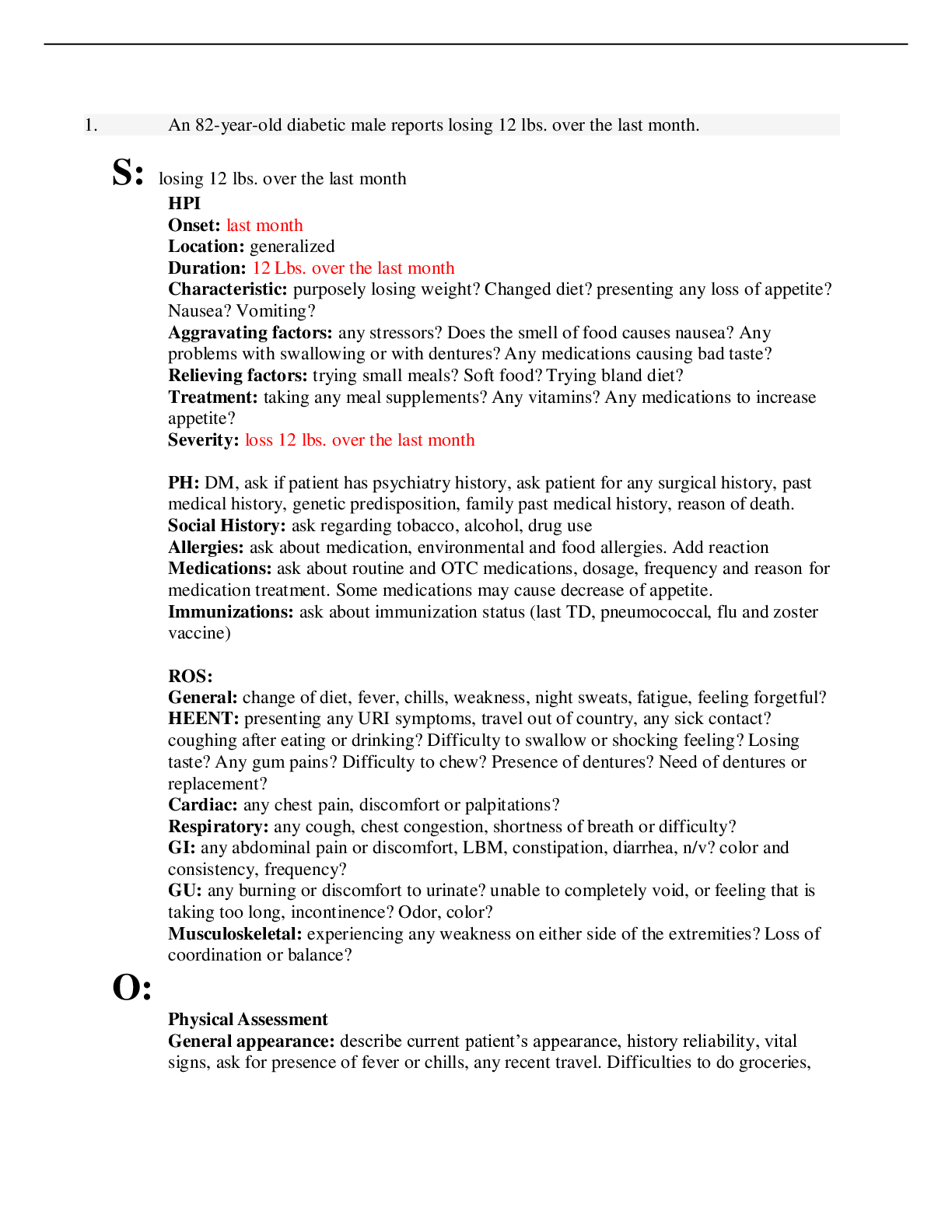
The purpose of this paper is to demonstrate the ability to analyze the subjective and objective information from the case study to formulate a management plan using evidenced based guidelines. It also demonstrates the student’s ability to write SOAP note in chronological order. In this case study the assessment, treatment plan, medication and its cost, and SOAP note will be discussed in detailed.
Assessment
Based on the chief complaints, subjective, and objective findings patient’s primary diagnosis is type 2 diabetes mellitus (E11). The pathophysiologic mechanism of type 2 diabetes involves insulin resistance and decreased insulin secretion by beta cells of pancreas (McCance, Huether, Brashers, & Rote, 2013). The genetic, epigenetic, and environmental factors interfere the ability to sense increased blood glucose, insulin synthesis, and insulin secretion, which causes type 2 diabetes. The prevalence of type 2 diabetes increased with age, is higher among African American female, but obesity, hypertension, physical inactivity, and family history predominantly increased the risk of type 2 diabetes (McCance et al., 2013). Polyuria, polydipsia, and polyphagia are the classis symptoms of diabetes, but patient may present with nonspecific symptoms such as fatigue, pruritus, recurrent infection, visual change, paresthesia, or weakness (McCance et al., 2013). Based on the information given, the pertinent positive findings include very fatigued, no energy, weight gain, increased hunger and thrust, and increased frequency of urination for past 3 month. The polydipsia, polyuria, and polyphagia also known as 3P are the hallmark symptoms of diabetes (American Diabetes Association [ADA], 2017). The laboratory finding indicates her hemoglobin A1C is 6.9%, total cholesterol is 230 mg/dl, LDL 144mg/dl, VLDL 36 mg/dl, HDL 38mg/dl and triglycerides 232. The hemoglobin A1C of ≥ to 6.5% is one
of the criteria that indicates diabetes (National Diabetes Education Initiative [NDEI], 2016). Mrs.
G. blood glucose level of 126 which is at the meets the criteria for diabetes but has limited information on fasting status. The fasting plasma glucose of ≥ 126 is indicative to diabetes (NDEI, 2016).Her history of delivering a baby who weigh 9lb 2 oz is another risk factor of type 2 diabetes according to the ADA guidelines (NDEI, 2016). In addition, she has 1+ glucose and small protein on her UA. She weighs 185 pounds and her BMI based on her height and weight is
33.3 which is considered obese. Type 2 diabetes is most common in overweight or obese because excess weight causes some degree of insulin resistance (ADA, 2017). Other pertinent positive information that helps to diagnose type 2 diabetes includes obesity, dyslipidemia, and being Hispanic age greater than 50 years because risk of type 2 increases with age, obesity, lack of physical activity, dyslipidemia, and in certain racial or ethic groups such as Hispanic (ADA, 2017). The pertinent negative findings include no pruritus, recurrent infection, visual change, paresthesia, or weakness (McCance et al., 2013). Type 2 diabetes has a strong genetic predisposition, which Mrs. G is negative for this risk. The patient presenting symptoms such as 3P which are the hallmark symptoms of diabetes, her risk factors, and laboratory findings strongly suggest type 2 diabetes, thus it is a primary diagnosis of Mrs. G.
Secondary Diagnosis
Mixed hyperlipidemia (E78.2) is a secondary diagnosis that needs to be addressed during this visit. Hyperlipidemia is an acquired or genetic disorder that causes increased circulating lipids such as cholesterol, triglycerides, and fats in the blood (Moneta, n.d.). It is most commonly caused due to consumption of food high in saturated or trans fats, sedentary lifestyle, obesity, smoking, and diabetes. The familial hyperlipidemia is result from mutation in gene in a form of
cholesterol called low density lipoprotein which causes atherosclerosis and cardiovascular diseases. The patient with type 2 diabetes often time have hypertriglyceridemia due to overproduction of lipoprotein in the liver which causes decrease high-density lipoprotein (HDL) and increased LDL, cholesterol, and triglycerides due to decrease lipoprotein activity (Karr, 2017). The role of race and gender in the development of hyperlipidemia is not clear, however, it is shown to be more prevalent in obese non-Hispanic black (Karr, 2017). The elevated blood lipids level doesn’t cause any symptoms, therefore patient remained asymptomatic and undiagnosed until they develop atherosclerosis plaques that reduce blood flow to the vital organ causing angina, heart attack, stroke, or pancreatitis (Karr, 2017). According to Kennedy-Malone, Fletcher, & Plank (2014), the physical finding may reveal xanthoma, xanthelasma, arterial bruits, or vascular claudication. Mrs. G did not have any symptoms related to hyperlipidemia. The pertinent positive data includes being obese, father has high cholesterol, and her laboratory finding of total cholesterol 230mg/dl which is borderline high (normal <200 mg/dl), LDL 144 mg/dl is at borderline high (normal <100mg/dl), VLDL 36mg/dl which is high (normal
<30mg/dl), HDL 38mg/dl which is low (normal >40mg/dl) and triglycerides 232 which is high (normal <150mg/dl) (Kennedy-Malone, Fletcher, & Plank, 2014). Mrs. G. neither has symptoms nor has physical finding that indicates hyperlipidemia, but being obese, family history of hyperlipidemia, her laboratory test that showed borderline to high lipid profile, as well as her new onset of type 2 diabetes warrant the diagnosis and treatment of hyperlipidemia. The decision to add this problem into diagnosis is because abnormal lipid profile requires compressive assessment of risk for atherosclerotic cardiovascular disease (ASCVD) and early management.
Multiple studies has shown that statin lowers total cholesterol and LDL which reduce the risk of
cardiovascular disease as well as reduce mortality and disease progression among patient with clinical ASCVD (Karr, 2017).
Obesity (E66.9) is another secondary diagnosis that needs to be addressed at this visit.
Obesity is a condition that causes excess adipose tissue manifested by body mass index (BMI) of 30kg/m2 or weight above the 95th percentile in the growth chart (McCance et al., 2013). It is more common in women, African American women are likely to be obese, but the incidence is high among people with low socioeconomic status (McCance et al., 2013). Diet, sedentary lifestyle, inactivity, environmental factors, and genetic predisposition contributes to the incidence of obesity. Intake of calories that exceed the metabolic needs of the body remained the major cause of obesity. Symptoms of obesity includes fatigue, decreased energy, weakness, joint pain, shortness of breath, daytime sleepiness, and depression (McCance et al., 2013). BMI of 30-40 kg/m2 is diagnosed as obesity (McCance et al., 2013). Mrs. G. BMI is 33.6 kg/m2 which indicates obesity. Her complaints of being very fatigue and lack of energy are additional pertinent positive data which support the diagnosis. However, she did not report other symptoms such as weakness, shortness of breath, or feeling down or depressed. Obesity increased the risk of type 2 diabetes, coronary artery disease, stroke, death, and disability. The nonesterified fatty acid secreted from the adipose tissue in obese patient causes insulin resistance and impair β-cell function, thus leading to type 2 diabetes (Al-Goblan, Al-Alfi, & Khan, 2014). In order to better manage her diabetes, it is important to address the obesity problem at this visit. Obesity is one of the medical comorbidity that impact the health and wellbeing of the patient, thus needs to be addressed and managed on timely manner.
Hypertension (I10) is another issue that can be address at this visit because early detection, prevention, and management has better outcome. Hypertension refers to elevation of blood
pressure above normal. The imbalance in the vasodilator and vasoconstrictive substance produced by endothelium or renin production increase vascular resistance and rise in blood pressure (McCance et al., 2013). Age, sex, ethnicity, genetic, environmental factors, and lifestyle plays significant role. The diagnosis of hypertension is typically made on routine visit based on the BP reading because patient remained asymptomatic, but sometime may present with headache or change in vision (McCance et al., 2013). Mrs. G BP reading is 129/80 on this visit which is considered elevated BP according to new updated ACC/AHA blood pressure guidelines. The systolic blood pressure between 120-129 and diastolic <80 is categorized as elevated BP (American college of Cardiology, 2017).The patient has one BP reading which is elevated from normal, therefore she will need at least one more BP reading at separate occasion and home BP monitoring before treating hypertension () However, given her mother’s history of hypertension, her age, elevated glucose level, lipid panel, and obesity, I think it is important to address the elevated BP now and encourage her to modify her lifestyle. The diagnosis of hypertension was chosen because her BP reading of 129/80 is considered elevated as per the new ACC/AHA guidelines.
Left knee arthritis (M17.12) is one of her past medical history. I think it is important to address this diagnosis because she is currently taking 500mg Tylenol every day for pain. Arthritis is one of the most common articular disease of older adults age 45 and older. Women tends to have higher chance of arthritis than men and obesity is one of a risk factors for knee arthritis. The biomechanical stresses and biochemical changes in articular cartilage and synovial membrane causes narrowing of joint space and osteophyte formation which leads to pain in the affected joint and impaired ability to perform activities of daily livings (McCance et al., 2013). The signs and symptoms include pain, morning stiffness, swelling, limited range of motion, cracking
sound, or crepitus (McCance et al., 2013). The pertinent positive data found in the case study includes history of left knee arthritis and takes Tylenol to manage her pain. Overweight and age greater than 45 are her risk factors of arthritis. Patient came in with the prior history of arthritis and she is actively taking pills to manage her pain, therefore it is included as a secondary diagnosis.
Differential Diagnosis
Depression (F33.0) is a common psychosocial problem seen in the primary care setting.
Most patient with depression present with complaints of severe feeling of sadness, apathy, unexplained fatigue, irritability, and anxiety. The exact pathophysiology of depression is unknown. The genetic and environmental factors play significant role in the etiology of mood disorder. Hypersecretion of cortisol may cause depression (McCance et al., 2013). A study indicated that a functional polymorphism in the serotonin transporter gene may interact with stressful life event increases the risk of depression (McCance et al., 2013). Alteration in sleep, appetite, sexual behavior as well as changes in endocrine, immunological, chronobiological abnormalities have a correlation with depression. Some of the signs and symptoms of depression includes irritability, low energy, fatigue, change in appetite or weight, insomnia, suicidal thoughts, helplessness, worthlessness, difficulty with memory and concentration (Ng, How, & Ng, 2016). Mrs. G complaint of very fatigue, low energy, recent weight gain, change in appetite, and feeling hungry are some of the pertinent positive finding for depression, therefore this diagnosis is added to the differential list. This patient neither report feeling of hopelessness, worthlessness, change in memory or concentration, restlessness, nor thoughts of suicide, therefore this is less likely to be her top most differential but given her symptoms it would still be considered as one of her differential diagnosis.
[Show More]


 GRADE A SOLUTION.png)

![Preview of [eBook] [PDF] Clinical Nursing Calculations 3rd Edition By Susan Sienkiewicz, Sandra Meg](https://browseimages.nyc3.digitaloceanspaces.com/paper-images/2025/Jul/04/4jF14r9I2025-07-04-05-586867ec3011731.png)




.png)


 (1).png)
.png)