MSN 572 Quiz 6.
A 35-year-old reporter presents to your office for evaluation of back pain and weakness in his left leg. He was play-wrestling with his nephew and hurt his back 2 weeks ago. He states that he has noticed
...
MSN 572 Quiz 6.
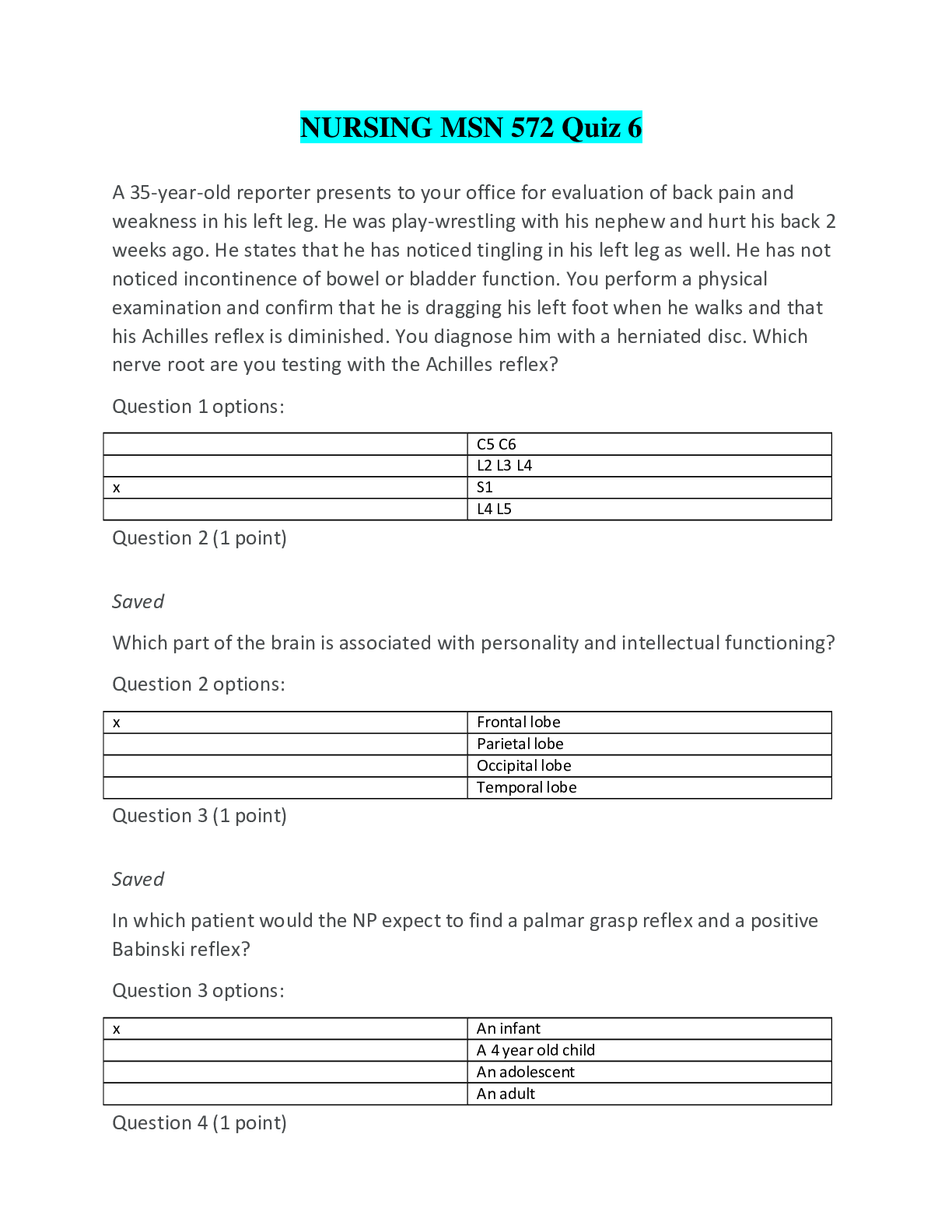
A 35-year-old reporter presents to your office for evaluation of back pain and weakness in his left leg. He was play-wrestling with his nephew and hurt his back 2 weeks ago. He states that he has noticed tingling in his left leg as well. He has not noticed incontinence of bowel or bladder function. You perform a physical examination and confirm that he is dragging his left foot when he walks and that his Achilles reflex is diminished. You diagnose him with a herniated disc. Which nerve root are you testing with the Achilles reflex?
Question 1 options:
C5 C6
L2 L3 L4
S1
L4 L5
Question 2 (1 point)
Saved
Which part of the brain is associated with personality and intellectual functioning? Question 2 options:
Frontal lobe
Parietal lobe
Occipital lobe
Temporal lobe
Question 3 (1 point)
Saved
In which patient would the NP expect to find a palmar grasp reflex and a positive Babinski reflex?
Question 3 options:
An infant
A 4 year old child
An adolescent
An adult
Question 4 (1 point)
Saved
In long-standing and poorly controlled hypertension, white matter tracts in the brain are subjected to arteriosclerotic affects. Which one of the following is most vulnerable to this process?
Question 4 options:
Thalamus
Basal ganglia
Reticular activating system
Diencephalon
Internal capsule
Question 5 (1 point)
Saved
A new mom brings in her six month old baby for not being able to keep his eyes together when looking to the left. On exam both of his eyes appear in alignment with conjugate gaze, upon looking to the right. However when looking to the left, the baby’s left eye stays in the forward gays position while the right continues on with full adduction to the left. The eyes appear out of alignment. Which cranial nerve is responsible for the dysfunction in looking left?
Question 5 options:
The left abducens nerve.
The right oculomotor nerve
The right abducens nerve
The left oculomotor nerve
The right Trochlear nerve
The left Trochlear nerve
Question 6 (1 point)
Saved
Which cranial nerve injury may cause anosmia in the patient? Question 6 options:
Cranial nerve I (olfactory nerve)
Cranial nerve II (optic nerve)
Cranial nerve III (oculomotor nerve)
Cranial nerve IV (trochlear nerve)
Question 7 (1 point)
Saved
A 70-year-old retired musician is brought to your clinic for a hospital follow-up visit after sustaining a stroke. He is able to articulate words but they sound slurred or indistinct. As the astute NP student you would document his speech as:
Question 7 options:
Dysarthria
Dysphonia
Dysphagia
Aphasia
Question 8 (1 point)
Saved
A 22-year-old daycare worker comes to the clinic for evaluation of fever as high as 103.5°F headache and neck pain. She has photophobia and neck stiffness. During the physical examination you flex the patient's leg at both the hip and the knee and then straighten her knee to elicit meningeal irritation. The patient experiences severe pain. The name of this sign is:
Question 8 options:
Kernig's sign
Brudzinski's sign
Babinski's sign
Lachman's sign
Question 9 (1 point)
Saved
A 25-year-old housewife presents to the clinic for evaluation of paralysis in her face. She has a history of an upper respiratory infection 2 weeks before the onset of these symptoms. She states that her face is drooping and that she is unable to close her eye. On physical examination you note that her forehead is smooth on
the right side her palpebral fissure appears widened and her nasolabial fold appears flattened and she is drooling. Based on this information what is the most likely diagnosis?
Question 9 options:
Cortical stroke
Bell's palsy
Horner's syndrome
Stress reaction
Question 10 (1 point)
Saved
You are evaluating a 55-year-old teacher for altered mental status. You are trying to distinguish between delirium and dementia. All of the following statements are true about delirium EXCEPT:
Question 10 options:
Delirium has an acute onset.
In delirium there is always a disturbed level of
consciousness.
Orientation is fairly well maintained but becomes
impaired in the later stages of illness.
Attention fluctuates
Question 11 (1 point)
Saved
Which nerve roots are tested when the patellar reflex is checked? Question 11 options:
C3 C4
L2 L3 L4
T10 T11 T12
C5 C6
Question 12 (1 point)
Saved
Which of the following is a disease-specific risk factor for stroke? Question 12 options:
Obstructive Sleep Apnea
Epilepsy
Smoking
Alcohol use
Question 13 (1 point)
Saved
What is the maximum score given to a patient in the Mini-Mental State Examination (MMSE)?
Question 13 options:
5
20
25
30
Question 14 (1 point)
Saved
Which of the following cranial nerves is responsible for lateral deviation of the eye:
Question 14 options:
CN II
CN III
CN IV
CN VI
Question 15 (1 point)
Saved
What are the components of a reflex arc? Question 15 options:
Nucleus Sensory nerve & motor nerve
Motor nerve Cranial nerve Sensory nerve
Sensory nerve Neuromuscular junction motor
nerve
Motor nerve and sensory nerve
Question 16 (1 point)
Saved
While assessing a patient the provider finds that the patient is an at-risk drinker. Which statement by the patient led the provider to conclude this?
Question 16 options:
I drink 5 alcoholic drinks per week.
I drink 6 alcoholic drinks per week.
I drink 1 alcoholic drink per occasion.
I drink 4 alcoholic drinks per occasion.
Question 17 (1 point)
Saved
A 63-year-old gardener makes an appointment with the office for a pain in his right leg for three days. Since working in the garden moving heavy bags over the weekend, he has begun having intermittent but excruciating pain shooting down the posterior aspect of his right leg. On examination, sensory loss to light touch in the right leg posteriorly corresponding to the S1 (sacral 1) dermatome is noted.
Which reflex would be expected to be decreased compared to the other side? Question 17 options:
Right plantar
Left knee
Left ankle
Right ankle
Left plantar
Right knee
Question 18 (1 point)
Saved
The FNP asks the patient to close the eyes and then traces the number 5 on the patient's palm. The patient is unable to identify the number even after repeated attempts. This finding could indicate damage to what part of the patient's brain?
Question 18 options:
Cerebellum
Sensory cortex
Cranial nerve XII
Dorsal spinothalamic tract
Question 19 (1 point)
Saved
How would an adult patient normally respond to the plantar reflex? Question 19 options:
By flexing the toes
By flexing the elbow
By extending the great toe
By extending the lower leg
Question 20 (1 point)
Saved
A 68-year-old male presents to the ER accompanied by his wife who is concerned he is experiencing a stroke. She states that he awoke with drooping of the right side of his mouth. He has a history of high blood pressure and diet controlled diabetes, but no history or prior symptoms of TIA, stroke or neurological deficits. Physical exam reveals a well nourished, right handed male who has an obvious flattening of the right nasolabial fold at rest. He is unable to close his right eye, wrinkle his forehead or raise his eyebrows. The remainder of the Neuro exam is symmetric with intact strength and normal DTRs. Based on the history and physical which of the following statements is most likely to be true?
Question 20 options:
The patient most likely has an isolated peripheral lower motor neuron lesion involving cranial nerve
seven, the facial nerve.
The patient most likely has a central process of unclear location, and therefore it must be ruled
out with an emergent CT scan.
Patient most likely has had an embolic event
affecting an upper motor neuron.
The patient most likely has an isolated peripheral lower motor neuron lesion involving cranial nerve
five, the trigeminal nerve.
The patient most likely has a central upper motor neuron lesion involving cranial nerve seven, the
facial nerve.
Question 21 (1 point)
Saved
Which conditions may cause peripheral neuropathy in a patient? Question 21 options:
Diabetes mellitus
Cervical spondylosis
Shoulder dislocation
Horner's syndrome
Question 22 (1 point)
Saved
During a mental status assessment the NP asks about the patient's first job. What is the NP trying to test?
Question 22 options:
Orientation
Attention span
Recent memory
Remote memory
Question 23 (1 point)
Saved
The NP flashes a light into the eyes of a 4-year-old child and observes ocular misalignment and a deviated gaze. What condition does the NP chart as the finding?
Question 23 options:
Nystagmus
Horner Syndrome
Exophthalmos
Strabismus
Question 24 (1 point)
Saved
While assessing the deep tendon reflexes in a patient the NP finds that the responses are very brisk and hyperactive with clonus. Which grade should the NP enter in the patient's medical record?
Question 24 options:
1+
2+
3+
4+
Question 25 (1 point)
Saved
What is the major function of the glossopharyngeal nerve? Question 25 options:
Tasting of food
Swallowing and gagging
Lateral movement of the eye
Muscular movement of the tongue
Question 26 (1 point)
Saved
Which of the following reflexes is not a cutaneous stimulation reflex?
Question 26 options:
Abdominal reflexes
Cremasteric reflex
Supinator (brachoiradialis reflex)
Plantar responses
Anal reflex
Question 27 (1 point)
Saved
Which lobe of the brain is associated with language comprehension? Question 27 options:
Frontal lobe
Parietal lobe
Occipital lobe
Temporal lobe
Question 28 (1 point)
Saved
A 14-year-old female comes with her family to the urgent care clinic, after having been hit in the right eye with a plastic baseball bat during a game. She complains of a painful, watery, red right eye and sensitivity to light. She has normal vision acuity in both eyes and no diplopia and can open and close her eyes normally. The pupils are unequal and size 3 mm on the left 5 mm on the right. Which cranial nerve would be implicated as the cause of photosensitivity and the pupillary asymmetry?
Question 28 options:
CN V
CN III
CN II
CN VI
CN VII
Question 29 (1 point)
Saved
An 18-year-old college freshman presents to the urgent care center for evaluation of fever headache and neck stiffness. On physical examination the patient is resting quietly and has a flushed face. His vital signs are as follows: temperature 104°F; pulse 110 bpm; and BP 105/70 mm Hg. He has no rashes. During the physical examination you flex the patient's neck and his hips and knees flex in response indicating meningeal irritation. The name of this positive sign is:
Question 29 options:
Kernig's sign
Brudzinski's sign
Babinski's sign
Lachman's sign
Question 30 (1 point)
Saved
How would an NP test a patient's superficial reflex? Question 30 options:
Test the elevation of the ipsilateral testicle
Test the reactions elicited by stroking the skin.
Test the rhythmic contractions of the calf muscle
Test the deep tendon reflexes of the lower
extremities
[Show More]