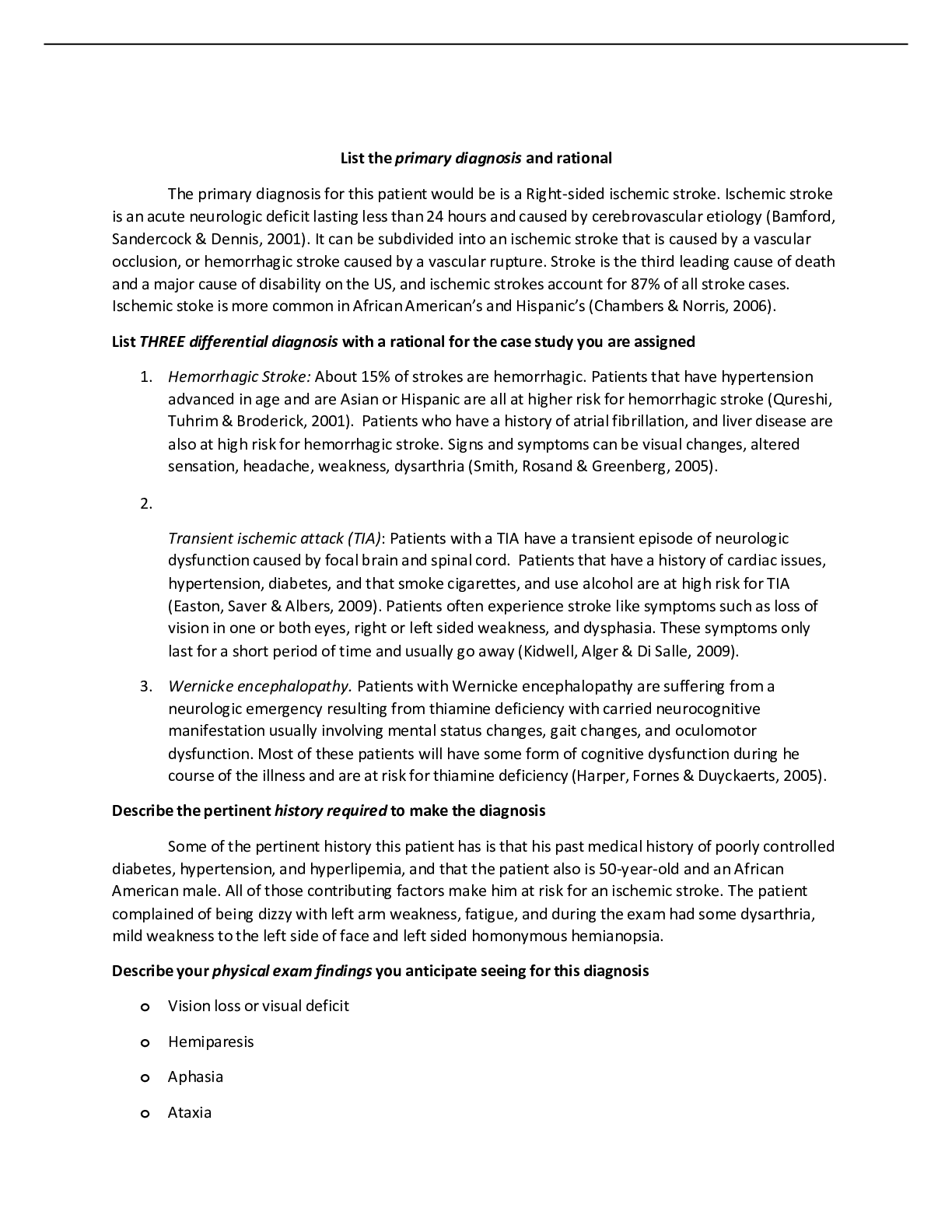
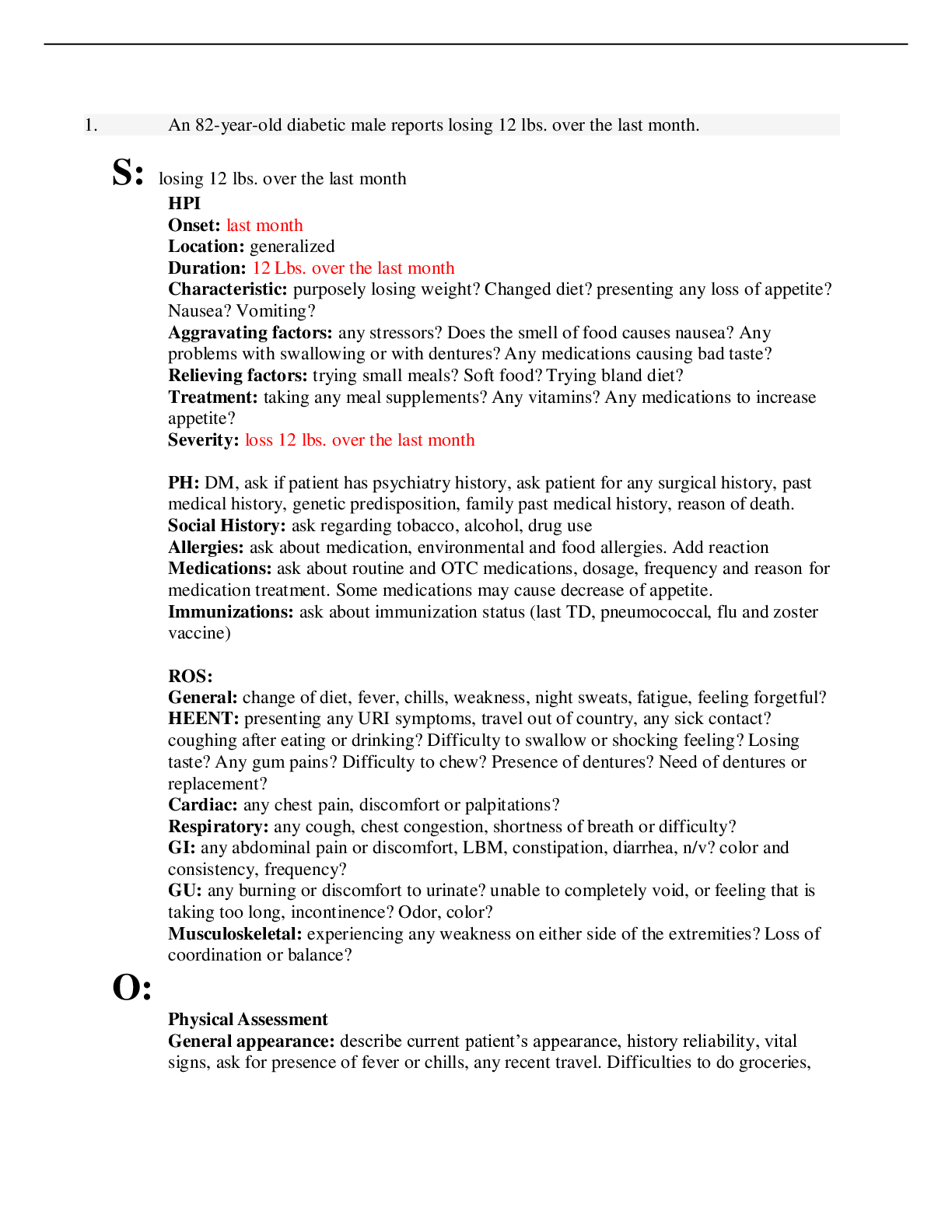
Case Study 99 - Severe Hypoglycemia Difficulty: Intermediate
Setting: Outpatient clinic
Index Words: hypoglycemia, type 1 diabetes mellitus (DM), crisis management, insulin therapy
Giddens Concepts: Metabolism, Glucos
...
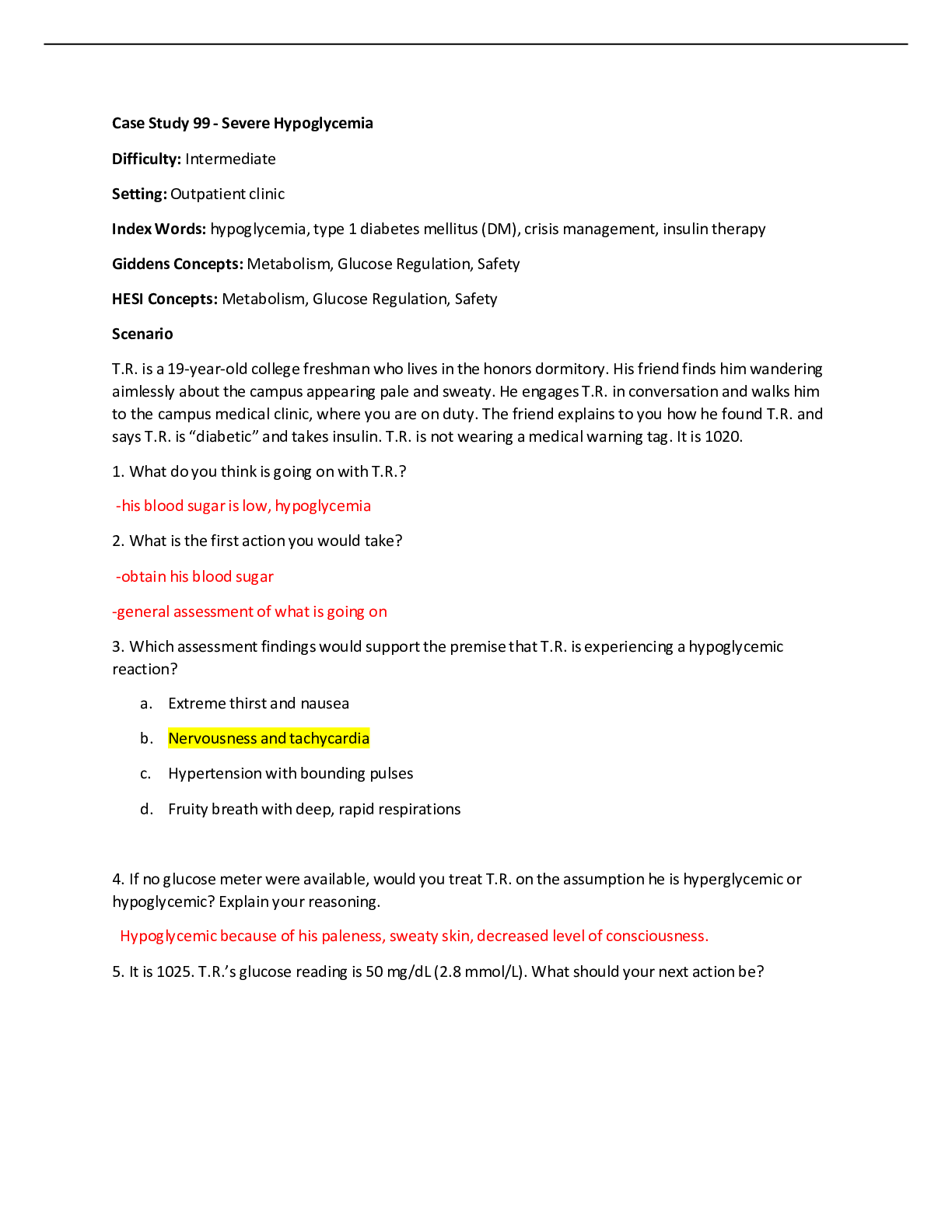
Case Study 99 - Severe Hypoglycemia Difficulty: Intermediate
Setting: Outpatient clinic
Index Words: hypoglycemia, type 1 diabetes mellitus (DM), crisis management, insulin therapy
Giddens Concepts: Metabolism, Glucose Regulation, Safety HESI Concepts: Metabolism, Glucose Regulation, Safety Scenario
T.R. is a 19-year-old college freshman who lives in the honors dormitory. His friend finds him wandering aimlessly about the campus appearing pale and sweaty. He engages T.R. in conversation and walks him to the campus medical clinic, where you are on duty. The friend explains to you how he found T.R. and says T.R. is “diabetic” and takes insulin. T.R. is not wearing a medical warning tag. It is 1020.
1. What do you think is going on with T.R.?
2. What is the first action you would take?
3. Which assessment findings would support the premise that T.R. is experiencing a hypoglycemic reaction?
4. If no glucose meter were available, would you treat T.R. on the assumption he is hyperglycemic or hypoglycemic? Explain your reasoning.
5. It is 1025. T.R.’s glucose reading is 50 mg/dL (2.8 mmol/L). What should your next action be?
-
6. When you enter the room to give the juice, T.R. is not responsive enough to drink the juice safely. What should you do?
7. T.R. is breathing at 16 breaths/min and has a pulse of 112 beats/min and regular. Because outpatient resources vary, describe your next actions if (1) your clinic is well equipped for emergencies or (2) your clinic has no emergency supplies.
CASE STUDY PROGRESS
A few minutes after administering 2 mg subcutaneous glucagon, T.R. begins to awaken. He becomes alert and asks where he is and what happened to him. You orient him and then explain what has transpired.
8. What questions would you ask to find out what precipitated this event?
-
9. What further action do you need to take at this time?
-pt education
-further monitoring
-reasses blood glucose level
10. At 1045, you recheck T.R.’s glucose and the reading is 64 mg/dL (3.6 mmol/L). His vital signs are 120/72, 18, 92. Has his status improved or not? Defend your response.
Yes, but not by much. His glucose has improved but is still lower than the normal range. Vitals are normal, LOC improved
11. What would your next action be?
-monitor glucose levels, continue to let the insulin get into the blood stream and monitor the levels
-provide pt education
-monitor pt safety
-offer something more hardy to eat (pb and j)
12. At 1110, you recheck T.R.’s glucose and the reading is 104 mg/dL (5.8 mmol/L). What should you do now?
-glucose level is within normal limits, so as long as he eats something substantial, he is okay for discharge
-recheck the vitals
CASE STUDY PROGRESS
T.R. tells you he took 35 units glargine (Lantus) insulin and 12 units of regular (Humulin R) insulin at 0745. He says he was late to class, so he just grabbed an apple on the way.
13. Based on this information, why did T.R. experience this episode of hypoglycemia?
- because he did not eat something substantial it dropped
14. Based on your knowledge of the types of insulin T.R. is receiving, when would you expect T.R. to experience a hypoglycemic reaction
2-4 hours for the Humulin R (9-11am)
Lantus does not have a peak (1.5 to start working but won’t contribute to hypoglycemia)
15. T.R. says he had a few similar episodes recently. He treated them by eating a candy bar. He says he is on a 2000-calorie, carbohydrate-controlled diet but has been checking his blood glucose levels every “couple of days” only. What common mistake in previously treated episodes of hypoglycemia did T.R. make?
-eating a candy bar and not something with protein/substance
-not checking his blood sugar early enough or before meals
16. He goes on to say he has had “a little bit much to drink at a few of the parties he has been to” on the weekends. What effect does alcohol have on blood glucose?
-alcohol can increase your blood glucose level for a short period of time and it will tank once it is out of your system
-very important to understand to limit alcohol consumption and monitor blood sugars, and make sure that he is eating
17. What should you teach T.R. about alcohol consumption and managing his diabetes?
-if he is just drinking the alcohol and not eating something with protein and carbs that will continue to keep high blood sugar high for an extended period of time
-checking blood sugar, before during and after drinking= frequently monitoring blood sugar
18. List 4 additional points you would stress in a teaching plan with T.R.
-schedule meal-times
-avoid excessive alcohol
-tracking his food to meds
-recommend an alert bracelet
19. You tell T.R. to check his blood glucose at 1230 then eat lunch at the normal time. You determine that he understands your teaching regarding averting hypoglycemia if he states:
a. “I need to eat within 30 minutes of taking the regular insulin.”
b. “If I am too sick to eat, I will not take any insulin until I feel better.”
c. “Only certain kinds of alcoholic drinks will affect my blood glucose levels.”
d. “I will exercise just before eating and taking insulin, so I do not get cramps.”
20. Write a sample documentation note for the encounter with T.R.
Pt presented the ED with decreased LOC, sweaty, hx of type 1 diabetes, retest for glucose, gave fruit juice, pt teaching, verbalized that he understood
CASE STUDY OUTCOME
T.R. follows up with you in 1 week to discuss how he has been managing his meals and insulin dosing. He states he feels that he has been doing a better job with eating meals at regular times and shows you the log from his new diabetes tracking app. You congratulate him on his progress and decide together that meeting weekly will help T.R. manage his diabetes while adjusting to college life.
[Show More]

![Preview of eBook [PDF] Barash, Cullen, and Stoelting's Clinical Anesthesia 9th Edition By Bruce F. Cu](https://browseimages.nyc3.digitaloceanspaces.com/paper-images/2024/Aug/29/8DF2QRTq2024-08-29-10-3966d0259b7c4b5.png)
![Preview of eBook [PDF] Fundamentals of Nursing 3rd Edition By Joanne Tollefson, Sue C. DeLaune, Patri](https://browseimages.nyc3.digitaloceanspaces.com/paper-images/2024/Aug/26/U6SQ8mmq2024-08-26-01-4766cc5d40d7385.png)
![Preview of eBook [PDF] Burns' Pediatric Primary Care 7th Edition BY Dawn Lee Garzon Maaks,, Nancy Bar](https://browseimages.nyc3.digitaloceanspaces.com/paper-images/2024/Aug/26/WR2rowXX2024-08-26-02-0966cc625bea839.png)

.png)


 (1).png)
.png)