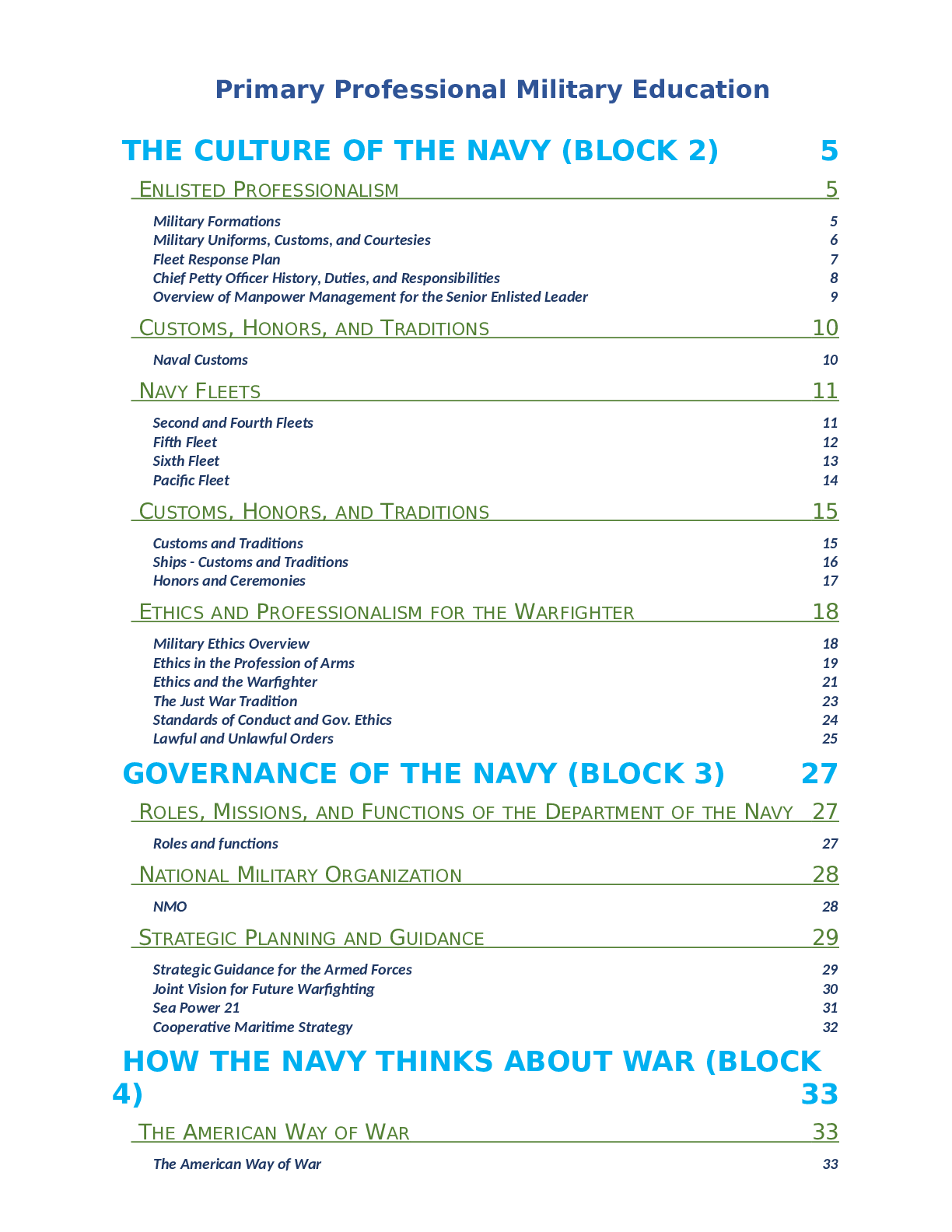
Primary Professional Military Education
THE CULTURE OF THE NAVY (BLOCK 2) 5
ENLISTED PROFESSIONALISM 5
Military Formations 5
Military Uniforms, Customs, and Courtesies 6
Fleet Response Plan 7
Chief Petty Offic
...
Primary Professional Military Education
THE CULTURE OF THE NAVY (BLOCK 2) 5
ENLISTED PROFESSIONALISM 5
Military Formations 5
Military Uniforms, Customs, and Courtesies 6
Fleet Response Plan 7
Chief Petty Officer History, Duties, and Responsibilities 8
Overview of Manpower Management for the Senior Enlisted Leader 9
CUSTOMS, HONORS, AND TRADITIONS 10
Naval Customs 10
NAVY FLEETS 11
Second and Fourth Fleets 11
Fifth Fleet 12
Sixth Fleet 13
Pacific Fleet 14
CUSTOMS, HONORS, AND TRADITIONS 15
Customs and Traditions 15
Ships - Customs and Traditions 16
Honors and Ceremonies 17
ETHICS AND PROFESSIONALISM FOR THE WARFIGHTER 18
Military Ethics Overview 18
Ethics in the Profession of Arms 19
Ethics and the Warfighter 21
The Just War Tradition 23
Standards of Conduct and Gov. Ethics 24
Lawful and Unlawful Orders 25
GOVERNANCE OF THE NAVY (BLOCK 3) 27
ROLES, MISSIONS, AND FUNCTIONS OF THE DEPARTMENT OF THE NAVY 27
Roles and functions 27
NATIONAL MILITARY ORGANIZATION 28
NMO 28
STRATEGIC PLANNING AND GUIDANCE 29
Strategic Guidance for the Armed Forces 29
Joint Vision for Future Warfighting 30
Sea Power 21 31
Cooperative Maritime Strategy 32
HOW THE NAVY THINKS ABOUT WAR (BLOCK
4) 33
THE AMERICAN WAY OF WAR 33
The American Way of War 33
Primary Professional Military Education
THE NAVAL WAY OF WAR 35
The Naval Way of War 35
THE NAVAL WAY OF WAR 2 37
The Naval Way of War 2 37
DOCTRINE 39
Doctrine 39
NAVAL WARFARE 40
JFMCC-CCW 40
Command and Control (C2) 40
Joint force Maritime Component Commander (JFMCC) 41
Composite Warfare Commander Concept 42
CWC Roles and Responsibilities 43
JFMCC/CWC Challenges 44
Strike Warfare 45
Origins and Development 45
Carrier Strike Groups 47
The Aircraft Carrier 48
Carrier Air Wing 49
Tomahawk Land Attack Missile 50
Expeditionary Warfare 51
Intro to Expeditionary Warfare Operations 51
Domains of Force Employment 52
Surface Warfare (SUW) 52
Air Defense 53
Undersea Warfare 55
Naval Special Warfare 57
Naval Logistics 58
Naval Logistics 58
JOINT WARFARE 59
Fundamentals of Joint Warfare 59
Fundamentals of Information Operations 60
FORCE CAPABILITIES 61
United States Army 61
United States Air Force 63
United States Marine Corps 64
United States Coast Guard 65
Special Operation Forces 66
RANGE OF MILITARY OPERATIONS 67
Homeland Security Homeland Defense 67
Irregular Warfare 68
HOW THE NAVY PLANS ITS OPERATIONS
(BLOCK 5) 69
REGIONAL AND CULTURAL AWARENESS 69
Political Stuctures 69
Primary Professional Military Education
GEOPOLITICAL CULTURE 71
Cultural Explanations of Political Behavior 71
Democracy and Nationalism 73
The Future of Democracy and Democratization 74
REGIONAL 75
Western Hemisphere 75
Western Hemisphere 75
Latin American Militaries 78
Eurasia 79
Eurasia 79
European Union 81
Africa 82
Africa 82
Religions of Africa 83
African Security 84
Asia Pacific 85
Asia Pacific Overview 85
Partition of the Indian Subcontinent 86
China: Alone and Joining the World 88
China Security Issues 89
China Environment and Development 90
China Ethnicity/Nationality and Development 91
The Arctic 92
The Arctic 92
INDIAN OCEAN 94
The Indian Ocean 94
Great Middle East 96
Greater Middle East Overview 96
The Arab-Israeli Conflict 97
U.S. Security, Strategy, and Policy 98
Islam in the Greater Middle East 99
OPERATIONAL PLANNING 100
Introduction to Planning 100
The Role of Intelligence 101
Navy Planning Process 103
MARITIME CYBERSPACE OPERATIONS 104
Maritime Cyberspace Operations 104
OPERATIONAL LAW 105
Law of the Sea and Airspace 105
Law of the Sea and Airspace 105
Law of Armed Conflict (LOAC) 106
Law of Armed Conflict, Scope 106
Law of Armed Conflict, Principles 108
Rules of Engagement 109
Rules of Engagement, General Principles 109
Standing Rules of Engagement 110
Self-Defense 112
MISSION ACCOMPLISHMENT 113
Rules for the Use of Force 115
Primary Professional Military Education
TECHNOLOGY IN THE MARITIME DOMAIN
(BLOCK 6) 116
SENSORS 116
Force Multiplication Sensors 116
Sensor Fundamentals 118
Understanding the Frequency Spectrum 119
Sensor Challenges for Modern Combat Systems 120
Maintaining Technical Superiority 121
Magnetic Sensors 122
Sonar 123
Radar 124
Electro-optic Technology 125
SPACE FORCE ENHANCEMENT 126
Military Space Mission Areas 126
Intelligence Surveillance Reconnaissance 127
Integrated Tactical Warning and Attack Assessment 128
Environmental Monitoring 129
Satellite Communications 130
Position, Time, Velocity, and Navigation 132
INFORMATION TECHNOLOGY AND FORCENET 133
Data and Information 133
Command and Control (C2) 134
Decision Making 135
FORCEnet 136
COMMUNICATIONS FOR THE WARFIGHTER 138
Communications for the warfighter 138
STEALTH TECHNOLOGY 139
Stealth Technology 139
EVALUATION OF NAVAL PLATFORMS 140
Evolution of the US Submarine 140
Evolution of the US Navy Surface Combatants 141
Evolution of Carrier Aviation 142
Primary Professional Military Education
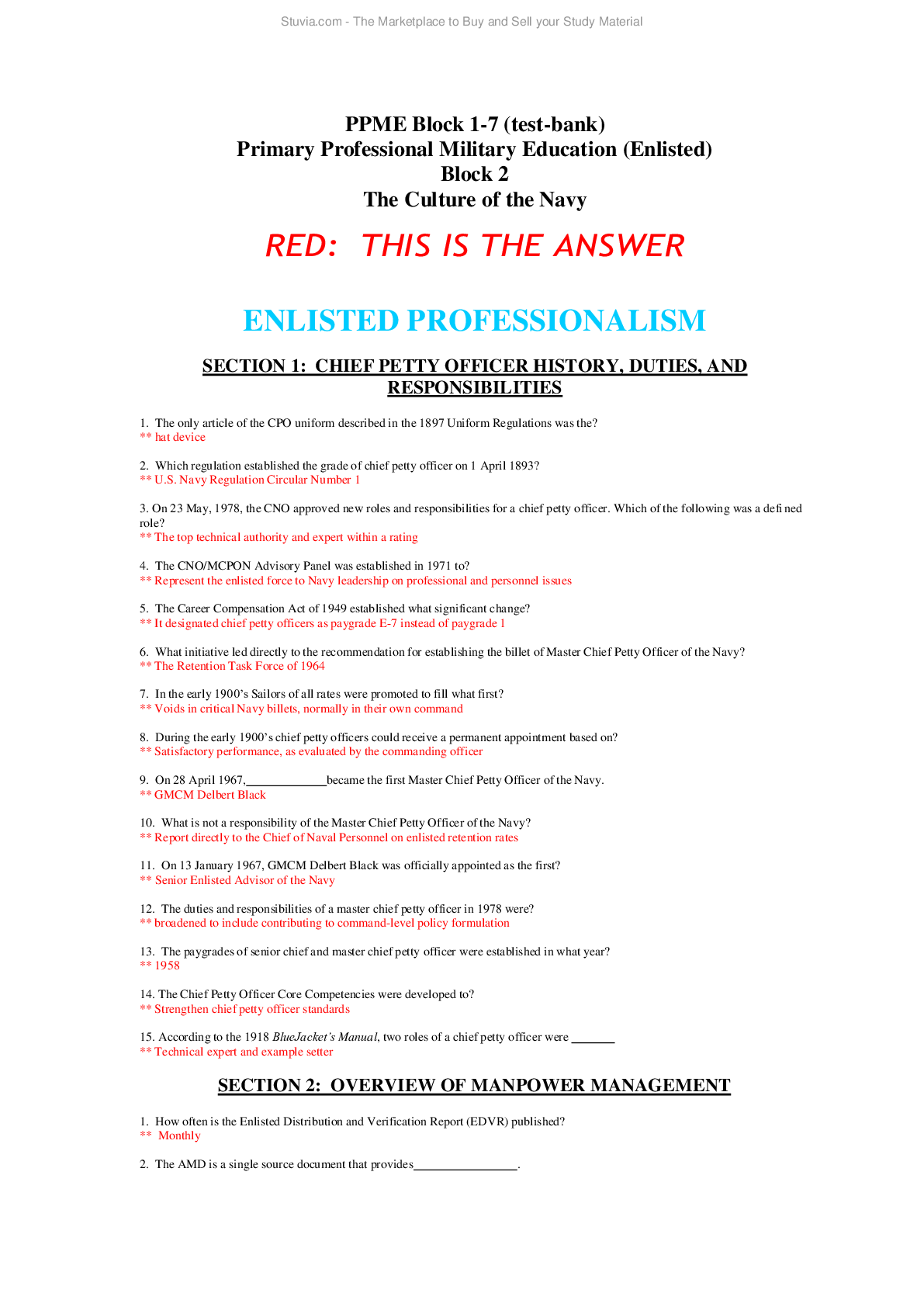
2The Culture of the Navy (Block 2)
Enlisted Professionalism
2.1.1Military Formations
Q1: Drill instills discipline and fosters what kind of habits?
A: Precision and automatic response
Q2: Traditionally, awards are handed out in what manner?
A: From most junior to senior
Q3: Which of the following is NOT a reason to conduct a personnel inspection?
A: To use as a tool to punish your Sailors
Q4: As a leader, you will organize your Sailors into formation for which one of the following
occasions?
A: Awards ceremony
Q5: During the Revolutionary War, ______________ developed a set of standardized drills for
General George Washington and the Continental Army.
A: Baron von Steuben
Q6: Which event would NOT require the Commanding Officer to order the ship to man the
rails?
A: Leaving the shipyards after 120 days
Q7: Who is known as the “Drillmaster of the American Revolution”?
A: Baron von Steuben
Q8: What type of command is the first word in “Parade Rest”?
A: Preparatory
Q9: At the beginning of the Revolutionary War, ______________ was the leaders' primary tool
to achieve discipline in ranks.
A: fear
Q10: What do you call the extreme right or left of an element?
A: Flank
[Show More]

.png)
.png)
.png)

.png)