l
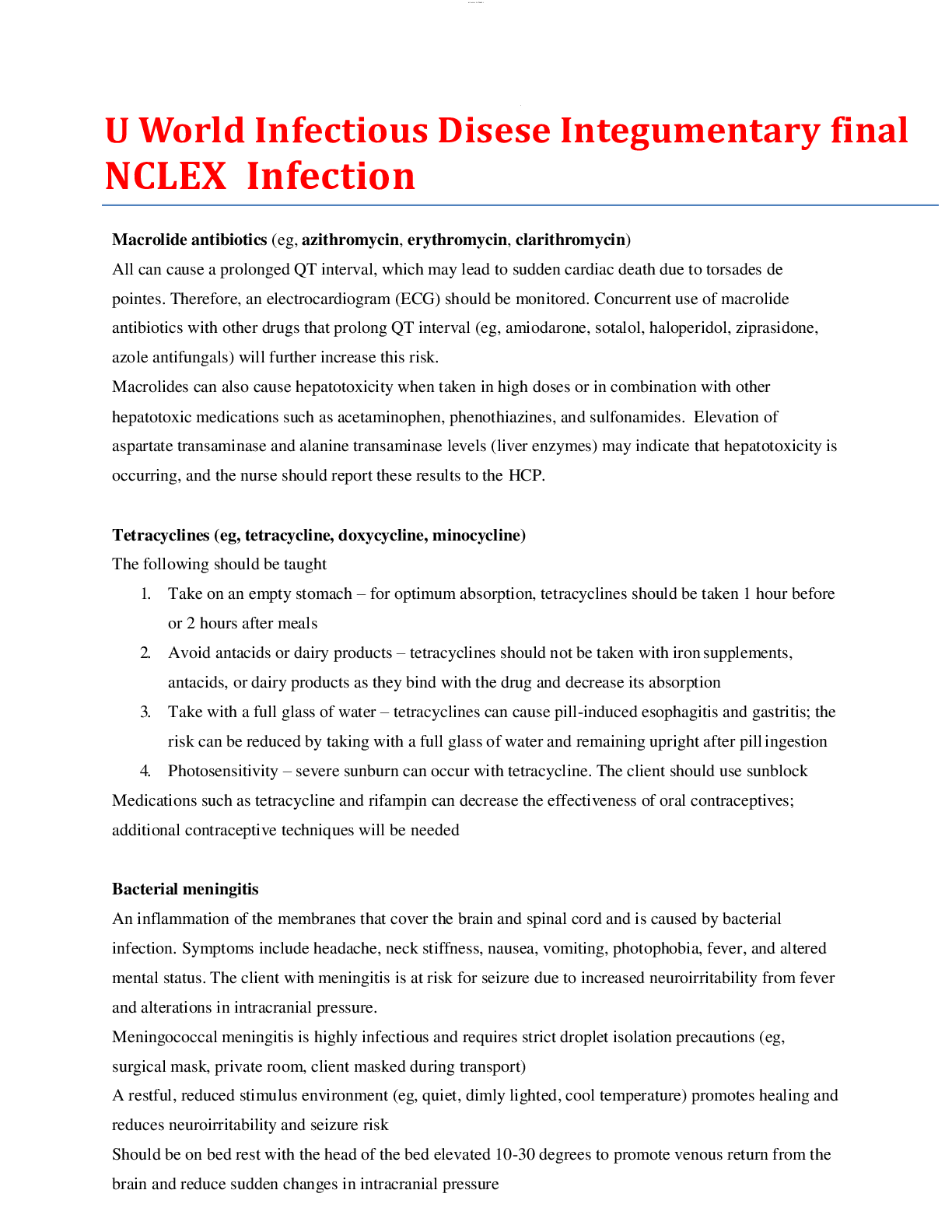
U World Infectious Disese Integumentary final
NCLEX Infection
Macrolide antibiotics (eg, azithromycin, erythromycin, clarithromycin)
All can cause a prolonged QT interval, which may lead to sudden cardiac death du
...
l
U World Infectious Disese Integumentary final
NCLEX Infection
Macrolide antibiotics (eg, azithromycin, erythromycin, clarithromycin)
All can cause a prolonged QT interval, which may lead to sudden cardiac death due to torsades de pointes. Therefore, an electrocardiogram (ECG) should be monitored. Concurrent use of macrolide antibiotics with other drugs that prolong QT interval (eg, amiodarone, sotalol, haloperidol, ziprasidone, azole antifungals) will further increase this risk.
Macrolides can also cause hepatotoxicity when taken in high doses or in combination with other hepatotoxic medications such as acetaminophen, phenothiazines, and sulfonamides. Elevation of aspartate transaminase and alanine transaminase levels (liver enzymes) may indicate that hepatotoxicity is occurring, and the nurse should report these results to the HCP.
Tetracyclines (eg, tetracycline, doxycycline, minocycline)
The following should be taught
1. Take on an empty stomach – for optimum absorption, tetracyclines should be taken 1 hour before or 2 hours after meals
2. Avoid antacids or dairy products – tetracyclines should not be taken with iron supplements, antacids, or dairy products as they bind with the drug and decrease its absorption
3. Take with a full glass of water – tetracyclines can cause pill-induced esophagitis and gastritis; the risk can be reduced by taking with a full glass of water and remaining upright after pill ingestion
4. Photosensitivity – severe sunburn can occur with tetracycline. The client should use sunblock Medications such as tetracycline and rifampin can decrease the effectiveness of oral contraceptives; additional contraceptive techniques will be needed
Bacterial meningitis
Burn injuries
Rehabilitation phase
Nystatin
Used to treat oral candidiasis, or thrush, that can be caused by medications such as antibiotics,
Skin cancers
Sepsis
Hypothermia i
fluoroquinolones (ciprofloxacin, levofloxacin, moxifloxacin, norfloxacin, ofloxacin)
C difficile
Red man syndrome (RMS)
Isotretinoin (Accutane)
Influenza
Trichomoniasis
Evisceration
Ethambutol (Myambutol)
Active TB
Acid-fast bacilli (AFB) smear and culture
Oropharyngeal candidiasis, or thrush (moniliasis)
Hepatitis A
bismuth subsalicylate (Pepto-Bismol)
Amoxicillin/clavulanate
Urinary tract infections (UTIs)
Cystitis is the most common community-acquired UTI. It is an infection of the lower urinary tract and
Herpes zoster, or shingles
First-degree (superficial) burns
Second-degree (partial-thickness) burns
Third-degree (full-thickness) burns
Fourth-degree (full-thickness) burns
Tinea corporis (ringworm)
.
West Nile virus
Rheumatic fever (RF)
Influenza
Toxic epidermal necrolysis
IV vancomycin,
Poison ivy
Immediately after exposure, the client should be instructed to thoroughly wash the area to remove the oily resin, which is responsible for causing the rash that follows in 12-48 hours. Applying cool, wet compresses; applying topical cortisone; and discouraging the child from scratching the area are all appropriate after the rash has developed. Washing the area has the highest priority and is most important immediately after exposure.
** Adalimumab (Humira), etanercept (Enbrel), and infliximab (Remicade) are common tumor necrosis factor inhibitor, biologic disease-modifying antirheumatic drugs. Major adverse effects include immunosuppression and infection.
** Clients prescribed sulfa antibiotics (eg, trimethoprim-sulfamethoxazole [Bactrim]) should be assessed for allergies to sulfa drugs and sulfonylurea medications, such as glyburide, due to potential cross- sensitivity reactions. Commonly used diuretics (eg, thiazides, furosemide) are also sulfa derivatives and can cause cross-sensitivity reaction.
** A client with a penicillin allergy may be allergic to cephalosporin antibiotics. Cephalosporins may be safely administered to clients with a history of mild allergic reaction, such as rash, but they are contraindicated in clients with a history of penicillin anaphylaxis.
When an abdominal wound evisceration occurs, the nurse should take the following actions:
• Remain calm and stay with the client. Have someone notify the HCP immediately
[Show More]